PUBLICATION

Family Law Definitions: Essential Terms Explained

"Understand family law definitions easily. Learn essential terms in family law and navigate legal situations with confidence."
Family Law Definitions: Essential Terms Explained

Family law cases involve complex terminology that can confuse anyone facing separation, divorce, or custody disputes. Understanding these legal terms helps you make informed decisions about your future.

We at Jameson Law have compiled essential family law definitions to guide you through this challenging time. This comprehensive overview covers custody arrangements, financial settlements, and legal procedures you’ll encounter.

What Are the Key Family Law Terms You Need to Know

Parenting Arrangements and Decision Making

Australian family law uses specific terminology that directly impacts your rights and responsibilities. The term “lives with” replaces traditional custody language and describes which parent the child primarily resides with. “Spends time with” refers to the other parent’s contact arrangements. These changes make parenting discussions more collaborative and less adversarial.

Parental responsibility covers all major long-term decisions about your child’s education, healthcare, religion, and significant lifestyle choices. Most separated parents retain equal parental responsibility, which means both must consult on important matters. Courts only grant sole parental responsibility in cases that involve family violence, abuse, or when one parent cannot participate in decision-making.

Legal Requirements Before Court Action

The Family Law Act 1975 requires parents to attempt Family Dispute Resolution before court applications (except in urgent situations). This mediation process helps families reach agreements without costly court proceedings. Family Relationship Centres and private mediators facilitate these discussions between separated parents.

Financial Settlements and Support Obligations

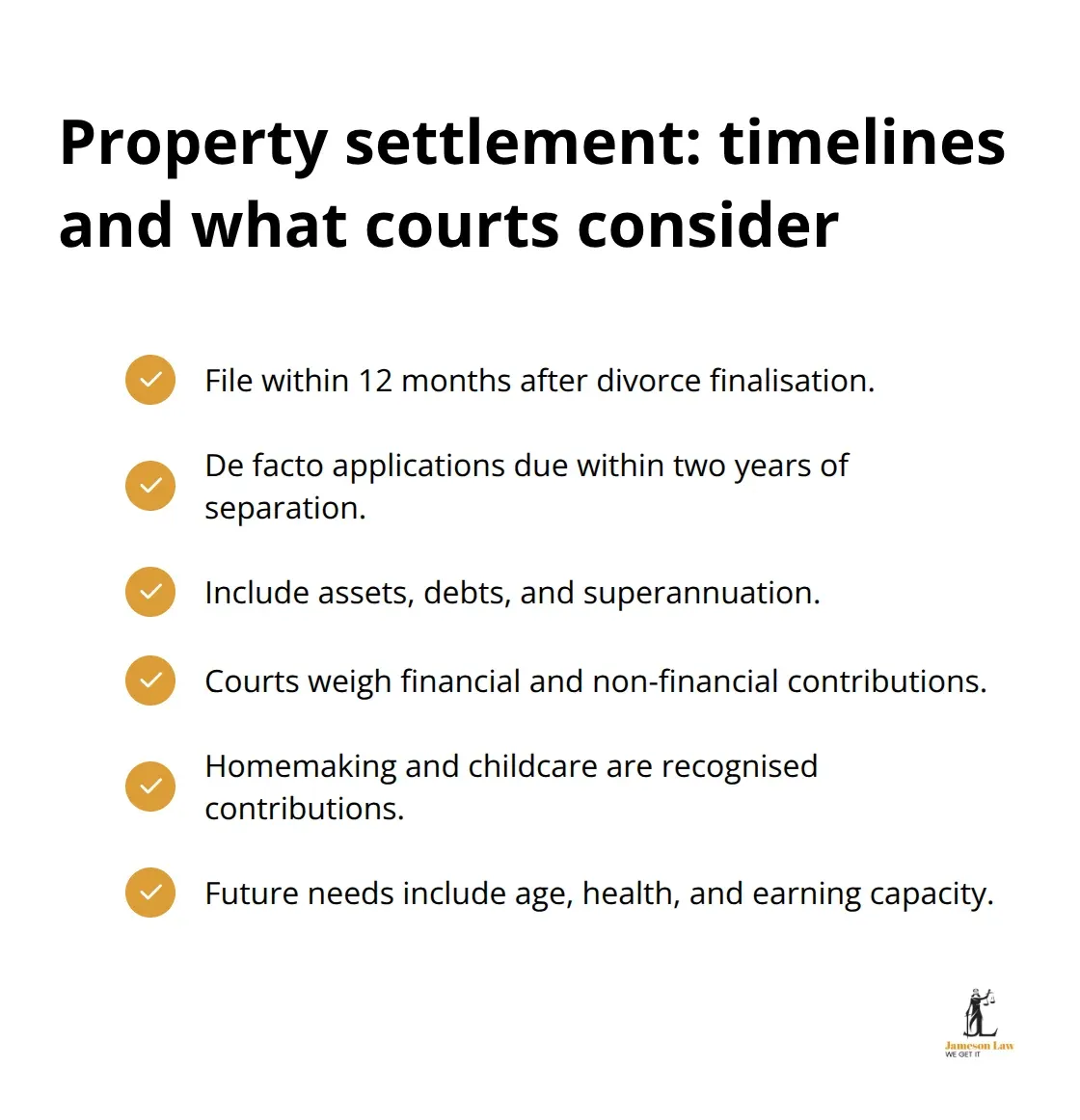
Property settlement divides assets, debts, and superannuation between former partners. Applications must be filed within 12 months after divorce finalisation for married couples, or within two years of separation for de facto relationships. Courts consider financial contributions, non-financial contributions like homemaking and childcare, and future needs that include age, health, and earning capacity.

Checklist of key deadlines and assessment factors for Australian family property settlements - family law definitions

Child Support and Spousal Maintenance

Child support calculations follow Services Australia’s assessment formula based on both parents’ income, care arrangements, and the child’s costs. Spousal maintenance provides ongoing financial support for a former partner who cannot adequately support themselves. Unlike child support, spousal maintenance has no automatic entitlement and depends on one party’s need and the other’s capacity to pay.

Understanding these fundamental terms prepares you for the legal processes and procedures that follow in family law matters.

How Do Family Law Processes Actually Work

Mediation Requirements and Realistic Outcomes

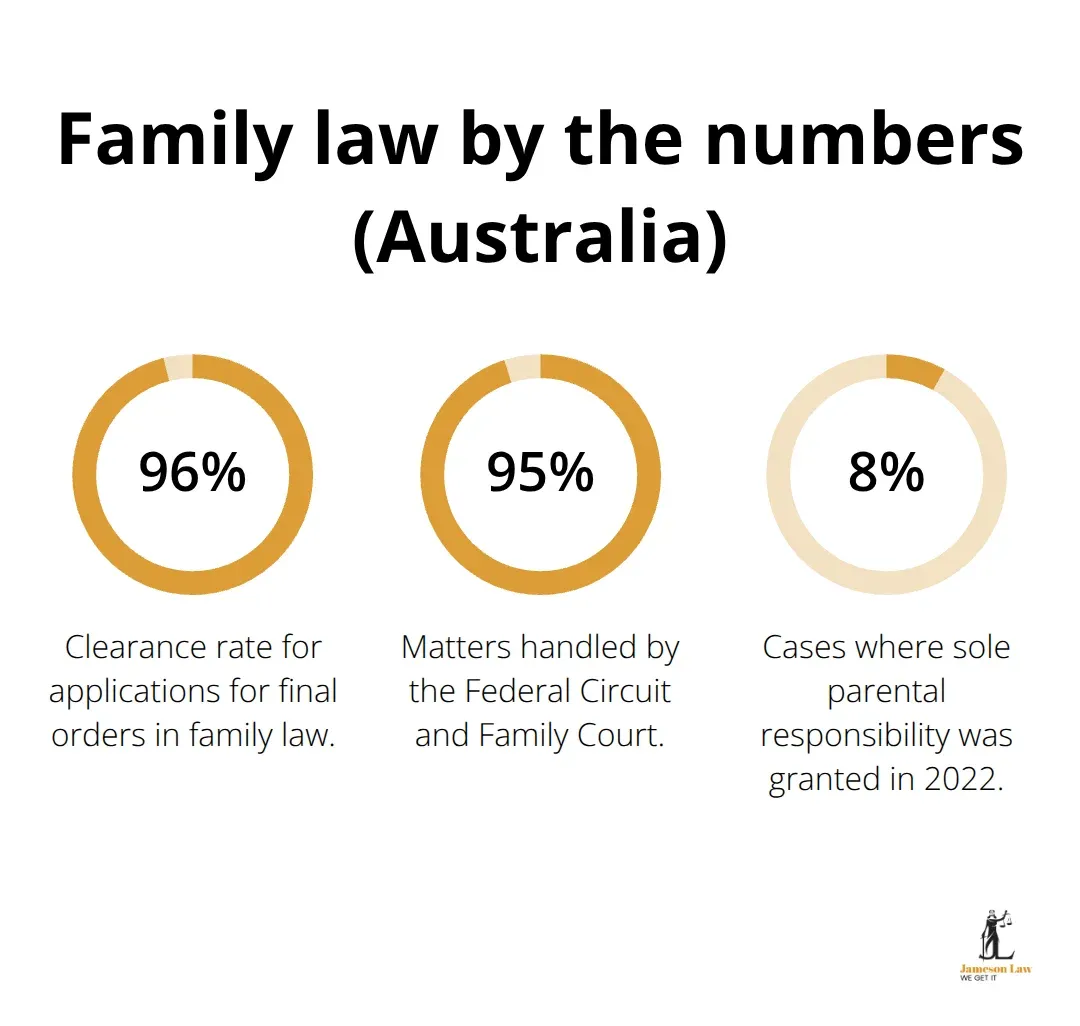
Family Dispute Resolution becomes mandatory before most court applications that involve children. The Federal Circuit and Family Court of Australia maintains an impressive clearance rate of 96% for applications for final orders in family law. Private mediation costs between $150-$300 per hour per party, while community services like Relationships Australia charge approximately $60 per hour per party.

The process typically requires 2-4 sessions that span 6-8 weeks. Mediation fails when power imbalances exist, family violence occurs, or parties refuse genuine negotiation. Courts accept mediation certificates as evidence that reasonable attempts at resolution occurred before formal proceedings.

Court Applications and Strategic Considerations

Court applications trigger strict procedural requirements and substantial costs. Application fees start at $365 for parenting matters and $1,140 for property disputes under $500,000. Priority Property Pool cases expedite settlements when total assets remain below $550,000 (excluding superannuation).

The Federal Circuit and Family Court processes 95% of family law matters, with average case duration that reaches 12-18 months. Interim hearings occur within 6-12 weeks for urgent matters that involve child safety or financial hardship. Final hearings require comprehensive financial disclosure, which includes three years of tax returns, bank statements, and asset valuations.

Key Australian family law statistics: clearance rates, court handling, and parental responsibility

Court-Ordered Assessments and Expert Reports

Family reports from family consultants cost $5,000 to $15,000, while child psychology reports cost $3,000 to $8,000. These reports help judges understand family dynamics and make decisions about parenting arrangements. Independent children’s lawyers may also represent the child’s interests in complex cases.

Courts appoint family consultants who interview parents, children, and relevant third parties. The assessment process takes 8-12 weeks and produces detailed recommendations about parenting arrangements that serve the child’s best interests.

Consent Orders Versus Financial Agreements

Consent Orders require court approval and become legally enforceable immediately. These orders cost $600 in court fees plus legal preparation expenses. The court must approve all Consent Orders to verify they meet legal requirements and protect all parties’ interests.

Binding Financial Agreements avoid court involvement but demand independent legal advice for each party, typically costing $2,500-$5,000 per person. The Family Law Act requires specific formalities that include certificates from separate lawyers who confirm advice provision. Consent Orders prove superior for most families because courts verify fairness and enforceability, while Binding Financial Agreements face higher challenge risks due to technical requirements.

These legal processes connect directly to your fundamental rights and responsibilities as parents and former partners.

What Rights Do You Actually Have in Family Matters

Children’s Best Interests Override Parental Preferences

The Family Law Act 1975 establishes children’s safety as the paramount consideration. Courts reject arrangements that expose children to family violence regardless of parental wishes. Australian courts apply specific factors when they determine best interests, which include the child’s relationship with each parent, their views if mature enough, and any history of violence. Research from the Australian Institute of Family Studies shows that parental disputes often settle when parents focus on children’s needs rather than their own preferences.

Parental responsibility continues after separation for both parents unless courts order otherwise. This responsibility requires consultation on major decisions about education, medical treatment, and religious upbringing. The Federal Circuit and Family Court granted sole parental responsibility in only 8% of cases in 2022 (typically cases that involved family violence or substance abuse). Parents who relocate without proper consultation face court sanctions and potential changes to parental arrangements.

Financial Duties Extend Beyond Child Support Calculations

Property settlement obligations demand full financial disclosure within strict timeframes. The Family Law Act requires complete revelation of assets, liabilities, and income for the past three years. Courts impose penalties up to $93,900 for deliberate non-disclosure and can set aside settlements obtained through deception. Asset protection through trusts or overseas transfers faces intense judicial scrutiny, with courts able to pierce corporate veils when arrangements lack commercial substance.

Spousal maintenance applications must demonstrate genuine need and the other party’s capacity to pay. Courts consider spousal maintenance in contested property cases, typically for periods of 2-5 years. The obligation continues until remarriage, death, or significant change in circumstances. Parents cannot escape child support through bankruptcy or overseas relocation, as Services Australia maintains international enforcement agreements with 30 countries.

Violence Orders Provide Immediate Legal Protection

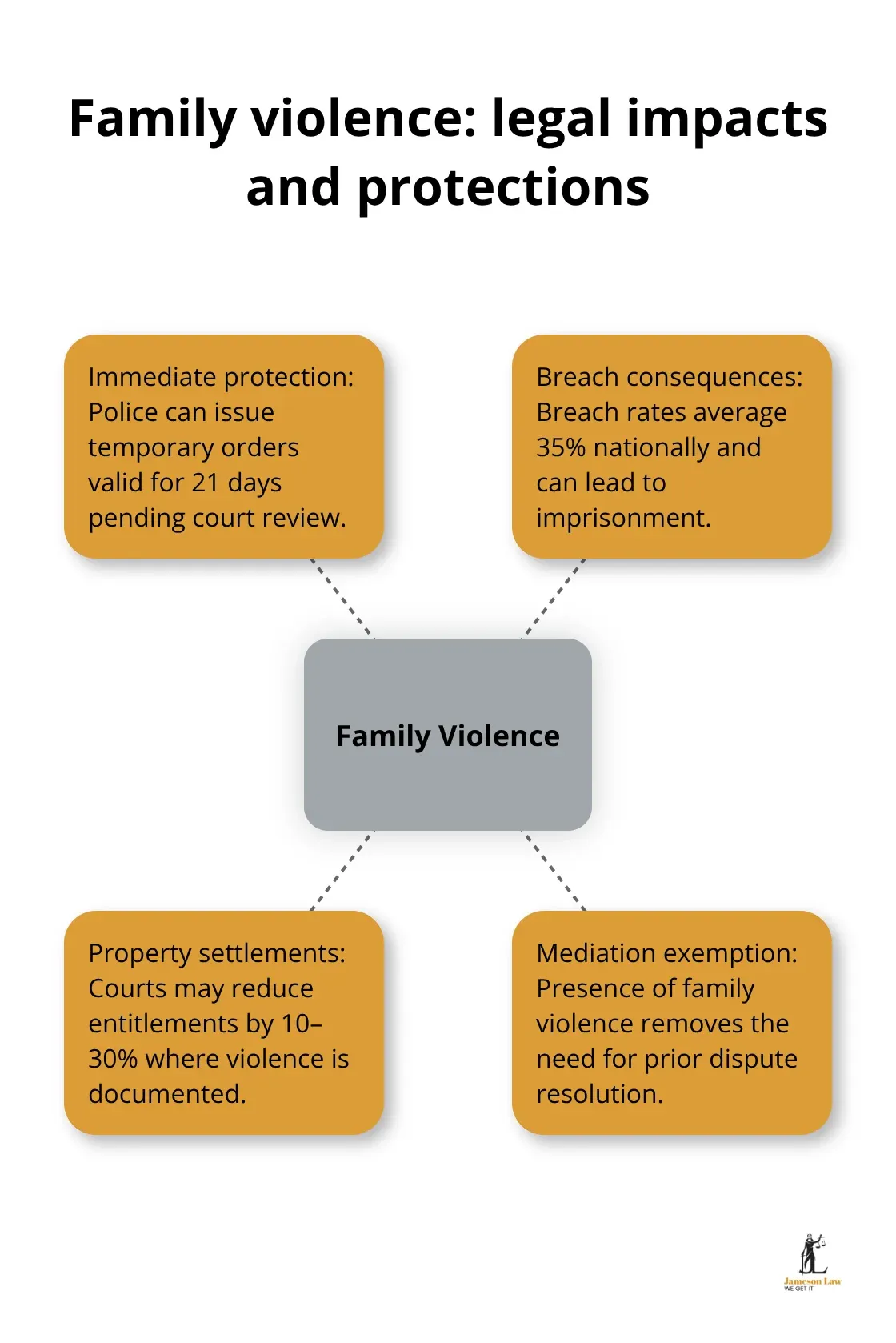
Domestic violence orders operate across all Australian states through national recognition schemes. Police can issue temporary protection orders immediately, which remain valid for 21 days before court review. Breach rates average 35% nationally, with imprisonment possible for serious violations. Family violence significantly impacts property settlements, with courts reducing violent parties’ entitlements by 10-30% in documented cases.

Hub-and-spoke showing how family violence affects protections, breaches, property outcomes, and mediation - family law definitions

The presence of family violence eliminates mediation requirements and allows urgent court applications without prior dispute resolution attempts.

Final Thoughts

Family law definitions form the foundation of successful legal outcomes during separation and divorce. These terms prevent costly mistakes and reduce stress during difficult times. Courts apply these definitions consistently across all family law matters.

The distinction between “lives with” and “spends time with” arrangements affects your daily life with children. Property settlement deadlines create urgent timeframes that demand immediate attention. Mediation requirements before court applications save thousands in legal costs while they protect family relationships.

Your rights extend beyond basic custody and financial arrangements (children’s best interests always override parental preferences). Full financial disclosure obligations carry serious penalties for non-compliance. We at Jameson Law provide expert family law services to help families navigate these complex legal processes and protect their rights.

Speak to an Expert Lawyer today

Laywers-Jameson-Law-The-best-law-firm-in-Sydney- Sydney Lawyers - Sydney
BOOK NOW

WE'RE IN IT TO WIN IT

Book your consultation

Book Now
Book Now Mobile 06 02 2025

This form submission is encrypted and secured to ensure your information remains confidential.

What our Clients

Related Publications:

What our clients say

.

Jameson Law - Voted the Best Law firm in Sydney Award

Legal Answers ... In Short

We're here to help

Our mission is to ensure our client matters are resolved successfully every time. Success to us does not simply involve winning, but moreover ensuring we take the most feasible, economic and stress-free path to help our clients achieve their goals. We fight hard for our clients, and always go by the motto: we’re in it to win it.

Jameson Law - Best Law Firm in Sydney

WE'RE IN IT TO WIN IT

Book your consultation

Call us now on (02) 8806 0866 or fill out the form below

Book Now Mobile

This form submission is encrypted and secured to ensure your information remains confidential.

WE'RE IN IT TO WIN IT

Book your consultation

Book Now Mobile 06 02 2025
lock

This form submission is encrypted and secured to ensure your information remains confidential.

Our Sydney Offices

Offices Parramatta and Sydney Jameson Law
Parramatta CBD - Head Office
jameson Law - Blacktown
jameson Law - Liverpool Office
Jameson Law - Bankstown
Court Houses We Frequent Jameson Law

Court Houses We Frequent

Balmain Local Court

Registry: Monday to Friday, 9:00am to 4:30pm

Bankstown Local Court

Court Operating Hours: 9:30am-4:30pm

Blacktown Local Court

Registry Hours: 9:00 – 4:30
Telephone Hours: 8:30 -4:30
Days open: Mon-Fri

Burwood Local Court

Registry Hours: 9:00 – 4:30
Telephone Hours: 8:30 – 4:30
Days open: Mon – Fri

Campbell Local Court

Registry Hours: 9:00 – 4:30
Telephone Hours: 8:30 – 4:30
Days open: Mon – Fri

Central Local Court

Registry Hours: 9:00 – 1:00 and 2:00 – 4:30
Telephone Hours: 8:30 – 4:30

Downing Local Court

Registry Hours: 9:00 – 1:00 and 2:00 – 4:30
Telephone Hours: 8:30 – 4:30

Wollongong Local Court

Registry Hours: 9:00 – 1:00 and 2:00 – 4:30
Telephone Hours: 8:30 – 4:30

Fairfield Local Court

Registry Hours: 9:00 – 1:00 and 2:00 – 4:30
Telephone Hours: 8:30 – 4:30

Hornsby Local Court

Registry Hours: 9:00 – 1:00 and 2:00 – 4:30
Telephone Hours: 8:30 – 4:30

Liverpool Local Court

Registry Hours: 9:00 – 1:00 and 2:00 – 4:30
Telephone Hours: 8:30 – 4:30

Manly Local Court

Registry Hours: 9:00 – 1:00 and 2:00 – 4:30
Telephone Hours: 8:30 – 4:30

Newtown Local Court

Registry Hours: 9:00 – 1:00 and 2:00 – 4:30
Telephone Hours: 8:30 – 4:30

Parramatta Local Court

Registry Hours: 9:00 – 1:00 and 2:00 – 4:30
Telephone Hours: 8:30 – 4:30

Penrith Local Court

Registry Hours: 9:00 – 1:00 and 2:00 – 4:30
Telephone Hours: 8:30 – 4:30

Sutherland Local Court

Registry Hours: 9:00 – 1:00 and 2:00 – 4:30
Telephone Hours: 8:30 – 4:30

Waverley Local Court

Registry Hours: 9:00 – 1:00 and 2:00 – 4:30
Telephone Hours: 8:30 – 4:30

Windsor Local Court

Registry Hours: 9:00 – 1:00 and 2:00 – 4:30
Telephone Hours: 8:30 – 4:30

Wollongong Local Court

Registry Hours: 9:00 – 1:00 and 2:00 – 4:30
Telephone Hours: 8:30 – 4:30

Downing Centre District Court

Registry Hours: 9:00 – 4:30
Telephone Hours: 8:30 – 4:30
Days open: Mon – Fri

Parramatta District Court

Registry Hours: 9:00 – 4:30
Days open: Mon-Fri

Penrith District Court

Registry Hours: 9:00 – 4:30
Days open: Mon-Fri

Campbelltown District Court

Registry Hours: 9:00 – 4:30
Days open: Mon – Fri

Liverpool District Court

Registry Hours: 9:00 – 4:30
Days open: Mon – Fri

Wollongong District Court

Registry Hours: 9:00 – 1:00 and 2:00 – 4:30
Telephone Hours: 8:30 – 4:30

Supreme Court New South Wales

Registry Hours: 9:00 AM – 4:30 PM
Telephone Hours: 8:30 AM – 4:30 PM
Days Open: Monday to Friday

Federal Circuit and Family Court of Australia

Registry Hours: 9:00 AM – 4:30 PM
Telephone Hours: 8:30 AM – 5:00 PM
Days Open: Monday to Friday

Federal Court

Monday to Friday, 8:30 AM – 4:30 PM

High Court

Monday to Friday, 8:30 AM – 5:00 PM

Children’s Court of New South Wales

Registry Hours: 9:00 AM – 4:30 PM
Telephone Hours: 8:30 AM – 4:30 PM
Days Open: Monday to Friday

Coroner’s Court New South Wales

Registry Hours: 9:00 AM – 4:30 PM
Telephone Hours: 8:30 AM – 4:30 PM
Days Open: Monday to Friday

Industrial Relations Commission of New South Wales

Registry Hours: 9:00 AM – 4:30 PM
Telephone Hours: 8:30 AM – 4:30 PM
Days Open: Monday to Friday

Land and Environment Court of New South Wales

Registry Hours: 9:00 AM – 4:30 PM
Telephone Hours: 8:30 AM – 4:30 PM
Days Open: Monday to Friday

WE'RE IN IT TO WIN IT

Book your consultation

Book Now
Book Now Mobile 06 02 2025
lock

This form submission is encrypted and secured to ensure your information remains confidential.