PUBLICATION

Will Validity NSW: Ensuring Your Will Withstands Legal Scrutiny

"Understand will validity NSW requirements to protect your estate and avoid costly legal disputes."
Will Validity NSW: Ensuring Your Will Withstands Legal Scrutiny

A poorly executed will can unravel years of planning. In NSW, thousands of wills face legal challenges each year because they fail to meet strict legal requirements.

At Jameson Law, we’ve seen firsthand how small mistakes during will creation lead to expensive court battles and family disputes. This guide walks you through what makes a will valid in NSW and how to protect yours from challenge.

What Makes a Will Valid in NSW

The Legal Framework for Will Validity

In NSW, a valid will must meet strict legal standards set out in the Succession Act 2006. Section 6 requires the will to be in writing and signed by the testator, with at least two witnesses present at the same time who also sign the document. The signature does not need to appear at the bottom of the page, and the testator can direct someone else to sign on their behalf if they cannot sign themselves. What matters most is that the testator intends the document to be their final will.
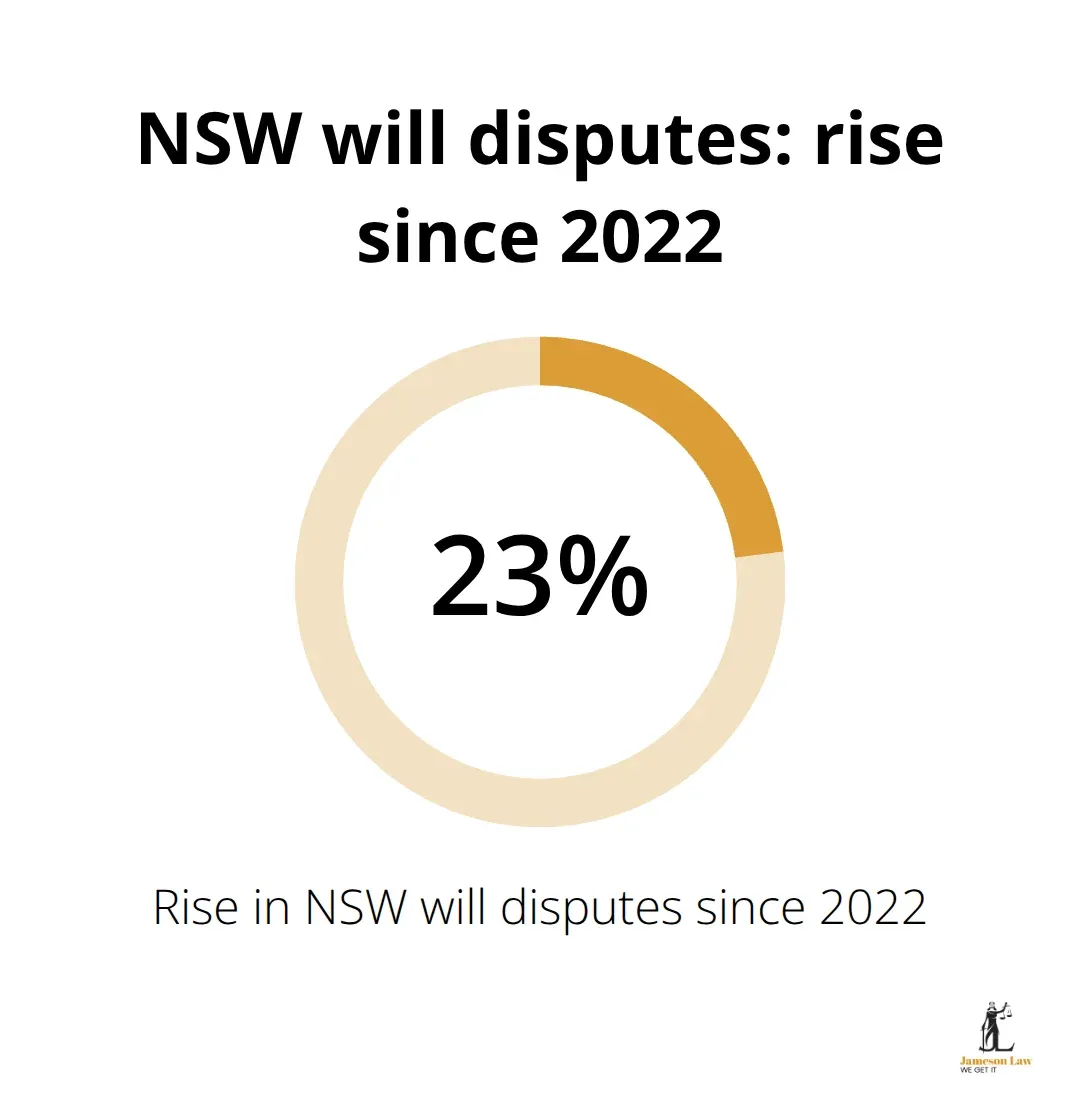
Courts have accepted unconventional materials as valid wills, including unsent text messages, handwritten notes, and typed unsigned documents stored digitally, provided the evidence clearly shows testamentary intention. However, this flexibility comes with risk. Will disputes in NSW have risen 23 per cent since 2022, according to State Library of NSW data, indicating that courts are scrutinising will validity more closely than ever.

Chart showing a 23 per cent rise in NSW will disputes since 2022 - Will validity NSW

The safer approach is to follow formal execution procedures precisely rather than relying on courts to overlook technical flaws.

Testamentary capacity and mental competence

Testamentary capacity sits at the heart of will validity. Anyone over the age of 18, and anyone under 18 who is married or contemplating marriage, can make a will, provided they have testamentary capacity. Courts assess capacity at the time of signing, not before or after. This distinction matters because a testator’s mental state can fluctuate, and only their condition on the day they sign the will counts.

Witnesses and Conflicts of Interest

Beneficiaries must not act as witnesses, as this creates a conflict of interest and can invalidate their gift or the entire will. Two independent adult witnesses must be present simultaneously when the testator signs. If witnessing procedures fall short, courts may still validate the document under section 8 of the Succession Act if testamentary intention is clear, but this uncertainty is expensive and emotionally draining for families.

Protecting Against Undue influence and duress

Undue influence and duress are separate grounds for challenge and occur when someone pressures the testator into making decisions that do not reflect their true wishes. These claims often arise in family disputes and require careful documentation to defend against. At Jameson Law, we recommend treating formal execution as non-negotiable. Have two independent adult witnesses present simultaneously, ensure the testator dates and signs every page, and keep the original in a secure location such as a bank safe or a lawyer’s office. This approach eliminates doubt and protects your estate from the costly disputes that arise when documentation is incomplete or ambiguous.

Understanding these requirements forms the foundation for a defensible will, but execution alone is not enough. The next section examines the specific reasons wills face legal challenge in NSW and what triggers disputes.

Why Wills Get Challenged in NSW

Capacity Disputes Dominate Will Challenges

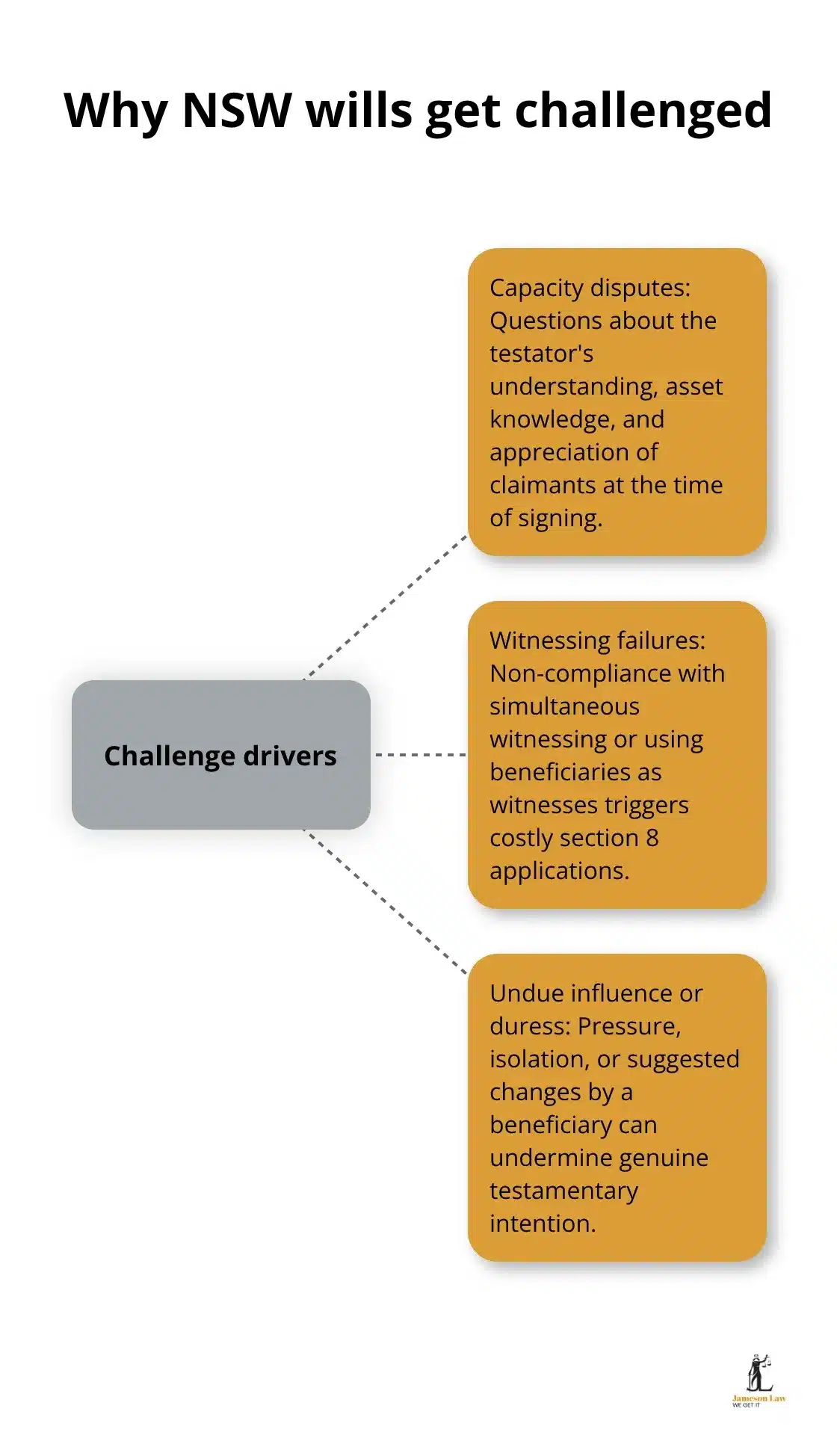
Capacity disputes represent the largest category of will challenges in NSW. Courts receive hundreds of applications each year from families questioning whether the testator possessed sound mind at the time of signing. The problem intensifies when the testator was elderly, unwell, or taking medication that affects cognition. Will disputes rose 23 per cent since 2022, with capacity claims representing a significant portion of these challenges.

Hub-and-spoke diagram of common grounds for will challenges in NSW

Capacity exists on a spectrum rather than as a simple yes-or-no question. A testator might manage daily tasks but lack the mental clarity to understand their full asset picture or the implications of their distribution choices. Courts apply a strict test: did the testator know the nature of making a will, understand the extent of their property, know the natural claims on their estate, and comprehend how the will distributes assets? If evidence suggests any weakness in these areas, the will becomes vulnerable to attack.

The Power of Witness Testimony

Witness testimony becomes critical when capacity comes under question. If witnesses can describe the testator’s lucid conversation, their awareness of family circumstances, and their clear articulation of wishes on the day of signing, capacity challenges collapse. Without this documentation, families face prolonged disputes and legal costs that consume thousands of dollars. Witnesses who take brief notes about the testator’s mental clarity and apparent independence create powerful defences against later challenges.

Witnessing Failures Create Expensive Problems

Witnessing failures create the second major category of challenge in NSW. Many people assume that any two people present during signing satisfy the law, but NSW rules are precise and unforgiving. Both witnesses must be present simultaneously when the testator signs, and both must sign in the testator’s presence. Beneficiaries or their spouses cannot act as witnesses, yet wills signed with a beneficiary present still appear regularly in legal disputes.

Once challenged, these wills face expensive court applications under section 8 of the Succession Act to validate them despite procedural flaws. The costs and delays associated with these applications drain estate resources and test family relationships. Proper execution from the outset eliminates this risk entirely.

Undue Influence and Duress Claims

The third challenge type involves undue influence or duress claims. These arise when a beneficiary appears to have pressured the testator into unfair distributions. A beneficiary who was present during will preparation, who suggested changes, or who isolated the testator from other family members creates obvious suspicion. Courts scrutinise the circumstances closely, and without clear evidence of independent decision-making, the will’s validity weakens.

The testator’s own documented statements about their intentions, written notes explaining choices, and independent legal advice all serve as powerful defences against these claims. Retain copies of all communications between the testator and their lawyer. Keep records showing the testator consulted independently. These practical steps transform a vulnerable will into one that withstands challenge and protects the testator’s true wishes from dispute.

Understanding why wills face challenge reveals what protection looks like in practice. The next section examines the specific steps that eliminate these vulnerabilities before they become costly legal battles.

How to Protect Your Will from Challenge

Document Your Intentions and Mental State

The gap between a valid will and a defensible will lies in deliberate documentation and strict adherence to execution procedures. Families often spend tens of thousands of dollars fighting over wills that could have been protected with straightforward precautions taken at the outset. Start by creating a written record of the testator’s mental state and intentions before signing. This record should describe the testator’s awareness of their assets, their understanding of family circumstances, and their reasoning for distribution choices.

A simple letter written by the testator explaining why they made specific decisions transforms a vulnerable will into one that withstands challenge. Courts weight contemporaneous written statements heavily because they eliminate speculation about the testator’s state of mind on the signing date. Medical records also matter. If the testator was managing a condition like early-stage dementia or taking medications affecting cognition, obtain a letter from their doctor confirming testamentary capacity at the time of signing. This clinical evidence defeats speculative capacity challenges before they escalate to court applications.

Strengthen Your Witness Documentation

Witnesses should document observations about the testator’s clarity and independence. A brief note from each witness describing the testator’s lucid conversation, their apparent understanding of the will’s contents, and any absence of pressure creates a powerful defence against capacity claims. These notes cost nothing to create and can save estates thousands in dispute resolution costs.

Witness testimony becomes critical when capacity comes under question. If witnesses can describe the testator’s lucid conversation, their awareness of family circumstances, and their clear articulation of wishes on the signing day, capacity challenges collapse. Without this documentation, families face prolonged disputes and legal costs that consume thousands of dollars.

Execute Your Will with Absolute Precision

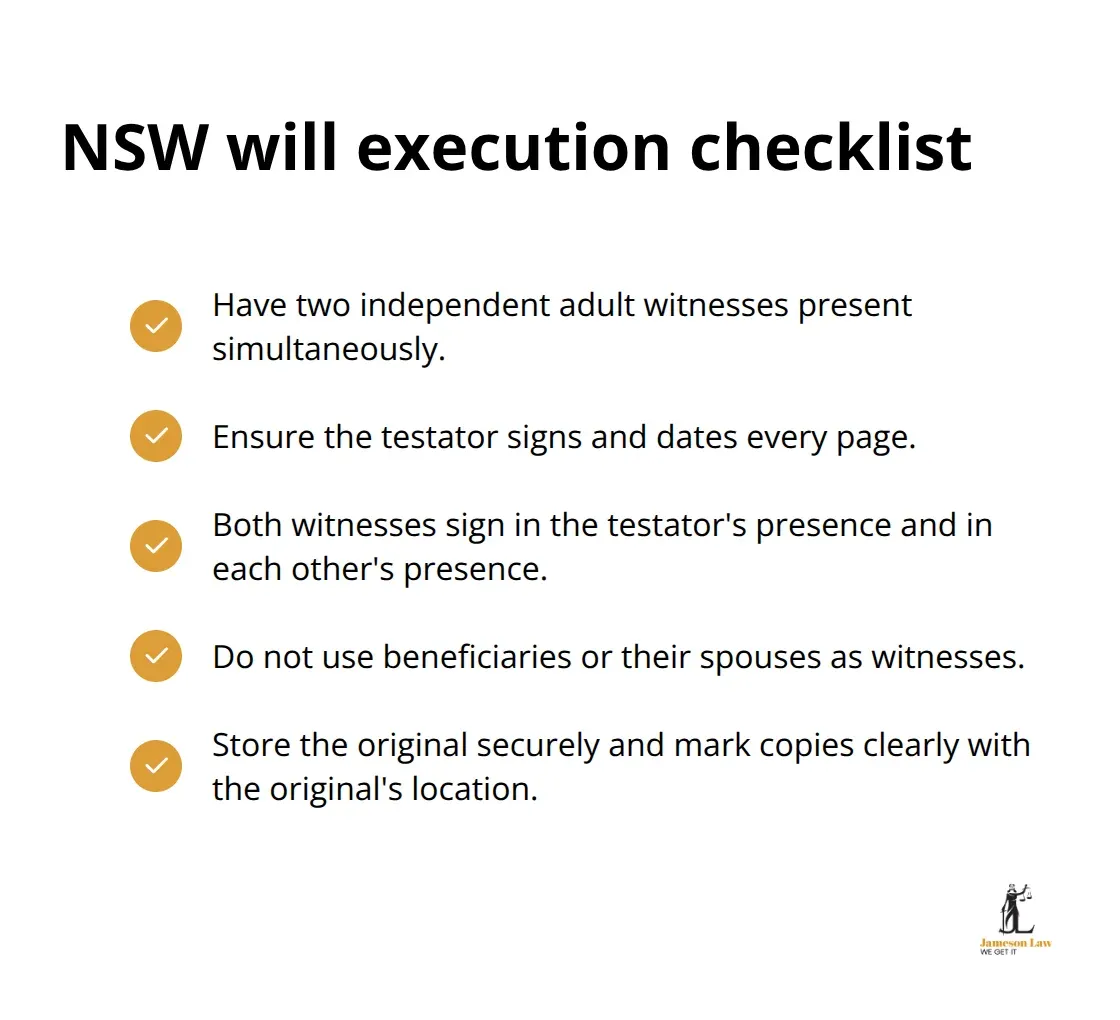
Execution procedure demands absolute precision because courts will not overlook technical failures without expensive court applications. Arrange for two independent adult witnesses who are not beneficiaries and not spouses of beneficiaries to be present simultaneously. The testator must sign every page and date the document. Both witnesses must sign in the testator’s presence and in each other’s presence.

Checklist of precise execution steps to make a NSW will defensible - Will validity NSW

Retain the original will in a secure location such as a bank safe or a lawyer’s office, and keep copies marked clearly as copies with a note about where the original is stored. Once challenged, wills with witnessing failures face expensive court applications to validate them despite procedural flaws. The costs and delays associated with these applications drain estate resources and test family relationships. Proper execution from the outset eliminates this risk entirely.

Obtain Independent Legal Advice

Have the testator sign a statement confirming they understand the will’s contents and that they signed it freely without pressure. This statement becomes evidence if undue influence is later alleged. Consider having the testator’s lawyer prepare a file note documenting the testator’s instructions, the advice given, the testator’s responses, and observations about their mental state. This file note becomes admissible evidence in disputes and demonstrates independent legal guidance.

Professional legal advice eliminates guesswork about what NSW courts require and ensures the will meets current legal standards. The cost of these precautions is minimal compared to the expense of defending a challenged will or applying to court for validation of a defectively executed document. Retain copies of all communications between the testator and their lawyer. Keep records showing the testator consulted independently. These practical steps transform a vulnerable will into one that withstands challenge and protects the testator’s true wishes from dispute.

Final Thoughts

Will validity in NSW rests on three core elements: strict adherence to execution procedures, clear documentation of testamentary intention, and independent legal guidance. Will disputes in NSW have risen 23 per cent since 2022, yet most challenges stem from preventable execution failures or inadequate documentation rather than genuine legal defects. The difference between a will that withstands scrutiny and one that collapses under challenge lies entirely in the care you take during creation.

Professional legal advice removes guesswork about NSW requirements and ensures your will meets current legal standards. We at Jameson Law bring extensive experience to wills and estates planning, helping clients protect their wishes from challenge and their families from unnecessary conflict. Our team prepares file notes documenting your instructions, observations about your mental state, and the advice provided, creating admissible evidence if disputes later arise.

Start your will planning process by contacting Jameson Law to arrange a consultation with a wills specialist. A properly executed will drawn with professional guidance withstands court scrutiny and protects your estate from the expensive legal battles that drain resources and test family relationships.

Speak to an Expert Lawyer today

Laywers-Jameson-Law-The-best-law-firm-in-Sydney- Sydney Lawyers - Sydney
BOOK NOW

WE'RE IN IT TO WIN IT

Book your consultation

Book Now
Book Now Mobile 06 02 2025

This form submission is encrypted and secured to ensure your information remains confidential.

What our Clients

Related Publications:

What our clients say

.

Jameson Law - Voted the Best Law firm in Sydney Award

Legal Answers ... In Short

We're here to help

Our mission is to ensure our client matters are resolved successfully every time. Success to us does not simply involve winning, but moreover ensuring we take the most feasible, economic and stress-free path to help our clients achieve their goals. We fight hard for our clients, and always go by the motto: we’re in it to win it.

Jameson Law - Best Law Firm in Sydney

WE'RE IN IT TO WIN IT

Book your consultation

Call us now on (02) 8806 0866 or fill out the form below

Book Now Mobile

This form submission is encrypted and secured to ensure your information remains confidential.

WE'RE IN IT TO WIN IT

Book your consultation

Book Now Mobile 06 02 2025
lock

This form submission is encrypted and secured to ensure your information remains confidential.

Our Sydney Offices

Offices Parramatta and Sydney Jameson Law
Parramatta CBD - Head Office
jameson Law - Blacktown
jameson Law - Liverpool Office
Jameson Law - Bankstown
Court Houses We Frequent Jameson Law

Court Houses We Frequent

Balmain Local Court

Registry: Monday to Friday, 9:00am to 4:30pm

Bankstown Local Court

Court Operating Hours: 9:30am-4:30pm

Blacktown Local Court

Registry Hours: 9:00 – 4:30
Telephone Hours: 8:30 -4:30
Days open: Mon-Fri

Burwood Local Court

Registry Hours: 9:00 – 4:30
Telephone Hours: 8:30 – 4:30
Days open: Mon – Fri

Campbell Local Court

Registry Hours: 9:00 – 4:30
Telephone Hours: 8:30 – 4:30
Days open: Mon – Fri

Central Local Court

Registry Hours: 9:00 – 1:00 and 2:00 – 4:30
Telephone Hours: 8:30 – 4:30

Downing Local Court

Registry Hours: 9:00 – 1:00 and 2:00 – 4:30
Telephone Hours: 8:30 – 4:30

Wollongong Local Court

Registry Hours: 9:00 – 1:00 and 2:00 – 4:30
Telephone Hours: 8:30 – 4:30

Fairfield Local Court

Registry Hours: 9:00 – 1:00 and 2:00 – 4:30
Telephone Hours: 8:30 – 4:30

Hornsby Local Court

Registry Hours: 9:00 – 1:00 and 2:00 – 4:30
Telephone Hours: 8:30 – 4:30

Liverpool Local Court

Registry Hours: 9:00 – 1:00 and 2:00 – 4:30
Telephone Hours: 8:30 – 4:30

Manly Local Court

Registry Hours: 9:00 – 1:00 and 2:00 – 4:30
Telephone Hours: 8:30 – 4:30

Newtown Local Court

Registry Hours: 9:00 – 1:00 and 2:00 – 4:30
Telephone Hours: 8:30 – 4:30

Parramatta Local Court

Registry Hours: 9:00 – 1:00 and 2:00 – 4:30
Telephone Hours: 8:30 – 4:30

Penrith Local Court

Registry Hours: 9:00 – 1:00 and 2:00 – 4:30
Telephone Hours: 8:30 – 4:30

Sutherland Local Court

Registry Hours: 9:00 – 1:00 and 2:00 – 4:30
Telephone Hours: 8:30 – 4:30

Waverley Local Court

Registry Hours: 9:00 – 1:00 and 2:00 – 4:30
Telephone Hours: 8:30 – 4:30

Windsor Local Court

Registry Hours: 9:00 – 1:00 and 2:00 – 4:30
Telephone Hours: 8:30 – 4:30

Wollongong Local Court

Registry Hours: 9:00 – 1:00 and 2:00 – 4:30
Telephone Hours: 8:30 – 4:30

Downing Centre District Court

Registry Hours: 9:00 – 4:30
Telephone Hours: 8:30 – 4:30
Days open: Mon – Fri

Parramatta District Court

Registry Hours: 9:00 – 4:30
Days open: Mon-Fri

Penrith District Court

Registry Hours: 9:00 – 4:30
Days open: Mon-Fri

Campbelltown District Court

Registry Hours: 9:00 – 4:30
Days open: Mon – Fri

Liverpool District Court

Registry Hours: 9:00 – 4:30
Days open: Mon – Fri

Wollongong District Court

Registry Hours: 9:00 – 1:00 and 2:00 – 4:30
Telephone Hours: 8:30 – 4:30

Supreme Court New South Wales

Registry Hours: 9:00 AM – 4:30 PM
Telephone Hours: 8:30 AM – 4:30 PM
Days Open: Monday to Friday

Federal Circuit and Family Court of Australia

Registry Hours: 9:00 AM – 4:30 PM
Telephone Hours: 8:30 AM – 5:00 PM
Days Open: Monday to Friday

Federal Court

Monday to Friday, 8:30 AM – 4:30 PM

High Court

Monday to Friday, 8:30 AM – 5:00 PM

Children’s Court of New South Wales

Registry Hours: 9:00 AM – 4:30 PM
Telephone Hours: 8:30 AM – 4:30 PM
Days Open: Monday to Friday

Coroner’s Court New South Wales

Registry Hours: 9:00 AM – 4:30 PM
Telephone Hours: 8:30 AM – 4:30 PM
Days Open: Monday to Friday

Industrial Relations Commission of New South Wales

Registry Hours: 9:00 AM – 4:30 PM
Telephone Hours: 8:30 AM – 4:30 PM
Days Open: Monday to Friday

Land and Environment Court of New South Wales

Registry Hours: 9:00 AM – 4:30 PM
Telephone Hours: 8:30 AM – 4:30 PM
Days Open: Monday to Friday

WE'RE IN IT TO WIN IT

Book your consultation

Book Now
Book Now Mobile 06 02 2025
lock

This form submission is encrypted and secured to ensure your information remains confidential.