PUBLICATION

Building Defects in NSW: Your Rights and Remedies

"Understand your rights with building defects in NSW. Learn warranty coverage, notification deadlines, and remedies to protect your home."
Building Defects in NSW: Your Rights and Remedies

Building defects in NSW can cost you thousands in repairs and create serious safety risks. We at Jameson Law know that homeowners often feel lost when facing structural problems, water damage, or poor workmanship.

This guide walks you through your legal rights, how to document defects properly, and the exact steps to claim compensation through Fair Trading NSW or NCAT.

What Defects Does NSW Law Actually Cover

Statutory Warranties Under the Home Building Act 1989

NSW statutory warranties under the Home Building Act 1989 apply to residential building work valued over $5,000, and they operate differently than most homeowners expect. The law guarantees that materials will be good, suitable for their purpose, and new unless your contract states otherwise. Work must be performed with due care and skill, comply with contract plans, follow all applicable laws, and be completed within the timeframe specified in your contract or within a reasonable time if no timeframe exists. For dwelling construction or renovations, the finished work must be reasonably fit for occupation and, if you specified a particular purpose, reasonably fit for that purpose.

These warranties apply to both you as the original owner and any subsequent owner of the property, meaning defects discovered years later still trigger legal obligations. The statutory framework covers three broad categories of defects that homeowners commonly encounter.

Three Main Categories of Building Defects

Structural defects and safety issues include problems with foundations, load-bearing walls, roof framing, and electrical installations that compromise building integrity or create hazards. Water ingress and moisture damage encompasses leaking roofs, failed waterproofing in bathrooms and kitchens, rising damp, and damaged guttering that leads to internal water penetration. Defective materials and workmanship covers poor quality finishes, sticking doors, failed grout joints, inadequate paint application, and use of substandard materials that don’t meet the contract specification.

Summary of NSW residential building defect categories under statutory warranties

Your Timeframe for Making Claims

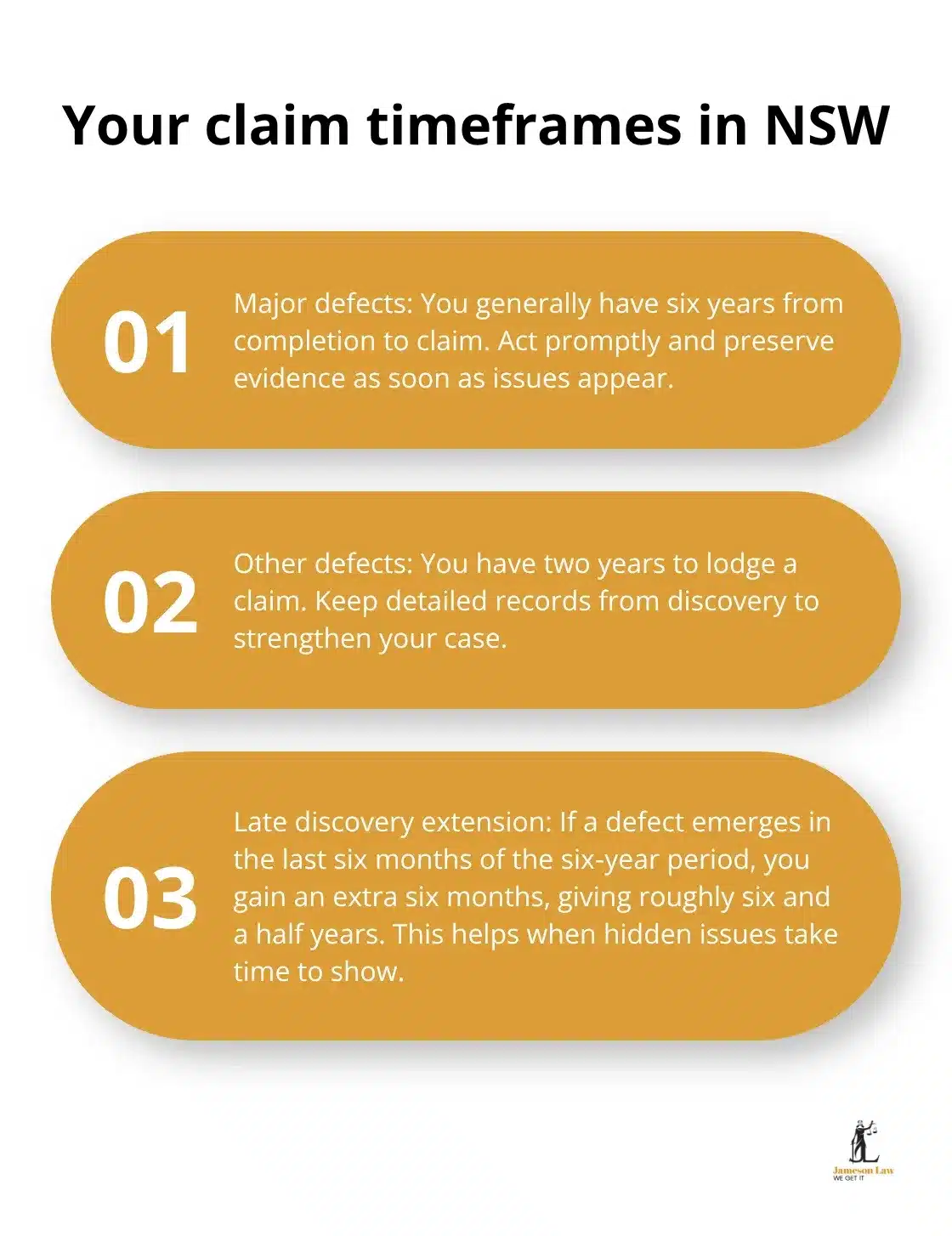
Under NSW law, you have six years from the date of completion to claim compensation for major defects and two years for other defects. If a defect becomes apparent in the last six months of the six-year period, the claim period extends a further six months, giving you a potential window of six and a half years. This extended timeframe recognises that some structural or hidden defects take years to manifest.

Overview of time limits to claim for building defects in NSW - building defects nsw

What Builders Cannot Do

The builder’s obligation is absolute for these warranties and cannot be excluded or restricted by any contract clause attempting to do so. If you notify the builder in writing of a breach, they must respond and inspect the work. If a breach is confirmed, the builder must either rectify the work or pay damages. NSW provides the Guide to Standards and Tolerances to help assess whether defects are genuinely defective or within acceptable tolerances, though expert assessment is often necessary for complex claims.

Once you understand what the law covers and your timeframe for action, the next critical step involves identifying whether defects actually exist in your property and collecting the evidence you’ll need to support any future claim.

Spotting Building Defects and Building Your Evidence

Warning Signs You Should Never Ignore

Identifying building defects early saves you thousands in repair costs and strengthens any claim you later pursue. Most homeowners miss warning signs because they don’t know what to look for. Water stains on ceilings or walls indicate roof leaks or failed waterproofing and demand immediate attention because moisture damage accelerates over time. Cracks in walls or ceilings, particularly those wider than 3mm or appearing in patterns rather than isolated spots, signal structural movement or settling issues that require professional assessment. Sticking doors and windows suggest frame movement or poor installation, while visible mould or musty odours point to moisture problems hidden behind walls. Electrical faults such as switches that don’t work properly or lights that flicker indicate unsafe wiring. Check your roof from the ground with binoculars for missing or damaged tiles, rusted guttering, or gaps where water can penetrate.

Documenting Defects with Photos and Written Records

Photography and written reports form the foundation of your claim. Take clear photos from multiple angles in natural daylight, capturing both wide shots showing the defect’s location and close-ups revealing the damage itself. Include photos of the surrounding area to establish context. Write a detailed description alongside each photo noting the date, location, what you’re seeing, and what caused it if known. If you notice water damage, photograph the affected area before it dries so the extent is visible. For structural issues, get a building inspector or surveyor to produce a formal defect report because courts and NCAT value expert assessment over your observations alone.

Engaging a Professional Inspector

The NSW Building Certifiers Public Register lists registered building surveyors in your area; verify their registration class matches residential work before engaging them. Expect inspection costs between $400 and $1,200 depending on property size and defect complexity. Inside, inspect bathrooms and kitchens for water damage around fixtures, soft or discoloured timber, and grout that’s crumbling or missing.

Notifying the Builder in Writing

Document everything the moment you notice it because NSW law requires you to notify the builder in writing within six months of discovering a defect to preserve your rights. Send your written notification to the builder via registered mail or email with read receipt enabled, clearly describing each defect and requesting their response within 14 days. Keep copies of everything you send and every response you receive. This documentation becomes your evidence if the matter escalates to Fair Trading NSW or NCAT later, and the strength of your evidence directly determines whether you succeed in recovering compensation or securing rectification orders.

How to Get Your Defects Fixed or Claim Compensation

Once you have documented defects and notified the builder in writing, your next step depends on whether the builder responds cooperatively or ignores your claim. Most builders will either rectify the work within a reasonable timeframe or dispute your claim. If rectification happens quickly, you avoid lengthy disputes entirely. However, if the builder refuses to act or disputes your assessment, NSW law provides two formal pathways: Fair Trading NSW investigation and NCAT proceedings.

Getting the Builder to Rectify Work First

Contact the builder directly and request rectification within 14 days of your written notification. Specify exactly what work needs fixing and set a deadline. Most builders have a defects liability period where they address minor issues like paint touch-ups, sticking doors, and grout repairs at no cost to you. If defects fall within this period and the builder refuses to fix them, escalate immediately.

If the builder agrees to rectify but misses the deadline repeatedly, document each missed appointment with dates and times. This evidence becomes critical if you later need to pursue compensation instead of rectification. Take photos during and after any rectification work to confirm the defect is genuinely fixed, not just covered up temporarily.

Some builders will quote repair costs and offer payment instead of fixing the work themselves. Only accept this if the quoted amount reflects fair market rates for the repairs. Get a second quote from an independent contractor to verify the builder’s figure is reasonable.

When Fair Trading NSW Gets Involved

If the builder refuses to respond or disputes your claim, lodge a complaint with Fair Trading NSW. Fair Trading will investigate your complaint at no cost to you. You must attach evidence of your Fair Trading investigation to any later NCAT application, so this step is mandatory before NCAT will hear your case unless your matter falls into specific exemptions (such as claims involving unlicensed contractors or de-registered companies).

Fair Trading typically takes 8 to 12 weeks to investigate, though complex cases take longer. During this time, continue documenting any worsening of the defect with new photos. Fair Trading’s investigation often prompts builders to settle because they want to avoid formal enforcement action. If Fair Trading finds the builder breached statutory warranties, this strengthens your position significantly. The investigation outcome becomes admissible evidence if you proceed to NCAT.

Fair Trading can also issue building work rectification orders, stop work orders, or prohibition orders for serious defects, though these are more common for residential apartment buildings managed by the NSW Building Commission.

Taking Your Claim to NCAT

NCAT’s Home Building division handles disputes about residential building work and can order payment for work, remedies for defective work, or damages to other structures. Application fees range from around $50 for smaller claims to several hundred dollars for claims exceeding $10,000, with concession card holders eligible for reduced fees.

You must identify the builder’s correct legal name and service address before applying; search the ASIC Registers if the builder operates as a company and attach the search result to your application. NCAT requires strong evidence including your building contract, certificate of insurance, building reports, contractor licence details, photos of defects, and your written correspondence with the builder.
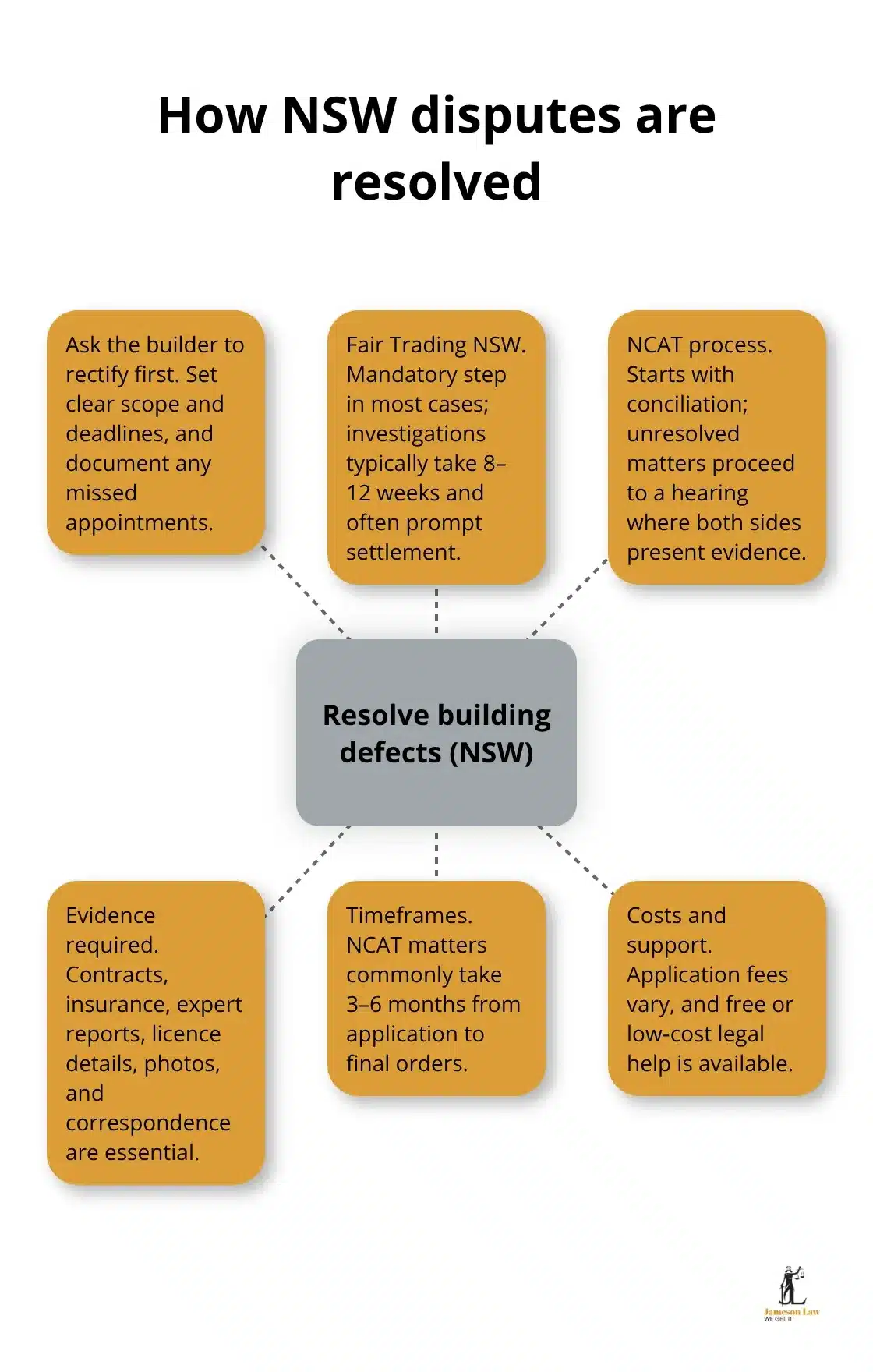
Most home building matters start with conciliation, and many settle at this stage without a contested hearing. If conciliation fails, your case proceeds to a formal hearing where both parties present evidence. You can represent yourself at NCAT without a lawyer, though complex cases benefit from legal representation.

Visual map of pathways to fix building defects or claim compensation in NSW - building defects nsw

NCAT cannot provide legal advice, but you can access free or low-cost legal help through Legal Aid NSW or community legal centres.

The entire NCAT process typically takes 3 to 6 months from application to final order, depending on hearing availability and case complexity. NCAT orders are binding and enforceable, meaning the builder must comply or face enforcement action by NCAT.

Final Thoughts

Building defects in NSW carry real financial and safety consequences, but NSW law gives you concrete pathways to recover compensation or force rectification. Your statutory warranties under the Home Building Act 1989 protect you for six years on major defects and two years on other defects, regardless of whether you’re the original owner or a subsequent buyer. The builder cannot contract out of these obligations, meaning your rights remain absolute.

Document defects immediately with photos and written descriptions, then notify the builder in writing within six months of discovery via registered mail or email with read receipt. Gather professional building reports because expert assessment carries far more weight than your observations alone, and if the builder refuses to rectify or respond, lodge a complaint with Fair Trading NSW, which investigates at no cost and often prompts settlement. Most building defects NSW homeowners face settle before reaching NCAT because builders want to avoid formal enforcement action and the reputational damage it brings.

Your evidence determines your success, so invest time in documentation from day one and keep every photo, email, inspection report, and piece of correspondence with the builder. If you’re facing building disputes or need guidance on your legal options, we at Jameson Law provide building dispute services to help you navigate the process and protect your rights. The resources available through Fair Trading NSW and NCAT are free, but professional legal advice ensures you don’t miss critical deadlines or weaken your claim through procedural errors.

Speak to an Expert Lawyer today

Laywers-Jameson-Law-The-best-law-firm-in-Sydney- Sydney Lawyers - Sydney
BOOK NOW

WE'RE IN IT TO WIN IT

Book your consultation

Book Now
Book Now Mobile 06 02 2025

This form submission is encrypted and secured to ensure your information remains confidential.

What our Clients

Related Publications:

What our clients say

.

Jameson Law - Voted the Best Law firm in Sydney Award

Legal Answers ... In Short

We're here to help

Our mission is to ensure our client matters are resolved successfully every time. Success to us does not simply involve winning, but moreover ensuring we take the most feasible, economic and stress-free path to help our clients achieve their goals. We fight hard for our clients, and always go by the motto: we’re in it to win it.

Jameson Law - Best Law Firm in Sydney

WE'RE IN IT TO WIN IT

Book your consultation

Call us now on (02) 8806 0866 or fill out the form below

Book Now Mobile

This form submission is encrypted and secured to ensure your information remains confidential.

WE'RE IN IT TO WIN IT

Book your consultation

Book Now Mobile 06 02 2025
lock

This form submission is encrypted and secured to ensure your information remains confidential.

Our Sydney Offices

Offices Parramatta and Sydney Jameson Law
Parramatta CBD - Head Office
jameson Law - Blacktown
jameson Law - Liverpool Office
Jameson Law - Bankstown
Court Houses We Frequent Jameson Law

Court Houses We Frequent

Balmain Local Court

Registry: Monday to Friday, 9:00am to 4:30pm

Bankstown Local Court

Court Operating Hours: 9:30am-4:30pm

Blacktown Local Court

Registry Hours: 9:00 – 4:30
Telephone Hours: 8:30 -4:30
Days open: Mon-Fri

Burwood Local Court

Registry Hours: 9:00 – 4:30
Telephone Hours: 8:30 – 4:30
Days open: Mon – Fri

Campbell Local Court

Registry Hours: 9:00 – 4:30
Telephone Hours: 8:30 – 4:30
Days open: Mon – Fri

Central Local Court

Registry Hours: 9:00 – 1:00 and 2:00 – 4:30
Telephone Hours: 8:30 – 4:30

Downing Local Court

Registry Hours: 9:00 – 1:00 and 2:00 – 4:30
Telephone Hours: 8:30 – 4:30

Wollongong Local Court

Registry Hours: 9:00 – 1:00 and 2:00 – 4:30
Telephone Hours: 8:30 – 4:30

Fairfield Local Court

Registry Hours: 9:00 – 1:00 and 2:00 – 4:30
Telephone Hours: 8:30 – 4:30

Hornsby Local Court

Registry Hours: 9:00 – 1:00 and 2:00 – 4:30
Telephone Hours: 8:30 – 4:30

Liverpool Local Court

Registry Hours: 9:00 – 1:00 and 2:00 – 4:30
Telephone Hours: 8:30 – 4:30

Manly Local Court

Registry Hours: 9:00 – 1:00 and 2:00 – 4:30
Telephone Hours: 8:30 – 4:30

Newtown Local Court

Registry Hours: 9:00 – 1:00 and 2:00 – 4:30
Telephone Hours: 8:30 – 4:30

Parramatta Local Court

Registry Hours: 9:00 – 1:00 and 2:00 – 4:30
Telephone Hours: 8:30 – 4:30

Penrith Local Court

Registry Hours: 9:00 – 1:00 and 2:00 – 4:30
Telephone Hours: 8:30 – 4:30

Sutherland Local Court

Registry Hours: 9:00 – 1:00 and 2:00 – 4:30
Telephone Hours: 8:30 – 4:30

Waverley Local Court

Registry Hours: 9:00 – 1:00 and 2:00 – 4:30
Telephone Hours: 8:30 – 4:30

Windsor Local Court

Registry Hours: 9:00 – 1:00 and 2:00 – 4:30
Telephone Hours: 8:30 – 4:30

Wollongong Local Court

Registry Hours: 9:00 – 1:00 and 2:00 – 4:30
Telephone Hours: 8:30 – 4:30

Downing Centre District Court

Registry Hours: 9:00 – 4:30
Telephone Hours: 8:30 – 4:30
Days open: Mon – Fri

Parramatta District Court

Registry Hours: 9:00 – 4:30
Days open: Mon-Fri

Penrith District Court

Registry Hours: 9:00 – 4:30
Days open: Mon-Fri

Campbelltown District Court

Registry Hours: 9:00 – 4:30
Days open: Mon – Fri

Liverpool District Court

Registry Hours: 9:00 – 4:30
Days open: Mon – Fri

Wollongong District Court

Registry Hours: 9:00 – 1:00 and 2:00 – 4:30
Telephone Hours: 8:30 – 4:30

Supreme Court New South Wales

Registry Hours: 9:00 AM – 4:30 PM
Telephone Hours: 8:30 AM – 4:30 PM
Days Open: Monday to Friday

Federal Circuit and Family Court of Australia

Registry Hours: 9:00 AM – 4:30 PM
Telephone Hours: 8:30 AM – 5:00 PM
Days Open: Monday to Friday

Federal Court

Monday to Friday, 8:30 AM – 4:30 PM

High Court

Monday to Friday, 8:30 AM – 5:00 PM

Children’s Court of New South Wales

Registry Hours: 9:00 AM – 4:30 PM
Telephone Hours: 8:30 AM – 4:30 PM
Days Open: Monday to Friday

Coroner’s Court New South Wales

Registry Hours: 9:00 AM – 4:30 PM
Telephone Hours: 8:30 AM – 4:30 PM
Days Open: Monday to Friday

Industrial Relations Commission of New South Wales

Registry Hours: 9:00 AM – 4:30 PM
Telephone Hours: 8:30 AM – 4:30 PM
Days Open: Monday to Friday

Land and Environment Court of New South Wales

Registry Hours: 9:00 AM – 4:30 PM
Telephone Hours: 8:30 AM – 4:30 PM
Days Open: Monday to Friday

WE'RE IN IT TO WIN IT

Book your consultation

Book Now
Book Now Mobile 06 02 2025
lock

This form submission is encrypted and secured to ensure your information remains confidential.