Family law orders need to be accurate. When a court order contains errors-whether a typo, missing information, or procedural mistake-the slip rule offers a way to fix them without starting over.
At Jameson Law, we help clients navigate slip rule applications in family law cases. This guide walks you through identifying errors, filing corrections, and understanding when this remedy applies to your situation.
What the Slip Rule Actually Does
Rule 10.13 of the Federal Circuit and Family Court of Australia Rules 2021 gives courts the power to correct orders after they’re made, but only for specific types of errors. The slip rule allows courts to correct accidental errors, such as clerical mistakes or omissions, in orders without requiring a lengthy appeal. It does not offer a second chance to argue your case or change the judge’s decision.
A misspelled name, a wrong date, or a missing clause that both parties agree was supposed to be there-these qualify for correction. Changing custody arrangements, parenting time, or property division does not. The distinction matters because courts are functus officio after making final orders, meaning they’ve exhausted their power to decide the case. The slip rule operates within a narrow window to correct the written record without reopening the merits.
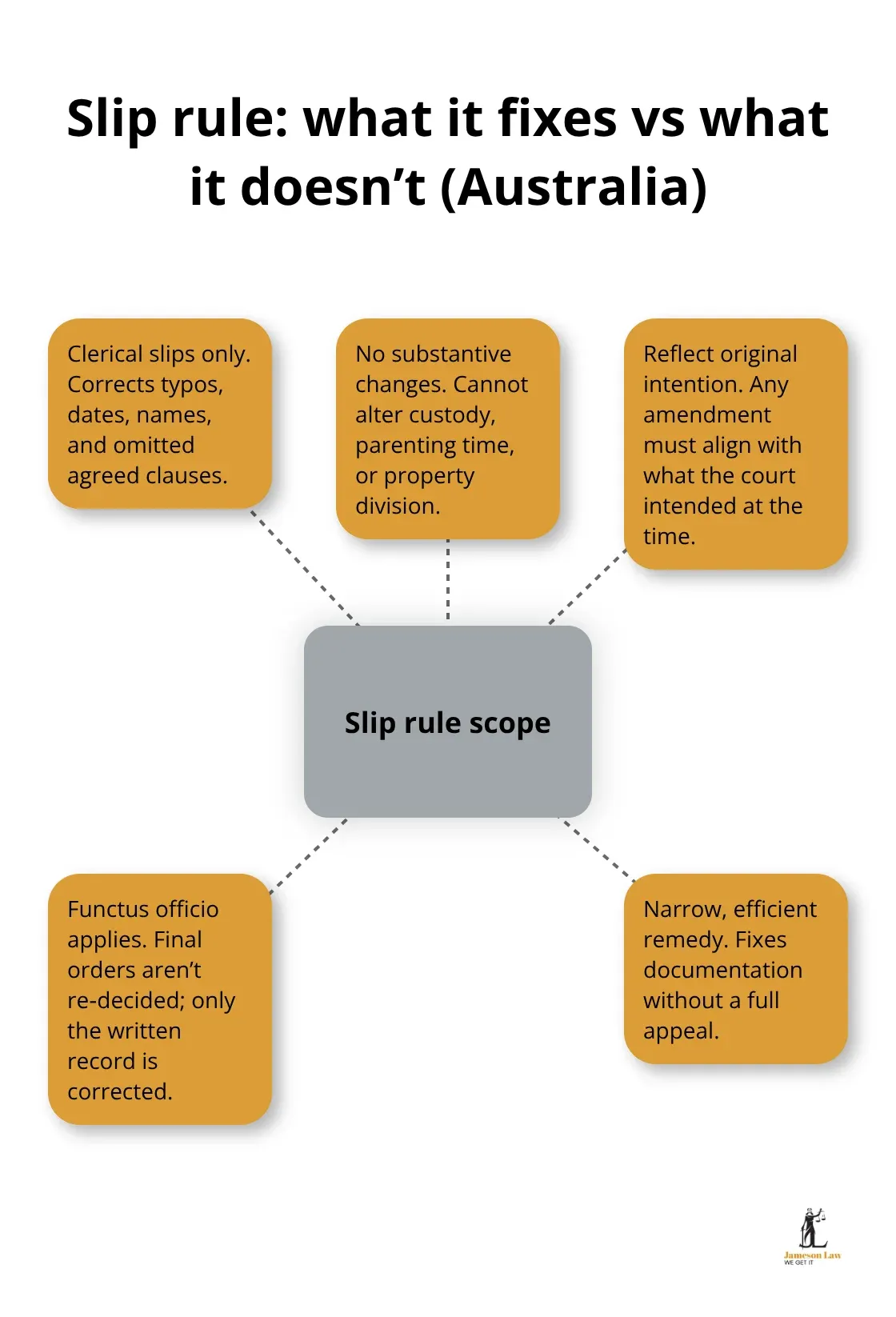
Two recent Federal Circuit and Family Court decisions-Aubert & Cranmore (No 3) [2024] FedCFamC1F 810 and Meadis & Evenson [2024] FedCFamC1F 836-confirm that slip rule applications remain a practical tool for post-judgment corrections. The key test comes from Pawley v Pawley (2017), which established that the slip rule can be applied only where the proposed amendment reflects the court’s original intention without changing the real effect of the order. If your proposed correction would alter rights, obligations, or outcomes, it’s not a slip rule matter.
Clerical errors versus substantive changes
Courts take a strict approach to what qualifies. Misspelled names, incorrect dates, transposed numbers in dollar amounts, and missing superannuation details all qualify for correction. However, if you want to shift parenting schedules, relocation terms, or property settlement figures, the slip rule won’t help. The difference between a clerical mistake and a substantive change is whether the correction affects the legal rights or obligations of the parties.
In family law property settlements, the slip rule can fix mistakes in how the order is worded without altering the settlement’s substantive terms. If both parties agree the error exists and what the correction should be, the process moves faster-often decided by a registrar without a formal hearing.
When disagreement arises
If disagreement exists about whether something is truly a clerical slip, you’ll need to prepare submissions showing that no real difference of opinion exists about the intended amendment. This is where the Pawley test becomes practical: you must show the court that the correction simply gives effect to what was already decided, rather than changing the decision itself. The court will assess whether the proposed amendment reflects a true slip with no substantive difference in outcome.
Understanding these boundaries helps you determine whether the slip rule applies to your situation or whether you need to pursue other remedies.
What Errors Qualify for Slip Rule Correction
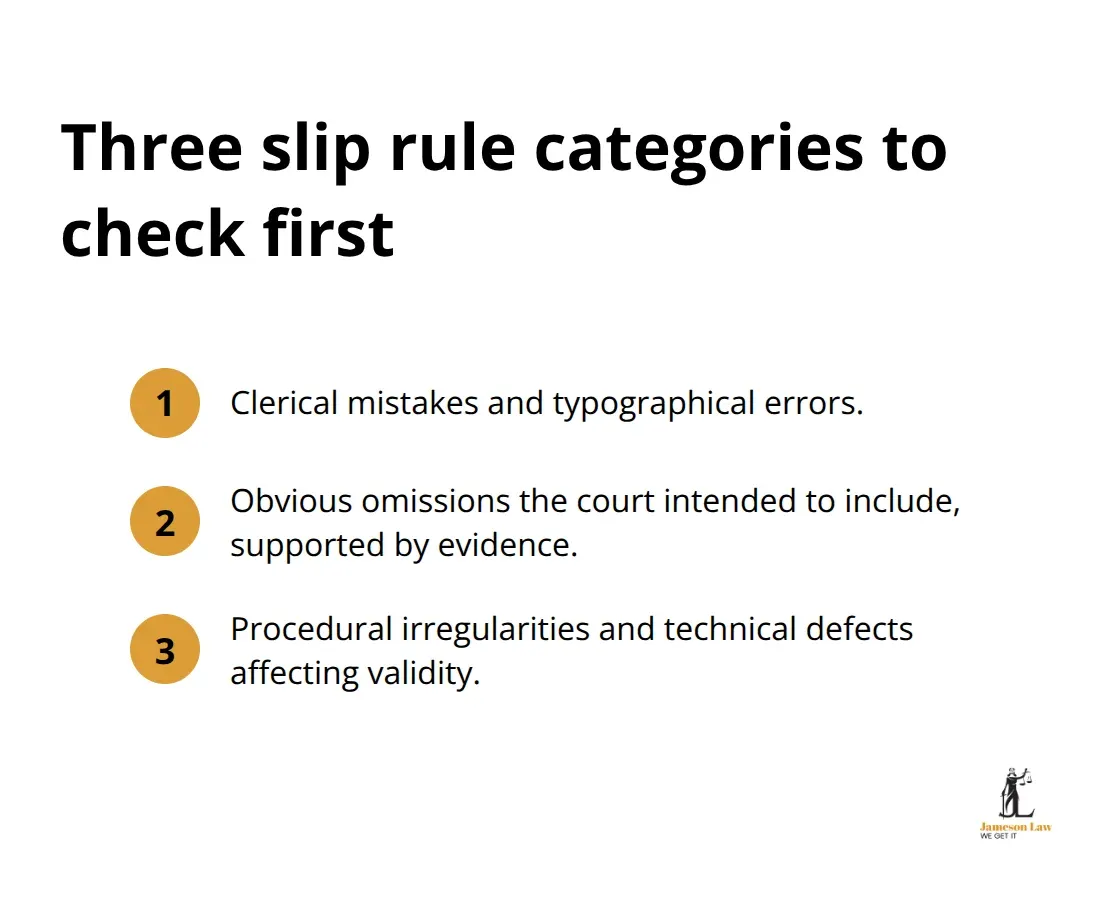
The slip rule exists to fix genuine mistakes, not to revisit decisions you wish had gone differently. The types of errors that qualify fall into three distinct categories, and understanding which category your error belongs to determines whether the slip rule will actually work for you.
Clerical mistakes and typographical errors
Misspelled party names, transposed numbers in dollar amounts, incorrect dates, and missing superannuation account details all qualify for correction under the slip rule. These corrections are straightforward because they don’t change what the court decided-they simply make the written order match what was actually intended. If a judge ordered you to pay $150,000 in property settlement but the order states $15,000, that’s a clerical error the slip rule handles efficiently. Similarly, if your child’s middle name was spelled wrong or a date of birth contains a transposition, these corrections proceed without difficulty. Registrars often approve these without requiring a hearing, and a clerical correction typically takes weeks rather than months.
Obvious omissions in court orders
Obvious omissions present a different situation. If the court made an order about parenting arrangements but failed to include a clause about school holiday arrangements that both parties agreed should be there, the slip rule can apply-but only if you can demonstrate the court intended to include it in the original judgment. This requires evidence. Transcripts from the hearing, the judge’s reasons, or correspondence between parties showing agreement all strengthen your position. The distinction matters because courts won’t use the slip rule to add terms that were never discussed or decided.
Procedural irregularities and technical defects
Procedural irregularities and technical defects form the third category, though they appear less often in family law than in commercial litigation. Missing signatures, incorrect case references, or formatting errors that affect the order’s validity all fall here. These corrections are necessary because an order with a procedural defect may be unenforceable. Before filing any slip rule application, you must be certain your error falls into one of these categories and that correcting it won’t alter the substantive outcome.
Determining whether your situation qualifies
If you’re uncertain whether your situation qualifies, that uncertainty itself signals the need to seek professional advice before investing time in an application that courts may reject. The next section walks you through the practical steps to identify errors in your family law order and prepare an application that courts will actually consider.
How to Build Your Slip Rule Application
Obtain and review the exact court order
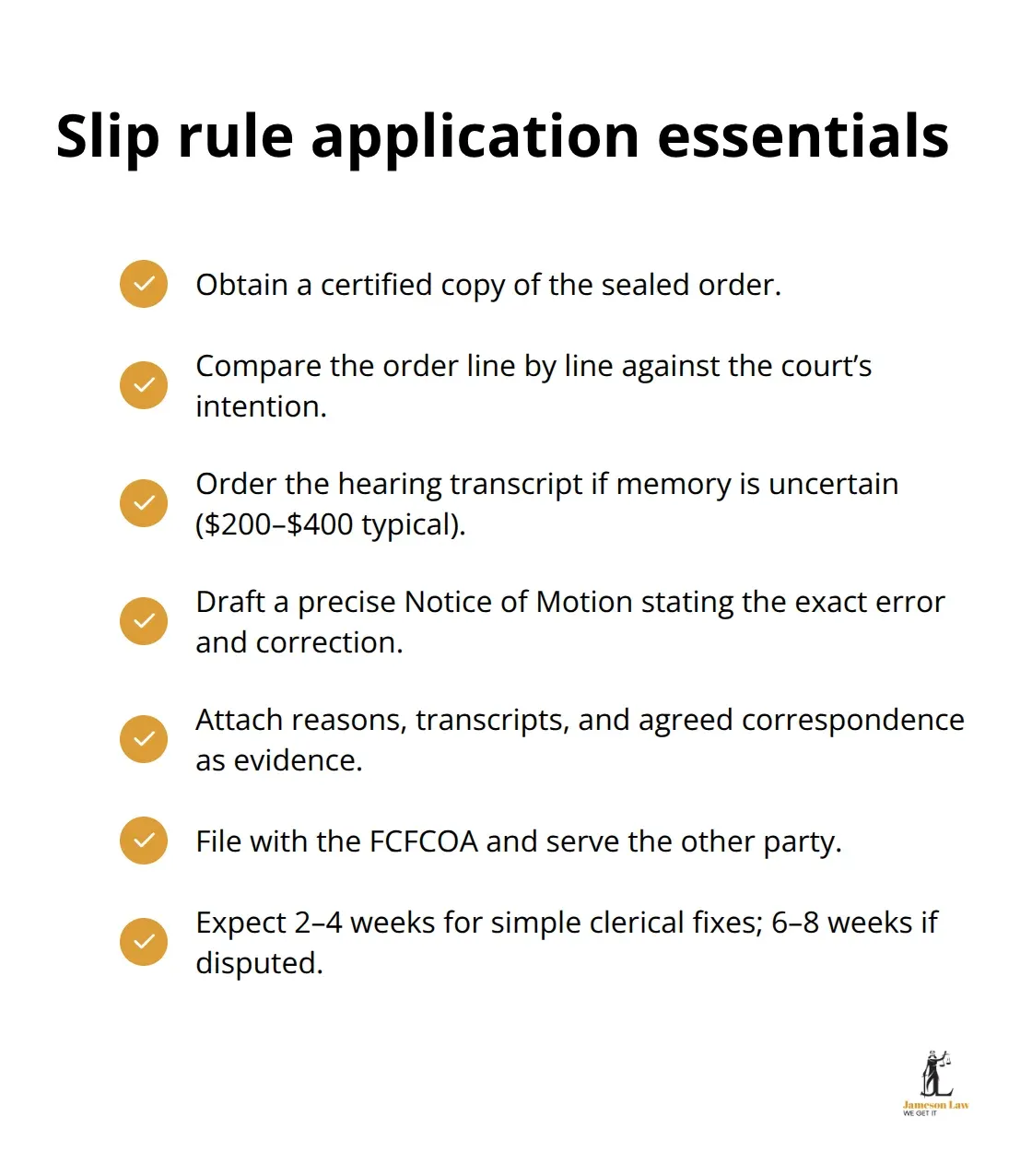
Start with a certified copy of the order you need to correct. Many people attempt slip rule applications without the exact document in front of them, which leads to rejected applications or corrections that miss the actual problem. Request this from the court registry or your solicitor if you don’t have it. Once you have the order, read it line by line against what you believe the court actually intended. Most errors emerge during this careful comparison. Check names, dates, dollar amounts, case references, and any clauses that should have been included.
If you’re working from memory about what was discussed in court, obtain the hearing transcript instead. Transcripts cost between $200 and $400 from court reporting services, but they provide the evidence you’ll need if the other party disputes whether your proposed correction truly reflects the judge’s intention. Without documentary proof, courts won’t accept your version of what was decided.
Prepare your Notice of Motion with precision
Once you’ve identified the specific error, prepare a Notice of Motion that clearly states what needs correcting and why. Include the exact wording of the error and the exact wording of your proposed correction. Many applications fail because they’re vague about what the problem actually is. Don’t write that the order states the wrong amount; instead write that the order states $15,000 when the judgment clearly stated $150,000 in the judge’s reasons.
Attach copies of supporting documents that prove the error exists and your correction reflects the court’s original intention. This might include the judge’s written reasons, hearing transcripts, or correspondence where both parties agreed on the term that was omitted. These documents form the backbone of your application.
File your application and manage the timeline
File your application with the Federal Circuit and Family Court of Australia, ensuring the other party receives notice. Most registrars decide straightforward clerical corrections within two to four weeks without requiring a hearing. If the other party objects or the registrar needs clarification, additional submissions may be requested, which can extend the timeline to six to eight weeks.
Courts rarely make slip rule corrections without evidence, so invest the time in gathering documentation before filing rather than hoping the registrar will accept your word about what was intended. The strength of your supporting materials directly affects how quickly the court processes your application and whether it succeeds at all.
Final Thoughts
The slip rule in family law corrects genuine mistakes without reopening settled disputes. If your court order contains a clerical error, an obvious omission, or a procedural defect, this remedy offers a straightforward path to correction faster than an appeal. The process demands precision: identify the exact error, gather supporting documentation, and file a Notice of Motion that clearly shows your proposed correction reflects the court’s original intention.
Most clerical corrections proceed within two to four weeks when the error is straightforward and both parties agree. Even when disagreement exists, the slip rule remains faster than alternative remedies. An uncorrected error in your order can create ongoing confusion, enforcement difficulties, or unintended consequences that affect your life significantly.
If you’ve identified an error in your family law order and you’re unsure whether the slip rule applies, contact Jameson Law to discuss your situation. Our family law team can assess whether your error qualifies for slip rule correction in family law, help you gather the necessary evidence, and prepare an application that courts will approve.