Australia’s sponsorship visa programs offer pathways for skilled workers to build careers abroad, but navigating sponsorship visa Australia requirements demands precision and planning.
At Jameson Law, we’ve guided hundreds of applicants through these processes. The three main visa categories-Temporary Skill Shortage, Employer Nomination Scheme, and Skilled Independent Regional-each have distinct requirements for health, character, and documentation.
This guide walks you through every step so you can submit a strong application.
Which Sponsorship Visa Fits Your Situation
Understanding the Three Main Visa Categories
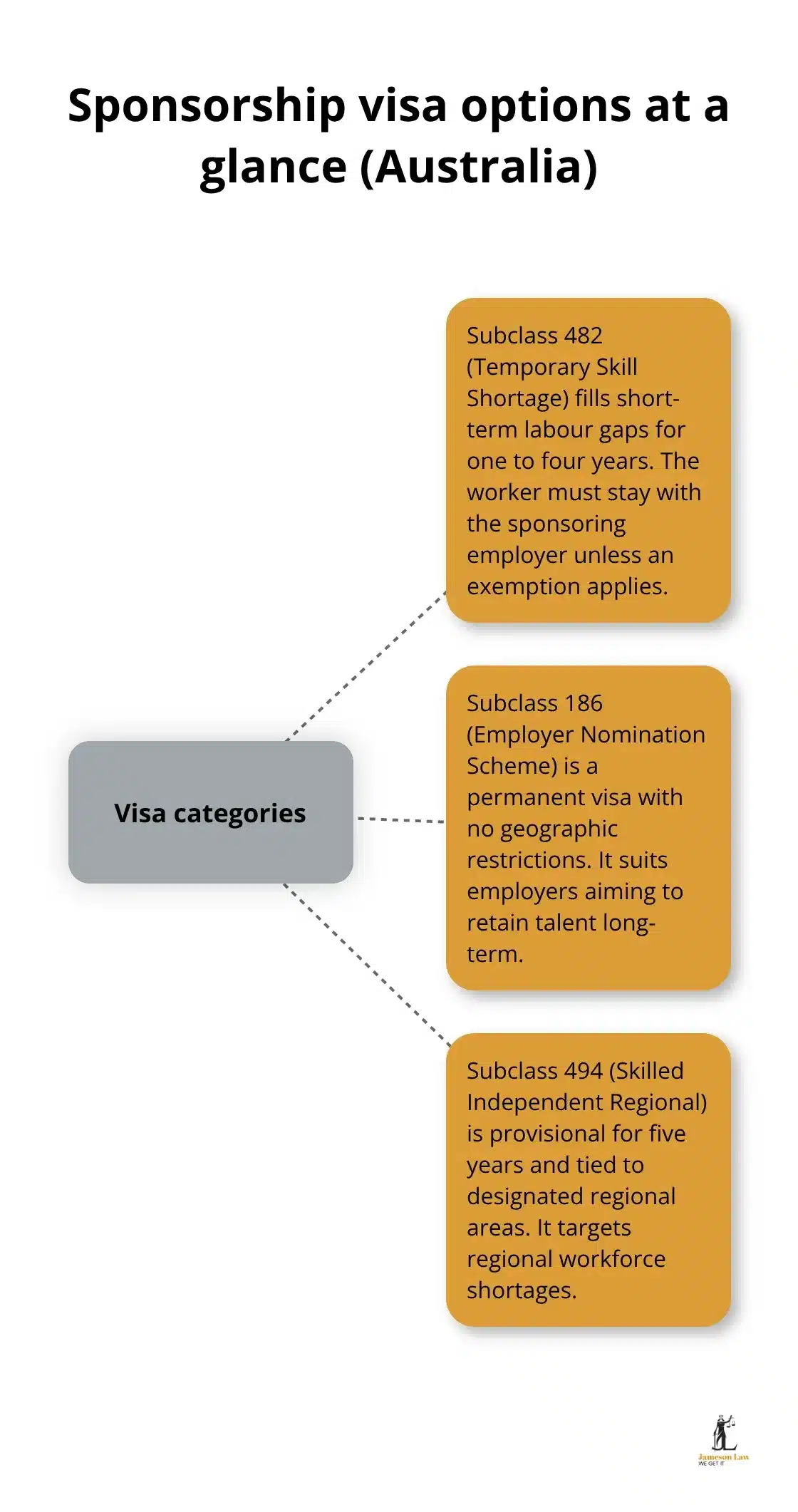
Australia’s Department of Home Affairs quarterly reports on temporary resident skilled visas reveal which pathways dominate the sponsorship landscape. As of 30 June 2025, the most recent snapshot shows that employers sponsor workers across three distinct visa categories, each with fundamentally different eligibility rules and employment conditions. The Temporary Skill Shortage visa (subclass 482) operates as a temporary pathway lasting one to four years, and the worker must remain with the sponsoring employer unless an exemption applies. The Employer Nomination Scheme (subclass 186) is a permanent visa with no geographic restrictions, meaning the worker can live and work anywhere in Australia once approved. The Skilled Independent Regional visa (subclass 494) differs significantly because it is provisional rather than permanent, lasting five years, and the nominated position must be in a designated regional area to qualify.
Subclass 482: Temporary Skill Shortage Visa
The Temporary Skill Shortage visa comes in multiple streams, with the Specialist Skills stream available for occupations in ANZSCO major groups 1, 2, 4, 5, and 6. A specific provision for Hong Kong visa holders extends stay up to five years if they have 12 months of work experience in the nominated occupation or a related field. Subclass 482 suits short-term labour gaps and processes faster than permanent options, but the worker’s mobility remains restricted to the sponsoring employer.
Subclass 186: Employer Nomination Scheme Visa
This visa includes a Temporary Residence Transition stream designed for existing skilled visa holders who have worked for the sponsoring employer for at least two years. It also offers a Direct Entry stream that requires skills assessment unless exempt, plus any licensing or registration your occupation demands. Subclass 186 is the choice when you want to retain a skilled worker permanently and offer them genuine career progression in Australia, and Direct Entry processes faster if your occupation does not require skills assessment.
Subclass 494: Skilled Independent Regional Visa
Employers often overlook the geographic requirement for this visa, which means verifying that your job location qualifies as regional is non-negotiable before investing time in the application. Subclass 494 makes financial sense for regional employers because it addresses labour shortages in areas outside major cities, though the provisional nature means the worker must transition to permanent residency after five years if they wish to stay longer.
Selecting Your Visa Category
The Department of Home Affairs provides resources to help determine which visa suits your circumstances, but the practical reality is that your choice hinges on three factors: how long you need the worker, whether you require geographic flexibility, and your budget for the application process. Identify your visa category early because every subsequent step-from documentation to assessment requirements-flows directly from this decision. The official Department of Home Affairs website contains occupation lists and regional area definitions that are updated regularly, so verify these before you commit to a specific pathway. Your visa selection determines which health, character, and security requirements apply to your application.
Health, Character and Security Checks
Medical Examination Requirements
Health requirements form the first major hurdle in any sponsorship visa application, and the Department of Home Affairs applies consistent standards across all three visa categories. You must undergo a medical examination by an Australian-approved panel doctor, not your local GP, which means locating an accredited panel doctor in your area is your first practical step. The examination covers chest X-rays, blood tests, and a full medical history review to screen for conditions that pose a public health or safety risk to Australia. Processing times for health assessments typically range from two to four weeks after your panel doctor submits results to the department, so plan this into your overall timeline. If the department requests additional health information or specialist reports, delays can extend to eight weeks or longer, making early medical appointments essential rather than something to defer until the final stages of your application.

Character Assessment and Police Certificates
Character assessment scrutinises your criminal history, financial conduct, and immigration compliance across all countries where you have lived for more than three months in the past ten years. The department obtains police certificates from relevant jurisdictions, and this is where delays most commonly occur because overseas police services operate on their own timelines, sometimes taking three to six months to issue certificates. Providing accurate information about any criminal convictions, traffic offences, or visa cancellations is non-negotiable because dishonesty at this stage results in automatic refusal and potential bans on future applications.
Security Clearance Assessment
Security clearance assessment happens concurrently with character assessment and focuses on whether you pose a risk to Australian national security or community safety. The practical reality is that most skilled workers pass health and character checks without issue, but any gaps in documentation or inconsistencies between your application and official records can trigger requests for further evidence that add weeks to processing.
Timeline Management and Documentation
Starting your police certificate applications immediately after you commit to a visa pathway prevents this from becoming your bottleneck, particularly if you have worked or studied overseas in countries with slower administrative systems. Coordinating your medical examination, police certificate requests, and security clearance submissions in parallel (rather than sequentially) significantly reduces your overall processing time. Once you have submitted your health, character, and security documentation, the Department of Home Affairs moves your application toward the documentation and application phase, where you will compile the evidence that supports your nomination and demonstrates your eligibility for your chosen visa category.
Compiling Your Evidence and Submitting Your Application
Gathering Documentation for Your Visa Category
Documentation makes or breaks your sponsorship visa application. The Department of Home Affairs rejects applications with missing or incomplete evidence far more often than they reject applications on eligibility grounds. Your documentation must directly address the specific requirements of your chosen visa category, which is why visa selection in the previous stage matters so critically.
For subclass 482, you need occupation nomination evidence, proof that the position is genuinely skilled, salary documentation showing compliance with the minimum rates published by the department, and work experience records demonstrating your qualifications. For subclass 186, the requirements shift toward skills assessment results (unless your occupation is exempt), employment history showing at least two years with the sponsor if you apply through the Temporary Residence Transition stream, and evidence of your ability to perform the nominated role. For subclass 494, regional designation proof for your job location is non-negotiable, alongside the same employment and skills assessment evidence as subclass 186.
Start collecting these documents immediately after your visa category decision because overseas document verification, skills assessments, and occupation licensing can take eight to twelve weeks. Rushing this phase introduces errors that delay processing. The Department of Home Affairs website publishes checklists specific to each visa subclass, and these checklists form your baseline, not your ceiling. Applicants who exceed these requirements with additional supporting evidence (such as referee reports from previous employers, performance reviews, or detailed role descriptions) strengthen their cases considerably.
Completing Your Visa Application Form
The actual visa application form demands precision because inconsistencies between your form responses and your supporting documents trigger requests for clarification that add four to eight weeks to processing times. Complete the form section by section, referring constantly to your evidence rather than relying on memory. Ensure dates, job titles, and salary figures match exactly across all documents.
Inaccuracies at this stage create unnecessary complications. A single mismatched date or job title can prompt the Department of Home Affairs to request clarification, which extends your timeline significantly. Take time to cross-reference every detail before you submit.
Lodging Your Application Through ImmiAccount
Lodging your application through ImmiAccount portal, the official Department of Home Affairs portal, is straightforward, but applicants commonly make mistakes by uploading documents in unsupported formats, submitting documents with poor image quality that cannot be read by departmental staff, or failing to clearly label documents so the case officer cannot identify what each file represents.
Upload documents in PDF format where possible. Ensure scans are clear and legible. Name each file descriptively (for example, Employment_Contract_2023-2024 rather than Document1).
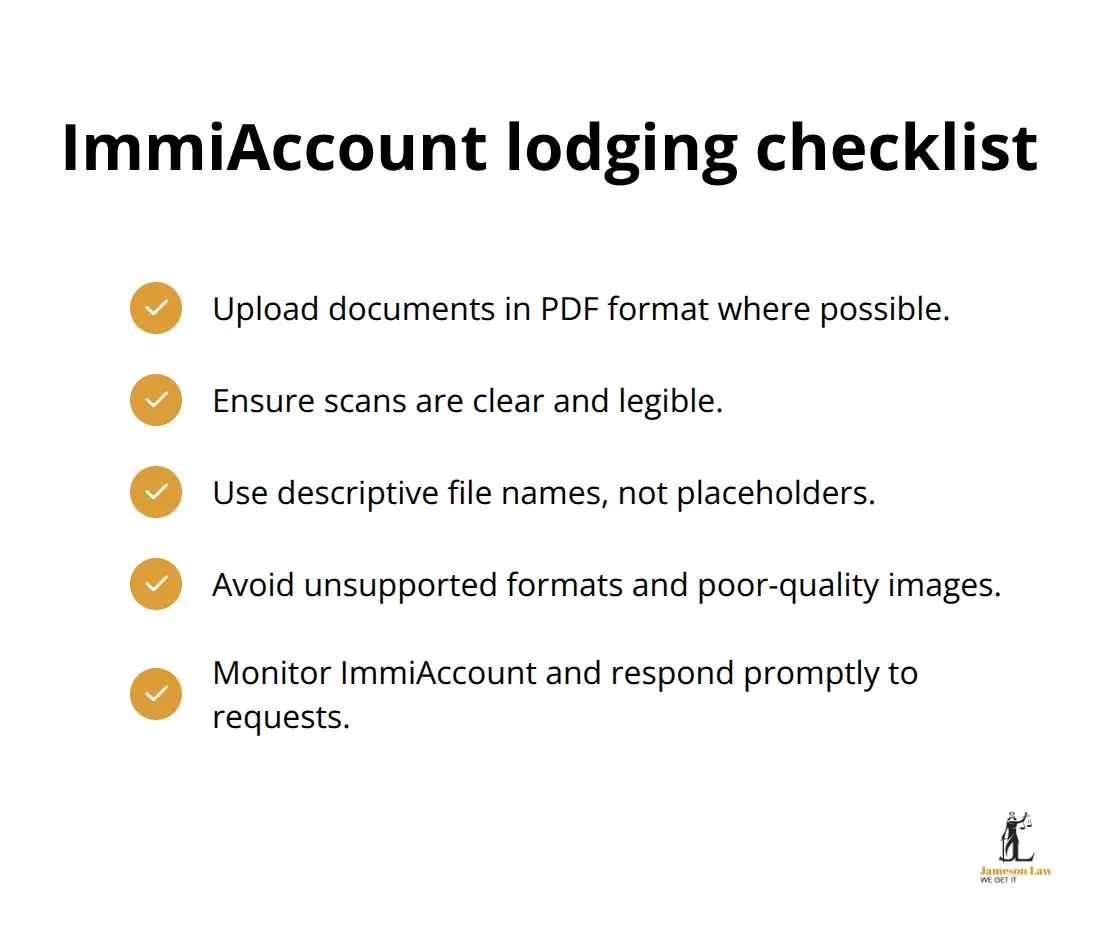
Poor file naming forces case officers to open multiple documents to identify what they contain, which slows processing and increases the risk of missing evidence.
Once you lodge your application, the Department of Home Affairs sends a receipt with your application ID and expected processing timeframe. Straightforward cases typically process within four to eight weeks, but processing extends significantly if the department requests additional information. Monitor your ImmiAccount regularly to respond promptly to any requests for further evidence. Delayed responses prevent unnecessary extensions that commonly stretch processing to twelve weeks or beyond.
Final Thoughts
Sponsorship visa Australia requirements demand attention to detail across three critical areas: visa category selection, health and character assessment, and documentation quality. The pathway you choose determines everything that follows, so verify your visa category against the Department of Home Affairs resources before committing time and resources to your application. Most rejections stem not from ineligibility but from incomplete documentation, mismatched information across forms and supporting evidence, or delays in obtaining police certificates and medical assessments from overseas jurisdictions.
Common mistakes cost applicants weeks of processing time. Uploading documents in unsupported formats, providing poor-quality scans that case officers cannot read, and failing to label files descriptively force departmental staff to spend extra time identifying what each document contains. Inconsistencies between your application form and your supporting documents trigger clarification requests that extend processing significantly, while starting your police certificate applications and medical examinations early prevents these from becoming your bottleneck (particularly if you have lived or worked overseas).
If your application faces complications, you receive a request for further information, or you need guidance on visa conditions after approval, Jameson Law can provide the support you need. Our team understands the complexities of sponsorship visa applications and can help you navigate every requirement the Department of Home Affairs demands. Contact us to discuss your sponsorship visa situation.