PUBLICATION

Part VIIIB Family Law Act Explained

"Understand Part VIIIB Family Law Act with clear guidance on property settlement and superannuation splitting. Get practical insights for your situation."
Part VIIIB Family Law Act Explained

Part VIIIB of the Family Law Act governs specific enforcement procedures that many families encounter during legal disputes. This section addresses how courts handle violations of family law orders and the remedies available.

We at Jameson Law regularly guide clients through these complex procedural requirements. Understanding Part VIIIB can help you navigate enforcement actions more effectively.

What Does Part VIIIB Actually Cover?

Part VIIIB of the Family Law Act 1975 addresses enforcement mechanisms when family law orders face breaches. This section provides courts with specific powers to deal with non-compliance, from financial penalties to imprisonment. The Australian Institute of Family Studies (AIFS) reports that many separated parents experience difficulties with order compliance.

Enforcement Powers Available to Courts

Courts can impose various sanctions under Part VIIIB including fines. Prison sentences can extend to 12 months for serious breaches. The Federal Circuit and Family Court of Australia processes numerous enforcement applications annually, with property settlement breaches representing a significant portion.

Courts also possess authority to order compensation, asset seizure, and community service. The legislation specifically targets wilful disobedience rather than inability to comply due to changed circumstances.

Visual summary of court enforcement powers available under Part VIIIB in Australia - part viiib family law act

Key Differences From Other Family Law Provisions

Unlike Parts VII and VIIIAB which focus on establishing orders and agreements, Part VIIIB operates purely as an enforcement mechanism. This section bypasses the need for fresh legal proceedings when existing orders face violations. Enforcement applications are typically resolved more quickly than property settlements.

Types of Breaches Commonly Addressed

Property settlement violations account for the largest category of Part VIIIB applications. Child support non-compliance follows closely, particularly when parents deliberately hide assets. Parenting order breaches also trigger enforcement action, especially when one parent consistently denies access.

How Do You Start Part VIIIB Enforcement Proceedings?

Part VIIIB enforcement proceedings demand precise documentation and strict adherence to court procedures. The Federal Circuit and Family Court requires specific forms, including supporting affidavits detailing the breach.

Required Documentation and Filing Procedures

Applications must include copies of the original orders, evidence of service, and documentation proving the breach. Filing fees vary, though fee waivers apply for hardship. Proper documentation significantly improves the likelihood of successful enforcement.

Court Processing Times and Response Requirements

Court processing times vary based on complexity. Respondents generally have 14 days to file their response. Many enforcement applications are resolved through consent orders before reaching a final hearing. Emergency applications for urgent breaches can receive expedited consideration.
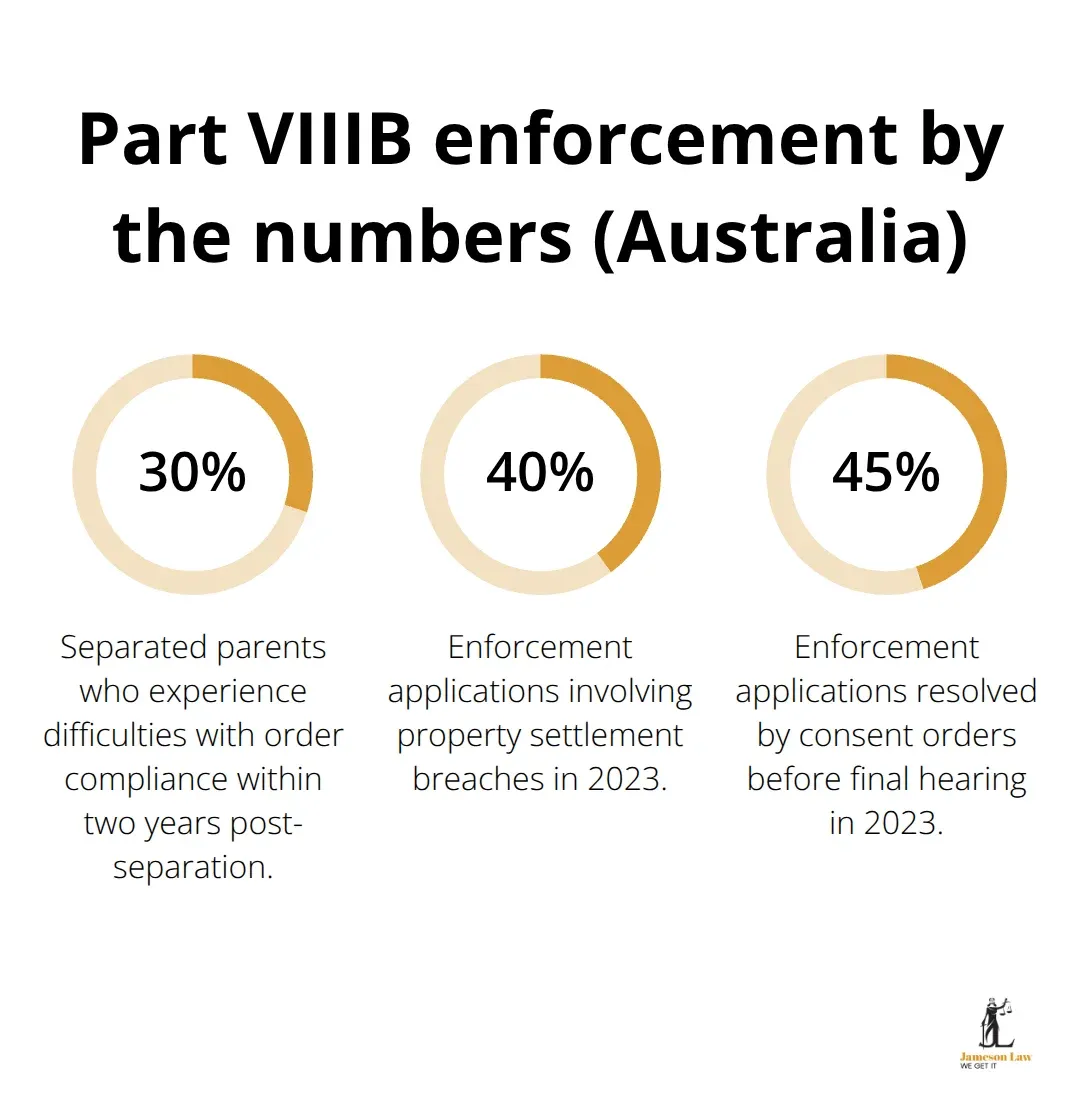
Key percentages on Australian family law enforcement under Part VIIIB

Legal Representation Considerations

Self-represented parties often face lower success rates compared to those with legal representation. Courts provide duty lawyer services, but they cannot provide ongoing representation. Legal advice is essential when dealing with complex asset structures or interstate enforcement.

Which Enforcement Challenges Matter Most?

Asset Concealment and Transfer Violations

Courts treat asset concealment as serious contempt. Successful enforcement often requires forensic accounting evidence to trace hidden assets. Freezing orders can prevent further asset disposal while enforcement proceedings continue.

Child Support Non-Compliance Patterns

Paying parents may fall behind on payments. Courts can impose wage garnishment, deducting payments directly from income. Prison sentences may apply when parents deliberately reduce income to avoid payments.

Parenting Order Violations and Remedies

Parenting order breaches, such as denial of contact, are common. Courts may order compensatory time for first-time breaches. Repeated violations can trigger more severe consequences, including changes to custody arrangements.
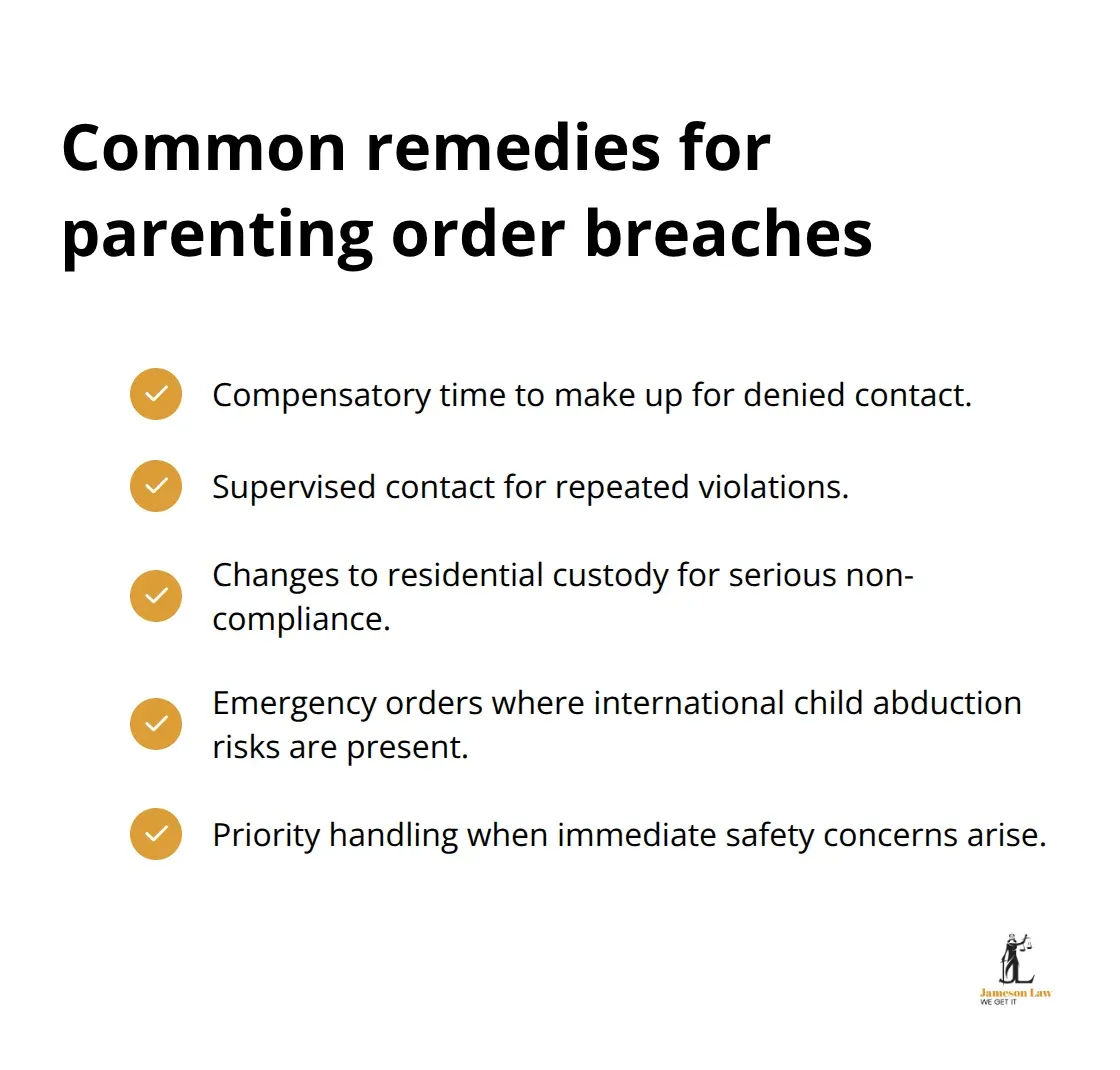
Checklist of typical remedies Australian courts use for parenting order violations - part viiib family law act

Final Thoughts

Part VIIIB of the Family Law Act provides courts with powerful enforcement tools. Courts impose penalties, prison sentences, and asset seizure orders to address non-compliance. These mechanisms protect families from deliberate breaches.

Property settlement breaches and parenting order violations require swift legal intervention. Professional legal advice becomes essential when you face enforcement proceedings. We at Jameson Law help clients navigate these complex procedures.

Contact Jameson Law today to discuss your enforcement options and protect your legal rights.

Speak to an Expert Lawyer today

Laywers-Jameson-Law-The-best-law-firm-in-Sydney- Sydney Lawyers - Sydney
BOOK NOW

WE'RE IN IT TO WIN IT

Book your consultation

Book Now
Book Now Mobile 06 02 2025

This form submission is encrypted and secured to ensure your information remains confidential.

What our Clients

Related Publications:

What our clients say

.

Jameson Law - Voted the Best Law firm in Sydney Award

Legal Answers ... In Short

We're here to help

Our mission is to ensure our client matters are resolved successfully every time. Success to us does not simply involve winning, but moreover ensuring we take the most feasible, economic and stress-free path to help our clients achieve their goals. We fight hard for our clients, and always go by the motto: we’re in it to win it.

Jameson Law - Best Law Firm in Sydney

WE'RE IN IT TO WIN IT

Book your consultation

Call us now on (02) 8806 0866 or fill out the form below

Book Now Mobile

This form submission is encrypted and secured to ensure your information remains confidential.

WE'RE IN IT TO WIN IT

Book your consultation

Book Now Mobile 06 02 2025
lock

This form submission is encrypted and secured to ensure your information remains confidential.

Our Sydney Offices

Offices Parramatta and Sydney Jameson Law
Parramatta CBD - Head Office
jameson Law - Blacktown
jameson Law - Liverpool Office
Jameson Law - Bankstown
Court Houses We Frequent Jameson Law

Court Houses We Frequent

Balmain Local Court

Registry: Monday to Friday, 9:00am to 4:30pm

Bankstown Local Court

Court Operating Hours: 9:30am-4:30pm

Blacktown Local Court

Registry Hours: 9:00 – 4:30
Telephone Hours: 8:30 -4:30
Days open: Mon-Fri

Burwood Local Court

Registry Hours: 9:00 – 4:30
Telephone Hours: 8:30 – 4:30
Days open: Mon – Fri

Campbell Local Court

Registry Hours: 9:00 – 4:30
Telephone Hours: 8:30 – 4:30
Days open: Mon – Fri

Central Local Court

Registry Hours: 9:00 – 1:00 and 2:00 – 4:30
Telephone Hours: 8:30 – 4:30

Downing Local Court

Registry Hours: 9:00 – 1:00 and 2:00 – 4:30
Telephone Hours: 8:30 – 4:30

Wollongong Local Court

Registry Hours: 9:00 – 1:00 and 2:00 – 4:30
Telephone Hours: 8:30 – 4:30

Fairfield Local Court

Registry Hours: 9:00 – 1:00 and 2:00 – 4:30
Telephone Hours: 8:30 – 4:30

Hornsby Local Court

Registry Hours: 9:00 – 1:00 and 2:00 – 4:30
Telephone Hours: 8:30 – 4:30

Liverpool Local Court

Registry Hours: 9:00 – 1:00 and 2:00 – 4:30
Telephone Hours: 8:30 – 4:30

Manly Local Court

Registry Hours: 9:00 – 1:00 and 2:00 – 4:30
Telephone Hours: 8:30 – 4:30

Newtown Local Court

Registry Hours: 9:00 – 1:00 and 2:00 – 4:30
Telephone Hours: 8:30 – 4:30

Parramatta Local Court

Registry Hours: 9:00 – 1:00 and 2:00 – 4:30
Telephone Hours: 8:30 – 4:30

Penrith Local Court

Registry Hours: 9:00 – 1:00 and 2:00 – 4:30
Telephone Hours: 8:30 – 4:30

Sutherland Local Court

Registry Hours: 9:00 – 1:00 and 2:00 – 4:30
Telephone Hours: 8:30 – 4:30

Waverley Local Court

Registry Hours: 9:00 – 1:00 and 2:00 – 4:30
Telephone Hours: 8:30 – 4:30

Windsor Local Court

Registry Hours: 9:00 – 1:00 and 2:00 – 4:30
Telephone Hours: 8:30 – 4:30

Wollongong Local Court

Registry Hours: 9:00 – 1:00 and 2:00 – 4:30
Telephone Hours: 8:30 – 4:30

Downing Centre District Court

Registry Hours: 9:00 – 4:30
Telephone Hours: 8:30 – 4:30
Days open: Mon – Fri

Parramatta District Court

Registry Hours: 9:00 – 4:30
Days open: Mon-Fri

Penrith District Court

Registry Hours: 9:00 – 4:30
Days open: Mon-Fri

Campbelltown District Court

Registry Hours: 9:00 – 4:30
Days open: Mon – Fri

Liverpool District Court

Registry Hours: 9:00 – 4:30
Days open: Mon – Fri

Wollongong District Court

Registry Hours: 9:00 – 1:00 and 2:00 – 4:30
Telephone Hours: 8:30 – 4:30

Supreme Court New South Wales

Registry Hours: 9:00 AM – 4:30 PM
Telephone Hours: 8:30 AM – 4:30 PM
Days Open: Monday to Friday

Federal Circuit and Family Court of Australia

Registry Hours: 9:00 AM – 4:30 PM
Telephone Hours: 8:30 AM – 5:00 PM
Days Open: Monday to Friday

Federal Court

Monday to Friday, 8:30 AM – 4:30 PM

High Court

Monday to Friday, 8:30 AM – 5:00 PM

Children’s Court of New South Wales

Registry Hours: 9:00 AM – 4:30 PM
Telephone Hours: 8:30 AM – 4:30 PM
Days Open: Monday to Friday

Coroner’s Court New South Wales

Registry Hours: 9:00 AM – 4:30 PM
Telephone Hours: 8:30 AM – 4:30 PM
Days Open: Monday to Friday

Industrial Relations Commission of New South Wales

Registry Hours: 9:00 AM – 4:30 PM
Telephone Hours: 8:30 AM – 4:30 PM
Days Open: Monday to Friday

Land and Environment Court of New South Wales

Registry Hours: 9:00 AM – 4:30 PM
Telephone Hours: 8:30 AM – 4:30 PM
Days Open: Monday to Friday

WE'RE IN IT TO WIN IT

Book your consultation

Book Now
Book Now Mobile 06 02 2025
lock

This form submission is encrypted and secured to ensure your information remains confidential.