PUBLICATION

How to Navigate Conveyancing Sale of Land Regulation 2010

"Navigate the Conveyancing Sale of Land Regulation 2010 with our step-by-step guide to compliance and best practices."
How to Navigate Conveyancing Sale of Land Regulation 2010

Selling or buying property in Australia requires strict compliance with the Conveyancing Sale of Land Regulation 2010. This regulation sets out mandatory requirements that protect both buyers and sellers throughout the transaction process.

At Jameson Law, we’ve seen countless property deals delayed or complicated because parties didn’t understand their obligations under this regulation. This guide walks you through the key requirements, common mistakes, and practical steps to keep your conveyancing on track.

What the Regulation Actually Covers

The Conveyancing Sale of Land Regulation 2010 commenced on 1 September 2010 in NSW and fundamentally changed how property transactions work. It replaced the 2005 Regulation and introduced stricter vendor disclosure requirements that directly affect what documents must attach to every contract for sale. The regulation applies to all residential and commercial property sales in NSW, with very few exceptions. The core purpose is straightforward: vendors must disclose material information upfront so buyers can make informed decisions before committing money. This isn’t theoretical protection-it gives purchasers the legal right to rescind contracts if vendors fail to attach required documents or breach prescribed warranties, and you can recover your deposit if you rescind.

Documents You Must Attach to the Contract

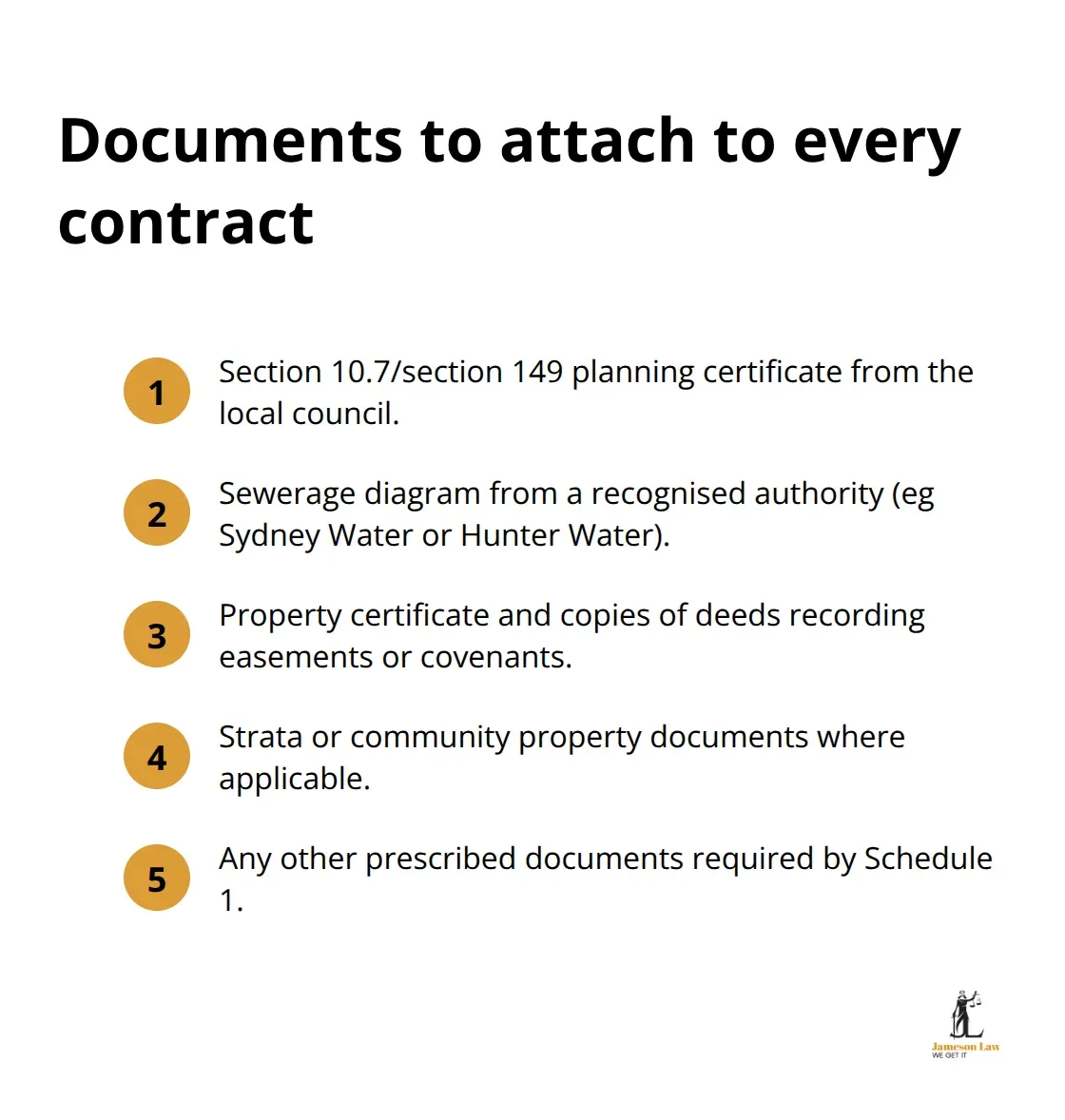
Schedule 1 of the Regulation requires vendors to attach specific prescribed documents to every contract. These include a section 149 certificate from the local council reflecting the true environmental planning status of the land, a diagram from a recognised sewerage authority like Sydney Water Corporation or Hunter Water Corporation showing sewer locations in relation to the property, a property certificate, copies of any deeds recording easements or covenants, and strata or community property documents where applicable.

List of prescribed documents vendors must attach to the contract

If any of these documents are missing, the purchaser can rescind the contract within 14 days of exchange without losing the deposit. Transactions often stall because vendors haven’t obtained the sewerage diagram or the section 149 certificate early enough. The sewerage diagram matters because it shows whether a sewer line crosses your property-if it does and you later damage it during construction, you could face significant liability. Attaching these documents to the contract prevents disputes and keeps settlements on schedule.

Vendor Warranties Under Schedule 3

Vendors must warrant under Schedule 3 that the land isn’t subject to adverse affectations, that no sewer belonging to a recognised authority affects the property without disclosure, and that the section 149 certificate accurately reflects the land’s true status. Adverse affectations are defined by the regulation and include scenarios where government actions or orders may affect the property. If a vendor breaches these warranties and you discover the breach before completion, you can rescind the contract before settlement occurs. After completion, your remedies become limited, so due diligence before exchange matters. The regulation lists these affectations explicitly so there’s no ambiguity about what counts-this protects buyers from inheriting hidden government or infrastructure liabilities that could restrict how they use or develop the property.

What Happens When Documents Go Missing

The consequences of missing documents are real and immediate. A purchaser who discovers that a vendor failed to attach required documents can issue written notice to rescind within 14 days after the contract is made. The vendor must then refund the purchaser’s deposit and any other money paid. This rescission right exists precisely because vendors control access to these documents-they hold the council records, they contact the sewerage authority, and they gather the deeds. When vendors skip these steps, purchasers shouldn’t bear the cost. The regulation shifts responsibility to the party best positioned to obtain the information, which is why the attachment requirement sits at the front of every transaction.

Understanding these core requirements sets the foundation for navigating the rest of the conveyancing process. The next section examines the specific timelines and procedural steps that both vendors and purchasers must follow to stay compliant.

What You Must Do Before Exchange

Obtaining Council and Sewerage Documents

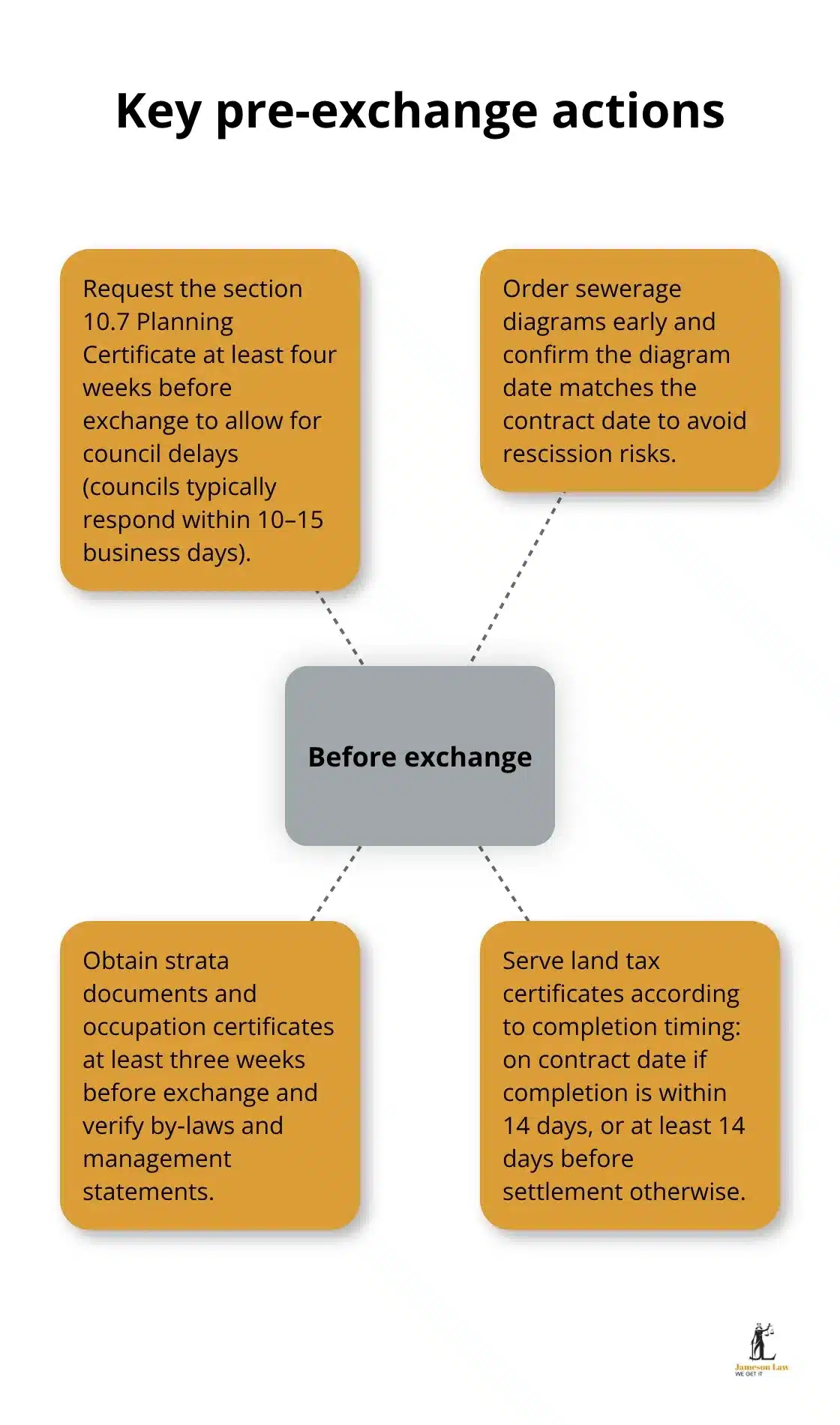
Vendors and purchasers operate under strict timelines that leave little room for error. The section 10.7 Planning Certificate (previously known as a Section 149 Certificate) from your local council must reflect the true environmental planning status of the land, and obtaining it takes time-councils typically respond within 10 to 15 business days, though some take longer.

Hub-and-spoke chart showing actions to complete before exchanging contracts - conveyancing sale of land regulation 2010

You cannot attach a stale certificate to the contract; it must be current as of the contract date. Sewerage diagrams from Sydney Water Corporation or Hunter Water Corporation follow similar delays. Start requesting these documents at least three weeks before you plan to exchange contracts.

The land tax certificate presents another timing trap: if completion occurs within 14 days of the contract, you must serve a current land tax certificate on the contract date itself. If completion is more than 14 days away, you must serve it at least 14 days before settlement. Missing this deadline gives the purchaser grounds to rescind.

Managing Strata and Occupation Certificates

Strata schemes add complexity because vendors must attach the by-laws, management statements, and any development contracts affecting the property. For off-the-plan purchases, vendors must provide occupation certificates before completion, confirming the building is ready for occupation. These aren’t suggestions-they’re mandatory under the Regulation, and breaching them costs money through deposit forfeitures and rescission rights.

Transactions often stall because parties underestimate how long document collection takes. Start early and track every deadline in writing.

The Conveyancer’s Role in Compliance

Conveyancers shoulder responsibility for coordinating these documents and verifying compliance, though vendors ultimately bear liability for missing attachments. A conveyancer’s role is to verify the contract contains all prescribed documents before exchange, to confirm the section 10.7 Planning Certificate matches the property’s true status, and to verify that vendor warranties are accurate.

If you’re a purchaser, don’t assume your conveyancer will catch everything-review the attached documents yourself and compare them against the property you inspected. Check the section 10.7 Planning Certificate for any adverse affectations listed, confirm the sewerage diagrams show no sewer line crossing your property unless you’re prepared for that liability, and verify strata information matches what the real estate agent disclosed.

Understanding Rescission and Cooling-Off Rights

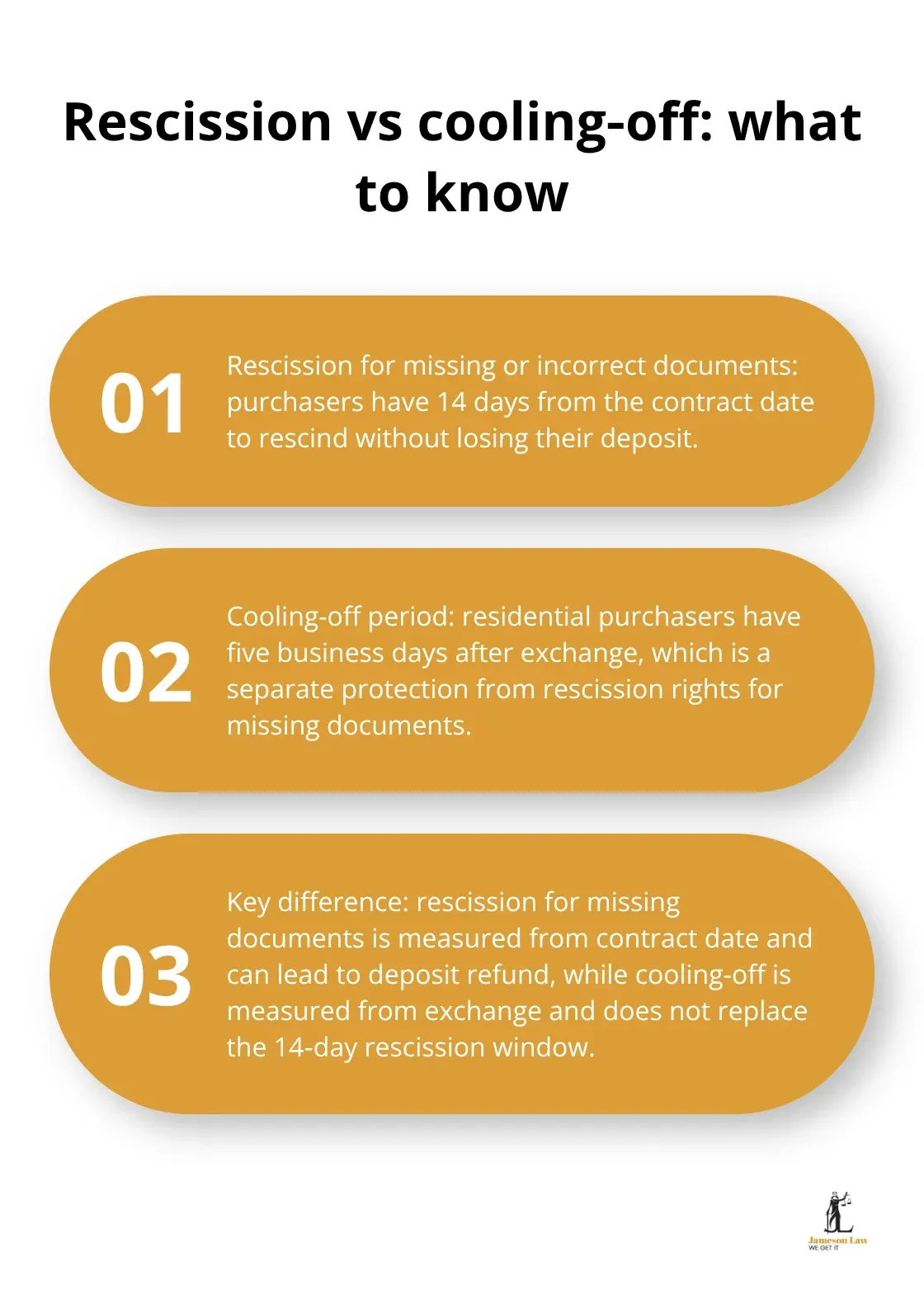
If documents are missing or inaccurate at exchange, you have 14 days to rescind without losing your deposit, but after that window closes, your options narrow significantly. The cooling-off period for residential contracts is five business days after exchange, which is separate from your rescission rights for missing documents.

Three key points distinguishing rescission rights for missing documents and the cooling-off period - conveyancing sale of land regulation 2010

Purchasers often confuse these two rights and lose the opportunity to rescind because they think the cooling-off period applies. It doesn’t-rescission for missing documents has its own 14-day window measured from contract date, not exchange date.

Understanding these timing requirements and rescission mechanics positions you to act decisively if problems emerge. The next section examines the specific pitfalls that derail transactions and the practical steps to avoid them.

Where Conveyancing Deals Fall Apart

The gap between what vendors think they’ve done and what the Regulation actually requires destroys more transactions than any other factor. Most conveyancing collapses occur because parties misunderstood the documentation requirements or missed critical deadlines by days. The section 10.7 Planning Certificate sits at the heart of most failures. Vendors assume they can attach any certificate issued within the past six months, but the Regulation demands a current certificate that reflects the true status on the contract date. Councils change planning overlays, heritage listings appear, and environmental restrictions activate without warning. If your certificate is stale by even one day and a purchaser discovers a new adverse affectation listed on a fresh certificate, that purchaser can rescind and recover the deposit.

Timing Traps with Planning and Sewerage Documents

This happens because vendors contact councils too late in the transaction or fail to refresh certificates after receiving an initial response. Sewerage diagrams present an identical trap. Sydney Water Corporation and Hunter Water Corporation can take time to issue diagrams, yet vendors often request them just days before exchange. When the diagram arrives after contracts are exchanged, purchasers have legitimate grounds to rescind. The sewerage authority won’t backdate a diagram to the contract date, and purchasers shouldn’t accept outdated sewerage information. Start requesting both the section 10.7 Planning Certificate and sewerage diagrams at least four weeks before your planned exchange date. This buffer absorbs council delays and allows time to address any adverse affectations or sewerage issues that emerge on the certificate.

Land Tax Certificates and Completion Dates

Land tax certificates create a different problem because timing depends on the completion date. If you complete within 14 days of the contract, the land tax certificate must be served on the contract date itself-not before, not after. If completion is more than 14 days away, you must serve it at least 14 days before settlement. Conveyancers sometimes misread the completion date and serve the certificate on the wrong day, which derails transactions. Your conveyancer must flag this deadline in writing and confirm the certificate is current.

Strata Documentation and Body Corporate Records

Strata information compounds these issues because missing by-laws, management statements, or development contracts give purchasers rescission rights, and strata schemes often change their documentation without warning. Request strata documents directly from the body corporate at least three weeks before exchange-don’t rely on the vendor to obtain them. This direct approach prevents delays caused by slow vendor responses or miscommunication between parties.

Understanding Adverse Affectations Before Exchange

Inadequate due diligence on the section 10.7 Planning Certificate itself causes post-settlement disputes that could have been prevented. Purchasers must read the certificate carefully and compare listed adverse affectations against the property’s intended use. If the certificate shows the property is in a heritage conservation area and you plan to renovate, that’s material information that affects your decision. If it shows a proposed road realignment or rail project, that directly impacts future value. Too many purchasers glance at the certificate without understanding what the listed matters actually mean for their specific circumstances. Engage your conveyancer to explain every item on the certificate and confirm those items align with your plans for the property before you exchange. This single step prevents most post-settlement regrets driven by adverse affectations that were disclosed but not properly understood.

Final Thoughts

The Conveyancing Sale of Land Regulation 2010 protects both buyers and sellers by enforcing transparency and accountability throughout property transactions. Vendors must disclose material information upfront, purchasers must conduct thorough due diligence before exchange, and both parties must meet strict deadlines for document collection and service. Missing a single required document or misunderstanding a timing requirement can derail months of negotiation and cost thousands in lost deposits or legal fees.

Conveyancing demands precision at every stage. Start requesting your section 10.7 Planning Certificate and sewerage diagrams at least four weeks before exchange, verify that every document attached to the contract is current and accurate, and read adverse affectations on planning certificates carefully to confirm they align with your intended use of the property. Understand the difference between cooling-off rights and rescission rights for missing documents, because confusing these two protections costs purchasers their legal remedies. Track every deadline in writing and confirm completion dates early so land tax certificates are served on the correct day.

Professional conveyancing assistance matters because conveyancers coordinate these moving parts and verify compliance before exchange occurs. Contact Jameson Law to discuss your conveyancing requirements and start with professional guidance that prevents costly delays and protects your interests throughout the transaction.

Speak to an Expert Lawyer today

Laywers-Jameson-Law-The-best-law-firm-in-Sydney- Sydney Lawyers - Sydney
BOOK NOW

WE'RE IN IT TO WIN IT

Book your consultation

Book Now
Book Now Mobile 06 02 2025

This form submission is encrypted and secured to ensure your information remains confidential.

What our Clients

Related Publications:

What our clients say

.

Jameson Law - Voted the Best Law firm in Sydney Award

Legal Answers ... In Short

We're here to help

Our mission is to ensure our client matters are resolved successfully every time. Success to us does not simply involve winning, but moreover ensuring we take the most feasible, economic and stress-free path to help our clients achieve their goals. We fight hard for our clients, and always go by the motto: we’re in it to win it.

Jameson Law - Best Law Firm in Sydney

WE'RE IN IT TO WIN IT

Book your consultation

Call us now on (02) 8806 0866 or fill out the form below

Book Now Mobile

This form submission is encrypted and secured to ensure your information remains confidential.

WE'RE IN IT TO WIN IT

Book your consultation

Book Now Mobile 06 02 2025
lock

This form submission is encrypted and secured to ensure your information remains confidential.

Our Sydney Offices

Offices Parramatta and Sydney Jameson Law
Parramatta CBD - Head Office
jameson Law - Blacktown
jameson Law - Liverpool Office
Jameson Law - Bankstown
Court Houses We Frequent Jameson Law

Court Houses We Frequent

Balmain Local Court

Registry: Monday to Friday, 9:00am to 4:30pm

Bankstown Local Court

Court Operating Hours: 9:30am-4:30pm

Blacktown Local Court

Registry Hours: 9:00 – 4:30
Telephone Hours: 8:30 -4:30
Days open: Mon-Fri

Burwood Local Court

Registry Hours: 9:00 – 4:30
Telephone Hours: 8:30 – 4:30
Days open: Mon – Fri

Campbell Local Court

Registry Hours: 9:00 – 4:30
Telephone Hours: 8:30 – 4:30
Days open: Mon – Fri

Central Local Court

Registry Hours: 9:00 – 1:00 and 2:00 – 4:30
Telephone Hours: 8:30 – 4:30

Downing Local Court

Registry Hours: 9:00 – 1:00 and 2:00 – 4:30
Telephone Hours: 8:30 – 4:30

Wollongong Local Court

Registry Hours: 9:00 – 1:00 and 2:00 – 4:30
Telephone Hours: 8:30 – 4:30

Fairfield Local Court

Registry Hours: 9:00 – 1:00 and 2:00 – 4:30
Telephone Hours: 8:30 – 4:30

Hornsby Local Court

Registry Hours: 9:00 – 1:00 and 2:00 – 4:30
Telephone Hours: 8:30 – 4:30

Liverpool Local Court

Registry Hours: 9:00 – 1:00 and 2:00 – 4:30
Telephone Hours: 8:30 – 4:30

Manly Local Court

Registry Hours: 9:00 – 1:00 and 2:00 – 4:30
Telephone Hours: 8:30 – 4:30

Newtown Local Court

Registry Hours: 9:00 – 1:00 and 2:00 – 4:30
Telephone Hours: 8:30 – 4:30

Parramatta Local Court

Registry Hours: 9:00 – 1:00 and 2:00 – 4:30
Telephone Hours: 8:30 – 4:30

Penrith Local Court

Registry Hours: 9:00 – 1:00 and 2:00 – 4:30
Telephone Hours: 8:30 – 4:30

Sutherland Local Court

Registry Hours: 9:00 – 1:00 and 2:00 – 4:30
Telephone Hours: 8:30 – 4:30

Waverley Local Court

Registry Hours: 9:00 – 1:00 and 2:00 – 4:30
Telephone Hours: 8:30 – 4:30

Windsor Local Court

Registry Hours: 9:00 – 1:00 and 2:00 – 4:30
Telephone Hours: 8:30 – 4:30

Wollongong Local Court

Registry Hours: 9:00 – 1:00 and 2:00 – 4:30
Telephone Hours: 8:30 – 4:30

Downing Centre District Court

Registry Hours: 9:00 – 4:30
Telephone Hours: 8:30 – 4:30
Days open: Mon – Fri

Parramatta District Court

Registry Hours: 9:00 – 4:30
Days open: Mon-Fri

Penrith District Court

Registry Hours: 9:00 – 4:30
Days open: Mon-Fri

Campbelltown District Court

Registry Hours: 9:00 – 4:30
Days open: Mon – Fri

Liverpool District Court

Registry Hours: 9:00 – 4:30
Days open: Mon – Fri

Wollongong District Court

Registry Hours: 9:00 – 1:00 and 2:00 – 4:30
Telephone Hours: 8:30 – 4:30

Supreme Court New South Wales

Registry Hours: 9:00 AM – 4:30 PM
Telephone Hours: 8:30 AM – 4:30 PM
Days Open: Monday to Friday

Federal Circuit and Family Court of Australia

Registry Hours: 9:00 AM – 4:30 PM
Telephone Hours: 8:30 AM – 5:00 PM
Days Open: Monday to Friday

Federal Court

Monday to Friday, 8:30 AM – 4:30 PM

High Court

Monday to Friday, 8:30 AM – 5:00 PM

Children’s Court of New South Wales

Registry Hours: 9:00 AM – 4:30 PM
Telephone Hours: 8:30 AM – 4:30 PM
Days Open: Monday to Friday

Coroner’s Court New South Wales

Registry Hours: 9:00 AM – 4:30 PM
Telephone Hours: 8:30 AM – 4:30 PM
Days Open: Monday to Friday

Industrial Relations Commission of New South Wales

Registry Hours: 9:00 AM – 4:30 PM
Telephone Hours: 8:30 AM – 4:30 PM
Days Open: Monday to Friday

Land and Environment Court of New South Wales

Registry Hours: 9:00 AM – 4:30 PM
Telephone Hours: 8:30 AM – 4:30 PM
Days Open: Monday to Friday

WE'RE IN IT TO WIN IT

Book your consultation

Book Now
Book Now Mobile 06 02 2025
lock

This form submission is encrypted and secured to ensure your information remains confidential.