PUBLICATION

How to Navigate Family Law Financial Agreements

"Understand family law financial agreements with practical tips on settlements, support obligations, and protecting your assets."
How to Navigate Family Law Financial Agreements

Family law financial agreements shape how assets, income, and liabilities are divided when relationships change. Getting these agreements right from the start protects both parties and prevents costly disputes later.

At Jameson Law, we’ve seen how proper financial agreements give people clarity and control over their financial future. This guide walks you through the types available, what you need to know, and the steps to get it done properly.

What Financial Agreements Actually Cover

A Financial Agreement under Australian family law isn’t a one-size-fits-all document. It addresses the specific financial matters you and your partner decide to include, which means you have real control over what gets covered and what stays flexible. The agreement can tackle property division, spousal maintenance, superannuation splitting, or just one of these areas depending on your circumstances.

Checklist of key areas a Financial Agreement can include in Australia - family law financial agreements

This flexibility matters because it lets you protect what’s important to you without being forced into arrangements that don’t suit your situation. One party might want the agreement to cover asset division but leave maintenance open, while another might prioritise locking down superannuation treatment. The Family Law Act 1975 sets the framework for marriages under Part VIIIA and de facto relationships under Part VIIIAB, but within that framework, you decide the scope.

What Makes an Agreement Legally Binding

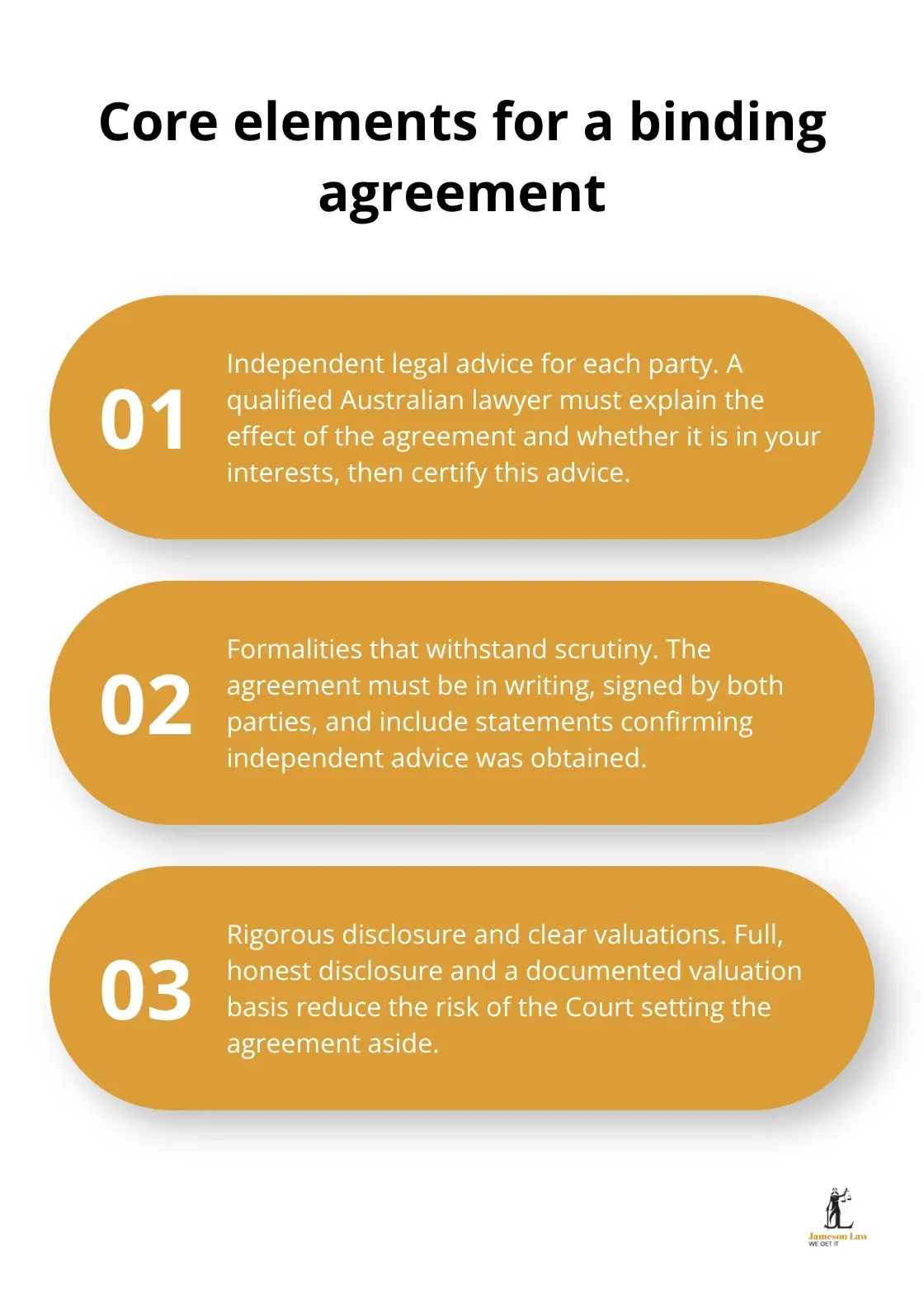
For your agreement to actually hold up in court, it must meet strict technical requirements that most people get wrong without legal guidance. Both parties must receive independent legal advice from an Australian legal practitioner before signing, and that lawyer must certify they’ve covered the prescribed matters with you. The agreement needs to be in writing, signed by both parties, and must contain statements confirming that each person obtained independent advice.

Courts in Australia have set aside poorly drafted agreements because they lacked proper disclosure of financial circumstances or because one party didn’t fully understand what they were agreeing to. The valuation date also matters significantly, especially in volatile markets. If you value assets on different dates or fail to document how you arrived at valuations, the agreement becomes vulnerable to challenge later. The Court can overturn an agreement under section 90K for marriages and section 90UM for de facto relationships if it finds the agreement was unfair or obtained improperly.

Why You Need Professional Help From the Start

Attempting to draft a Financial Agreement without a lawyer typically costs more money later when disputes arise or the agreement needs correction. The independent legal advice requirement isn’t just paperwork-it’s your protection against entering an arrangement that disadvantages you. A lawyer reviews the other party’s financial disclosure, identifies hidden liabilities, checks whether future assets like inheritances are addressed, and flags risks specific to your circumstances.

Three key legal requirements to make a Financial Agreement binding

If your agreement later gets challenged in court, having proper legal documentation of the advice process strengthens your position considerably. A lawyer also ensures you understand the implications of what you’re signing and that both parties have made full, honest disclosure of their financial circumstances. This foundation prevents costly disputes after separation begins.

Moving Forward With Confidence

The type of Financial Agreement you need depends on when you want to enter it and what stage your relationship is at. Before marriage, during the relationship, or after separation-each timing brings different considerations and opportunities to protect your interests.

When to Enter a Financial Agreement

The timing of your Financial Agreement fundamentally changes what you can protect and how you structure the arrangement. Think about this decision early, because the window for action closes quickly once relationships end. If you’re planning to marry, a Financial Agreement before the wedding locks in protections while both parties are still cooperative and motivated to reach fair terms. Section 90B of the Family Law Act allows marriages to enter agreements before the ceremony, giving you a clean slate to address asset protection, business interests, and inheritance treatment without the emotional weight of separation negotiations. Many people wrongly assume prenuptial agreements only apply to the wealthy, but they protect assets, set clear financial expectations, and help couples plan ahead. The key advantage is that you negotiate from a position of goodwill rather than conflict.

Financial Agreements During Your Relationship

During an active relationship, a Financial Agreement under section 90C serves a different purpose entirely. You might enter one when circumstances change significantly, such as one party receiving a substantial inheritance, starting a business, or acquiring investment property. This type of agreement acts as a circuit-breaker, allowing you to formalise how new assets are treated without renegotiating everything you’ve already agreed upon. The practical benefit is clarity, not conflict. If you’ve been together for years without formal arrangements and suddenly face uncertainty around a major asset, a mid-relationship agreement for new assets prevents future disputes by documenting your intentions now. The cost of preparing this agreement is typically far lower than the cost of fighting over undefined asset treatment later.

Post-Separation Agreements and Your Deadline

After separation, you have a two-year window under section 90UD two-year deadline to enter a Financial Agreement, but this window closes faster than most people realise. Courts won’t extend deadlines without compelling reasons, so if you’ve reached an agreement with your former partner, formalising it immediately through a Financial Agreement or consent orders protects both parties and prevents the agreement from unravelling due to changed circumstances or competing legal advice. The sooner you act after separation, the more likely both parties remain aligned on the terms you’ve negotiated. Delays introduce new variables-asset values shift, financial circumstances change, and the motivation to cooperate fades. What seems settled today can become contentious within months if you don’t formalise it properly.

The specific timing you choose determines not only what protections you can include but also how straightforward the negotiation process becomes. Your next step is understanding exactly what financial information you and your partner need to disclose to make any agreement legally sound and fair.

Making Financial Disclosure Work for You

Full financial disclosure is non-negotiable if you want an agreement that actually holds up in court. The Family Law Act requires both parties to disclose everything honestly, and courts take this requirement seriously. When disclosure is incomplete or deliberately hidden, courts use this as grounds to set aside the entire agreement under section 90K for marriages. This isn’t a technicality you can work around.

Gathering and Organising Your Financial Information

You need to collect tax returns for the last two years, recent payslips, bank statements showing the last three months of transactions, superannuation statements from all funds you hold, property valuations, details of any business interests, investment statements, and a list of liabilities including mortgages, car loans, and credit card debts. If you own a business, prepare a detailed breakdown of its assets, annual turnover, and net profit for the last three years. For investment properties, include rental income documentation and expense records.

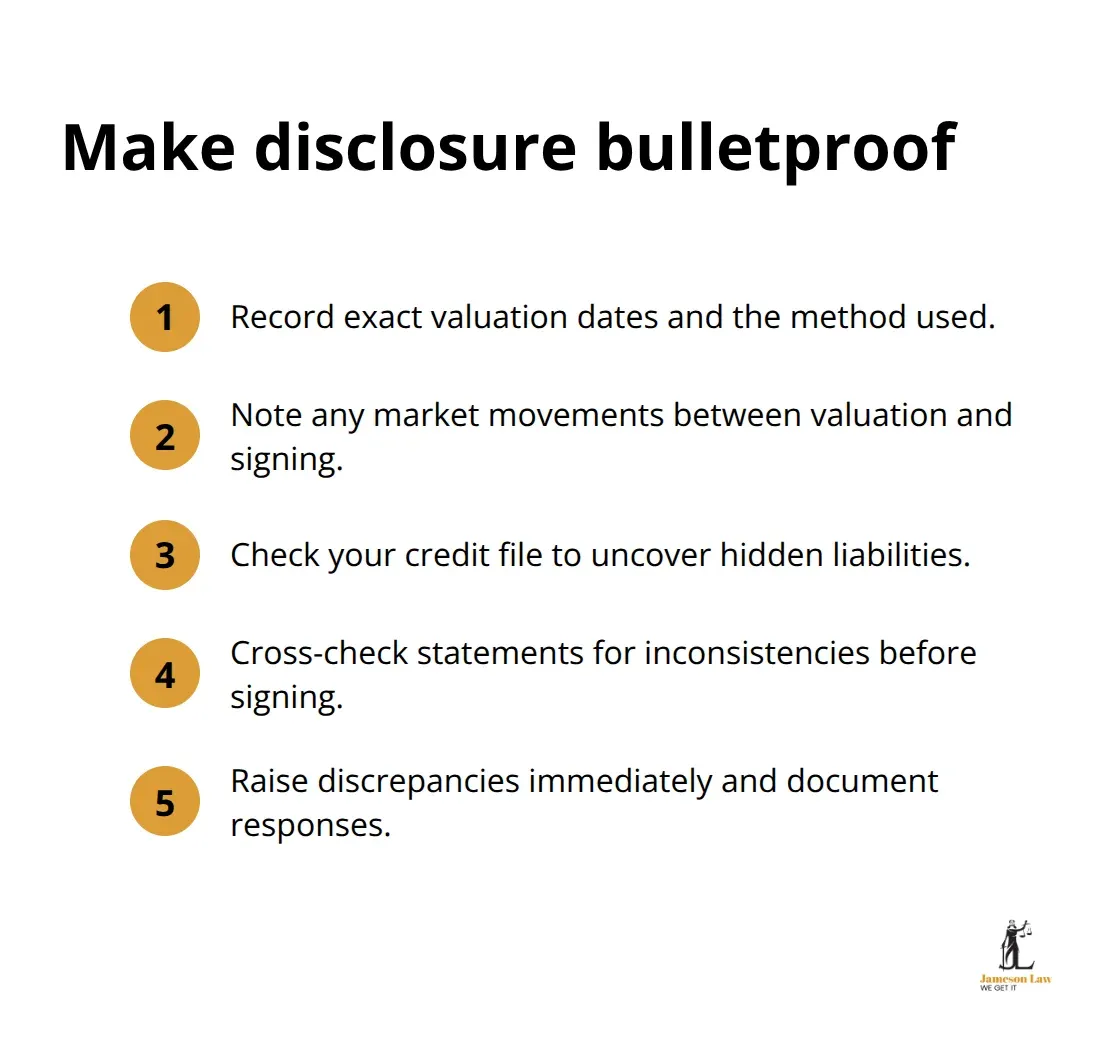
The valuation date matters enormously in volatile markets, so document exactly when you valued each asset and what method you used to arrive at that figure. If markets shifted significantly between valuation and agreement signing, this creates vulnerability later. Many people underestimate hidden liabilities. Check your credit file through Equifax or Experian to identify any debts you might have forgotten about, then disclose everything to your partner in writing.

Practical steps to strengthen financial disclosure in Australian Financial Agreements - family law financial agreements

This step prevents your former partner from claiming later that you hid something deliberately.

Once both parties have exchanged documents, verify the other person’s disclosure by reviewing their statements carefully. Look for inconsistencies between what they claim they own and what the documents actually show. If something doesn’t add up, raise it immediately rather than signing an agreement based on incomplete information.

Negotiating Terms That Reflect Your Reality

Negotiating terms that reflect your actual circumstances requires you to separate emotional wants from financial reality. Courts divide property based on contributions, future needs, and circumstances, not on who feels more entitled. If you’re negotiating a Financial Agreement, anchor your position to these principles rather than to fairness feelings. For instance, if one party sacrificed career advancement to raise children, that non-financial contribution has real value in property division calculations and should reflect in the agreement terms.

If one party brought significant assets into the relationship or received an inheritance during it, document this clearly and agree on how it’s treated. Some people want to protect business interests entirely, but courts often view this sceptically unless the business existed before the relationship or was acquired entirely through one party’s separate funds. A more defensible approach is to agree on a formula for business valuation and specify that only growth occurring during the relationship is shared.

If you’re negotiating superannuation treatment, understand that splitting super is optional, not mandatory. Some couples prefer to leave super untouched and adjust property division instead. Others split super to equalise retirement security. The choice depends on your ages, current super balances, and life expectancy expectations. Document your reasoning in the agreement so courts understand this wasn’t an oversight.

When you’ve reached agreement on all terms, write them out clearly before involving lawyers. Ambiguous language creates disputes later. Instead of vague phrases like “fair division of assets,” specify exactly which assets go to whom and at what value. If you’re dividing a house, state whether it’s sold and proceeds split, or whether one party keeps it and pays the other party their share. This clarity prevents costly renegotiations after you’ve both paid for legal advice.

Getting Independent Legal Advice Done Right

Independent legal advice isn’t a box-ticking exercise. Your lawyer must review the other party’s financial disclosure, identify gaps or inconsistencies, and flag whether the agreement genuinely reflects your circumstances and protects your interests. If you’re earning significantly less than your partner, a lawyer checks whether maintenance provisions adequately address your future needs. If you have children, a lawyer confirms that the agreement doesn’t inadvertently affect child support calculations.

The lawyer also explains what you’re giving up by entering the agreement. Section 90G for marriages requires your lawyer to certify they’ve covered prescribed matters with you, including the effect of the agreement and your rights if you didn’t have it. This certification is mandatory for the agreement to be binding. Don’t rush this step. A one-hour consultation isn’t sufficient. You need time to ask questions, understand implications, and feel confident in your decision.

If your lawyer raises concerns about fairness or completeness, take those concerns seriously. Courts often cite poor legal advice as a reason to set aside agreements later. Choose a lawyer who specialises in family law rather than a generalist who handles agreements occasionally. Specialist lawyers spot issues that generalists miss, particularly around superannuation treatment, business valuations, and the interaction between financial agreements and child support (including how maintenance provisions interact with child support obligations).

Once you’ve received advice, your lawyer provides a signed statement confirming they’ve advised you and that you’ve received independent legal advice before signing. Keep this statement with your original agreement. If the agreement is ever challenged, this documentation proves the process was proper and strengthens your position in court.

Final Thoughts

Getting a family law financial agreement right from the start saves you money, stress, and years of potential disputes. The agreements we’ve covered in this guide work because they rest on honest disclosure, fair negotiation, and proper legal advice. Without these foundations, even well-intentioned agreements fall apart when circumstances change or one party challenges them in court.

Whether you’re planning to marry, navigating changes during your relationship, or finalising finances after separation, acting early gives you control over the terms rather than leaving decisions to a judge. Courts can overturn poorly drafted agreements, but they rarely overturn ones that followed proper procedures and reflected genuine agreement between informed parties. The timing of your family law financial agreement matters enormously.

Gather your financial documents, identify what matters most to you in the agreement, and arrange independent legal advice for both parties before any drafting begins. Contact Jameson Law for guidance tailored to your specific circumstances if you’re uncertain about what information you need or how to approach negotiations. Getting this right now protects your financial future and gives you genuine peace of mind.

Speak to an Expert Lawyer today

Laywers-Jameson-Law-The-best-law-firm-in-Sydney- Sydney Lawyers - Sydney
BOOK NOW

WE'RE IN IT TO WIN IT

Book your consultation

Book Now
Book Now Mobile 06 02 2025

This form submission is encrypted and secured to ensure your information remains confidential.

What our Clients

Related Publications:

What our clients say

.

Jameson Law - Voted the Best Law firm in Sydney Award

Legal Answers ... In Short

We're here to help

Our mission is to ensure our client matters are resolved successfully every time. Success to us does not simply involve winning, but moreover ensuring we take the most feasible, economic and stress-free path to help our clients achieve their goals. We fight hard for our clients, and always go by the motto: we’re in it to win it.

Jameson Law - Best Law Firm in Sydney

WE'RE IN IT TO WIN IT

Book your consultation

Call us now on (02) 8806 0866 or fill out the form below

Book Now Mobile

This form submission is encrypted and secured to ensure your information remains confidential.

WE'RE IN IT TO WIN IT

Book your consultation

Book Now Mobile 06 02 2025
lock

This form submission is encrypted and secured to ensure your information remains confidential.

Our Sydney Offices

Offices Parramatta and Sydney Jameson Law
Parramatta CBD - Head Office
jameson Law - Blacktown
jameson Law - Liverpool Office
Jameson Law - Bankstown
Court Houses We Frequent Jameson Law

Court Houses We Frequent

Balmain Local Court

Registry: Monday to Friday, 9:00am to 4:30pm

Bankstown Local Court

Court Operating Hours: 9:30am-4:30pm

Blacktown Local Court

Registry Hours: 9:00 – 4:30
Telephone Hours: 8:30 -4:30
Days open: Mon-Fri

Burwood Local Court

Registry Hours: 9:00 – 4:30
Telephone Hours: 8:30 – 4:30
Days open: Mon – Fri

Campbell Local Court

Registry Hours: 9:00 – 4:30
Telephone Hours: 8:30 – 4:30
Days open: Mon – Fri

Central Local Court

Registry Hours: 9:00 – 1:00 and 2:00 – 4:30
Telephone Hours: 8:30 – 4:30

Downing Local Court

Registry Hours: 9:00 – 1:00 and 2:00 – 4:30
Telephone Hours: 8:30 – 4:30

Wollongong Local Court

Registry Hours: 9:00 – 1:00 and 2:00 – 4:30
Telephone Hours: 8:30 – 4:30

Fairfield Local Court

Registry Hours: 9:00 – 1:00 and 2:00 – 4:30
Telephone Hours: 8:30 – 4:30

Hornsby Local Court

Registry Hours: 9:00 – 1:00 and 2:00 – 4:30
Telephone Hours: 8:30 – 4:30

Liverpool Local Court

Registry Hours: 9:00 – 1:00 and 2:00 – 4:30
Telephone Hours: 8:30 – 4:30

Manly Local Court

Registry Hours: 9:00 – 1:00 and 2:00 – 4:30
Telephone Hours: 8:30 – 4:30

Newtown Local Court

Registry Hours: 9:00 – 1:00 and 2:00 – 4:30
Telephone Hours: 8:30 – 4:30

Parramatta Local Court

Registry Hours: 9:00 – 1:00 and 2:00 – 4:30
Telephone Hours: 8:30 – 4:30

Penrith Local Court

Registry Hours: 9:00 – 1:00 and 2:00 – 4:30
Telephone Hours: 8:30 – 4:30

Sutherland Local Court

Registry Hours: 9:00 – 1:00 and 2:00 – 4:30
Telephone Hours: 8:30 – 4:30

Waverley Local Court

Registry Hours: 9:00 – 1:00 and 2:00 – 4:30
Telephone Hours: 8:30 – 4:30

Windsor Local Court

Registry Hours: 9:00 – 1:00 and 2:00 – 4:30
Telephone Hours: 8:30 – 4:30

Wollongong Local Court

Registry Hours: 9:00 – 1:00 and 2:00 – 4:30
Telephone Hours: 8:30 – 4:30

Downing Centre District Court

Registry Hours: 9:00 – 4:30
Telephone Hours: 8:30 – 4:30
Days open: Mon – Fri

Parramatta District Court

Registry Hours: 9:00 – 4:30
Days open: Mon-Fri

Penrith District Court

Registry Hours: 9:00 – 4:30
Days open: Mon-Fri

Campbelltown District Court

Registry Hours: 9:00 – 4:30
Days open: Mon – Fri

Liverpool District Court

Registry Hours: 9:00 – 4:30
Days open: Mon – Fri

Wollongong District Court

Registry Hours: 9:00 – 1:00 and 2:00 – 4:30
Telephone Hours: 8:30 – 4:30

Supreme Court New South Wales

Registry Hours: 9:00 AM – 4:30 PM
Telephone Hours: 8:30 AM – 4:30 PM
Days Open: Monday to Friday

Federal Circuit and Family Court of Australia

Registry Hours: 9:00 AM – 4:30 PM
Telephone Hours: 8:30 AM – 5:00 PM
Days Open: Monday to Friday

Federal Court

Monday to Friday, 8:30 AM – 4:30 PM

High Court

Monday to Friday, 8:30 AM – 5:00 PM

Children’s Court of New South Wales

Registry Hours: 9:00 AM – 4:30 PM
Telephone Hours: 8:30 AM – 4:30 PM
Days Open: Monday to Friday

Coroner’s Court New South Wales

Registry Hours: 9:00 AM – 4:30 PM
Telephone Hours: 8:30 AM – 4:30 PM
Days Open: Monday to Friday

Industrial Relations Commission of New South Wales

Registry Hours: 9:00 AM – 4:30 PM
Telephone Hours: 8:30 AM – 4:30 PM
Days Open: Monday to Friday

Land and Environment Court of New South Wales

Registry Hours: 9:00 AM – 4:30 PM
Telephone Hours: 8:30 AM – 4:30 PM
Days Open: Monday to Friday

WE'RE IN IT TO WIN IT

Book your consultation

Book Now
Book Now Mobile 06 02 2025
lock

This form submission is encrypted and secured to ensure your information remains confidential.