PUBLICATION

How to Navigate Family Law for Men

"Understand men's rights in family law, from custody battles to child support. Get expert guidance on protecting your interests and securing fair outcomes."
How to Navigate Family Law for Men

Family law disputes hit men differently. You face unique challenges around custody, property division, and financial obligations that demand a clear strategy.

At Jameson Law, we’ve guided countless men through these situations. This guide breaks down your rights and shows you exactly how to protect your interests from the start.

What Legal Rights Do You Actually Have

In Australia, family law operates under the Family Law Act 1975, and it’s designed around one principle: the best interests of the child. This matters because it shifts how courts assess your position as a father. You don’t have automatic disadvantages just because you’re a man. The legislation treats parental responsibility and time with children separately from gender, which means your involvement in your child’s life carries real weight in court decisions. Courts assess factors like your work schedule, your caregiving ability, and your capacity to co-parent effectively. If you’ve been the primary caregiver or actively involved in school meetings and medical appointments, document this now. Evidence of consistent involvement strengthens your position significantly.

Parental Responsibility Versus Time With Your Child

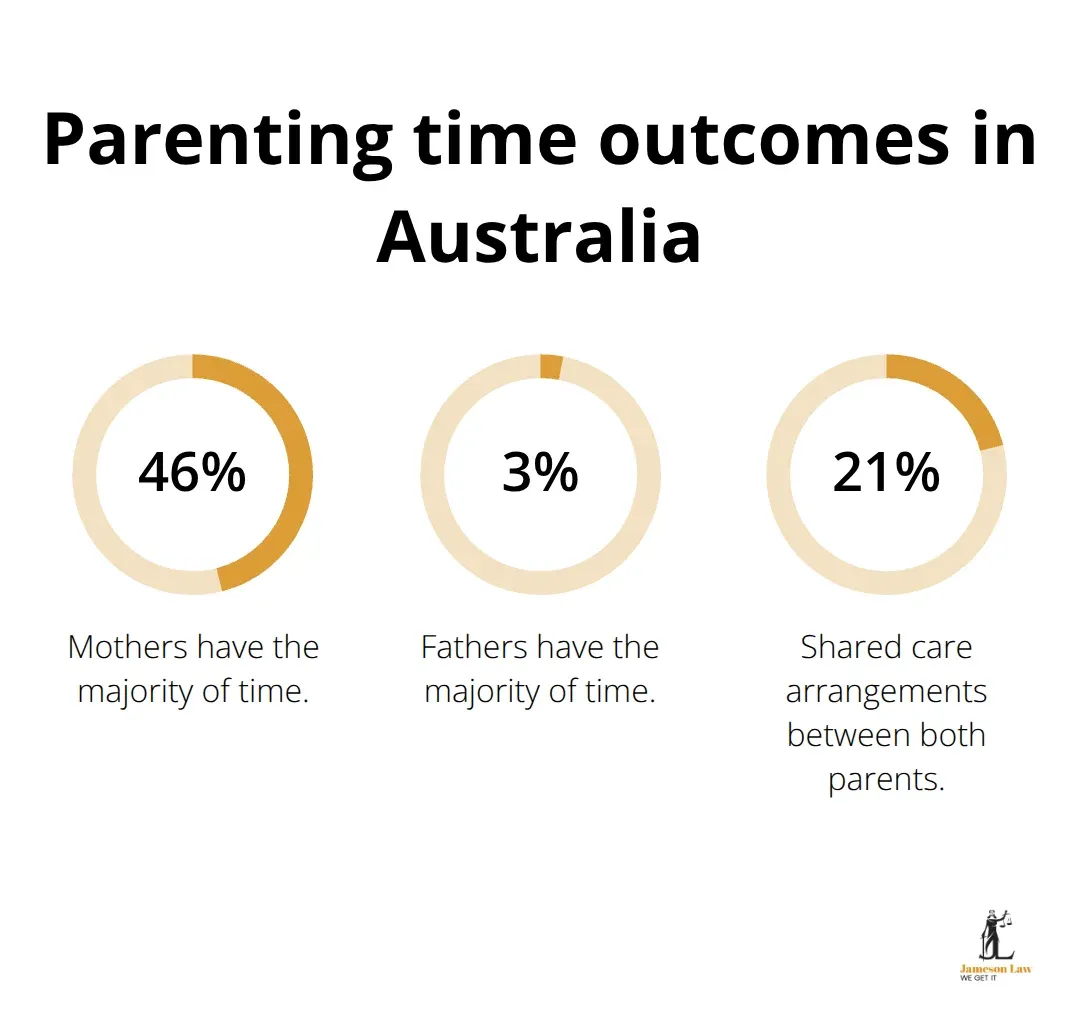
Parental responsibility determines who can make long-term decisions about education, medical treatment, and religious upbringing. If the mother holds sole parental responsibility, she can make these decisions without consulting you. This differs from time with your child, which can take numerous forms. In separated cases, mothers have the majority of time in 46% of cases, while fathers have the majority in only 3% of cases. About 21% of cases involve shared care arrangements where both parents share decision-making and time relatively equally. Fathers spend time with their children in approximately 91% of cases overall. The data shows that shared care or equal arrangements do occur, but they depend on demonstrating you’re a capable, involved parent.

Percentages of parenting time arrangements in Australian separated families

Overnight time with young children isn’t automatic and depends on age, development, and your primary caregiving history. If you want to shift these arrangements, you need concrete evidence showing your ability to provide stable, consistent care.

Property and Financial Obligations

Property division in family law requires full disclosure of all assets and debts. This is mandatory, not optional. Property you owned before the relationship may receive different treatment than assets acquired during marriage, so keep clear records of what you brought into the relationship. Loans and gifts also affect how assets are divided, which is why documentation matters. Consent Orders and Binding Financial Agreements allow you to structure settlements outside court if you reach agreement with the other party. Spousal maintenance obligations depend on factors like your income, the other party’s earning capacity, and the length of the marriage. Courts won’t order you to pay beyond what’s sustainable, but they assess this based on your actual financial position. If you’re self-employed or have variable income, prepare detailed financial records because courts scrutinise these situations carefully.

Why Early Legal Advice Changes Your Position

Getting early legal advice in family law protects your interests substantially. A family law specialist identifies risks in your situation and outlines realistic pathways forward. They help you understand what documentation you need to gather and what evidence strengthens your case. Early intervention also prevents you from making statements or taking actions that courts later view unfavourably. Many men delay seeking advice because they hope disputes resolve informally, but this approach often costs more time and money later. The sooner you understand your rights and obligations, the sooner you can make informed decisions about custody, property, and financial matters.

The Real Obstacles Men Face in Family Law

Custody Disputes and What the Data Actually Shows

Custody disputes consume most of the emotional energy in family law cases for men, and the statistics reveal why. According to the Australian Institute of Family Studies Survey of Separated Parents 2014, mothers have the majority of time with children in 46% of cases, while fathers achieve this in only 3% of cases. Shared care arrangements occur in about 21% of cases. These numbers matter because they show the starting position you’re working from, not a fixed outcome. Courts assess custody based on factors like your work schedule, caregiving history, and ability to co-parent.

If you’ve been involved in school pickups, medical appointments, or after-school care, document this now with dates and details. Schools and medical centres keep records you can request. The key differentiator is demonstrating consistent, active involvement before separation occurs. Fathers who show they’ve been engaged parents from day one have substantially stronger positions in negotiations and court proceedings.

Overnight Arrangements and Parenting Evidence

Overnight arrangements with younger children depend on your primary caregiving role and the child’s age and needs, not on blanket rules. If the mother restricts access without legal justification, courts can enforce contact and adjust arrangements as needed. Building your case means gathering concrete evidence of your parenting contributions over months and years, not making promises about future involvement. Photos, school reports, medical records, and communications showing your involvement all strengthen your position significantly.

Property Settlement Requires Meticulous Documentation

Property settlement and financial obligations demand a different kind of attention because errors here have long-term consequences. Full asset disclosure is mandatory-hiding or misrepresenting what you own or owe creates serious legal problems later. Self-employed men face extra scrutiny because courts examine business income carefully, so maintain detailed tax records and accounting statements.

Loans you’ve taken during the marriage, gifts from family members, and inheritances all affect how assets are divided, which is why documentation from the time these transactions occurred matters enormously. Spousal maintenance obligations depend on your actual earning capacity and the length of the marriage, not on assumptions about what you should earn. If your income has dropped due to job loss or industry change, gather evidence showing this reality rather than expecting courts to assume your earning capacity remains unchanged.

Checklist of key records for Australian family law property matters - family law for men

Structuring Settlements Outside Court

Consent Orders formalise an agreement about property division by submitting it to the Federal Circuit and Family Court of Australia for approval, allowing you to structure settlements outside court if you reach agreement. The mistake men frequently make is treating property settlement as separate from custody arrangements, when courts assess both together as part of your overall family law outcome. Early financial planning and transparent disclosure protect your position substantially more than attempting to negotiate from incomplete information later.

Understanding these obstacles positions you to move forward strategically. The next section examines how selecting the right legal representation transforms your ability to navigate these challenges effectively.

Choosing the Right Family Lawyer Makes the Difference

Finding a family lawyer who understands men’s specific challenges in family law separates a manageable process from years of costly complications. Most men select based on convenience or cost alone, then discover their lawyer lacks experience with cases involving fathers seeking substantial parenting time or protecting assets during property settlement. A good family lawyer for your situation needs specific capabilities.

What Experience Matters Most

First, they should have demonstrated experience handling cases where fathers achieved meaningful parenting arrangements or even sole parental responsibility, not just cases where mothers retained primary care. Ask potential lawyers directly about their recent cases involving fathers and what outcomes they achieved. Second, they need to understand the financial complexity of your specific situation. If you’re self-employed, own a business, or have variable income, your lawyer must know how to present this information to courts because judges scrutinise these circumstances carefully. Third, they should be willing to refer you to counselling or support services when needed, recognising that family law involves emotional and mental health dimensions alongside legal strategy.

The Role of Support Services in Your Case

The Australian Divorce Transitions Project found that 72% of people who sought help during marriage turned to counselling or mediation, and this support matters for your long-term wellbeing and your ability to co-parent effectively after separation. Your lawyer should recognise when emotional support strengthens your overall position and connect you with appropriate professionals. This multidisciplinary approach-combining legal strategy with mental health support-produces better outcomes than legal advice alone.
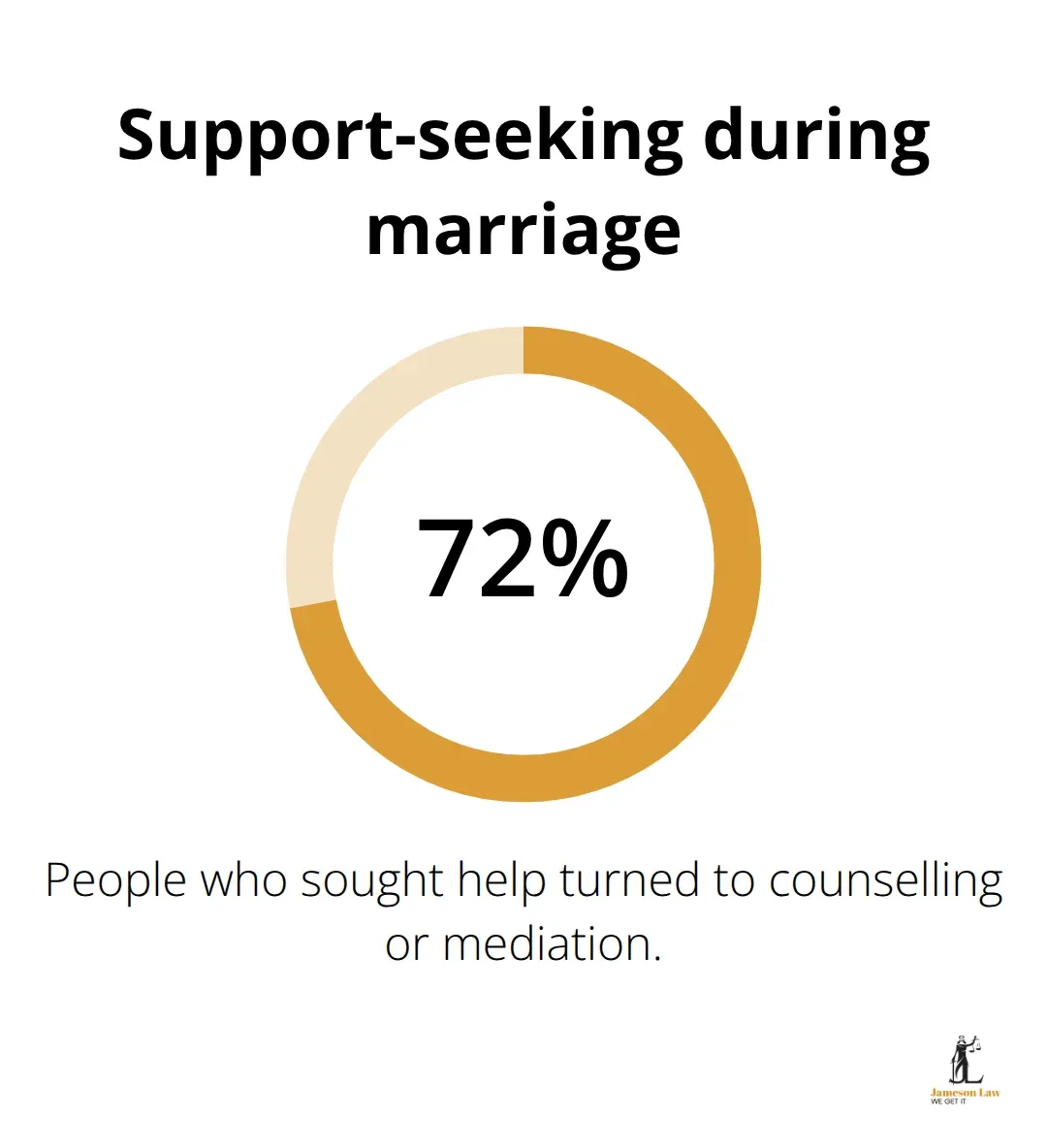
Share of people who turned to counselling or mediation in Australia - family law for men

What Early Consultation Actually Accomplishes

Early legal advice changes your entire position in family law disputes. When you consult a family lawyer before property settlement negotiations begin or custody arrangements crystallise, they identify documentation you need to gather immediately, explain realistic timelines, and outline the specific evidence strengthening your case. A first consultation clarifies your options and removes the uncertainty that keeps men stuck in harmful situations. Contact a family law specialist as soon as separation appears likely, not after disputes have hardened or you’ve already made statements that complicate your position.

Understanding Your Obligations and Options

The cost of early advice is minimal compared to the expense of fixing problems created by delay or poor strategy. Your lawyer should explain the difference between parental responsibility and time with your child, walk through what property disclosure requires, and help you understand your spousal maintenance obligations based on your actual financial circumstances. They should also be clear about what mediation can achieve versus when court intervention becomes necessary. Professional guidance protects your interests from the first conversation onward.

Final Thoughts

Family law for men demands clear strategy and immediate action. Document your involvement in your children’s lives now by collecting school reports, medical records, and communications that show consistent caregiving. Gather complete financial records including tax returns, business accounts, and asset documentation, since courts scrutinise self-employed income carefully and full disclosure is mandatory.

Contact a family law specialist before disputes crystallise and positions harden. Early consultation identifies what documentation you need, explains realistic timelines, and outlines the specific evidence that strengthens your case. The Australian Divorce Transitions Project found that 72% of people who sought help during marriage turned to counselling or mediation, and this support matters for your long-term wellbeing and your ability to co-parent effectively after separation.

We at Jameson Law understand the specific challenges men face in family law and have guided countless fathers through custody disputes, property settlements, and financial obligations. Contact Jameson Law today to discuss your situation and protect your interests from the start.

Speak to an Expert Lawyer today

Laywers-Jameson-Law-The-best-law-firm-in-Sydney- Sydney Lawyers - Sydney
BOOK NOW

WE'RE IN IT TO WIN IT

Book your consultation

Book Now
Book Now Mobile 06 02 2025

This form submission is encrypted and secured to ensure your information remains confidential.

What our Clients

Related Publications:

What our clients say

.

Jameson Law - Voted the Best Law firm in Sydney Award

Legal Answers ... In Short

We're here to help

Our mission is to ensure our client matters are resolved successfully every time. Success to us does not simply involve winning, but moreover ensuring we take the most feasible, economic and stress-free path to help our clients achieve their goals. We fight hard for our clients, and always go by the motto: we’re in it to win it.

Jameson Law - Best Law Firm in Sydney

WE'RE IN IT TO WIN IT

Book your consultation

Call us now on (02) 8806 0866 or fill out the form below

Book Now Mobile

This form submission is encrypted and secured to ensure your information remains confidential.

WE'RE IN IT TO WIN IT

Book your consultation

Book Now Mobile 06 02 2025
lock

This form submission is encrypted and secured to ensure your information remains confidential.

Our Sydney Offices

Offices Parramatta and Sydney Jameson Law
Parramatta CBD - Head Office
jameson Law - Blacktown
jameson Law - Liverpool Office
Jameson Law - Bankstown
Court Houses We Frequent Jameson Law

Court Houses We Frequent

Balmain Local Court

Registry: Monday to Friday, 9:00am to 4:30pm

Bankstown Local Court

Court Operating Hours: 9:30am-4:30pm

Blacktown Local Court

Registry Hours: 9:00 – 4:30
Telephone Hours: 8:30 -4:30
Days open: Mon-Fri

Burwood Local Court

Registry Hours: 9:00 – 4:30
Telephone Hours: 8:30 – 4:30
Days open: Mon – Fri

Campbell Local Court

Registry Hours: 9:00 – 4:30
Telephone Hours: 8:30 – 4:30
Days open: Mon – Fri

Central Local Court

Registry Hours: 9:00 – 1:00 and 2:00 – 4:30
Telephone Hours: 8:30 – 4:30

Downing Local Court

Registry Hours: 9:00 – 1:00 and 2:00 – 4:30
Telephone Hours: 8:30 – 4:30

Wollongong Local Court

Registry Hours: 9:00 – 1:00 and 2:00 – 4:30
Telephone Hours: 8:30 – 4:30

Fairfield Local Court

Registry Hours: 9:00 – 1:00 and 2:00 – 4:30
Telephone Hours: 8:30 – 4:30

Hornsby Local Court

Registry Hours: 9:00 – 1:00 and 2:00 – 4:30
Telephone Hours: 8:30 – 4:30

Liverpool Local Court

Registry Hours: 9:00 – 1:00 and 2:00 – 4:30
Telephone Hours: 8:30 – 4:30

Manly Local Court

Registry Hours: 9:00 – 1:00 and 2:00 – 4:30
Telephone Hours: 8:30 – 4:30

Newtown Local Court

Registry Hours: 9:00 – 1:00 and 2:00 – 4:30
Telephone Hours: 8:30 – 4:30

Parramatta Local Court

Registry Hours: 9:00 – 1:00 and 2:00 – 4:30
Telephone Hours: 8:30 – 4:30

Penrith Local Court

Registry Hours: 9:00 – 1:00 and 2:00 – 4:30
Telephone Hours: 8:30 – 4:30

Sutherland Local Court

Registry Hours: 9:00 – 1:00 and 2:00 – 4:30
Telephone Hours: 8:30 – 4:30

Waverley Local Court

Registry Hours: 9:00 – 1:00 and 2:00 – 4:30
Telephone Hours: 8:30 – 4:30

Windsor Local Court

Registry Hours: 9:00 – 1:00 and 2:00 – 4:30
Telephone Hours: 8:30 – 4:30

Wollongong Local Court

Registry Hours: 9:00 – 1:00 and 2:00 – 4:30
Telephone Hours: 8:30 – 4:30

Downing Centre District Court

Registry Hours: 9:00 – 4:30
Telephone Hours: 8:30 – 4:30
Days open: Mon – Fri

Parramatta District Court

Registry Hours: 9:00 – 4:30
Days open: Mon-Fri

Penrith District Court

Registry Hours: 9:00 – 4:30
Days open: Mon-Fri

Campbelltown District Court

Registry Hours: 9:00 – 4:30
Days open: Mon – Fri

Liverpool District Court

Registry Hours: 9:00 – 4:30
Days open: Mon – Fri

Wollongong District Court

Registry Hours: 9:00 – 1:00 and 2:00 – 4:30
Telephone Hours: 8:30 – 4:30

Supreme Court New South Wales

Registry Hours: 9:00 AM – 4:30 PM
Telephone Hours: 8:30 AM – 4:30 PM
Days Open: Monday to Friday

Federal Circuit and Family Court of Australia

Registry Hours: 9:00 AM – 4:30 PM
Telephone Hours: 8:30 AM – 5:00 PM
Days Open: Monday to Friday

Federal Court

Monday to Friday, 8:30 AM – 4:30 PM

High Court

Monday to Friday, 8:30 AM – 5:00 PM

Children’s Court of New South Wales

Registry Hours: 9:00 AM – 4:30 PM
Telephone Hours: 8:30 AM – 4:30 PM
Days Open: Monday to Friday

Coroner’s Court New South Wales

Registry Hours: 9:00 AM – 4:30 PM
Telephone Hours: 8:30 AM – 4:30 PM
Days Open: Monday to Friday

Industrial Relations Commission of New South Wales

Registry Hours: 9:00 AM – 4:30 PM
Telephone Hours: 8:30 AM – 4:30 PM
Days Open: Monday to Friday

Land and Environment Court of New South Wales

Registry Hours: 9:00 AM – 4:30 PM
Telephone Hours: 8:30 AM – 4:30 PM
Days Open: Monday to Friday

WE'RE IN IT TO WIN IT

Book your consultation

Book Now
Book Now Mobile 06 02 2025
lock

This form submission is encrypted and secured to ensure your information remains confidential.