Family law cases move fast, and missing a single deadline can derail your entire matter. Central Practice Direction family law case management sets out the rules that courts expect you to follow, and understanding these requirements is non-negotiable.
At Jameson Law, we’ve seen too many cases suffer because parties didn’t grasp the procedural framework. This guide walks you through the essential steps, common mistakes, and practical strategies to stay compliant and protect your interests.
What Central Practice Direction Actually Means for Your Case
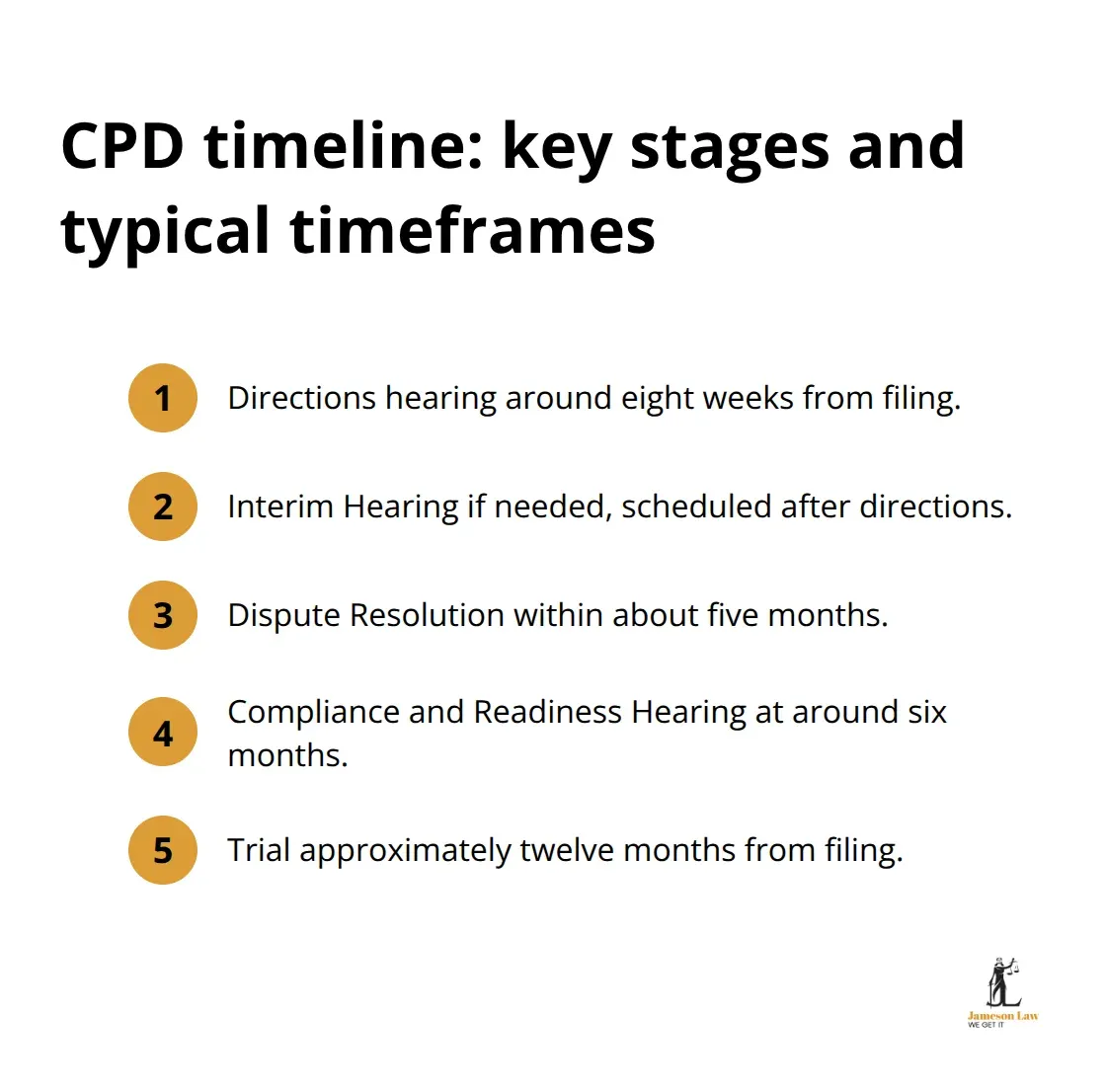
The Federal Circuit and Family Court of Australia introduced the Central Practice Direction on 1 September 2021 following the merger of the Family Court and Federal Circuit Court. This direction outlines the core principles applicable to family law proceedings and establishes a consistent national case management system that applies to every family law matter filed across Australia. CPD isn’t optional guidance-it’s the procedural framework courts enforce, and non-compliance triggers real consequences including cost orders and sanctions under the Family Law Rules. The system establishes fixed timelines and mandatory steps that replace the old approach where cases could drag on indefinitely. Courts now expect parties to move through defined stages: a Directions hearing within approximately eight weeks of filing, an Interim Hearing if needed, Dispute Resolution within about five months, a Compliance and Readiness Hearing around six months, and trial within approximately twelve months from filing.

The Real Purpose Behind Case Management
CPD fundamentally shifts responsibility to parties and their lawyers to drive cases forward efficiently. The court no longer tolerates vague affidavits, late document filing, or parties treating court dates as optional. At the Directions hearing, the court assesses whether you’ve complied with pre-filing requirements, identifies issues early, and determines whether your matter needs specialist management through lists like the Magellan List for complex parenting disputes. The emphasis on dispute resolution at multiple points isn’t bureaucratic padding-it reflects evidence that adversarial family law often fails to recognise family violence and can escalate risk. CPD’s structured approach with early risk screening via the Lighthouse risk screen allows courts to identify safety concerns immediately and refer families to appropriate services rather than forcing everyone through lengthy trials. The system explicitly requires parties and lawyers to be cost-conscious at every step, identify issues early, narrow disputes, give full and frank disclosure, avoid ambit claims, limit witnesses, and pursue proportionate, resolution-focused processes.
How This Framework Protects Your Interests
Understanding CPD mechanics gives you a tactical advantage. The First Court Event focuses on consent orders where possible, meaning early preparation and genuine settlement attempts can resolve matters without trial. If you’re unprepared at any court event, judges will penalise you through cost orders. Conversely, thorough preparation at each stage-filing concise affidavits no later than seven days before hearings, providing full financial disclosure, and engaging genuinely in dispute resolution-positions your case for faster resolution. The system’s emphasis on proportionality means courts won’t allow excessive expert evidence or witness testimony. For financial matters, the Compliance and Readiness Hearing around six months requires finalised issues, confirmed trial readiness, and a trial plan including compulsory settlement offers, which forces realistic evaluation of your position before trial costs mount. The Fast Track Hearing List available for suitable matters limits affidavits to 20 pages, annexures to 50 pages, and submissions to five pages, with hearing dates typically within 28 days of readiness-this option exists specifically to reduce costs for straightforward cases. CPD’s national consistency means the same rules apply whether you’re in Sydney, Melbourne, or regional Queensland, eliminating jurisdictional confusion that previously forced families into multiple court systems.
What Happens When You Miss the Mark
Non-compliance with CPD requirements carries immediate consequences. The Defaulters List mechanism activates when parties fail to take required steps, triggering cost orders or other sanctions under the Family Law Rules. Courts view late affidavits, incomplete financial disclosure, or failure to attend court events as deliberate obstruction rather than administrative oversight. A single missed deadline can push your matter onto the Defaulters List, which signals to the judge that you’re not serious about resolution. This status affects how courts view your credibility and can result in orders made against you without your input. The court’s expectation that you move cases forward efficiently means delays now work against you rather than providing tactical advantage. If you fail to prepare adequately for a Directions hearing or Interim Hearing, the judge won’t grant adjournments-they’ll make orders based on incomplete information, which often disadvantages the unprepared party.
Moving Forward with Confidence
The structured nature of CPD means you can plan your case with precision. Each stage has defined objectives and timelines, allowing you to budget costs and prepare strategically. The next section walks you through the essential steps you must take at each stage, from initial filing through to trial, and shows you exactly what courts expect at every court event.
What You Must File and When
Initial Filing Requirements and Pre-Action Steps
Filing your Initiating Application or Response starts the Central Practice Direction clock. The Federal Circuit and Family Court expects your application to include all required documentation, completed accurately and signed by an authorised person. Incomplete or poorly prepared applications delay your Directions hearing, which the court schedules within approximately eight weeks of filing.
Before filing, you must satisfy pre-action requirements. You need to obtain a Genuine Steps Certificate confirming you’ve made genuine attempts to resolve the matter. For parenting matters, section 60I of the Family Law Act requires you to complete pre-action procedures and provide evidence of this compliance with your Initiating Application. Courts take these requirements seriously because they filter out matters that could resolve without court involvement.
Your affidavits at this stage must be concise and fact-based, avoiding speculation or argument. The court won’t tolerate rambling narratives padded with irrelevant detail. Financial disclosure documents must be complete and accurate from day one. If you lodge incomplete financial statements or omit assets, the court will view this as deliberate non-disclosure rather than oversight, which damages your credibility and invites cost orders against you.
Accessing the Commonwealth Courts Portal
The Commonwealth Courts Portal serves as your gateway to all filings and order access. Register immediately with your email address if you haven’t already, as all subsequent court communication flows through this system. The National Enquiry Centre can assist with registration at 1300 352 000 if you encounter technical difficulties.
Compliance Obligations After Filing
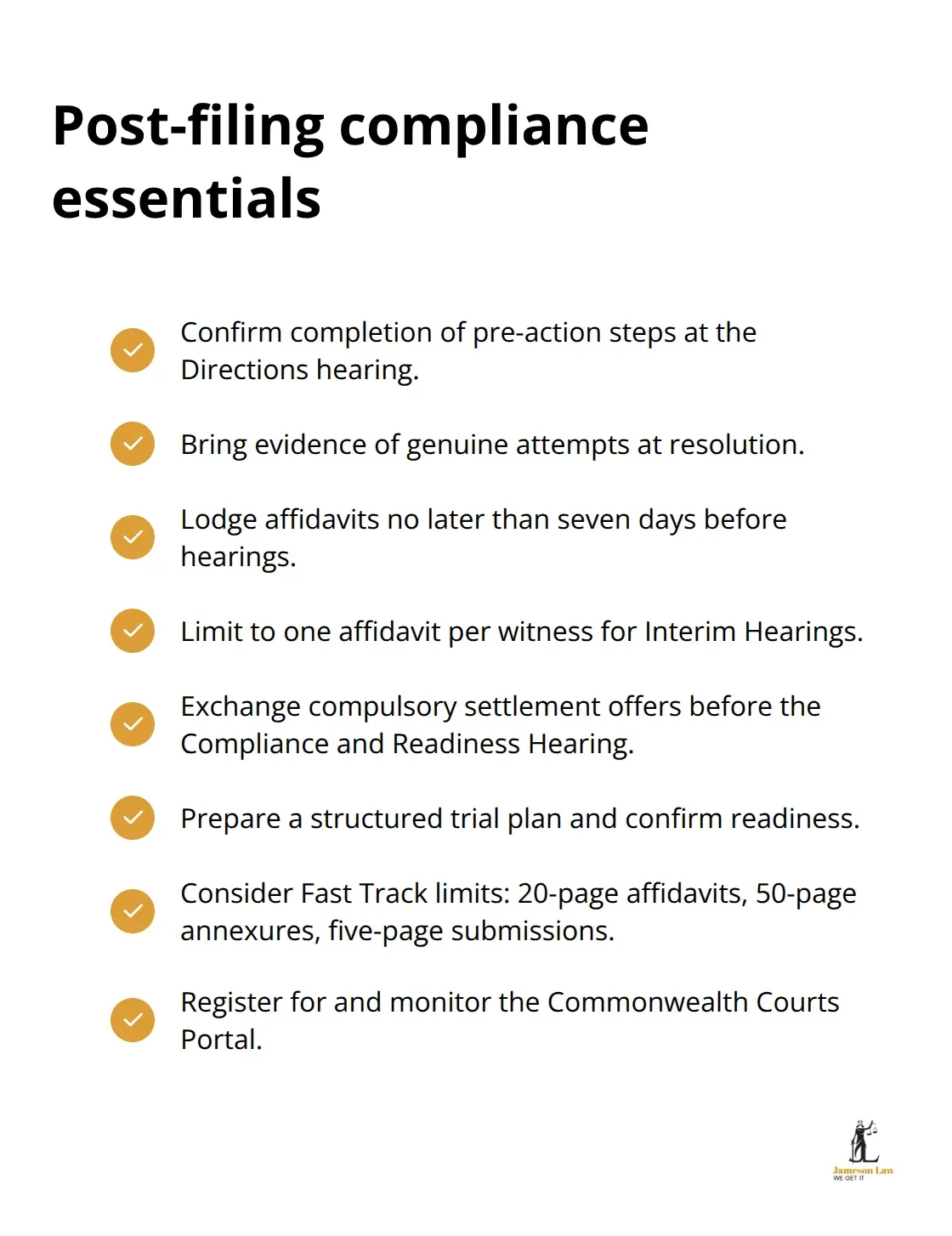
Your compliance obligations intensify immediately after filing. The Directions hearing within eight weeks requires you to confirm completion of all pre-action steps and produce evidence of genuine attempts at resolution. Arrive with a realistic understanding of your position because judges assess whether you’re negotiating in good faith or pursuing ambit claims.

If you file affidavit evidence for any subsequent court event, lodge it no later than seven days before the hearing. Courts routinely refuse to accept late affidavits without exceptional circumstances. For Interim Hearings, only one affidavit per witness typically receives consideration, so consolidate your evidence strategically.
The Compliance and Readiness Hearing around six months from filing demands finalised financial statements, confirmed trial readiness, and a structured trial plan. Compulsory settlement offers in financial disputes must be exchanged before this hearing, forcing realistic evaluation of your case value. The Fast Track Hearing List offers a viable pathway for straightforward matters, but it imposes strict limits: affidavits capped at 20 pages, annexures at 50 pages, and submissions at five pages maximum. If your case qualifies, this option typically delivers a hearing date within 28 days of readiness, substantially reducing costs compared to standard trial preparation.
Progressive Disclosure and Evidence Exchange
Discovery and evidence exchange occur progressively through each court event rather than in one bulk disclosure phase. At the Directions hearing, the court determines what disclosure is necessary and sets deadlines. Financial matters require updated statements at the Compliance and Readiness Hearing. Parenting matters involving safety concerns trigger the Lighthouse risk screen during early triage, which identifies whether child welfare authorities hold information relevant to your case. Courts can request information sharing between family law and child protection systems where safety is at stake.
Trial directions mandate electronic filing of all evidence, with subpoenas strictly capped at generally five per party to prevent excessive fishing expeditions. Prepare a case outline, chronology, and authorities bundle well before trial dates. Non-compliance at any stage activates the Defaulters List, which signals serious procedural breaches and invites cost sanctions.
Understanding these filing and compliance requirements positions you to move through each court event without delays or penalties. The next section examines the common pitfalls that derail cases and shows you exactly how to avoid them.
What Derails Family Law Cases
Missed Deadlines Destroy Your Position
Deadline breaches destroy family law cases faster than any substantive weakness in your position. Parties with strong legal arguments lose because they file affidavits two days late or miss the seven-day threshold before an Interim Hearing. Courts do not grant extensions based on good intentions. The Federal Circuit and Family Court operates under fixed timelines, and judges view late filings as deliberate non-compliance rather than administrative error.
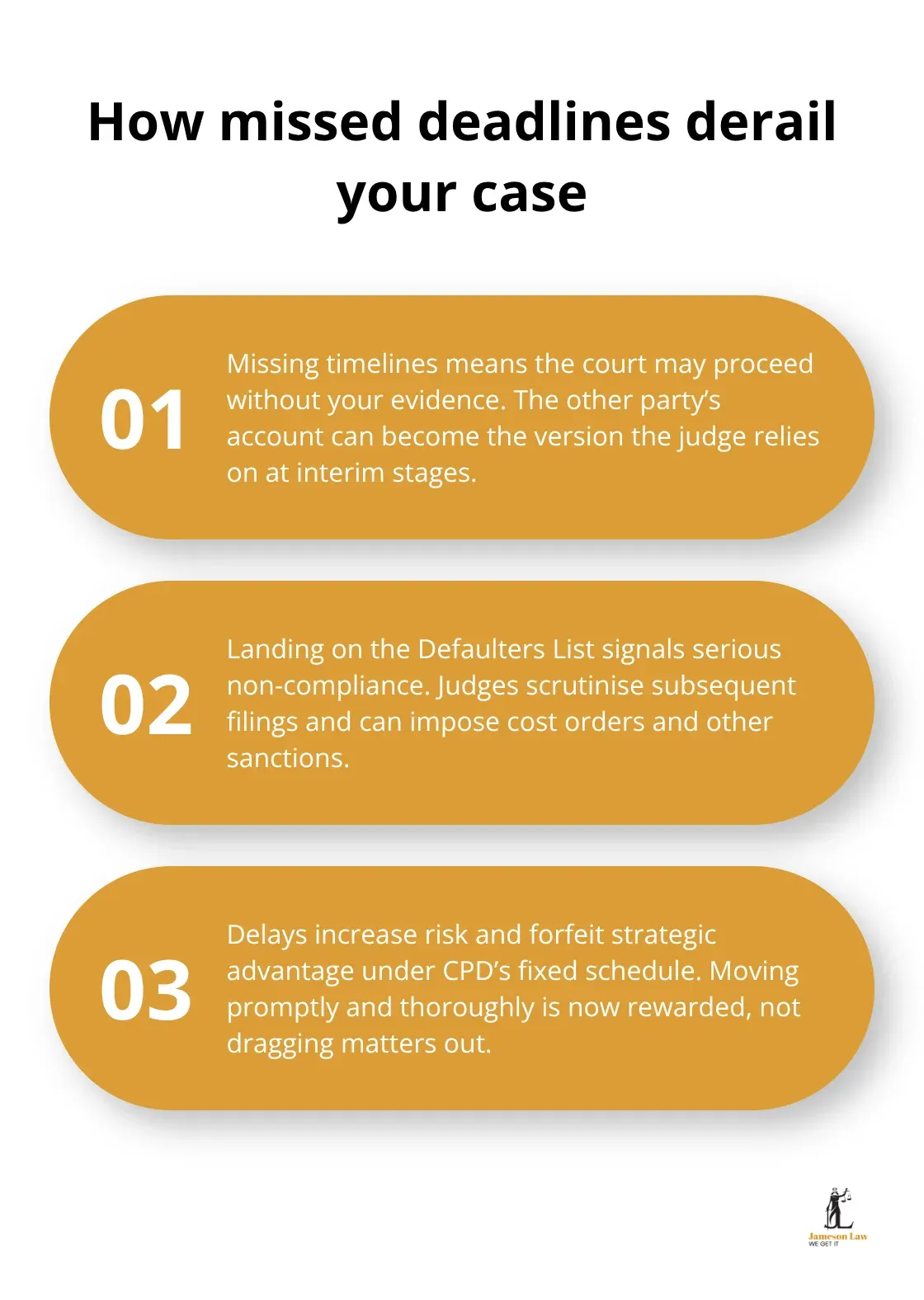
When you miss a deadline, the court proceeds without your evidence, which means the other party’s version becomes the narrative the judge hears. For Interim Hearings determining temporary parenting arrangements or financial support, arriving unprepared or with incomplete affidavits means the judge makes orders based on one-sided information. You then spend months living under unfavourable interim orders while trying to correct the record at trial.
Defaulters List activation and cost orders follow when you breach filing deadlines. Once your matter lands there, judges scrutinise every subsequent filing for compliance. The Australian Law Reform Commission’s 2010 report on family violence noted that court delays substantially increase risk, with some matters extending up to 36 months. Yet CPD’s fixed timeline system now penalises parties who create delays through poor preparation.

Your strategic advantage lies in moving faster and more thoroughly than the other party, not in dragging matters out.
Incomplete Financial Disclosure Destroys Credibility
Financial disclosure must be complete and accurate from your first filing because courts treat omitted assets as deliberate concealment. If you discover missing superannuation or property three months into proceedings, the court views this as bad faith disclosure rather than oversight, which destroys your credibility permanently.
The Compliance and Readiness Hearing is a procedural court event designed to confirm that both parties have complied with financial disclosure requirements. Parties frequently arrive unprepared because they have not organised their evidence or obtained necessary valuations. If you have not secured property valuations or superannuation statements before this hearing, you cannot confirm trial readiness, which extends your matter indefinitely. Compulsory settlement offers in financial disputes must be exchanged before the Compliance and Readiness Hearing, forcing realistic evaluation of your case value. If you arrive at this hearing without understanding your actual financial position or the other party’s position, you cannot make informed settlement decisions.
Weak Affidavit Evidence Undermines Your Case
Affidavits must contain only evidence you can prove, not speculation or argument disguised as fact. A judge reading your affidavit should immediately understand the core facts without needing to interpret vague statements. Many parties write affidavits as narrative complaints about the other party rather than structured evidence of disputed issues. This wastes court time and signals poor legal understanding.
For parenting matters, the Lighthouse risk screen conducted during early triage identifies safety concerns immediately. Hiding family violence issues in affidavits only delays their discovery and damages your credibility when they emerge. The Fast Track Hearing List offers hearing dates within 28 days of readiness for straightforward matters, but it demands meticulous preparation because your entire case fits within 20 pages of affidavits, 50 pages of annexures, and five pages of submissions. Parties who attempt Fast Track without this discipline get rejected or face trial with inadequate evidence.
Final Thoughts
Central Practice Direction family law case management works because it forces parties to prepare thoroughly and move cases forward without delay. The system eliminates the old approach where cases dragged on indefinitely, costs spiralled, and families remained trapped in uncertainty. Understanding the fixed timelines, filing requirements, and compliance obligations positions you to navigate proceedings efficiently and protect your interests.
Most parties underestimate how quickly courts now expect cases to move under this framework. Your Directions hearing arrives within eight weeks of filing, your Interim Hearing follows shortly after, Dispute Resolution occurs within five months, the Compliance and Readiness Hearing around six months forces realistic evaluation of your position, and trial happens within approximately twelve months from filing. Missing a single deadline or arriving unprepared at any court event triggers consequences that compound throughout your matter.
Professional legal guidance matters more than ever before because the procedural framework leaves no room for error, and the cost of mistakes is immediate and severe. We at Jameson Law understand the pressure families face navigating family law proceedings, and our family law team works with you stage by stage to ensure you meet every deadline, prepare compelling evidence, and make informed decisions about settlement. Contact us today to discuss your situation and understand exactly what your case requires.