PUBLICATION

How to Find a Lawyer for Your Separation Agreement

"Find a lawyer for your separation agreement with our practical guide. Learn key steps to protect your interests."
How to Find a Lawyer for Your Separation Agreement

Finding the right lawyer for your separation agreement can feel overwhelming. At Jameson Law, we know that choosing someone qualified and trustworthy makes all the difference in protecting your interests.

This guide walks you through what to look for, how to search effectively, and what to expect in terms of costs. You’ll have the clarity you need to move forward with confidence.

What to Look for in a Separation Lawyer

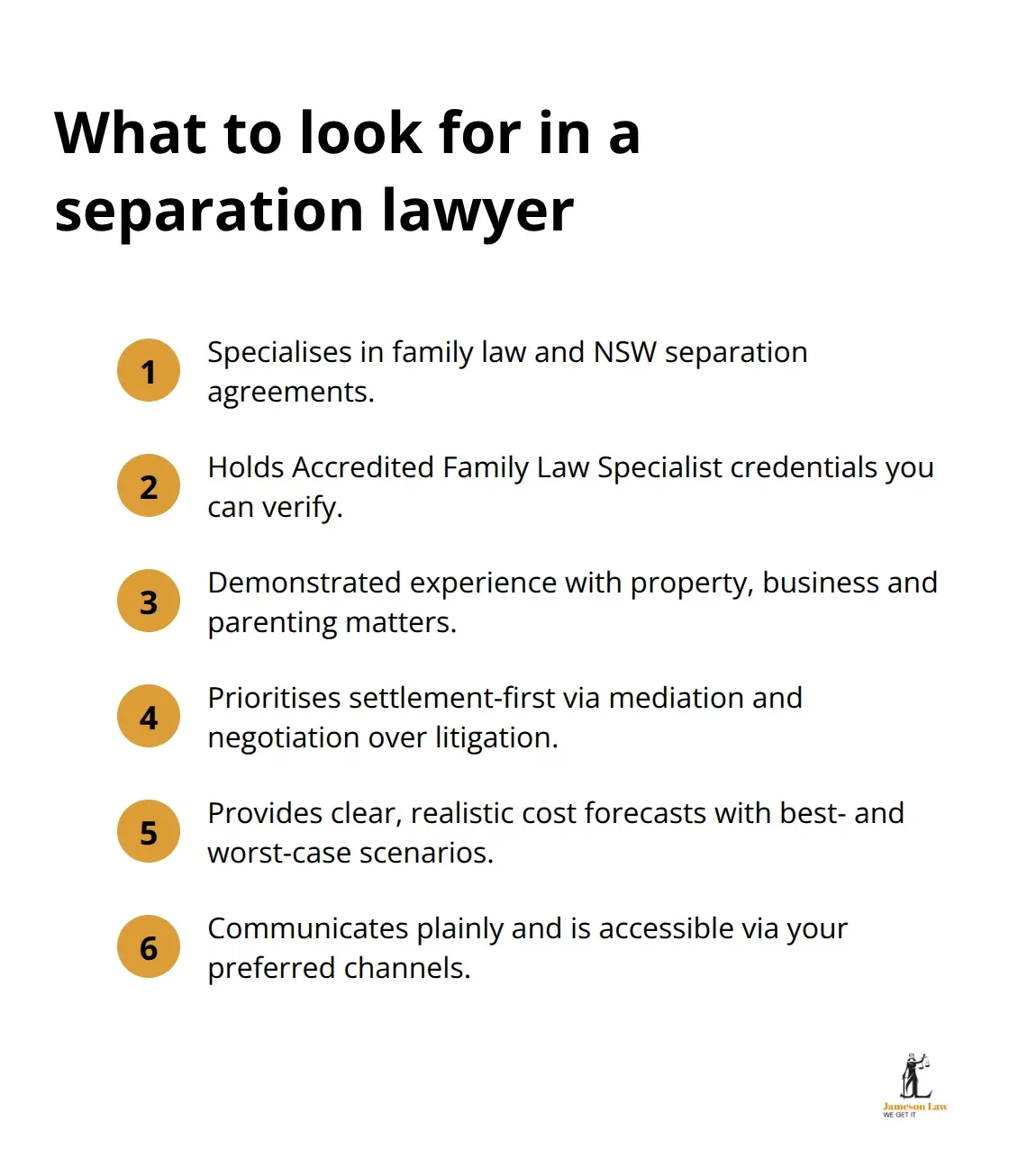
A separation lawyer who specialises in family law will guide you through one of life’s most complex decisions. The difference between a generalist and a specialist matters significantly. Look specifically for someone with demonstrated experience handling separation agreements in NSW. Ask potential lawyers about cases similar to yours-whether that involves property division, business ownership, or parenting arrangements. An Accredited Family Law Specialist signals advanced expertise in complex family matters and shows they’ve met rigorous professional standards. Check their membership with professional associations and verify their credentials through the Law Council of Australia’s Family Law Section directory or the Law Society of NSW.

Key criteria Australians should use to choose a separation lawyer in NSW - lawyer for separation agreement

This protects you from inexperienced practitioners who charge the same rates as specialists but deliver inferior results.

Approach and Problem-Solving Philosophy

The lawyer you choose should prioritise non-litigation routes first. Mediation and negotiation typically cost far less and resolve matters faster than court proceedings. Ask directly whether they support collaborative approaches or if they view litigation as their default strategy. A lawyer who structures services around your specific circumstances rather than applying a one-size-fits-all solution will save you time and money. Request clarity on their preferred approach: do they push for settlement first, or do they jump to court? The best lawyers present multiple resolution options and let you decide which path suits your situation. They should also be honest about what your case might cost, including best-case and worst-case scenarios. If they cannot give you a realistic cost forecast with breakdown details, move on. You need someone who listens carefully to your goals and explains your rights in plain language, not legal jargon that leaves you confused about your own matter.

Communication and Accessibility

Your lawyer must be accessible in ways that work for your life. Some people prefer in-person meetings, while others need phone, video, or email options. Confirm upfront which communication methods the firm supports and who your primary contact will be. Ask whether you’ll speak with the lead lawyer or junior staff managing your matter. Clarify billing for minor updates-some firms charge for every email or phone call, while others include brief consultations in their retainer. This distinction can add hundreds of dollars to your final bill. Request an estimated timeline with key milestones and discuss factors that could cause delays (court scheduling or your ex-partner’s responsiveness).
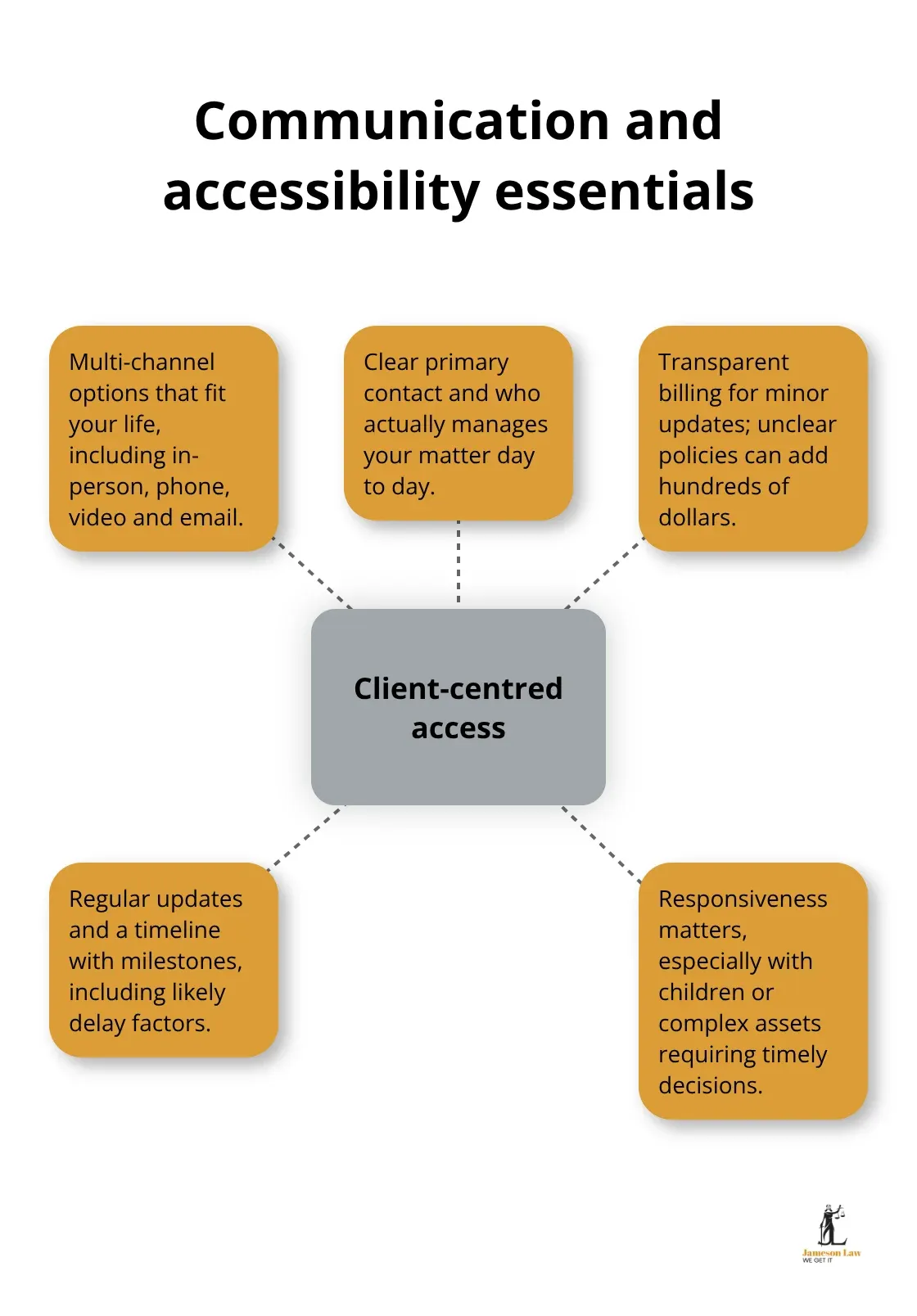
How an Australian family lawyer should communicate and stay accessible during your separation

A lawyer who maintains regular communication and provides updates without you having to chase them reduces stress during an already difficult period. This matters more than you might think, especially if your separation involves children or complex assets where decisions need timely resolution.

What to Bring to Your First Meeting

Prepare a clear list of your goals, assets, and parenting plans before you meet with a lawyer. Bring relevant documents including identification, financial statements, tax returns, and any existing parenting arrangements. Ask the lawyer what else they need and by when so you can gather everything upfront. This preparation speeds up the process and helps the lawyer give you accurate advice about your specific situation. Many firms offer fixed-fee initial meetings (typically 1–2 hours), so confirm the cost and what to bring when you book. The more organised you are, the more value you extract from that first consultation and the clearer your next steps become.

Finding the Right Lawyer to Represent You

Starting your search with the right resources saves weeks of wasted time. The Law Council of Australia’s Family Law Section directory lists specialists across Australia, and you can filter by location and expertise. The Law Society of NSW also maintains a directory where you can verify credentials and check whether a lawyer holds Accredited Family Law Specialist status. These directories let you cross-reference multiple sources before making contact. When you identify potential candidates, visit their websites and review their experience summaries. Look for specific mention of separation agreements, property division, and parenting arrangements rather than vague claims about general family law experience. If a lawyer’s website doesn’t clearly outline what they specialise in, that signals poor communication standards.

Verifying Experience and Track Record

Check professional association memberships first because they confirm a lawyer has met baseline standards and maintains ongoing education. An Accredited Family Law Specialist designation means they’ve completed additional training and demonstrated advanced expertise, not just general family law knowledge. When you call potential lawyers, ask directly about their experience with cases similar to yours. If you’re dealing with a business asset, ask how many business valuations they’ve handled in separations. If children are involved, ask about their experience with complex parenting arrangements or high-conflict custody disputes. Expect specific answers with numbers, not vague responses about being experienced. A lawyer who cites they’ve handled hundreds of separations over 15 years proves more credibility than one who can’t give you clear information. Ask whether they’ve appeared in court for family matters or primarily settle cases outside court. This tells you whether they have trial experience if your situation requires it. Request the names of previous clients you can contact as references, though some lawyers may decline for confidentiality reasons. If they won’t provide any references, question why.

Making Your Initial Contact Count

When you call or email a potential lawyer, be specific about your situation in your opening message. Instead of saying you need help with a separation, mention whether property division, children, or business assets are involved. This helps the lawyer assess whether they’re the right fit and whether they charge for initial consultations. Many NSW family law firms offer fixed-fee initial consultations ranging from $200 to $500 for one to two hours, though some offer free 15-minute phone calls to discuss your matter first. Ask about this upfront so you know what to expect. During your initial consultation, assess how the lawyer listens and whether they ask detailed questions about your goals, finances, and parenting arrangements. A lawyer who dominates the conversation with their own experience rather than learning about your situation will likely impose a one-size-fits-all approach. Notice whether they explain legal concepts in plain language or resort to jargon that leaves you confused. Ask them to outline a realistic timeline and cost estimate before you commit.

Understanding Costs and Pathways

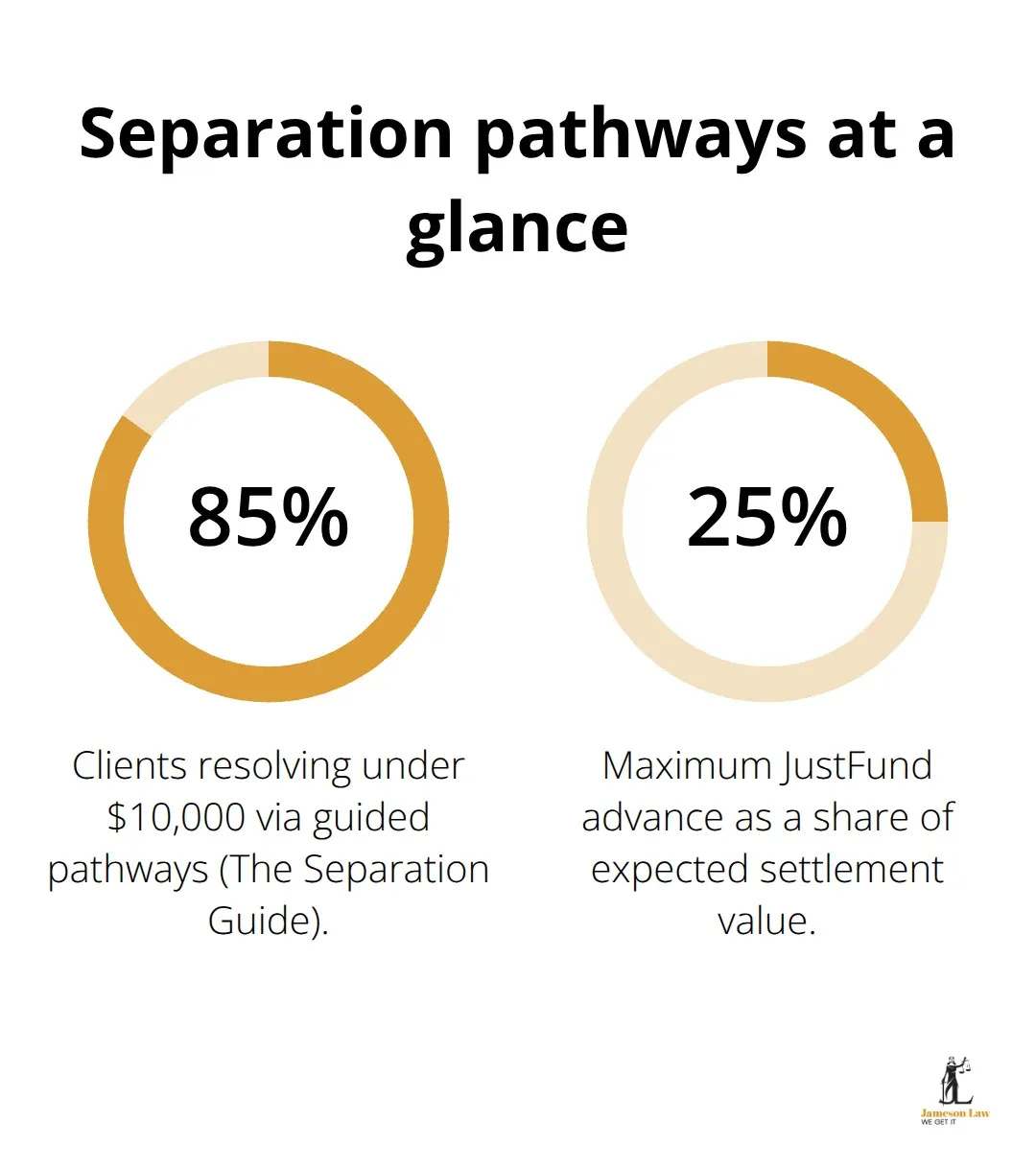
Research from The Separation Guide found that the average cost of separation without court is about $21,000 per person, while court proceedings average between $50,000 and $100,000 and can take up to three years. However, guided separation pathways cost as little as $3,000 per person plus filing fees. A good lawyer will explain which pathway suits your circumstances and why. About 85% of The Separation Guide’s clients achieve resolution for under $10,000, which demonstrates that staying amicable and avoiding court significantly reduces your expenses.

Key percentage figures for Australian separation pathways and funding options - lawyer for separation agreement

Your lawyer should present multiple resolution options and help you understand the cost implications of each approach. This transparency allows you to make informed decisions about how to proceed with your separation.

What You’ll Actually Pay for Separation Legal Services

Most family lawyers in Australia charge hourly rates between $300 and $750 per hour (plus GST), depending on experience and location. Some offer fixed fees for specific services like drafting a separation agreement or preparing court documents. The Separation Guide research shows that uncontested separations without court average $21,000 per person, but guided separation pathways cost as little as $3,000 per person plus court filing fees. Court proceedings, by contrast, average $50,000 to $100,000 and stretch over three years. The difference matters enormously.

Understanding Your Fee Structure

When you contact a lawyer, ask explicitly whether they charge hourly, offer fixed fees, use retainers, or provide capped fee arrangements. Some firms bundle services into packages, charging a set amount for property settlement advice or parenting arrangement mediation. Others bill every email, phone call, and short consultation at their hourly rate, which adds hundreds of dollars for minor updates. Clarify whether brief consultations are included in your retainer or charged separately. If a lawyer cannot or will not provide a cost forecast with best-case and worst-case scenarios broken down by service, that’s a red flag. You deserve transparency about what your separation will cost.

Accessing Legal Aid and Community Support

Legal Aid NSW covers family law matters for eligible applicants based on means and merits tests, which can reduce or eliminate your costs if you qualify. Community Legal Centres across NSW also provide free legal advice and information on family law, though they typically cannot provide full representation. If upfront costs are your barrier, explore whether you qualify for Legal Aid before hiring a private lawyer. Some firms offer payment plans or reduced rates for clients facing genuine hardship.

Financing Options for Legal Fees

JustFund, a family law finance provider, allows you to borrow against your expected settlement to cover legal fees upfront, with repayment from your property settlement proceeds. You can access JustFund funding between $5,000 and 25% of your expected settlement value, and eligibility applies even if you’ve sold property or your funds are held in trust. Law in Check offers a separate service to review legal bills, negotiate reductions, or challenge unfair charges if you believe your lawyer has overcharged. Their initial chat is free, and you can reach them on 1800 529 462.

Requesting a Detailed Cost Estimate

A realistic cost estimate requires a breakdown of all potential expenses including court fees, valuations, expert services (such as forensic accountants), and barrister fees if your case requires court representation. Ask your lawyer to estimate costs for different scenarios: if you reach agreement quickly, if negotiations stall, or if the matter proceeds to court. This gives you genuine control over how much you spend and which pathway makes financial sense for your circumstances. About 85% of The Separation Guide’s clients achieve resolution for under $10,000, which demonstrates that staying amicable and avoiding court significantly reduces your expenses.

Final Thoughts

Choosing a lawyer for your separation agreement comes down to three core factors: experience with separations in NSW, a problem-solving approach that prioritises settlement over litigation, and genuine accessibility when you need advice. The right lawyer listens to your goals, explains your options clearly, and gives you honest cost forecasts so you can make informed decisions about your pathway forward. Start by researching lawyers through the Law Council of Australia’s Family Law Section directory or the Law Society of NSW to verify credentials and Accredited Family Law Specialist status.

When you contact potential candidates, ask specific questions about their experience with cases like yours and their preferred approach to resolution. Request a fixed-fee initial consultation so you can assess whether their communication style and problem-solving philosophy match your needs. Staying amicable and avoiding court significantly reduces your costs and timeline-about 85% of clients who use guided separation pathways achieve resolution for under $10,000, compared to $50,000 to $100,000 for court proceedings.

If upfront costs create a barrier, explore Legal Aid NSW eligibility or JustFund financing options before ruling out professional representation. We at Jameson Law understand that separation involves complex decisions about property, finances, and parenting arrangements, and our family law team has over 40 years of combined experience helping clients navigate these matters with clarity and confidence. If you’re ready to discuss your separation agreement with a lawyer who listens and explains things plainly, contact Jameson Law to arrange your initial consultation today.

Speak to an Expert Lawyer today

Laywers-Jameson-Law-The-best-law-firm-in-Sydney- Sydney Lawyers - Sydney
BOOK NOW

WE'RE IN IT TO WIN IT

Book your consultation

Book Now
Book Now Mobile 06 02 2025

This form submission is encrypted and secured to ensure your information remains confidential.

What our Clients

Related Publications:

What our clients say

.

Jameson Law - Voted the Best Law firm in Sydney Award

Legal Answers ... In Short

We're here to help

Our mission is to ensure our client matters are resolved successfully every time. Success to us does not simply involve winning, but moreover ensuring we take the most feasible, economic and stress-free path to help our clients achieve their goals. We fight hard for our clients, and always go by the motto: we’re in it to win it.

Jameson Law - Best Law Firm in Sydney

WE'RE IN IT TO WIN IT

Book your consultation

Call us now on (02) 8806 0866 or fill out the form below

Book Now Mobile

This form submission is encrypted and secured to ensure your information remains confidential.

WE'RE IN IT TO WIN IT

Book your consultation

Book Now Mobile 06 02 2025
lock

This form submission is encrypted and secured to ensure your information remains confidential.

Our Sydney Offices

Offices Parramatta and Sydney Jameson Law
Parramatta CBD - Head Office
jameson Law - Blacktown
jameson Law - Liverpool Office
Jameson Law - Bankstown
Court Houses We Frequent Jameson Law

Court Houses We Frequent

Balmain Local Court

Registry: Monday to Friday, 9:00am to 4:30pm

Bankstown Local Court

Court Operating Hours: 9:30am-4:30pm

Blacktown Local Court

Registry Hours: 9:00 – 4:30
Telephone Hours: 8:30 -4:30
Days open: Mon-Fri

Burwood Local Court

Registry Hours: 9:00 – 4:30
Telephone Hours: 8:30 – 4:30
Days open: Mon – Fri

Campbell Local Court

Registry Hours: 9:00 – 4:30
Telephone Hours: 8:30 – 4:30
Days open: Mon – Fri

Central Local Court

Registry Hours: 9:00 – 1:00 and 2:00 – 4:30
Telephone Hours: 8:30 – 4:30

Downing Local Court

Registry Hours: 9:00 – 1:00 and 2:00 – 4:30
Telephone Hours: 8:30 – 4:30

Wollongong Local Court

Registry Hours: 9:00 – 1:00 and 2:00 – 4:30
Telephone Hours: 8:30 – 4:30

Fairfield Local Court

Registry Hours: 9:00 – 1:00 and 2:00 – 4:30
Telephone Hours: 8:30 – 4:30

Hornsby Local Court

Registry Hours: 9:00 – 1:00 and 2:00 – 4:30
Telephone Hours: 8:30 – 4:30

Liverpool Local Court

Registry Hours: 9:00 – 1:00 and 2:00 – 4:30
Telephone Hours: 8:30 – 4:30

Manly Local Court

Registry Hours: 9:00 – 1:00 and 2:00 – 4:30
Telephone Hours: 8:30 – 4:30

Newtown Local Court

Registry Hours: 9:00 – 1:00 and 2:00 – 4:30
Telephone Hours: 8:30 – 4:30

Parramatta Local Court

Registry Hours: 9:00 – 1:00 and 2:00 – 4:30
Telephone Hours: 8:30 – 4:30

Penrith Local Court

Registry Hours: 9:00 – 1:00 and 2:00 – 4:30
Telephone Hours: 8:30 – 4:30

Sutherland Local Court

Registry Hours: 9:00 – 1:00 and 2:00 – 4:30
Telephone Hours: 8:30 – 4:30

Waverley Local Court

Registry Hours: 9:00 – 1:00 and 2:00 – 4:30
Telephone Hours: 8:30 – 4:30

Windsor Local Court

Registry Hours: 9:00 – 1:00 and 2:00 – 4:30
Telephone Hours: 8:30 – 4:30

Wollongong Local Court

Registry Hours: 9:00 – 1:00 and 2:00 – 4:30
Telephone Hours: 8:30 – 4:30

Downing Centre District Court

Registry Hours: 9:00 – 4:30
Telephone Hours: 8:30 – 4:30
Days open: Mon – Fri

Parramatta District Court

Registry Hours: 9:00 – 4:30
Days open: Mon-Fri

Penrith District Court

Registry Hours: 9:00 – 4:30
Days open: Mon-Fri

Campbelltown District Court

Registry Hours: 9:00 – 4:30
Days open: Mon – Fri

Liverpool District Court

Registry Hours: 9:00 – 4:30
Days open: Mon – Fri

Wollongong District Court

Registry Hours: 9:00 – 1:00 and 2:00 – 4:30
Telephone Hours: 8:30 – 4:30

Supreme Court New South Wales

Registry Hours: 9:00 AM – 4:30 PM
Telephone Hours: 8:30 AM – 4:30 PM
Days Open: Monday to Friday

Federal Circuit and Family Court of Australia

Registry Hours: 9:00 AM – 4:30 PM
Telephone Hours: 8:30 AM – 5:00 PM
Days Open: Monday to Friday

Federal Court

Monday to Friday, 8:30 AM – 4:30 PM

High Court

Monday to Friday, 8:30 AM – 5:00 PM

Children’s Court of New South Wales

Registry Hours: 9:00 AM – 4:30 PM
Telephone Hours: 8:30 AM – 4:30 PM
Days Open: Monday to Friday

Coroner’s Court New South Wales

Registry Hours: 9:00 AM – 4:30 PM
Telephone Hours: 8:30 AM – 4:30 PM
Days Open: Monday to Friday

Industrial Relations Commission of New South Wales

Registry Hours: 9:00 AM – 4:30 PM
Telephone Hours: 8:30 AM – 4:30 PM
Days Open: Monday to Friday

Land and Environment Court of New South Wales

Registry Hours: 9:00 AM – 4:30 PM
Telephone Hours: 8:30 AM – 4:30 PM
Days Open: Monday to Friday

WE'RE IN IT TO WIN IT

Book your consultation

Book Now
Book Now Mobile 06 02 2025
lock

This form submission is encrypted and secured to ensure your information remains confidential.