Family law matters in NSW can drain your finances fast. Court fees, solicitor rates, and expert reports add up quickly, leaving many people unsure how to budget for legal help.
At Jameson Law, we’ve seen families struggle with unexpected costs. That’s why we’ve created this guide to break down family law costs NSW and show you practical ways to reduce them.
What Are the Real Costs Breaking Down Family Law in NSW
Court Fees You’ll Pay Upfront
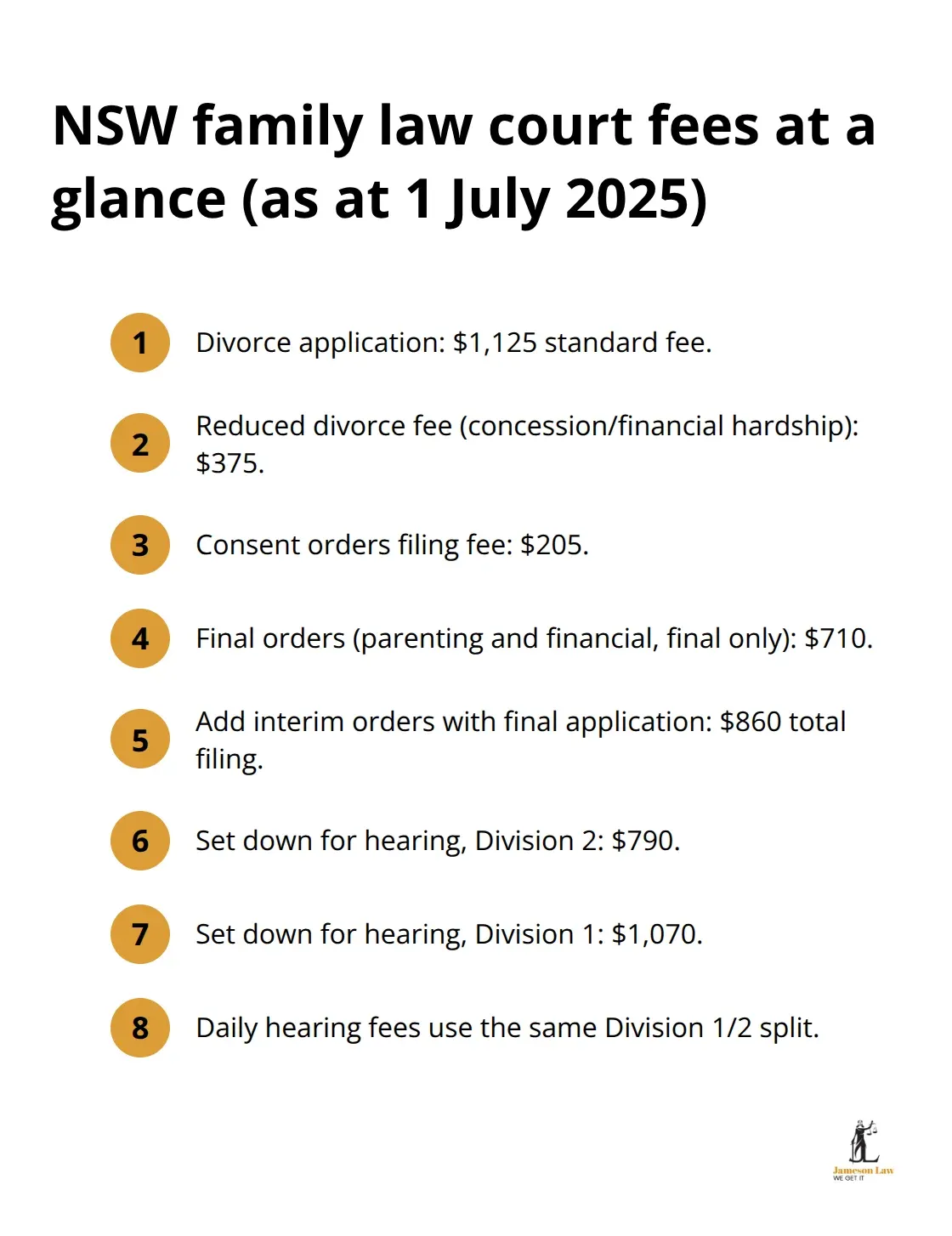
Court fees represent the first tangible expense you’ll encounter when filing a family law matter in NSW. The Federal Circuit and Family Court of Australia sets these fees under federal regulations, and they vary depending on what you file. An application for divorce costs $1,125, though you can access a reduced fee of $375 if you qualify based on financial hardship or holding a government concession card. If you seek consent orders, you’ll pay $205. For parenting and financial matters filed together as final only, expect $710, jumping to $860 if you also need interim orders.

Court event fees add another layer: setting down for a hearing costs $790 in Division 2 or $1,070 in Division 1, with daily hearing fees using the same split. These are fixed amounts as of 1 July 2025, so budget accordingly and check the current schedule before filing.
Solicitor and Barrister Rates in NSW
Solicitor and barrister rates in NSW vary significantly based on experience and location. Senior associates typically charge $3,000–$6,000 per day in court, while junior lawyers cost considerably less but may take longer to resolve your matter. Outside of court, most solicitors bill between $200–$500 per hour, though fixed-fee arrangements for straightforward advice or document drafting commonly range from $2,000–$5,000. A retainer of $5,000–$20,000 is standard to cover preparation and final trial attendance, with unused funds refunded at the end. Sydney CBD firms charge more than regional NSW practices due to higher overheads and demand, so exploring regional options can meaningfully reduce your overall bill. Barrister fees follow similar patterns: $200–$500 per hour or daily rates when a final hearing occurs. The experience level matters enormously here; a more senior practitioner costs more per hour but resolves issues faster, potentially reducing total hours and your final bill.
Expert Witnesses and Additional Services
Beyond court and solicitor fees, expert witnesses and additional services quickly escalate costs. Family reports prepared by court-appointed specialists often range from $2,000 to $7,000. Mediation and family dispute resolution services sit in the $10,000–$30,000 range for negotiations or settlement conferences, though these costs often prove far cheaper than proceeding to a contested final hearing, which can exceed $100,000 per person in complex matters.
What You Should Ask Your Lawyer
Before hiring any lawyer, ask directly about each team member’s hourly rate, any travel or communication charges, whether they can provide a total fee estimate, and what additional expenses might arise. Regularly review your invoices to catch billing issues early, and seek clarification on any charges you don’t understand before work proceeds further.
Real Cost Ranges for Different Matter Types
The Federal Circuit and Family Court of Australia data shows that uncontested divorces typically cost $1,000 to $5,000, while parenting disputes can range significantly depending on evidence complexity and court steps required. Complex property settlements involving businesses, trusts, or overseas assets can easily exceed $100,000. This wide range reinforces why a written cost estimate upfront matters-it allows you to understand your exposure and make informed decisions about whether to pursue litigation or explore alternative pathways that might suit your situation better.
What Really Drives Your Family Law Costs
Complexity Creates the Biggest Cost Swings
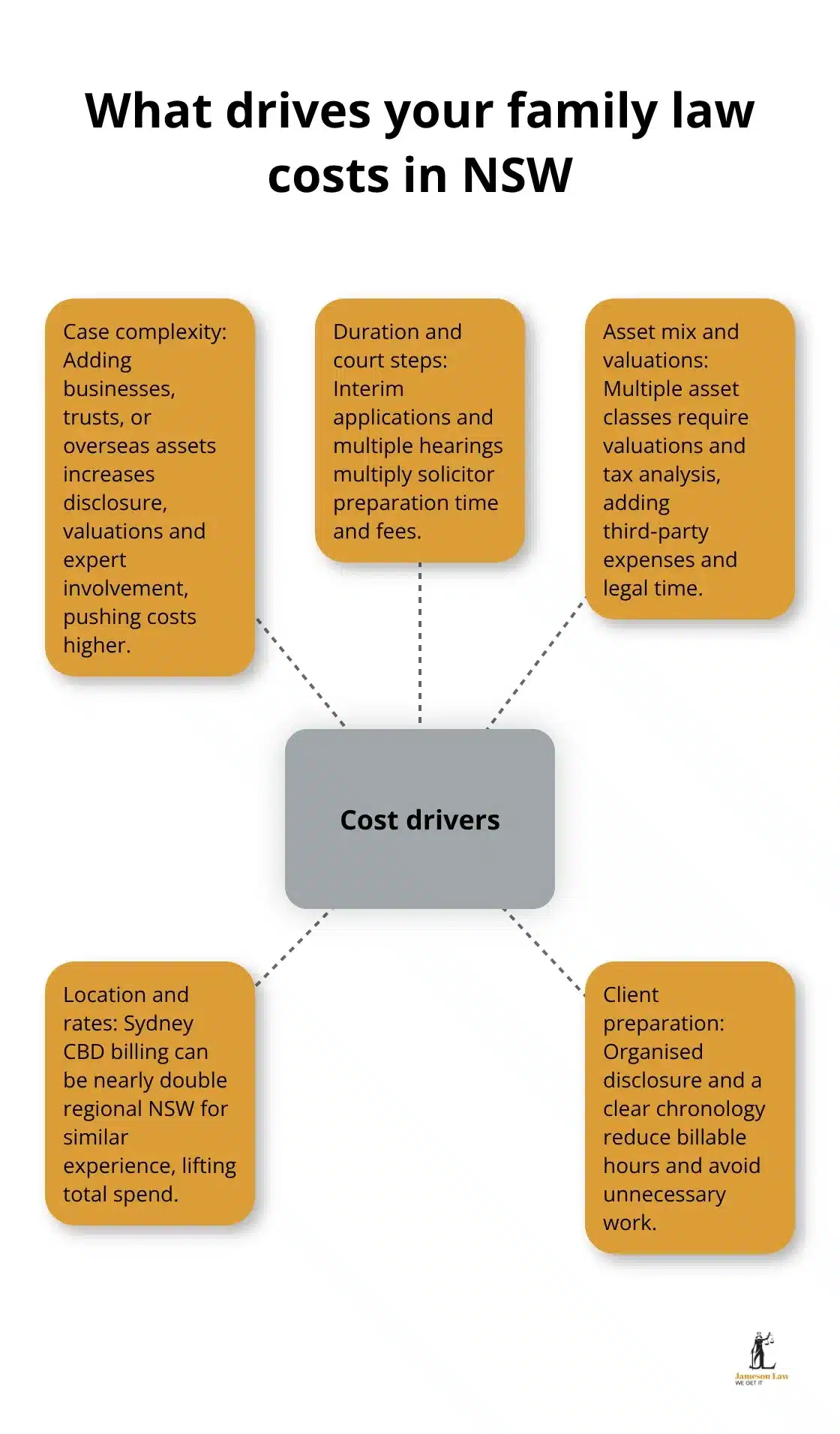
The price you pay for family law depends far less on fixed formulas and far more on three interconnected variables that shift throughout your case. Complexity sits at the centre. A straightforward uncontested divorce with no children or assets in dispute costs around $1,100 in application fees as of July 2024, but introduce a business, trust, or overseas property and costs routinely exceed $100,000 per person. Property settlements involving multiple asset classes demand extensive financial disclosure, valuations from accountants or valuers adding $600–$1,500 per property, and significantly more solicitor hours to untangle ownership structures. Parenting disputes typically land between $15,000 and $40,000 depending on how contested the matter becomes and whether expert evidence from psychologists or child specialists is required.
Duration and Court Steps Multiply Your Bill
Duration of proceedings magnifies costs directly. A matter that settles at mediation within three months costs substantially less than one that runs through disclosure, interim hearings, and finally a contested trial spanning eighteen months. Each court appearance, each round of correspondence, and each expert report extends your bill. The number of court steps matters enormously. Matters resolved by consent orders typically cost far less than those requiring interim applications, then a final hearing. Each interim step-interim parenting orders, interim financial orders-adds court fees ($150 per interim application), solicitor preparation time, and potentially barrister fees if representation is needed. The contested nature of your case determines whether you’ll face one final hearing or multiple contested interlocutory applications. Straightforward matters with cooperative parties resolve faster and cheaper. Highly contested matters with parties at odds on every issue require extensive evidence gathering, expert reports, and multiple court appearances.
Asset Complexity and Location Affect Rates Significantly
Your matter’s specific facts determine which cost drivers dominate. If you own a small investment property with a straightforward mortgage, costs stay predictable. If you own shares in a family business, hold superannuation with multiple accounts, or have asset complexity in family law cases involving business interests trusts and overseas property, costs escalate sharply because your lawyer must understand tax implications, corporate structures, and beneficiary interests. Location influences rates significantly. Sydney CBD solicitors charge substantially more per hour than regional NSW practitioners, sometimes double the rate for equivalent experience. A senior solicitor in the city might bill $400–$500 per hour while a regional practitioner with similar experience charges $250–$350 per hour. Over a 100-hour matter, that difference amounts to $15,000–$20,000.

How Your Preparation Level Impacts the Final Bill
Your own preparation level affects costs directly. Clients who arrive with organised bank statements, superannuation records, asset valuations, and a clear chronology of events reduce solicitor time spent on research and document gathering. Disorganised disclosure packages force your lawyer to spend additional hours locating and verifying information, inflating costs significantly. The type of family law matter matters too. Divorce applications alone are relatively contained expenses, but parenting disputes combined with property settlements create compounding complexity. A case involving all three elements-divorce, children’s arrangements, and asset division-demands coordinated strategy across multiple fronts, multiplying solicitor time and court steps. Understanding these cost drivers helps you anticipate where your matter will land on the expense spectrum and what steps you can take to control them before costs spiral beyond your budget.
How to Cut Family Law Costs Without Sacrificing Your Outcome
Mediation and Alternative Dispute Resolution Deliver Real Savings
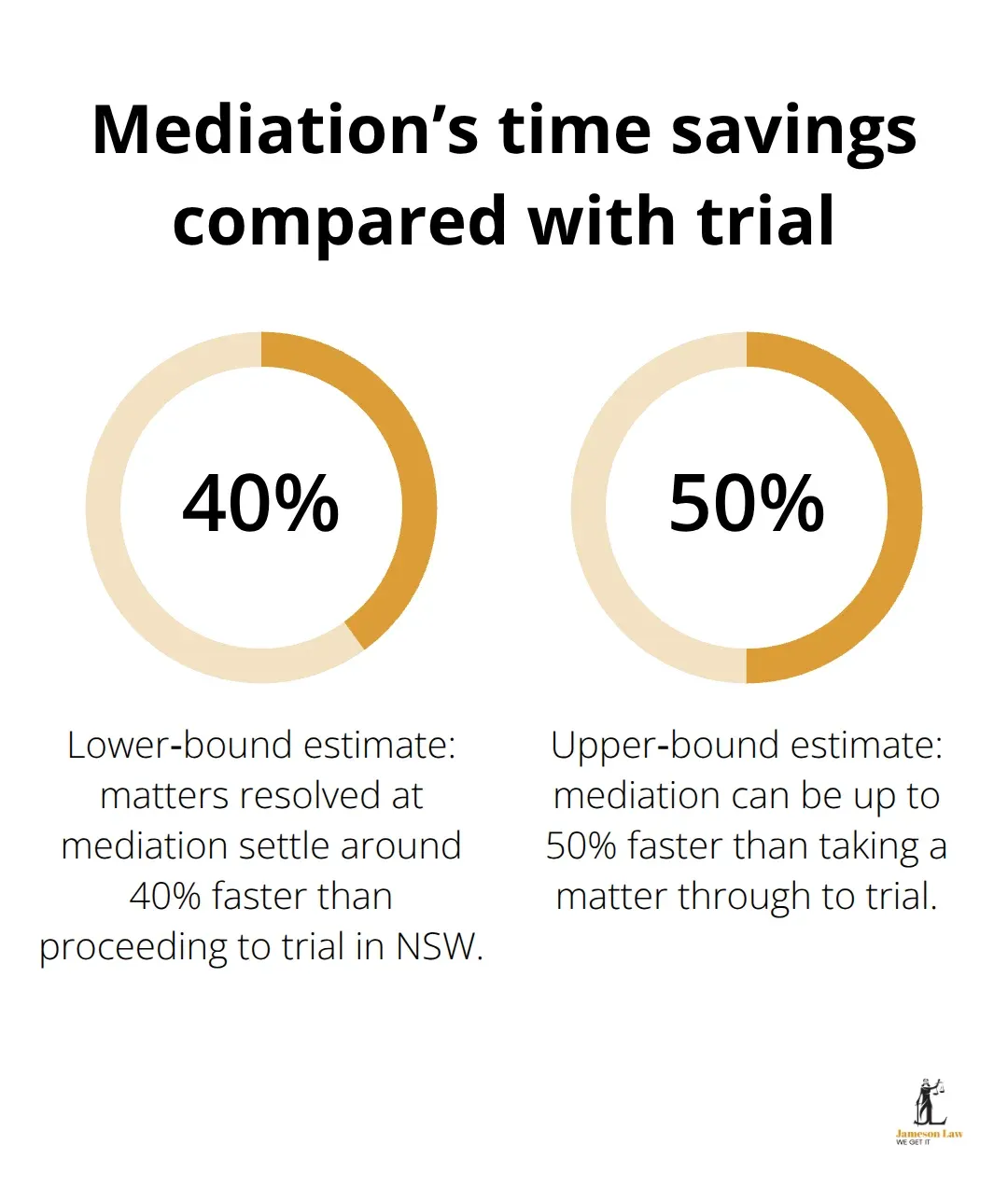
Mediation and Alternative Dispute Resolution (ADR) represent the single most effective cost-reduction strategy available to you. When you settle a matter through mediation rather than litigation, you avoid the compounding expense of court appearances, expert evidence, and barrister fees that drive costs beyond $100,000 per person in contested hearings. A mediation session typically costs $490 for both parties according to Federal Court fee schedules, yet resolves matters that might otherwise consume $30,000 to $50,000 in legal fees. Relationships Australia NSW operates mediation services specifically designed for family disputes, and evidence shows that matters resolved through mediation settle 40–50% faster than those proceeding to trial. This speed reduction translates directly to lower solicitor hours.

If your matter involves parenting arrangements or property division, early mediation prevents the accumulation of interim court applications, each of which adds $150 in court fees plus solicitor preparation time. The practical reality is this: contested trials demand extensive evidence gathering, expert reports costing $5,000–$15,000 each, and multiple court steps spanning 12–18 months. Mediation compresses this timeline to weeks or months and eliminates most expert costs entirely.
Fixed-Fee Arrangements Control Your Budget
Fixed-fee arrangements offer another lever for cost control, particularly for discrete tasks within your matter. Rather than hourly billing at $200–$500 per hour, you can negotiate fixed fees for defined tasks and get the scope in writing. This approach removes uncertainty from your budget and prevents cost overruns if your lawyer requires additional research time. Ask your solicitor upfront whether they offer fixed fees for defined tasks and get the scope in writing.
Legal Aid NSW and Community Support Programs
Legal Aid NSW provides means-tested support for eligible applicants, with grants available through multiple pathways including Early Resolution Assistance (ERA) for faster access and Extended Legal Assistance (ELA) for complex matters. The Simplified Means Test streamlines eligibility decisions, and you can apply online via LawAccess NSW or contact the service directly. If you qualify, Legal Aid covers legal advice, court representation, or both, potentially eliminating solicitor costs entirely. Even if you don’t qualify for full coverage, Legal Aid NSW assesses contributions on a sliding scale based on your financial circumstances, making legal support accessible when cash flow is tight.
Beyond Legal Aid, Community Legal Centres NSW offer free or low-cost advice for family law matters, and some law firms provide pro bono services for clients experiencing genuine financial hardship. Before pursuing litigation, verify your eligibility for these schemes because the difference between paying full solicitor rates and accessing subsidised assistance can exceed $20,000–$30,000 across your matter.
Preparation and Transparency Reduce Billable Hours
Your own preparation directly reduces what your solicitor charges you in billable hours. Organising bank statements, superannuation statements, property valuations, and asset records before your first consultation eliminates research time your lawyer would otherwise bill. A comprehensive disclosure package prepared in advance can reduce solicitor hours by 10–20%, translating to $2,000–$5,000 in savings on matters lasting several months. Request a cost estimate upfront and revisit it monthly as your case progresses, ensuring costs remain aligned with your budget and strategy. If costs escalate unexpectedly, discuss whether your legal strategy can shift toward settlement or ADR rather than continuing toward trial. Transparency about your budget constraints allows your solicitor to tailor advice accordingly and prioritise cost-effective pathways.
Final Thoughts
Family law costs NSW vary dramatically based on how you approach your matter from day one. An uncontested divorce costs around $1,100 in court fees, while complex property settlements involving businesses or trusts routinely exceed $100,000 per person. The difference lies in whether you settle early through mediation or proceed to a contested trial spanning months, making your initial strategy decision the single most important cost factor you control.
Getting a written cost estimate upfront matters more than almost any other step you can take. Ask your solicitor directly about hourly rates, retainer amounts, what fixed fees include, and what additional costs might emerge as your case progresses. If costs escalate unexpectedly, discuss whether shifting toward mediation or settlement makes financial sense rather than continuing toward trial, and explore Legal Aid NSW if you qualify for means-tested support.
Your preparation level directly reduces what you’ll pay-organising bank statements, superannuation records, and asset documentation before your first consultation eliminates research time your lawyer would otherwise bill. We at Jameson Law work with families navigating these decisions every day and provide transparent cost estimates upfront to help you understand whether litigation, mediation, or settlement makes sense for your situation. Contact us at (02) 8806 0866 or book a consultation online to discuss your family law matter and get clarity on costs before you commit to any pathway forward.