Bringing family members to Australia through a family visa NSW requires understanding multiple visa types and meeting strict eligibility criteria. The process involves financial assessments, health checks, and substantial documentation that many applicants find overwhelming.
We at Jameson Law have guided hundreds of families through this journey, and we know where applications typically stumble. This guide walks you through each stage so you can avoid costly delays and rejections.
Family Visa Options in Australia
Australia’s family visa system offers three primary pathways, each with distinct eligibility requirements and processing considerations. Partner visas allow Australian citizens or permanent residents to sponsor their spouse or de facto partner, making this the most common family visa category. Parent visas enable adult children to sponsor their parents, though these visas operate under strict financial thresholds that often catch applicants off guard. Child visas serve a different purpose entirely, allowing parents to sponsor dependent children or adopted children into Australia. The critical distinction lies in who sponsors whom and what financial commitments each visa type demands.
Partner Sponsorship and Relationship Proof
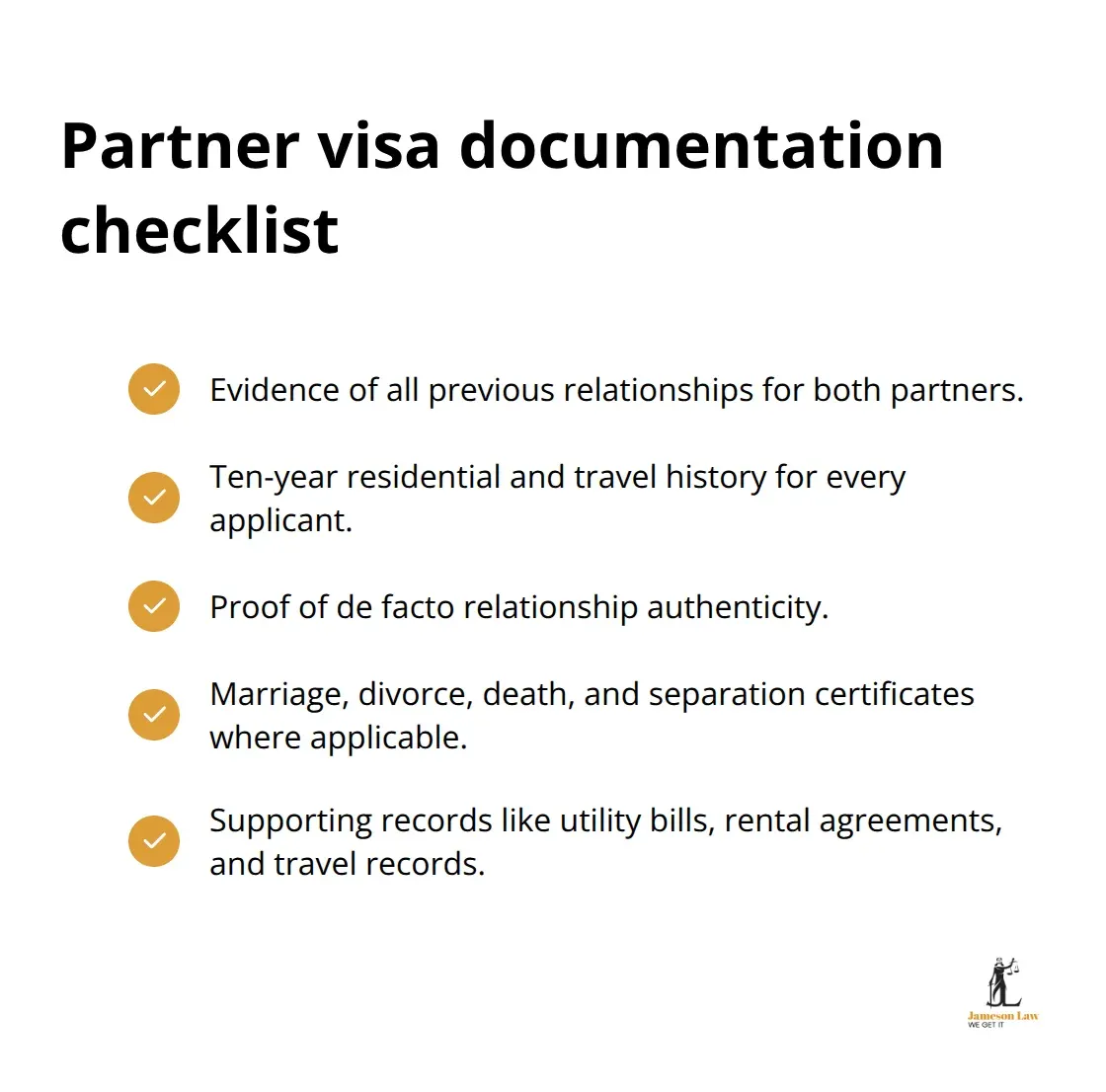
Partner visas demand comprehensive relationship history documentation spanning your entire relationship, not just recent years. The Department of Home Affairs requires evidence of all previous relationships for both partners, including marriage certificates, divorce documents, death certificates, and separation papers as applicable. The department scrutinises relationship authenticity thoroughly, particularly for de facto partnerships. You must provide ten years of residential and travel history for every applicant, including any dependent children, which means you need to gather utility bills, rental agreements, travel records, and address confirmations spanning a decade.

Name consistency across all documents proves more important than most people realise-any spelling variation between your passport and other documents creates processing delays. If the department requests biometric data, you must provide it within the specified timeframe because delays here directly extend your overall processing time. Applications submitted through ImmiAccount, the Department’s online portal, allow you to track progress and respond quickly to information requests, which significantly improves processing outcomes.
Parent Visa Sponsorship Requirements
Parent visa sponsorship operates differently because the adult child becomes the financial guarantor, not the parent. The sponsor must lodge the sponsorship application first and obtain approval before the parent can apply. The sponsor must provide a Notice of Assessment from the Australian Taxation Office proving sufficient income. This two-stage process frustrates many families because the parent cannot progress their application until the sponsor’s financial documentation passes departmental scrutiny.
The Sponsored Parent Temporary visas income threshold typically excludes many middle-income Australian families, making this option inaccessible despite strong family connections. Health and character assessments apply to all family visa types, with penal checks required for applicants over seventeen from certain countries.
Child Visas and Dependent Family Members
Child visas require evidence of the parent-child relationship established through birth certificates and passports. If IVF or surrogacy was involved in conception, you must include all medical records and custody documentation to establish parental rights. For applicants under eighteen, you may need police checks from every country where you spent more than twelve months.
Partner visas typically require the sponsoring partner to meet income thresholds and pass character assessment, while parent visas flip this around by requiring the adult child sponsor to demonstrate they can financially support their parents for ten years. Child visas focus on establishing the parent-child relationship through birth certificates, passports, and in cases involving surrogacy or IVF, comprehensive medical and custody documentation. Understanding these distinctions helps you prepare the correct documentation and avoid costly delays before you lodge your application.
What Stops Family Visa Applications
Financial Thresholds and Income Requirements
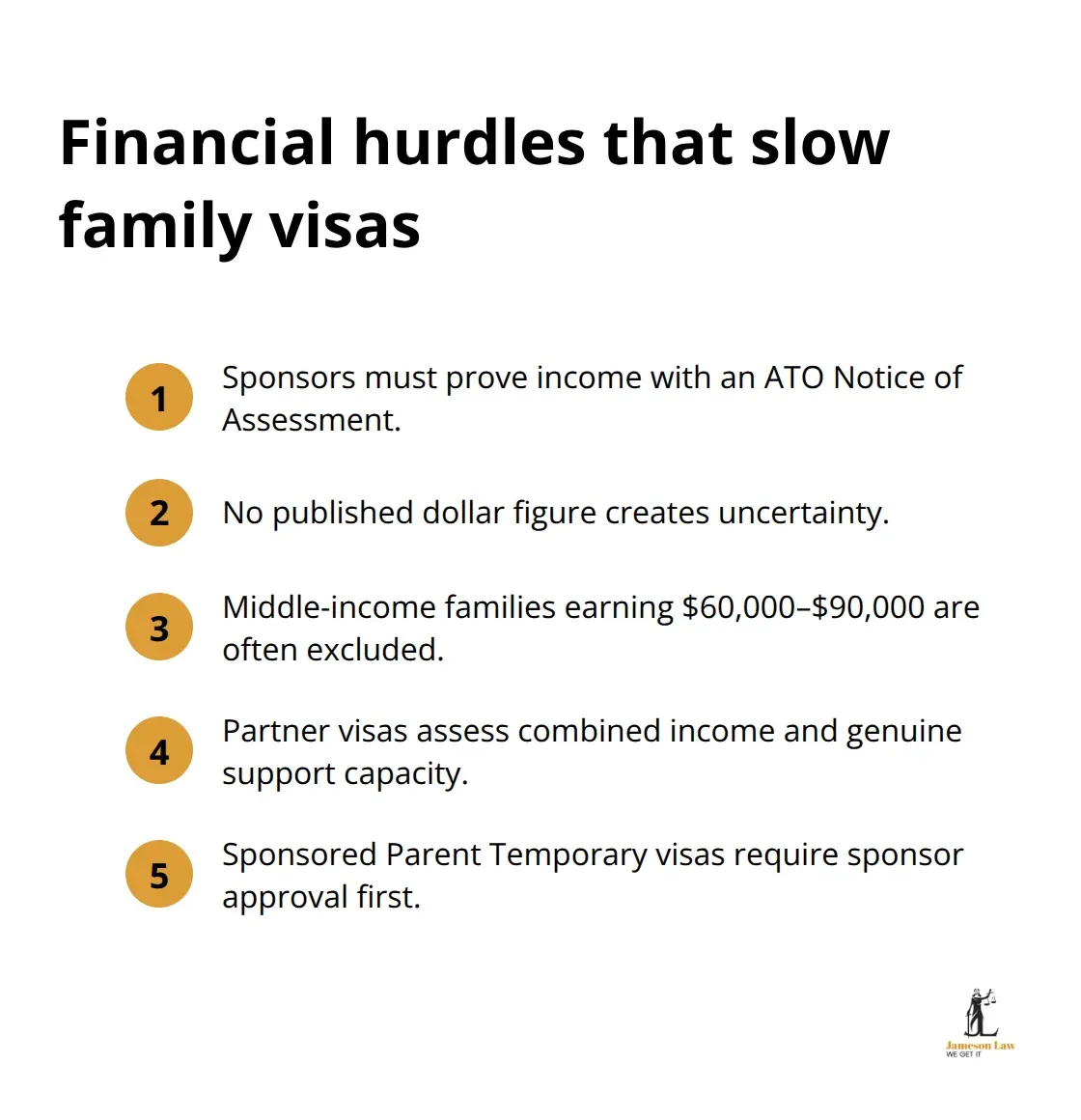
Financial thresholds represent the first major hurdle most families encounter. For parent visas, the sponsoring adult child must prove they can support their parents, and financial thresholds for parent visas create significant barriers for many families. The Department of Home Affairs does not publish a specific dollar figure, but the threshold effectively prices out families earning between $60,000 and $90,000 annually.

Partner visas involve different financial assessments focused on the couple’s combined income and assets, though the department scrutinises whether the sponsoring partner can genuinely support a dependent without government assistance. If you apply for a Sponsored Parent Temporary visa, your Notice of Assessment must show sufficient income before your parent can lodge their application, creating a two-stage financial gatekeeping system that delays everything.
Health and Character Assessment Costs
Health assessments require a civil surgeon’s examination and chest X-ray for most applicants, costing between $500 and $800, plus additional specialist assessments if the department identifies health concerns. Character checks involve police clearances from every country where you spent more than twelve months, and applicants over seventeen face penal checks that can take weeks to obtain from overseas authorities. The character assessment extends beyond criminal history to examine your general conduct, meaning traffic violations, fraud allegations, or immigration violations all trigger additional scrutiny.
Documentation Gaps and Missing Records
Documentation proves where most applications actually fail. Incomplete documentation stands as the primary culprit that slows applications, with the department demanding residential and travel history for the past 10 years for every applicant, which sounds straightforward until utility bills disappear, rental agreements get lost, and people cannot locate proof of where they lived in 2015. Partner visas require evidence of all previous relationships for both applicants, not just the current one, meaning you need divorce decrees, death certificates, and separation documentation spanning decades. Child visas involving surrogacy or IVF demand medical records, custody agreements, and court orders proving parental rights-documents that many families never anticipated needing.
Translation and Name Consistency Issues
Name consistency across all documents matters more than people expect because any spelling variation between your passport and birth certificate creates processing delays that the department will not overlook. Translation of non-English documents must include the NAATI practitioner number if translated in Australia, or the translator’s name and qualifications if translated overseas, and many families submit translations without this information and watch their applications stall. Submitting online through ImmiAccount from the start eliminates the complication of importing paper applications later, which adds weeks to processing times.
Preparing Before You Lodge
Gathering your complete ten-year residential history before you lodge anything prevents the department from requesting missing documentation later, which extends processing times significantly. Once the department identifies gaps in your application, the delays compound quickly, making thorough preparation at the outset the most efficient approach. Understanding these obstacles allows you to address them systematically before submission, positioning your application for faster processing and reducing the likelihood of rejection.
How to Lodge and Track Your Family Visa Application
Submitting Your Application Online
ImmiAccount provides the fastest path to approval, and you must submit your application online from the outset to avoid weeks of delay compared to paper applications that require later importing. You cannot progress incomplete applications, so complete all required documentation before you lodge anything. Submitting prematurely forces you into a cycle of information requests that extends processing times unnecessarily. Partner visas require you to declare your full relationship history, including all previous relationships for both applicants, and the Department of Home Affairs cross-references this against your travel history and residential records to verify authenticity.
Parent visas demand your Notice of Assessment from the Australian Taxation Office before the sponsorship approval, which means your sponsor must lodge first and secure approval before you submit anything. Once you lodge, the department sends an acknowledgement letter within days containing your application reference number that you use to track progress through ImmiAccount. The department contacts you only when they need additional information or documents, so you must check ImmiAccount regularly to prevent missed deadlines that could result in refusal.
Tracking Progress and Department Communications
The Department of Home Affairs does not publish fixed processing timeframes, making it impossible to predict your exact outcome. Partner visas typically take 12 to 24 months while parent visas often extend to 24 months or longer due to financial verification requirements. Applicants who provide decision-ready applications with all documents, correct information, and prompt responses to information requests consistently experience faster processing.
The department may request biometric data, health assessments, or character checks at any stage, and you must respond within the specified timeframe because delays directly extend your overall processing time. If the department identifies gaps in your documentation or inconsistencies in your application, they issue a request for additional information with a specified deadline, and missing this deadline results in refusal without further opportunity to respond.
Managing Health and Character Assessments
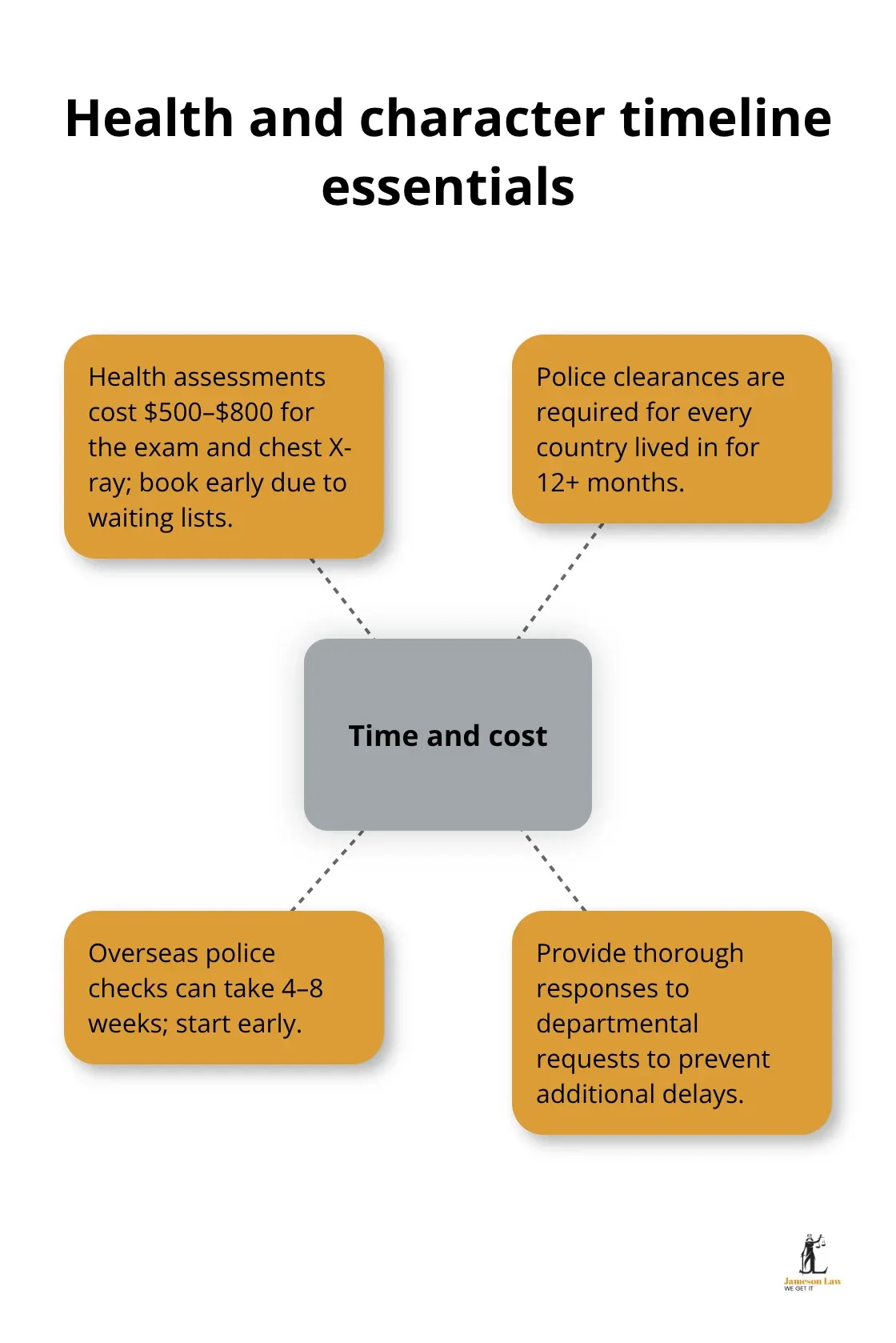
Health assessments cost between $500 and $800 for the civil surgeon examination and chest X-ray, and you should book these appointments early because some civil surgeons have waiting lists extending several weeks. Character checks require police clearances from every country where you spent more than twelve months in the past ten years, and obtaining these from overseas authorities can take 4 to 8 weeks, making early action essential.

You must provide comprehensive answers to all departmental requests rather than minimal responses, because thorough replies reduce follow-up requests and accelerate processing toward approval. This approach prevents the department from issuing additional information requests that compound delays unnecessarily.
Final Thoughts
Family visa NSW applications succeed when you prepare thoroughly before you lodge anything and understand which visa type matches your situation. Partner visas demand comprehensive relationship history and ten-year residential records, parent visas require financial proof from your sponsor, and child visas focus on establishing parental relationships through birth certificates and medical documentation where applicable. The most common rejections stem from incomplete documentation, name inconsistencies across records, missing NAATI numbers on translations, and underestimating health assessment costs or character check timelines.
Submitting through ImmiAccount from the outset prevents weeks of delay that paper applications create when imported later, and responding promptly to departmental requests accelerates processing significantly. Financial thresholds for parent visas often surprise families, and understanding these barriers before you invest time and money prevents wasted effort on applications that won’t succeed. Health assessments cost between $500 and $800, while overseas police clearances take 4 to 8 weeks to arrive, so you must plan accordingly.
We at Jameson Law help families navigate family visa NSW applications by identifying documentation gaps, explaining financial requirements specific to your circumstances, and preparing responses that strengthen your case. Contact Jameson Law today to discuss your family visa application and move forward with confidence.