PUBLICATION

Partner Visa Eligibility Australia: Are You Eligible?

"Check your partner visa eligibility for Australia with our complete requirements guide. Understand financial, relationship, and character criteria now."
Partner Visa Eligibility Australia: Are You Eligible?

Partner visas open doors for couples who want to build their lives together in Australia. But getting approved isn’t automatic-immigration authorities have strict eligibility requirements you need to meet.

We at Jameson Law help people navigate partner visa eligibility Australia every day. This guide breaks down what you need to know about relationship recognition, character assessments, financial capacity, and the documentation that matters most.

What Makes You Eligible for a Partner Visa

The Department of Home Affairs sets three non-negotiable foundations for partner visa approval: your relationship must be genuine, both you and your sponsor must pass character and health checks, and your sponsor must demonstrate financial capacity to support you. These aren’t boxes to tick superficially-immigration officers scrutinise each element carefully, and weak evidence in any area can delay or reject your application by months or years.

Infographic showing the three core eligibility pillars for Australian partner visas

Proving Your Relationship Is Real

A genuine relationship means more than saying you love each other. The Department of Home Affairs looks for evidence of cohabitation, joint financial commitments, social recognition from family and friends, and ongoing communication patterns. Start collecting this evidence now, not when you apply. Marriage certificates are straightforward, but de facto relationships require stronger documentation. Joint bank statements, shared lease agreements, photos together spanning months or years, emails and messages showing regular contact, and statutory declarations from people who know you both carry real weight. If you’ve been together for less than two years, expect more scrutiny-there’s no minimum relationship length, but officers will want proof the relationship isn’t rushed or based on immigration convenience. Many applications stall because applicants underestimate how much evidence officers need. One statutory declaration from a friend won’t suffice. You need multiple forms of proof showing the relationship operates across different areas of life: financial, domestic, and social.

Character and Health Requirements

Both you and your sponsor must obtain police clearance certificates from every country where you’ve lived for six months or longer in the past ten years. This is mandatory, not optional. Health examinations are equally strict. You’ll undergo a medical assessment that checks for conditions affecting public health or creating healthcare costs for Australia. Health results remain valid for twelve months, so time your medical strategically within your application timeline. If the Department requests additional health information, you must respond within the timeframe specified-delays here can push your processing time from months into years. Your sponsor also faces character assessment. If your sponsor has any criminal history, traffic offences, or character concerns, you should disclose them early. Hiding issues guarantees rejection. The Department runs thorough background checks on both parties, and anything discovered during processing that wasn’t disclosed becomes grounds for refusal.

Your Sponsor’s Financial Responsibility

Your Australian sponsor must prove they can support you financially during your temporary visa period, which typically lasts two years. This isn’t theoretical-the Department wants evidence of actual income. Tax returns, payslips, employment letters, and bank statements showing consistent deposits matter. If your sponsor earns less than the required threshold, they can add a second sponsor or co-sponsor (though this complicates the application). Assets like property can count toward financial capacity, but liquid assets matter more. The sponsor’s obligation continues for the entire temporary visa period. If your sponsor loses employment or their circumstances change significantly, you should notify the Department using the Partner Processing Enquiry Form. Failing to disclose changed circumstances can result in visa cancellation after approval. Discussing financial obligations thoroughly with your sponsor before applying proves essential-misaligned expectations about money cause relationship breakdowns during the visa processing period, which then requires reporting to immigration authorities.

Moving Forward With Your Documentation

Once you understand these three pillars of eligibility, the next step involves assembling the specific documents that prove you meet each requirement. The Department of Home Affairs has detailed lists for every visa subclass, and knowing exactly what to submit upfront prevents costly delays.

Which Partner Visa Should You Apply For

Australia offers two distinct pathways for partner visas, and your choice determines where you apply, how long processing takes, and when you can enter Australia. The onshore subclasses 820 and 801 suit couples already in Australia or those who can arrive on another visa first, while the offshore subclasses 309 and 100 are designed for partners applying from outside Australia. This distinction matters because onshore applications let you work and study in Australia immediately after temporary visa grant, whereas offshore applicants must wait for approval before entering the country.

Onshore Versus Offshore: Which Route Fits Your Situation

Processing times differ significantly between the two pathways. Temporary onshore visas typically process within several months, but offshore applications can take considerably longer because the Department of Home Affairs must conduct more extensive background checks without direct access to Australian records. The permanent stage of both pathways takes roughly two years after temporary grant, assuming your relationship remains genuine and circumstances don’t change.

Compact list comparing onshore (820/801) and offshore (309/100) partner visa pathways in Australia - partner visa eligibility Australia

If you’re already in Australia on a student or work visa, the onshore route (820/801) means you maintain your current visa rights while your partner visa processes. If you’re overseas, the offshore route (309/100) is your only option, but you’ll spend months waiting for the temporary visa before you can move to Australia. Most couples underestimate how much their choice of visa subclass affects their life during processing.

De Facto Relationships: Stricter Evidence Standards

De facto relationships and same-sex partnerships follow identical eligibility pathways to marriages, with one critical difference: evidence standards are stricter. The Department of Home Affairs treats de facto relationships the same way under immigration law as marriages, but officers scrutinise the evidence more thoroughly because there’s no formal registration to prove the relationship exists.

For de facto couples, cohabitation evidence becomes your strongest proof. Lease agreements showing both names, joint utility bills spanning at least several months, and statutory declarations from people who’ve visited your home together carry substantial weight. The Department doesn’t require a minimum relationship length, but officers will want proof the relationship isn’t rushed or based on immigration convenience.

Same-Sex Partnerships and Equal Recognition

Same-sex partners have full equality under Australian immigration law since 2017, and the visa application process is identical to opposite-sex couples. However, some applicants from countries where same-sex relationships aren’t recognised face additional scrutiny regarding their sponsor’s genuine commitment.

If you’re in a same-sex relationship and your home country doesn’t recognise your partnership, gather extra evidence of social recognition such as photos at events, communications from friends acknowledging your relationship, and employment records listing your partner as a nominated emergency contact. Thorough documentation prevents unnecessary delays when officers assess applications from culturally conservative backgrounds.

Selecting Your Visa Subclass and Moving to Documentation

Your visa subclass choice shapes your entire application timeline and your ability to work in Australia during processing. Once you’ve determined whether onshore or offshore suits your circumstances, the next step involves identifying the specific documents that prove you meet eligibility requirements for your chosen pathway.

What Documentation Proves You Meet Each Requirement

The Department of Home Affairs rejects vague claims about your relationship, finances, or character. Officers need specific documents that demonstrate you genuinely meet eligibility criteria across three distinct areas. Start collecting evidence now, not months into the application process. Many applications delay because applicants scramble to gather documents after submission, forcing the Department to request additional information multiple times.

Financial Documentation for Your Sponsor

Tax returns, payslips, and employment letters for your sponsor should span the last two years and show consistent income. Bank statements revealing joint accounts, regular transfers between partners, or shared expense payments carry weight that income documents alone cannot match. If your sponsor’s income falls below the required threshold, a co-sponsor’s financial documents become necessary, but this adds complexity and processing time.

Property valuations, investment statements, and superannuation balances count as assets, though the Department prioritises liquid funds over property. Gather documents that show your sponsor can support you financially during your temporary visa period, which typically lasts two years. The Department wants evidence of actual income, not theoretical capacity.

Relationship Evidence Across Multiple Contexts

Statutory declarations from at least three people who know you both well carry substantial weight. These declarations must come from different contexts-a family member, a friend, and a work colleague creates stronger evidence than three friends. Each declarant should address how long they have known you both, in what context, and provide concrete examples of the relationship’s genuineness.

Marriage certificates are straightforward if you’re married, but de facto couples need lease agreements showing both names, utility bills in both names spanning several months, and joint insurance policies. Photographs spanning years, not weeks, demonstrate the relationship’s longevity. Email threads, text messages, and social media posts showing regular communication matter more than people expect. Joint bank statements showing regular deposits from both partners and shared withdrawals for household expenses demonstrate financial interdependence more convincingly than separate accounts with occasional transfers.

De facto couples face stricter scrutiny because there’s no registration document. The Department treats de facto relationships identically to marriages under law, but officers need proof the relationship genuinely exists. Cohabitation evidence becomes paramount. Lease agreements showing both names, utility bills in both names, and council rates notices address both partners as residents. If you own property together, the title deed serves as powerful evidence. Joint superannuation nominations, life insurance with your partner as beneficiary, and medical directives naming your partner demonstrate commitment beyond cohabitation alone.

Health and Character Assessment Timelines

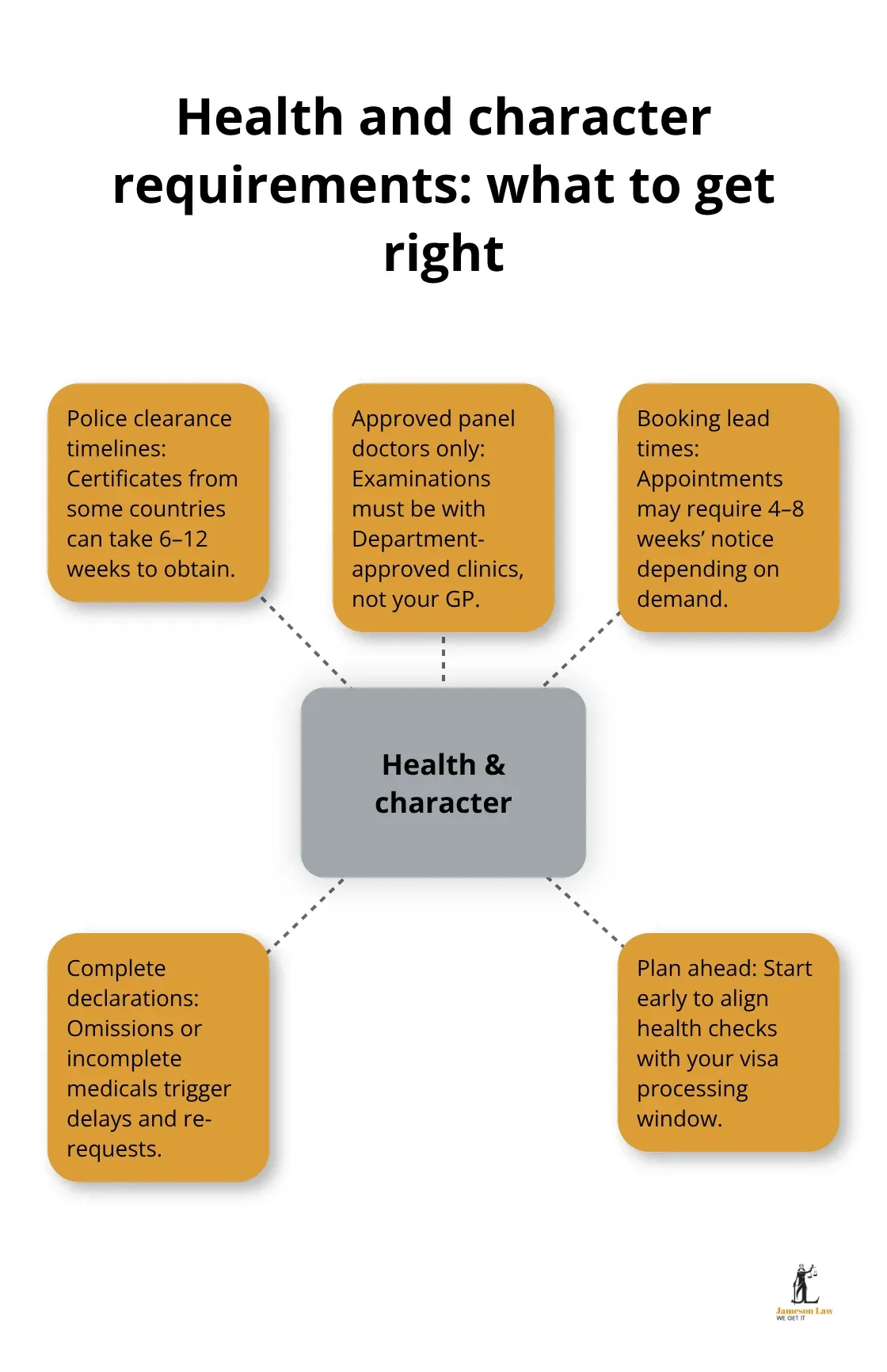
Health examinations take longer than most applicants expect. Panel doctors approved by the Department conduct the examination, which involves a medical history review, physical examination, and pathology tests. Results typically arrive within two to three weeks, but the Department’s assessment of those results adds another two to four weeks. If the Department identifies a health concern requiring further investigation, additional specialist reports become necessary, extending this timeframe substantially. Health examination results remain valid for twelve months from the date of the medical, so schedule your appointment strategically within your application timeline.

Three-point overview of health examination timing, police certificate waits, and character checks for Australian partner visas - partner visa eligibility Australia

Police clearance certificates present similar delays. Australian state and territory authorities process requests within four to eight weeks typically, but international certificates take considerably longer. If you’ve lived in the United Kingdom, Canada, or New Zealand, expect six to twelve weeks. Some countries provide certificates within days, while others require months. Request certificates from all relevant countries simultaneously rather than sequentially. You must obtain police clearance certificates from every country where you’ve lived for six months or longer in the past ten years.

Character assessment doesn’t end with police certificates. The Department conducts its own background checks using Australian databases, interstate records, and international intelligence. If you’ve ever been charged with an offence, even if acquitted, disclose this immediately. Failure to disclose creates grounds for refusal far more serious than the original offence. Your sponsor faces identical scrutiny. Traffic offences, drink-driving convictions, and minor criminal matters must be disclosed. The Department’s character assessment process examines whether you pose risks to Australian community safety, public order, or national security. Minor matters rarely cause refusal alone, but patterns of offending do. If either you or your sponsor have character concerns, seek legal advice before applying.

Final Thoughts

Partner visa eligibility Australia requires you to satisfy three non-negotiable elements: proving your relationship is genuine, passing character and health assessments, and demonstrating your sponsor’s financial capacity. You must gather relationship evidence across multiple contexts-statutory declarations, financial records, cohabitation proof, and communications spanning months or years. You need to obtain police clearance certificates from every country where you’ve lived for six months or longer in the past decade, and you should schedule health examinations strategically, knowing results remain valid for twelve months.

Your circumstances determine which pathway suits you best. If you’re already in Australia on another visa, the onshore pathway (subclasses 820/801) allows you to work and study while processing continues, whereas the offshore route (subclasses 309/100) applies if you’re overseas, though processing takes longer. You must assemble all required documents before submitting your application through ImmiAccount-the Department of Home Affairs rejects incomplete submissions and requests additional information multiple times if documents arrive piecemeal.

Partner visa applications involve complex legal requirements and strict documentation standards that demand careful attention to detail. We at Jameson Law specialise in immigration law and help couples navigate these requirements every day, reviewing your eligibility, identifying documentation gaps, and guiding you through the entire application process. Contact Jameson Law today for expert legal support with your partner visa application.

Speak to an Expert Lawyer today

Laywers-Jameson-Law-The-best-law-firm-in-Sydney- Sydney Lawyers - Sydney
BOOK NOW

WE'RE IN IT TO WIN IT

Book your consultation

Book Now
Book Now Mobile 06 02 2025

This form submission is encrypted and secured to ensure your information remains confidential.

What our Clients

Related Publications:

What our clients say

.

Jameson Law - Voted the Best Law firm in Sydney Award

Legal Answers ... In Short

We're here to help

Our mission is to ensure our client matters are resolved successfully every time. Success to us does not simply involve winning, but moreover ensuring we take the most feasible, economic and stress-free path to help our clients achieve their goals. We fight hard for our clients, and always go by the motto: we’re in it to win it.

Jameson Law - Best Law Firm in Sydney

WE'RE IN IT TO WIN IT

Book your consultation

Call us now on (02) 8806 0866 or fill out the form below

Book Now Mobile

This form submission is encrypted and secured to ensure your information remains confidential.

WE'RE IN IT TO WIN IT

Book your consultation

Book Now Mobile 06 02 2025
lock

This form submission is encrypted and secured to ensure your information remains confidential.

Our Sydney Offices

Offices Parramatta and Sydney Jameson Law
Parramatta CBD - Head Office
jameson Law - Blacktown
jameson Law - Liverpool Office
Jameson Law - Bankstown
Court Houses We Frequent Jameson Law

Court Houses We Frequent

Balmain Local Court

Registry: Monday to Friday, 9:00am to 4:30pm

Bankstown Local Court

Court Operating Hours: 9:30am-4:30pm

Blacktown Local Court

Registry Hours: 9:00 – 4:30
Telephone Hours: 8:30 -4:30
Days open: Mon-Fri

Burwood Local Court

Registry Hours: 9:00 – 4:30
Telephone Hours: 8:30 – 4:30
Days open: Mon – Fri

Campbell Local Court

Registry Hours: 9:00 – 4:30
Telephone Hours: 8:30 – 4:30
Days open: Mon – Fri

Central Local Court

Registry Hours: 9:00 – 1:00 and 2:00 – 4:30
Telephone Hours: 8:30 – 4:30

Downing Local Court

Registry Hours: 9:00 – 1:00 and 2:00 – 4:30
Telephone Hours: 8:30 – 4:30

Wollongong Local Court

Registry Hours: 9:00 – 1:00 and 2:00 – 4:30
Telephone Hours: 8:30 – 4:30

Fairfield Local Court

Registry Hours: 9:00 – 1:00 and 2:00 – 4:30
Telephone Hours: 8:30 – 4:30

Hornsby Local Court

Registry Hours: 9:00 – 1:00 and 2:00 – 4:30
Telephone Hours: 8:30 – 4:30

Liverpool Local Court

Registry Hours: 9:00 – 1:00 and 2:00 – 4:30
Telephone Hours: 8:30 – 4:30

Manly Local Court

Registry Hours: 9:00 – 1:00 and 2:00 – 4:30
Telephone Hours: 8:30 – 4:30

Newtown Local Court

Registry Hours: 9:00 – 1:00 and 2:00 – 4:30
Telephone Hours: 8:30 – 4:30

Parramatta Local Court

Registry Hours: 9:00 – 1:00 and 2:00 – 4:30
Telephone Hours: 8:30 – 4:30

Penrith Local Court

Registry Hours: 9:00 – 1:00 and 2:00 – 4:30
Telephone Hours: 8:30 – 4:30

Sutherland Local Court

Registry Hours: 9:00 – 1:00 and 2:00 – 4:30
Telephone Hours: 8:30 – 4:30

Waverley Local Court

Registry Hours: 9:00 – 1:00 and 2:00 – 4:30
Telephone Hours: 8:30 – 4:30

Windsor Local Court

Registry Hours: 9:00 – 1:00 and 2:00 – 4:30
Telephone Hours: 8:30 – 4:30

Wollongong Local Court

Registry Hours: 9:00 – 1:00 and 2:00 – 4:30
Telephone Hours: 8:30 – 4:30

Downing Centre District Court

Registry Hours: 9:00 – 4:30
Telephone Hours: 8:30 – 4:30
Days open: Mon – Fri

Parramatta District Court

Registry Hours: 9:00 – 4:30
Days open: Mon-Fri

Penrith District Court

Registry Hours: 9:00 – 4:30
Days open: Mon-Fri

Campbelltown District Court

Registry Hours: 9:00 – 4:30
Days open: Mon – Fri

Liverpool District Court

Registry Hours: 9:00 – 4:30
Days open: Mon – Fri

Wollongong District Court

Registry Hours: 9:00 – 1:00 and 2:00 – 4:30
Telephone Hours: 8:30 – 4:30

Supreme Court New South Wales

Registry Hours: 9:00 AM – 4:30 PM
Telephone Hours: 8:30 AM – 4:30 PM
Days Open: Monday to Friday

Federal Circuit and Family Court of Australia

Registry Hours: 9:00 AM – 4:30 PM
Telephone Hours: 8:30 AM – 5:00 PM
Days Open: Monday to Friday

Federal Court

Monday to Friday, 8:30 AM – 4:30 PM

High Court

Monday to Friday, 8:30 AM – 5:00 PM

Children’s Court of New South Wales

Registry Hours: 9:00 AM – 4:30 PM
Telephone Hours: 8:30 AM – 4:30 PM
Days Open: Monday to Friday

Coroner’s Court New South Wales

Registry Hours: 9:00 AM – 4:30 PM
Telephone Hours: 8:30 AM – 4:30 PM
Days Open: Monday to Friday

Industrial Relations Commission of New South Wales

Registry Hours: 9:00 AM – 4:30 PM
Telephone Hours: 8:30 AM – 4:30 PM
Days Open: Monday to Friday

Land and Environment Court of New South Wales

Registry Hours: 9:00 AM – 4:30 PM
Telephone Hours: 8:30 AM – 4:30 PM
Days Open: Monday to Friday

WE'RE IN IT TO WIN IT

Book your consultation

Book Now
Book Now Mobile 06 02 2025
lock

This form submission is encrypted and secured to ensure your information remains confidential.