Australia’s visa system is complex, with dozens of pathways designed for different circumstances. Getting it wrong can cost you months of delays or outright rejection.
At Jameson Law, we’ve helped hundreds of applicants navigate these requirements successfully. This guide walks you through the visa types, common pitfalls, and how an immigration lawyer in Australia can strengthen your application.
Visa Pathways That Match Your Situation
Australia’s visa system splits into four main categories, each designed for different circumstances and outcomes. Understanding which pathway applies to you is the first step toward a successful application.
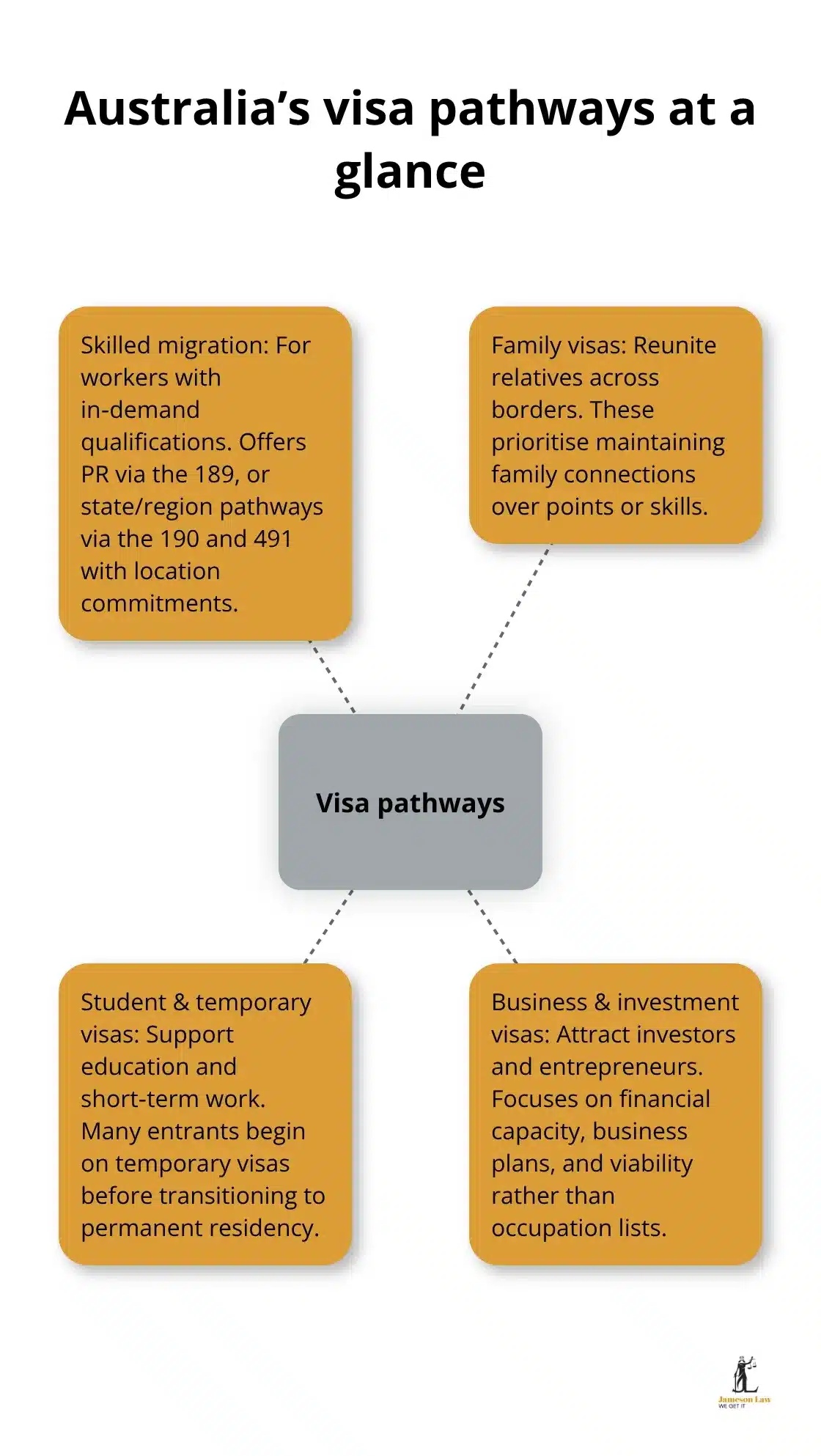
The skilled migration route targets workers with in-demand qualifications, family visas reunite relatives across borders, student and temporary visas support education and short-term work, and business visas attract investors and entrepreneurs. Net overseas migration to Australia reached 306,000 in 2024-25 according to the Australian Bureau of Statistics, with temporary visa arrivals dominating at 363,000 compared to just 88,000 permanent visa arrivals. This shift means most people entering Australia start on temporary pathways before transitioning to permanent residency, making it critical to understand both your immediate visa and your long-term migration strategy.
Skilled Migration for Workers in Demand
Skilled migration visas reward applicants with qualifications that Australia needs. The 189 visa offers permanent residency without state sponsorship if your occupation appears on the skilled occupation list, while the 190 and 491 visas require state or regional sponsorship and carry work location commitments. India and China contributed the largest share of skilled migrants in 2024-25, with India providing approximately 76,000 arrivals and China around 75,000 according to the Australian Bureau of Statistics. Your occupation, English language ability, work experience, and qualifications all factor into the points test. Most applications fail not because applicants lack skills but because they submit incomplete evidence of their qualifications or work history, or they underestimate the English language requirements. Employer-sponsored visas like the 186 and 187 bypass the points test entirely, moving you directly to permanent residency once your employer nominates you. The key here is gathering comprehensive documentation from your previous employers, educational institutions, and English test providers before you lodge your application.
Family Reunion and Student Pathways
Family visas span partner visas (309/100 and 820/801), child visas (101/802), aged dependent relative visas (114/838), and carer visas (116/836). These visas prioritise maintaining family connections rather than skills or points. The application process requires proof of your relationship, financial capacity to support family members, and character clearance. Student visas remain Australia’s largest temporary visa category, with 157,000 international student arrivals in 2024-25 according to the Australian Bureau of Statistics. To secure a student visa, you need a valid Confirmation of Enrolment from an Australian education provider, proof of sufficient funds to cover tuition and living costs, and evidence of genuine student intent. Many applications fail because applicants provide weak explanations of why they want to study in Australia or fail to demonstrate adequate student visa financial capacity requirements. The Department of Home Affairs requires clear evidence that you intend to study, not simply reside in Australia, so your application must connect your study goals to your career aspirations. Temporary work visas like working holiday visas (417/462) and temporary skilled visas (482) serve different purposes-the former targets young adults seeking adventure and casual work, while the latter supports employers in filling labour shortages. Processing times vary significantly by visa type and your country of residence, so you should apply early to prevent delays around course start dates or work commencement.
Business and Investment Opportunities
Business and investment visas target entrepreneurs and investors willing to commit capital to Australia. These visas require substantial financial investment, business plans, and often involve state government assessment. Unlike skilled migration visas that rely on occupation lists, business visas focus on your financial capacity and business viability. The application process demands detailed financial documentation, business plans, and sometimes evidence of prior business experience. Character and health checks apply to all visa types, regardless of your financial strength or professional qualifications. These requirements form the foundation of Australia’s visa assessment process, and understanding them now positions you to address them effectively in your application.
Common Visa Application Mistakes to Avoid
Incomplete or Inaccurate Documentation
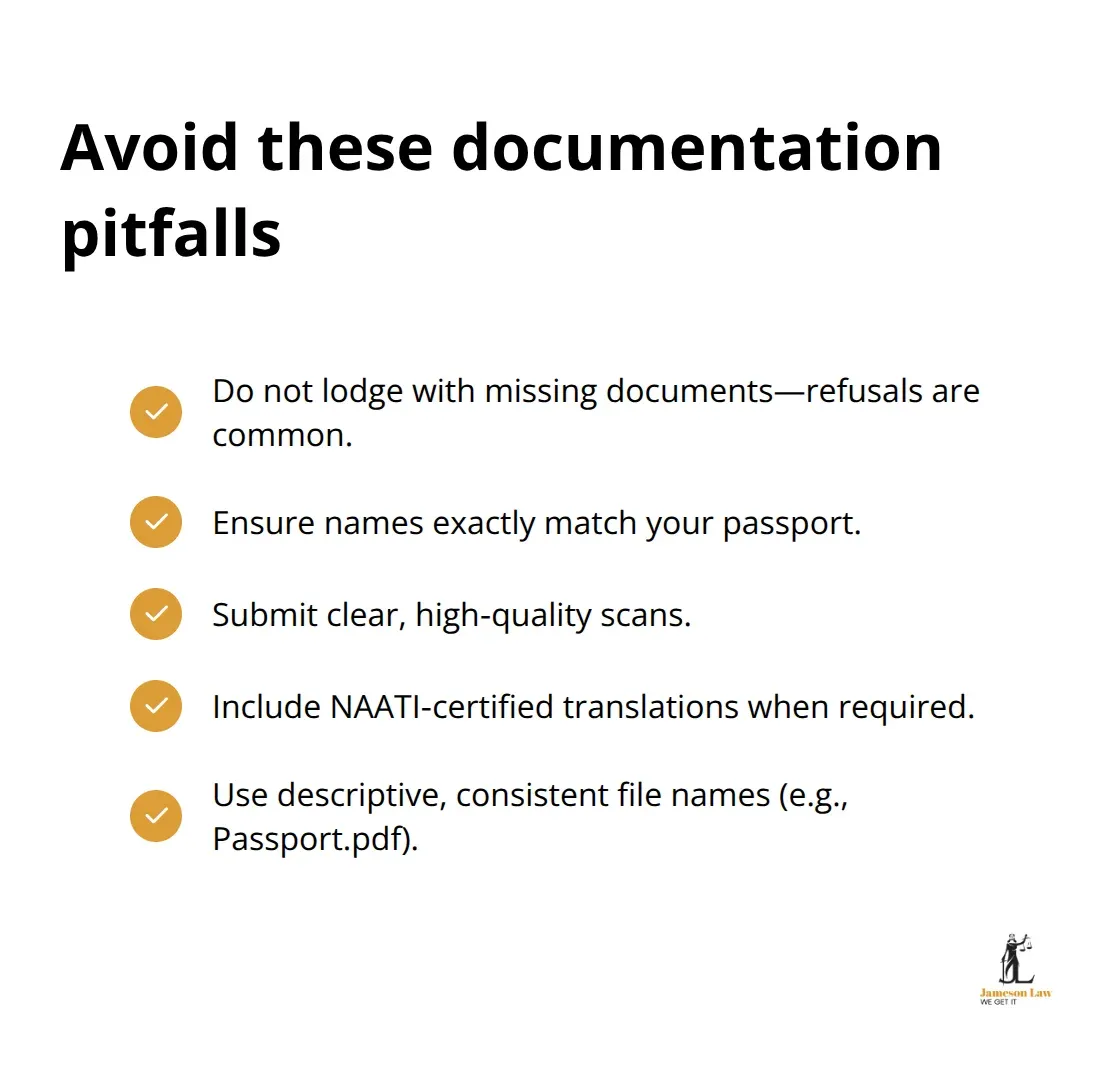
The Department of Home Affairs will not chase missing documents. If something is absent from your application, your visa gets refused. This harsh reality explains why incomplete or inaccurate documentation stands as a leading reason applications fail. Applicants lose months or face outright rejection because they submit names that don’t match their passport, provide blurry document scans, or forget translations when required. The Department’s own guidance emphasises the Check Twice, Submit Once principle for exactly this reason.

You get one chance to present a complete, accurate application. A name mismatch between your passport and application forms, an incorrect date of birth format, or a missing translation certified by a NAATI-certified translator will trigger a refusal rather than a request for clarification. Organise your documents with descriptive file names like Passport.pdf and use high-quality scans that remain legible. For documents originally in another language, include translations by a NAATI-certified translator if translating within Australia or provide the translator’s full details if translating overseas.
The Department’s Document Checklist Tool lets you tailor required documents to your specific passport country and circumstances, so use it before you lodge anything. This step prevents the costly mistake of submitting irrelevant paperwork or missing essential evidence that your case officer needs to make a decision. A visa application preparation checklist ensures you’ve covered every requirement before submission.
Missing Deadlines and Processing Delays
Processing delays and missed deadlines create unnecessary stress and often stem from poor timing rather than administrative failures. Student visa applications can take weeks or months depending on your country of residence, yet applicants frequently lodge applications just weeks before their course starts, leaving no buffer for processing time. The Department of Home Affairs provides a visa processing time guide based on recently decided applications, though actual times vary.
Apply early, especially if you’re coordinating with course start dates or work commencement. When the Department requests further information-typically within 28 days-delays in responding directly cause refusals. Incomplete applications destroy your timeline through external checks and peak period bottlenecks, but if you anticipate a delay, contact your case officer before the deadline expires rather than hoping for an automatic extension. This proactive approach prevents your application from moving into refusal territory through inaction.
Failing to Meet Health and Character Requirements
Health and character assessments apply universally across visa types and cannot be bypassed through financial strength or professional qualifications. The Medical Officer of the Commonwealth assesses whether you pose a significant healthcare cost or burden to public services, focusing on objective health risk rather than your personal insurance situation. Character requirements disqualify applicants with substantial criminal records, associations with criminal groups, or involvement in people smuggling, trafficking, or crimes against humanity.
Even past conduct suggesting you lack good character can trigger refusal. These checks extend to accompanying family members depending on your visa subclass, so disclose everything relevant rather than hoping certain matters go unnoticed. Attempting to hide criminal history or health conditions will almost certainly result in refusal under Public Interest Criterion 4020, which penalises false or misleading information far more severely than honest disclosure of problematic facts.
Overlooking Visa Condition Compliance
Visa conditions exist to protect Australia’s system and your own status. Overlooking them-whether conditions on work hours, study load, health insurance maintenance, or reporting requirements-creates the conditions for cancellation. Once a visa is cancelled, securing another becomes exponentially harder, and you may face removal from Australia. Understanding your specific visa conditions before you arrive and maintaining compliance throughout your stay prevents this outcome entirely.
The difference between a successful visa journey and a failed one often comes down to how thoroughly you prepare your application and how carefully you manage your obligations once approved. An immigration lawyer can identify which documents matter most for your circumstances, flag potential health or character issues before you lodge, and ensure your application presents a coherent, credible picture to the Department.
How an Immigration Lawyer Strengthens Your Visa Application
Identifying Gaps Before Submission
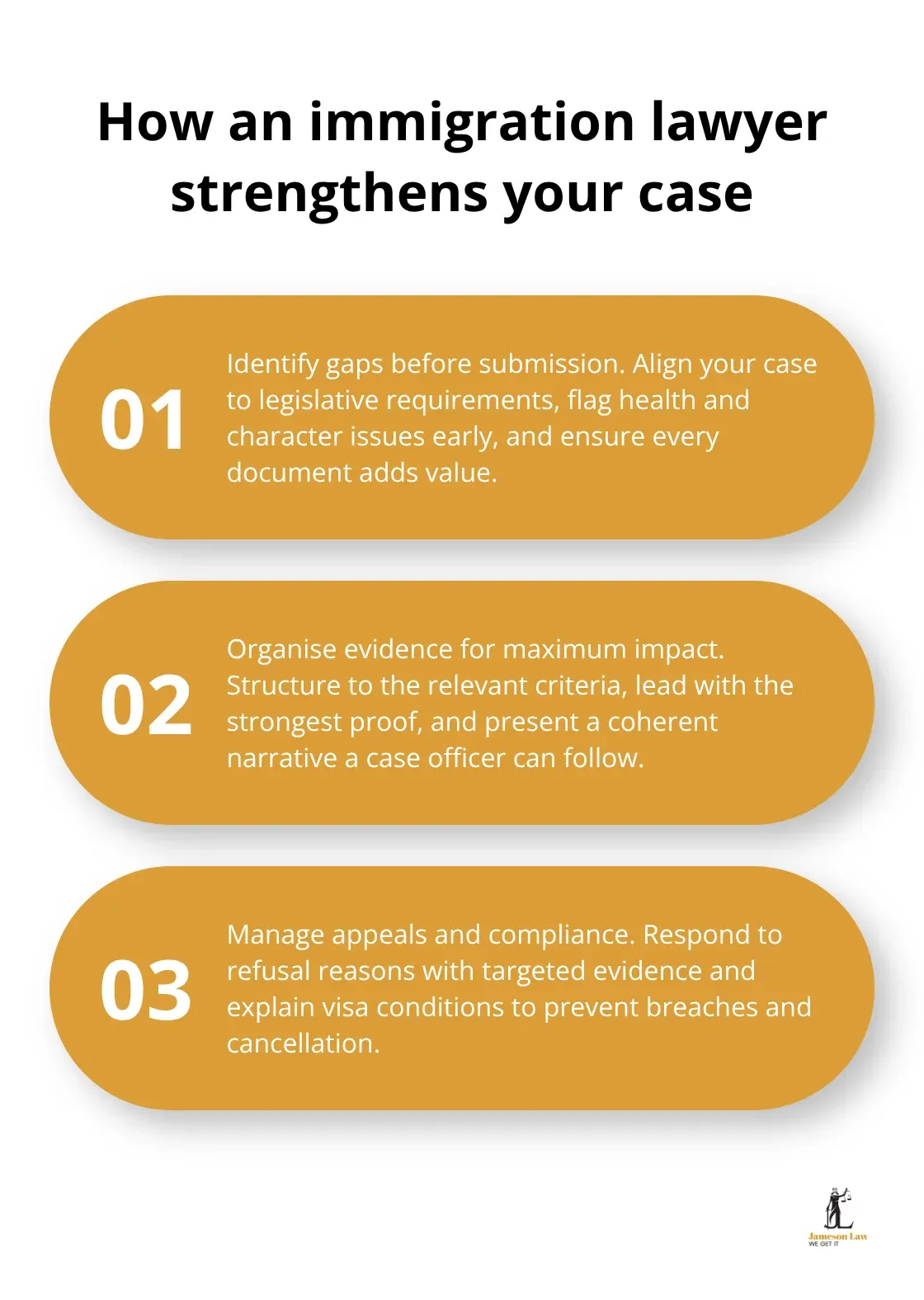
An immigration lawyer identifies gaps in your case before you submit. Most applicants don’t realise they’re missing critical evidence until the Department of Home Affairs refuses their application, at which point recovery becomes exponentially harder. We at Jameson Law have observed applicants with strong qualifications fail because they couldn’t articulate why they genuinely wanted to study in Australia, or they submitted health assessments that triggered unnecessary concerns through poor explanation. A migration lawyer reviews your circumstances against the actual legislative requirements rather than internet rumours, flags health or character issues that need addressing before lodgement, and ensures every document in your application strengthens your case rather than creating confusion.
For skilled migration visas, this means checking whether your occupation actually appears on the relevant list for your state, whether your English language test meets the Department’s requirements, and whether your work experience evidence genuinely demonstrates the skills you claim. For student visas, it means ensuring your Confirmation of Enrolment matches your application timeline, your financial capacity documentation clearly covers tuition and living costs, and your statement about why you’re studying connects logically to your career goals rather than sounding generic. The difference between a refusal and approval often hinges on presentation and completeness, not your underlying eligibility.
Organising Documents for Maximum Impact
Document organisation becomes your responsibility, but a lawyer ensures you’re organising the right documents. The Department of Home Affairs won’t accept password-protected files or zipped folders without instruction, and blurry scans of important documents can trigger refusal just as quickly as missing documents. A migration lawyer prepares your application as a coherent narrative that leads the case officer through your eligibility step by step, rather than submitting 200 pages of unrelated paperwork and hoping something sticks.
Your lawyer structures each section to address specific legislative requirements, placing the strongest evidence first and supporting documents in logical order. This approach transforms a pile of paperwork into a persuasive case that demonstrates your eligibility clearly and comprehensively.

Handling Appeals and Refusals
If your application faces refusal or reaches the Administrative Appeals Tribunal, an immigration lawyer handles the appeal process, responding to the Department’s reasons for refusal with targeted evidence that addresses each specific concern rather than repeating your original application. They understand the legal grounds for appeal, the evidence that carries weight with the tribunal, and the procedural requirements that determine whether your appeal succeeds or fails.
Appeals demand precision and strategic thinking (not simply resubmitting what didn’t work the first time). A lawyer transforms a refusal into an opportunity to present your case more effectively, identifying where the original assessment went wrong and providing evidence that corrects the Department’s concerns.
Guiding Compliance and Protecting Your Status
They guide you on visa condition compliance before you arrive in Australia, explaining work hour restrictions for student visas, health insurance maintenance requirements for temporary visas, and reporting obligations that vary by subclass. This guidance prevents the catastrophic outcome of visa cancellation, which destroys your ability to remain in Australia and makes future visa applications substantially harder.
Visa conditions exist to protect Australia’s system and your own status. A lawyer ensures you understand exactly what your visa permits and what it prohibits, preventing costly mistakes that could end your stay prematurely. Once you arrive, maintaining compliance becomes your responsibility, but understanding those obligations from the start keeps you on solid ground throughout your visa period.
Tailored Support Across All Visa Pathways
We at Jameson Law provide this level of practical, targeted support across skilled migration, family visas, student visas, and all other pathways. Your circumstances are unique, and your application strategy should reflect that reality rather than following a generic template that works for nobody in particular.
Final Thoughts
Your visa application succeeds or fails based on preparation, accuracy, and understanding what the Department of Home Affairs actually requires. Incomplete documentation triggers refusal, missed deadlines create unnecessary delays, health and character issues demand attention before submission, and visa conditions require ongoing compliance throughout your stay. An immigration lawyer Australia-based can identify these issues before you submit, organise your documents for maximum impact, and handle appeals if the Department’s initial assessment goes wrong.
Your next step depends on where you stand right now. If you’re still researching visa options, use the Department of Home Affairs’ official resources and processing time guides to understand your timeline and requirements. If you’ve already identified your visa pathway, start gathering documentation immediately rather than waiting until the last moment. If you’re facing a refusal or considering an appeal, professional legal support becomes essential because the stakes are too high for guesswork.
The difference between a successful visa outcome and a rejected application often comes down to whether you had expert guidance identifying gaps before submission. Contact Jameson Law to review your circumstances, clarify your eligibility, and develop an application strategy tailored to your situation rather than following generic advice that applies to nobody in particular.