PUBLICATION

NSW Criminal Law Penalties: Understanding Potential Outcomes

"Understand NSW criminal law penalties and potential outcomes to protect your rights and make informed legal decisions."
NSW Criminal Law Penalties: Understanding Potential Outcomes

NSW criminal law penalties can range from fines to lengthy prison sentences, depending on the offence and circumstances. The difference between a summary offence and an indictable offence alone can dramatically change your potential outcome.

At Jameson Law, we’ve seen how quickly a criminal charge can shift someone’s life. This guide breaks down the penalties you might face, what influences sentencing, and why legal representation matters from day one.

How Offence Classification Shapes Your Sentence

The distinction between summary and indictable offences fundamentally determines your sentencing range. Summary offences-handled in the Local Court-carry maximum penalties of two years imprisonment, whilst indictable offences can reach significantly longer terms and are heard in higher courts. This classification isn’t academic; it directly affects whether you face six months in custody or six years. An assault charge, for instance, can be prosecuted as a summary offence with a maximum of two years or as an indictable offence with substantially harsher potential outcomes depending on the circumstances and prosecution decision.

What Aggravation Does to Your Penalty

Aggravated offences exist in a separate tier entirely. Under section 21A(2) of the Crimes (Sentencing Procedure) Act 1999, courts must consider aggravating factors that intensify penalties. Violence involving weapons, offences targeting vulnerable victims, or conduct that demonstrates deliberate cruelty can push sentences from moderate community orders into custodial terms. A common assault might attract a fine or conditional release order; the same assault against an elderly person or with a weapon becomes aggravated and frequently results in imprisonment. Aggravating circumstances consistently elevate outcomes across offence categories, making the factual details of your conduct absolutely critical to the final penalty.

Seriousness Determines Your Sentencing Range

The court’s first step involves assessing objective seriousness-the actual conduct that occurred, not your intentions. Parliament sets maximum penalties for each offence, but courts reserve those maximums only for the worst-category cases. Most offences sit well below the maximum. A break and enter with intent to steal might carry a ten-year maximum, but most cases resolve with community orders or shorter imprisonment terms. Your specific actions, the harm caused, and whether premeditation was involved all feed into this assessment.

Why Early Legal Advice Matters

Defence lawyers can shape how the prosecution frames the conduct and what evidence the court sees at this critical stage. The way the court perceives your conduct’s seriousness directly influences the sentencing range it applies. A lawyer who acts early can challenge the prosecution’s framing, present mitigating evidence, and influence how the court assesses objective seriousness before sentencing occurs. This intervention at the assessment stage often produces better outcomes than attempting to address seriousness issues later in proceedings.

The factors courts weigh-aggravation, seriousness, and how they classify your offence-form only part of the sentencing picture. Your personal circumstances, criminal history, and the specific mitigating factors in your case also shape the final penalty significantly.

The Penalties You Actually Face

Imprisonment: When Courts Order Custody

Imprisonment remains the most visible penalty, yet most criminal cases in NSW resolve without anyone spending time in custody. The Local Court handles roughly 90% of criminal matters, and the vast majority result in fines, community orders, or conditional release rather than jail time. When courts impose imprisonment, they set two components: the head sentence (total time) and the non-parole period (minimum time before parole eligibility).
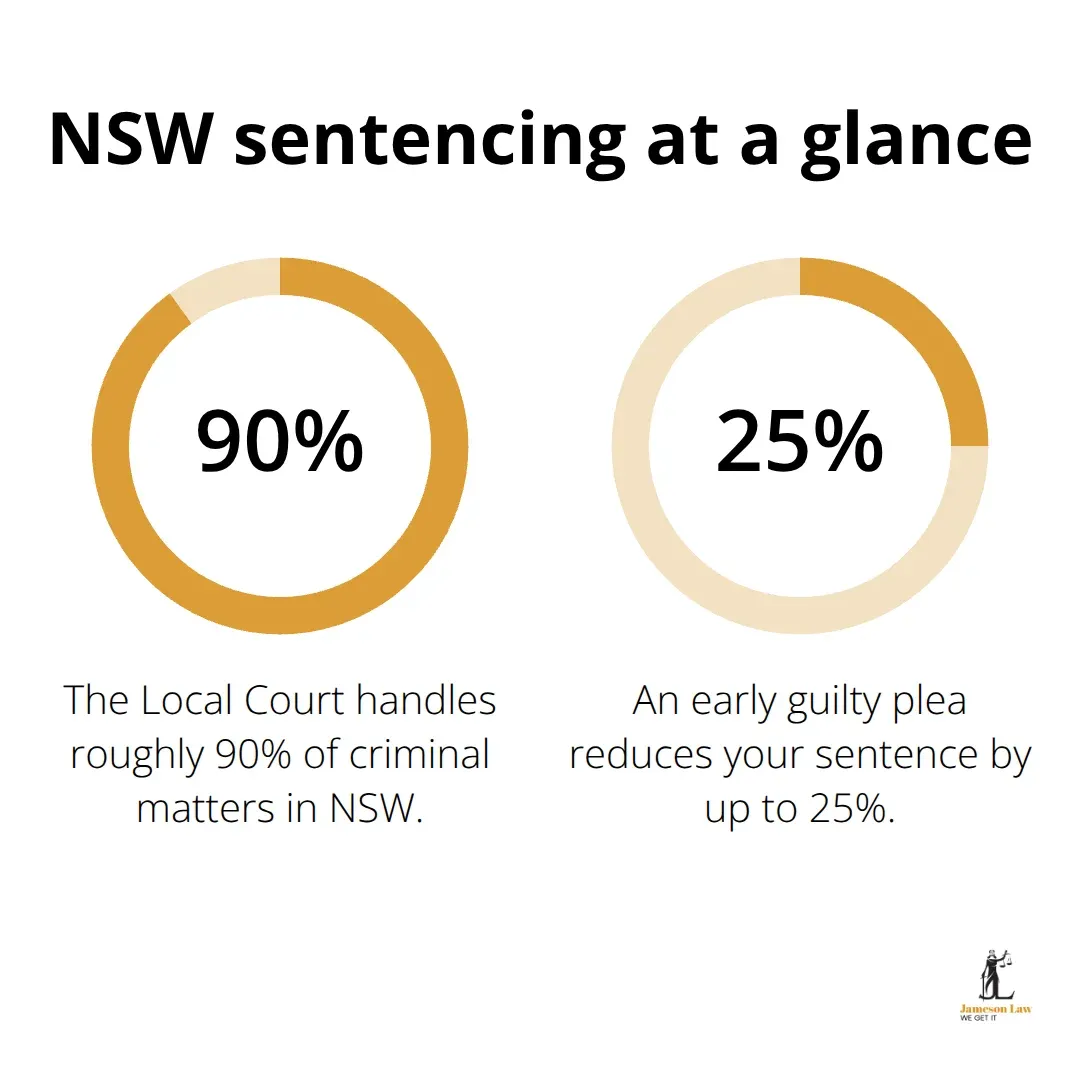
Percentage visual showing the Local Court’s share of cases and the early guilty plea discount in NSW. - NSW criminal law penalties

For a single offence in the Local Court, the maximum imprisonment is two years. This anchors your sentencing range from the outset. If you face an indictable offence, higher courts can impose substantially longer terms, but courts must consider alternatives first under the Crimes (Sentencing Procedure) Act 1999. An early guilty plea reduces your sentence by up to 25%, making the timing of your legal advice genuinely consequential.

Fines: How Courts Calculate What You Pay

Fines operate differently depending on offence severity. For minor matters, fines range from a few hundred to several thousand dollars, and you typically have 28 days to pay. If you cannot pay within that timeframe, you can apply to Revenue NSW for extended payment arrangements, but unpaid fines attract enforcement action and additional costs. Courts will not impose a fine for indictable offences unless the legislation specifically allows it, meaning serious charges almost always lead to non-monetary penalties instead.

Community Orders: The Most Common Outcome

Community-based sentences dominate NSW sentencing outcomes because they keep people working, supporting families, and remaining in the community whilst serving their penalty. Conditional Release Orders last up to two years and include standard conditions (not committing another offence and attending court) plus additional requirements like supervision, rehabilitation programs, or non-association conditions. Community Correction Orders are stricter and can last up to three years with conditions such as community service work, curfews, counselling, or alcohol and drug abstinence requirements. Intensive Correction Orders function as a community-based alternative to short prison sentences, with mandatory electronic monitoring, supervision, and program participation.

Community Service Hours: The Limits Courts Apply

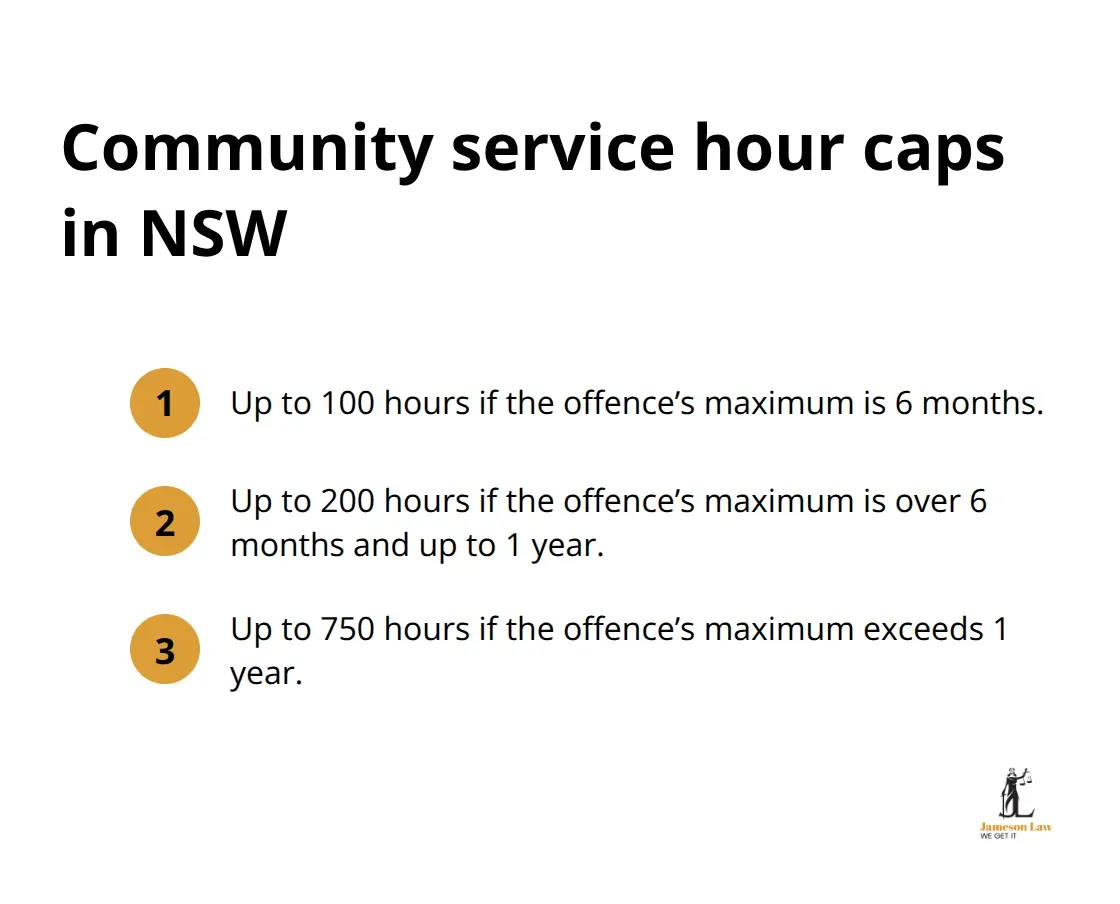
Courts cannot impose community service hours arbitrarily; the maximum depends on the offence’s maximum prison term (100 hours for offences carrying up to six months imprisonment, 200 hours for six months to one year, or 750 hours for offences exceeding one year). Minimum durations apply too, meaning 100 hours of community service typically spans at least six months. These limits protect offenders from excessive unpaid labour whilst ensuring the penalty reflects the offence’s seriousness.

Ordered list of maximum community service hours based on the offence’s maximum prison term in NSW.

Breaches: What Happens When You Violate Your Order

A breach of a Conditional Release Order or Community Correction Order can result in revocation and re-sentencing to harsher penalties, including custody. Courts distinguish between minor breaches (which may attract warnings) and serious or repeated breaches (which often lead to immediate revocation). If you face multiple offences, only one order applies per offence, but orders can overlap across different offences, with Intensive Correction Orders taking priority over Community Correction Orders, which take priority over Conditional Release Orders. Understanding these priorities matters because they determine which conditions actually govern your conduct. The specific conditions attached to your order-and your compliance with them-directly shape whether you remain in the community or return to custody. Your personal circumstances, your response to supervision, and your engagement with any required programs all influence how courts view compliance and what they do if breaches occur.

What Really Changes Your Sentence

Criminal History: The Pattern Courts Cannot Ignore
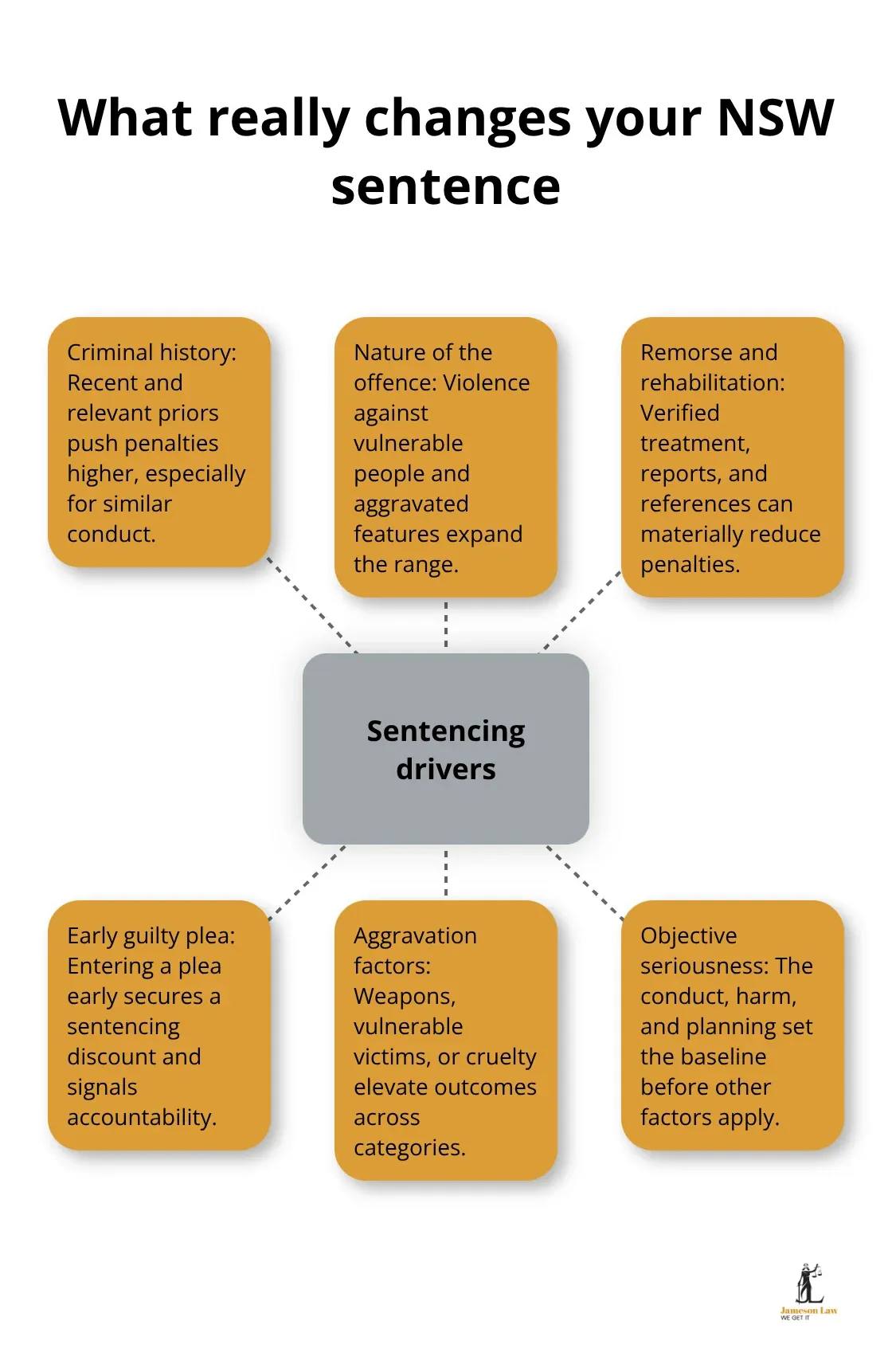
Hub-and-spoke diagram showing the main factors that drive sentencing outcomes in NSW courts. - NSW criminal law penalties

Your criminal history stands as the single most predictive factor in sentencing, and courts apply it with brutal consistency. A first-time offender facing assault walks away with a conditional release order or community service; the same offence committed by someone with five prior convictions triggers immediate custody considerations. Section 21A(3) of the Crimes (Sentencing Procedure) Act 1999 requires courts to weigh prior convictions as either mitigating or aggravating depending on how recent and relevant they are. Courts do not view your history abstractly-they examine the pattern. Two drink-driving convictions within five years signals a systemic problem that justifies harsher penalties than an isolated ten-year-old offence. If your priors involve similar conduct to your current charge, expect the court to treat that as significant aggravation. This means your defence strategy must address not just the current offence but also how your history will be presented to the court.

An early guilty plea reduces your sentence by up to 25 percent, but that discount applies less generously if you have prior convictions. Courts assume you should have learned from previous penalties, and repeated conduct demonstrates a failure to respond to earlier intervention.

The Nature of Your Offence Sets the Range

The nature of your offence determines the sentencing range before any other factor enters the equation. Offences involving violence against vulnerable people attract substantially harsher penalties under section 21A(2) aggravating factors. A theft charge might result in a fine; the same theft from an aged care facility becomes aggravated and shifts into community correction order or custody territory. Domestic violence offences receive mandatory consideration of victim safety, meaning courts impose stricter conditions and longer supervision periods regardless of other circumstances.

Premeditation matters enormously in how courts assess your conduct. Spontaneous assault receives lighter treatment than carefully planned violence. Courts also examine whether you caused actual harm or merely created risk. A reckless driving charge causing injury carries penalties several times higher than the same driving conduct that fortunately harmed no one.

Remorse and Rehabilitation: Evidence Speaks Louder Than Words

Remorse and rehabilitation prospects operate as powerful mitigating factors, but only if you support them with evidence. A psychological report showing you have addressed underlying issues, testimony from treatment providers, or concrete steps toward education or employment carry real weight with courts. Character references from employers, community members, or professionals who know you personally influence outcomes far more than generic statements about being a good person.

Courts want specifics: that you have completed anger management, maintained employment despite charges, or supported family members through hardship. These concrete actions demonstrate rehabilitation capacity that abstract apologies cannot match. The difference between a sentence that includes custody and one that keeps you in the community often hinges on whether you present tangible evidence of change rather than promises of future improvement. Early legal advice can help you build this evidence from the outset and shape how your case unfolds.

Final Thoughts

NSW criminal law penalties range from dismissals through to years of imprisonment, and your outcome depends entirely on how you handle your case from the moment charges arise. The classification of your offence, aggravating factors, your criminal history, and the evidence you present all combine to determine whether you face a conditional release order or custody. Courts follow a structured framework, but within that framework sits enormous discretion-the difference between community-based sentences and imprisonment often comes down to the quality of your legal representation and how early you engage professional advice.

Building a strong case means gathering evidence of rehabilitation, securing character references, and addressing underlying issues that contributed to your offence. An early guilty plea can reduce your sentence by up to 25 percent, but only if your lawyer negotiates it strategically and presents it alongside compelling mitigating evidence. The decisions you make in the first weeks after charges are laid directly influence your final penalty.

Contact Jameson Law immediately if you face criminal charges. Our criminal law team understands how NSW courts approach sentencing and can guide you through the process from your first appearance through to final outcome. The early legal advice you obtain will shape whether you minimise penalties and pursue non-custodial options.

Speak to an Expert Lawyer today

Laywers-Jameson-Law-The-best-law-firm-in-Sydney- Sydney Lawyers - Sydney
BOOK NOW

WE'RE IN IT TO WIN IT

Book your consultation

Book Now
Book Now Mobile 06 02 2025

This form submission is encrypted and secured to ensure your information remains confidential.

What our Clients

Related Publications:

What our clients say

.

Jameson Law - Voted the Best Law firm in Sydney Award

Legal Answers ... In Short

We're here to help

Our mission is to ensure our client matters are resolved successfully every time. Success to us does not simply involve winning, but moreover ensuring we take the most feasible, economic and stress-free path to help our clients achieve their goals. We fight hard for our clients, and always go by the motto: we’re in it to win it.

Jameson Law - Best Law Firm in Sydney

WE'RE IN IT TO WIN IT

Book your consultation

Call us now on (02) 8806 0866 or fill out the form below

Book Now Mobile

This form submission is encrypted and secured to ensure your information remains confidential.

WE'RE IN IT TO WIN IT

Book your consultation

Book Now Mobile 06 02 2025
lock

This form submission is encrypted and secured to ensure your information remains confidential.

Our Sydney Offices

Offices Parramatta and Sydney Jameson Law
Parramatta CBD - Head Office
jameson Law - Blacktown
jameson Law - Liverpool Office
Jameson Law - Bankstown
Court Houses We Frequent Jameson Law

Court Houses We Frequent

Balmain Local Court

Registry: Monday to Friday, 9:00am to 4:30pm

Bankstown Local Court

Court Operating Hours: 9:30am-4:30pm

Blacktown Local Court

Registry Hours: 9:00 – 4:30
Telephone Hours: 8:30 -4:30
Days open: Mon-Fri

Burwood Local Court

Registry Hours: 9:00 – 4:30
Telephone Hours: 8:30 – 4:30
Days open: Mon – Fri

Campbell Local Court

Registry Hours: 9:00 – 4:30
Telephone Hours: 8:30 – 4:30
Days open: Mon – Fri

Central Local Court

Registry Hours: 9:00 – 1:00 and 2:00 – 4:30
Telephone Hours: 8:30 – 4:30

Downing Local Court

Registry Hours: 9:00 – 1:00 and 2:00 – 4:30
Telephone Hours: 8:30 – 4:30

Wollongong Local Court

Registry Hours: 9:00 – 1:00 and 2:00 – 4:30
Telephone Hours: 8:30 – 4:30

Fairfield Local Court

Registry Hours: 9:00 – 1:00 and 2:00 – 4:30
Telephone Hours: 8:30 – 4:30

Hornsby Local Court

Registry Hours: 9:00 – 1:00 and 2:00 – 4:30
Telephone Hours: 8:30 – 4:30

Liverpool Local Court

Registry Hours: 9:00 – 1:00 and 2:00 – 4:30
Telephone Hours: 8:30 – 4:30

Manly Local Court

Registry Hours: 9:00 – 1:00 and 2:00 – 4:30
Telephone Hours: 8:30 – 4:30

Newtown Local Court

Registry Hours: 9:00 – 1:00 and 2:00 – 4:30
Telephone Hours: 8:30 – 4:30

Parramatta Local Court

Registry Hours: 9:00 – 1:00 and 2:00 – 4:30
Telephone Hours: 8:30 – 4:30

Penrith Local Court

Registry Hours: 9:00 – 1:00 and 2:00 – 4:30
Telephone Hours: 8:30 – 4:30

Sutherland Local Court

Registry Hours: 9:00 – 1:00 and 2:00 – 4:30
Telephone Hours: 8:30 – 4:30

Waverley Local Court

Registry Hours: 9:00 – 1:00 and 2:00 – 4:30
Telephone Hours: 8:30 – 4:30

Windsor Local Court

Registry Hours: 9:00 – 1:00 and 2:00 – 4:30
Telephone Hours: 8:30 – 4:30

Wollongong Local Court

Registry Hours: 9:00 – 1:00 and 2:00 – 4:30
Telephone Hours: 8:30 – 4:30

Downing Centre District Court

Registry Hours: 9:00 – 4:30
Telephone Hours: 8:30 – 4:30
Days open: Mon – Fri

Parramatta District Court

Registry Hours: 9:00 – 4:30
Days open: Mon-Fri

Penrith District Court

Registry Hours: 9:00 – 4:30
Days open: Mon-Fri

Campbelltown District Court

Registry Hours: 9:00 – 4:30
Days open: Mon – Fri

Liverpool District Court

Registry Hours: 9:00 – 4:30
Days open: Mon – Fri

Wollongong District Court

Registry Hours: 9:00 – 1:00 and 2:00 – 4:30
Telephone Hours: 8:30 – 4:30

Supreme Court New South Wales

Registry Hours: 9:00 AM – 4:30 PM
Telephone Hours: 8:30 AM – 4:30 PM
Days Open: Monday to Friday

Federal Circuit and Family Court of Australia

Registry Hours: 9:00 AM – 4:30 PM
Telephone Hours: 8:30 AM – 5:00 PM
Days Open: Monday to Friday

Federal Court

Monday to Friday, 8:30 AM – 4:30 PM

High Court

Monday to Friday, 8:30 AM – 5:00 PM

Children’s Court of New South Wales

Registry Hours: 9:00 AM – 4:30 PM
Telephone Hours: 8:30 AM – 4:30 PM
Days Open: Monday to Friday

Coroner’s Court New South Wales

Registry Hours: 9:00 AM – 4:30 PM
Telephone Hours: 8:30 AM – 4:30 PM
Days Open: Monday to Friday

Industrial Relations Commission of New South Wales

Registry Hours: 9:00 AM – 4:30 PM
Telephone Hours: 8:30 AM – 4:30 PM
Days Open: Monday to Friday

Land and Environment Court of New South Wales

Registry Hours: 9:00 AM – 4:30 PM
Telephone Hours: 8:30 AM – 4:30 PM
Days Open: Monday to Friday

WE'RE IN IT TO WIN IT

Book your consultation

Book Now
Book Now Mobile 06 02 2025
lock

This form submission is encrypted and secured to ensure your information remains confidential.