PUBLICATION

Drug Lawyer Sydney: Defence Options for Possession and Trafficking Charges

"Protect your rights against drug charges in NSW. Expert drug lawyer Sydney guidance on possession and trafficking defences, penalties, and strategies."
Drug Lawyer Sydney: Defence Options for Possession and Trafficking Charges

Drug possession and trafficking charges in NSW carry serious consequences that can affect your career, housing, and future opportunities. A drug lawyer in Sydney can help you understand your legal options and build a strong defence strategy.

We at Jameson Law know that the outcome of your case depends on challenging the evidence against you and exploring every available avenue, from questioning search procedures to accessing diversion programs. This guide covers the defences, penalties, and pathways that matter most when facing drug charges.

Understanding NSW Drug Offence Categories

Simple Possession vs. Deemed Supply

NSW drug law distinguishes between possession, supply, and manufacturing offences under the Drug Misuse and Trafficking Act 1985. The category that applies to you fundamentally changes both the penalties you face and the defences available. Simple possession means you had a drug but no intent to supply it to anyone else.

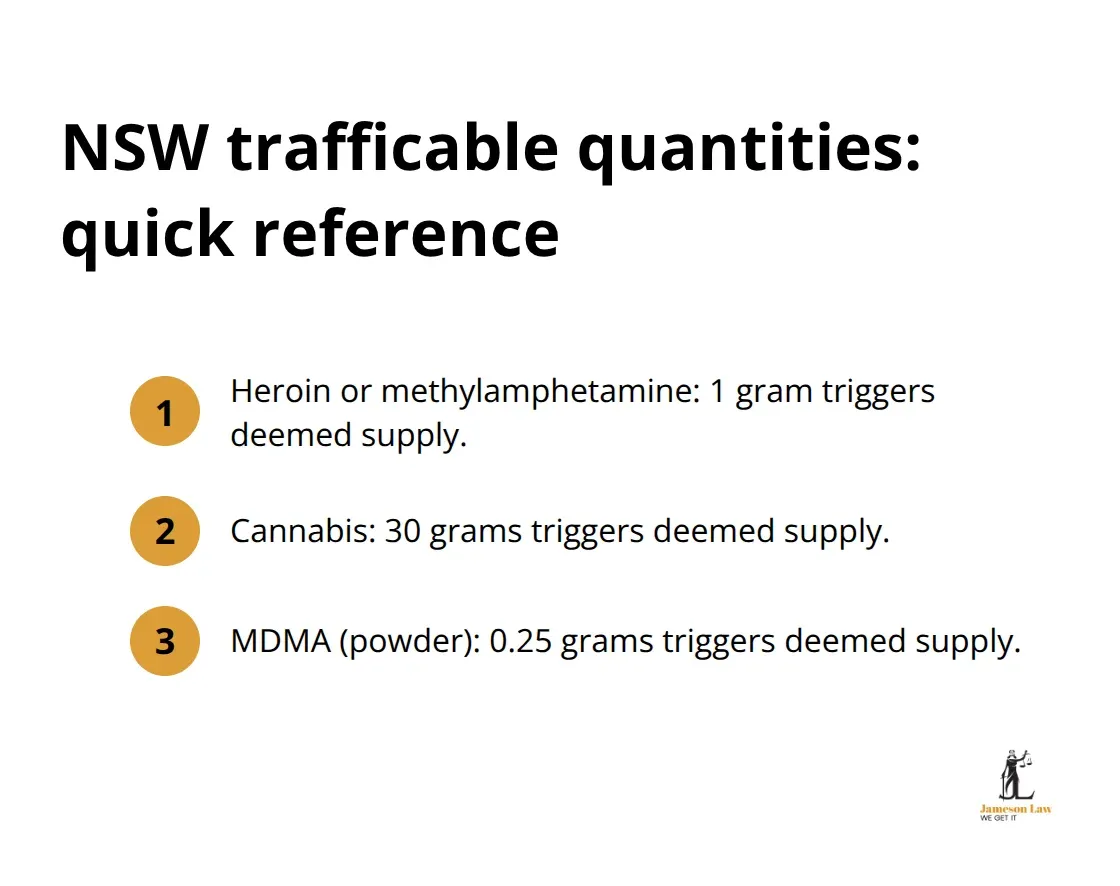
The Act sets specific thresholds called trafficable quantities for each drug. If police find you with drugs at or above that amount, a presumption of intent to supply automatically applies under Section 29 unless you can prove otherwise. For example, trafficable quantities in NSW are 1 gram for heroin or methylamphetamine, 30 grams for cannabis, and 0.25 grams for MDMA in powder form.

Compact list showing NSW trafficable quantities for heroin or methylamphetamine, cannabis, and MDMA (powder). - drug lawyer sydney

Possession of these amounts triggers deemed supply, which means the prosecution assumes you intended to sell the drugs rather than use them personally. The burden shifts to you to prove personal use. This distinction matters enormously: a personal-use defence requires evidence showing your consumption patterns, quantities consistent with your own use, and sometimes expert testimony about typical usage rates.

Supply and Trafficking Penalties

If you face charges for possession with intent to supply or trafficking, the penalties jump dramatically. Supply carries a maximum of 10 years imprisonment for a standard supply charge under Section 25, compared to 2 years for simple possession under Section 10. The NSW Bureau of Crime Statistics and Research tracks possession offences separately by drug type, and the data show that amphetamines and methamphetamine account for significant portions of drug proceedings in NSW, with cocaine and heroin following.

Manufacturing and Cultivation Offences

Manufacturing and cultivation offences carry even harsher sentences. Cultivation offences carry 15 years for not less than the commercial quantity under Section 23. Indoor hydroponic cultivation faces enhanced penalties under Section 23(1A), particularly if a child under 16 is exposed to the operation, which can push sentences higher.

The stage of cultivation matters substantially: early-stage plants or seedlings support arguments for lower objective seriousness compared to mature plants ready for harvest. Courts have consistently held that profit motive and commercial scale are the key factors distinguishing a serious trafficking operation from a lower-level offence. If the operation shows no evidence of profit or financial gain, that significantly affects how serious the court treats your conduct.

Aggravated Offences and Additional Penalties

Aggravated drug offences involve additional elements like possession near a school or supplying to a minor, which increase penalties by several years. These circumstances elevate the seriousness of your charge and narrow your available defences.

The quantity involved, your role in any supply network, and whether you can challenge the evidence police gathered against you all determine what you actually face. Understanding which category applies to your situation is the first step toward building an effective defence strategy.

Hub-and-spoke diagram showing key factors that influence drug sentencing in NSW.

How Police Search Powers Affect Your Defence

Unlawful Search and Evidence Exclusion

Police misconduct during a search or seizure can render critical evidence inadmissible, fundamentally weakening the prosecution’s case. Courts regularly exclude evidence when officers act outside their lawful powers. Section 138 of the Evidence Act 1995 gives courts discretion to exclude evidence obtained unlawfully or improperly, and NSW courts apply this provision strictly. If police searched your home, vehicle, or person without a warrant or lawful grounds, the drugs they found may be inadmissible in court.

The key is identifying exactly where police deviated from procedure. Did they have a warrant? Did they have your consent in writing? Did they claim reasonable suspicion-and if so, was that suspicion actually reasonable based on what they observed at the time? A common error occurs when officers conduct strip searches without proper justification or documentation. NSW legislation requires specific grounds and procedural compliance.

Chain of Custody Problems

Another frequent issue is the chain of custody after seizure. If the drugs were not properly recorded, sealed, or tracked from seizure to testing, that gap can undermine the prosecution’s ability to prove the substance tested was actually what police found. You need to examine police records, body-worn camera footage if available, and witness statements about how the search occurred.

Request disclosure of all police documents-the search warrant application, the officer’s statement, custody records, and the forensic report. Look for inconsistencies between what the officer claims happened and what physical evidence or other witnesses show actually occurred. Did the officer’s notes match the timeline? Were photographs taken of the scene? These details matter because courts are sceptical of vaguely or poorly documented searches.

Knowledge and Possession as Separate Elements

Knowledge and possession are separate legal elements, and the prosecution must prove both beyond reasonable doubt. You cannot be guilty of possession if you did not know the substance was in your presence or control. This defence works particularly well in shared spaces-if drugs were found in a house or vehicle you share with others, the prosecution must prove you knew about them and controlled them.

The Fillippeti defence (established through case law) applies when mere presence in a space where drugs exist is insufficient. The prosecution needs evidence showing you had knowledge of the drugs and exclusive or joint control over them. For example, if police find drugs in a shared bedroom, the prosecution must prove you knew they were there and had access to them-not just that you lived in the house.

Momentary Possession and Intent

The Carey defence applies when you possessed drugs only momentarily or temporarily with the honest intention to return them to their owner. A person who briefly holds someone else’s drugs to pass them back has not committed the offence of possession in the legal sense. Quantity becomes important here too. Small amounts found in your possession may support an argument that you did not know what you had or did not intend to keep it.

Lack of Knowledge of the Substance

The prosecution’s case weakens further if they cannot show you had knowledge that the substance was a prohibited drug. Under NSW law, the accused must know or believe the substance in their possession is a prohibited drug. If you genuinely believed you were carrying a legal substance, that lack of knowledge is a complete defence. This rarely succeeds in practice, but it matters when the substance is misidentified or when circumstances genuinely suggest you were misled about what you carried.

These evidentiary challenges form the foundation of many successful defences. The next section examines how to demonstrate lack of intent to supply-a critical distinction that can reduce charges from trafficking to simple possession.

Avoiding Court: Diversion and Early Intervention

EDDI: The On-the-Spot Alternative

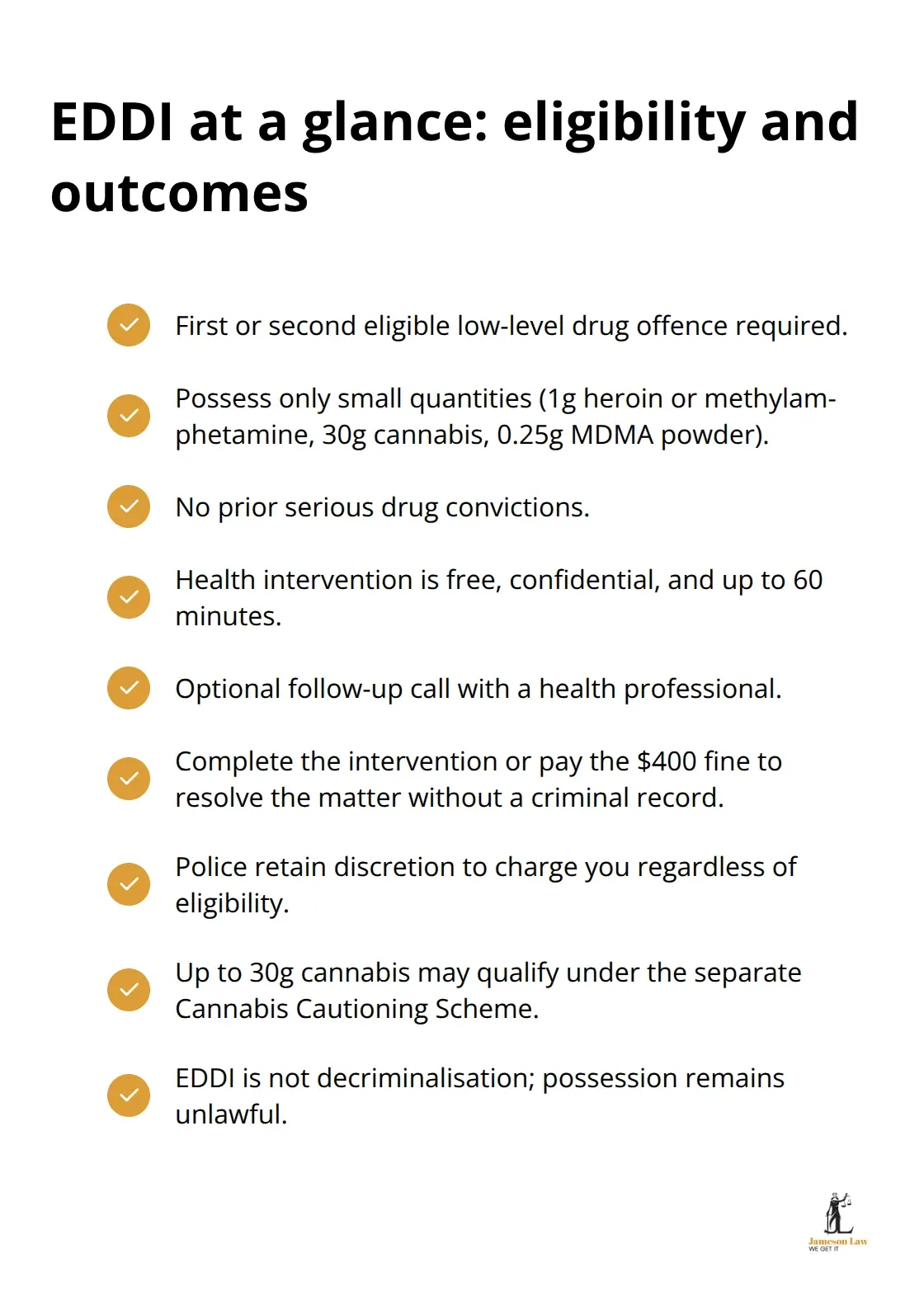
NSW offers practical pathways to resolve low-level drug charges without conviction, but eligibility is strict and timing matters. The Enhanced Drug Diversion Initiative (EDDI) allows police to issue a $400 on-the-spot fine or refer you to a free health intervention instead of charging you with a criminal offence, provided you meet specific criteria. You must face a first or second eligible low-level drug offence, possess only small quantities (such as 1 gram of heroin or methylamphetamine, 30 grams of cannabis, or 0.25 grams of MDMA in powder form), and have no prior serious drug convictions. The health intervention is confidential, lasts up to 60 minutes, and includes an optional follow-up call; a health professional discusses drug risks and support services without judgment. Completing the intervention or paying the fine resolves the matter without a criminal record appearing, though police retain discretion to charge you regardless of eligibility.

Checklist summarising who qualifies for EDDI in NSW and what it involves. - drug lawyer sydney

Cannabis possession up to 30 grams may qualify under the separate Cannabis Cautioning Scheme instead. EDDI is not decriminalisation-possession remains unlawful-but it recognises that court processing wastes resources on cases better handled through health intervention.

Taking Action Before the Fine Deadline

If you are arrested and eligible for EDDI, you must act quickly. Book the health intervention immediately before the fine due date; contact the nominated health professional on 1800 844 881 between 10am and 6pm, Monday to Friday. Revenue NSW enforces unpaid fines under the Fines Act 1996, though you can negotiate instalments or seek a Work and Development Order if payment is difficult. The window for intervention closes fast, so delay costs you this opportunity.

Sentencing Factors for Charges Beyond EDDI

For charges exceeding EDDI eligibility or involving supply allegations, sentencing outcomes depend heavily on objective seriousness factors courts assess under Section 21A of the Crimes Sentencing Procedure Act 2005. Courts weigh quantity, your role in any supply network, financial gain, and aggravating circumstances such as supplying near schools or to minors. The NSW Court of Criminal Appeal established in Parente v R (2017) that full-time custody is not automatic; courts must consider alternatives including Intensive Correction Orders or Community Correction Orders where appropriate.

Rehabilitation as a Sentencing Mitigator

Rehabilitation programs significantly influence sentencing outcomes. If you demonstrate genuine commitment to addressing drug dependency through counselling, residential treatment, or community support, courts recognise this as a mitigating factor reducing sentences. The NSW Drug Court specialises in cases where dependency drives offending; successful completion of a Drug Court program substantially reduces recidivism compared to standard sentencing. Expert evidence about your dependency, treatment prospects, and participation in rehabilitation strengthens mitigation arguments. Courts are increasingly sceptical of addiction alone as a complete excuse but recognise motive matters: using drugs to fund your own habit differs from selling for profit. Evidence of stable employment, family support, and genuine rehabilitation commitment carries weight in sentencing.

Early Engagement With Treatment

Early engagement with treatment before court appearance demonstrates seriousness and often results in lower sentences or non-custodial outcomes. Securing treatment referrals and completing initial assessments before your first court date shows courts that you act proactively rather than waiting for court orders. This approach substantially improves your prospects when sentencing occurs.

Final Thoughts

Drug possession and trafficking charges in NSW demand immediate action and strategic thinking. The defences available to you depend on the specific circumstances of your arrest, the evidence police gathered, and whether you qualify for diversion programs like EDDI. Challenging unlawful searches, disputing knowledge or possession, and demonstrating lack of intent to supply are powerful tools that can reduce charges or lead to acquittal.

Timing matters enormously when you face drug charges. If you qualify for EDDI, you must book a health intervention before the fine deadline to avoid a criminal record entirely. For more serious charges, securing legal advice before your first court appearance allows you to gather evidence, identify search procedure breaches, and arrange treatment referrals that influence sentencing outcomes.

A drug lawyer Sydney-based can identify which defences apply to your specific facts, challenge the prosecution’s evidence, and negotiate outcomes that protect your interests. Contact Jameson Law today to discuss your case and explore your options before your next court date.

Speak to an Expert Lawyer today

Laywers-Jameson-Law-The-best-law-firm-in-Sydney- Sydney Lawyers - Sydney
BOOK NOW

WE'RE IN IT TO WIN IT

Book your consultation

Book Now
Book Now Mobile 06 02 2025

This form submission is encrypted and secured to ensure your information remains confidential.

What our Clients

Related Publications:

What our clients say

.

Jameson Law - Voted the Best Law firm in Sydney Award

Legal Answers ... In Short

We're here to help

Our mission is to ensure our client matters are resolved successfully every time. Success to us does not simply involve winning, but moreover ensuring we take the most feasible, economic and stress-free path to help our clients achieve their goals. We fight hard for our clients, and always go by the motto: we’re in it to win it.

Jameson Law - Best Law Firm in Sydney

WE'RE IN IT TO WIN IT

Book your consultation

Call us now on (02) 8806 0866 or fill out the form below

Book Now Mobile

This form submission is encrypted and secured to ensure your information remains confidential.

WE'RE IN IT TO WIN IT

Book your consultation

Book Now Mobile 06 02 2025
lock

This form submission is encrypted and secured to ensure your information remains confidential.

Our Sydney Offices

Offices Parramatta and Sydney Jameson Law
Parramatta CBD - Head Office
jameson Law - Blacktown
jameson Law - Liverpool Office
Jameson Law - Bankstown
Court Houses We Frequent Jameson Law

Court Houses We Frequent

Balmain Local Court

Registry: Monday to Friday, 9:00am to 4:30pm

Bankstown Local Court

Court Operating Hours: 9:30am-4:30pm

Blacktown Local Court

Registry Hours: 9:00 – 4:30
Telephone Hours: 8:30 -4:30
Days open: Mon-Fri

Burwood Local Court

Registry Hours: 9:00 – 4:30
Telephone Hours: 8:30 – 4:30
Days open: Mon – Fri

Campbell Local Court

Registry Hours: 9:00 – 4:30
Telephone Hours: 8:30 – 4:30
Days open: Mon – Fri

Central Local Court

Registry Hours: 9:00 – 1:00 and 2:00 – 4:30
Telephone Hours: 8:30 – 4:30

Downing Local Court

Registry Hours: 9:00 – 1:00 and 2:00 – 4:30
Telephone Hours: 8:30 – 4:30

Wollongong Local Court

Registry Hours: 9:00 – 1:00 and 2:00 – 4:30
Telephone Hours: 8:30 – 4:30

Fairfield Local Court

Registry Hours: 9:00 – 1:00 and 2:00 – 4:30
Telephone Hours: 8:30 – 4:30

Hornsby Local Court

Registry Hours: 9:00 – 1:00 and 2:00 – 4:30
Telephone Hours: 8:30 – 4:30

Liverpool Local Court

Registry Hours: 9:00 – 1:00 and 2:00 – 4:30
Telephone Hours: 8:30 – 4:30

Manly Local Court

Registry Hours: 9:00 – 1:00 and 2:00 – 4:30
Telephone Hours: 8:30 – 4:30

Newtown Local Court

Registry Hours: 9:00 – 1:00 and 2:00 – 4:30
Telephone Hours: 8:30 – 4:30

Parramatta Local Court

Registry Hours: 9:00 – 1:00 and 2:00 – 4:30
Telephone Hours: 8:30 – 4:30

Penrith Local Court

Registry Hours: 9:00 – 1:00 and 2:00 – 4:30
Telephone Hours: 8:30 – 4:30

Sutherland Local Court

Registry Hours: 9:00 – 1:00 and 2:00 – 4:30
Telephone Hours: 8:30 – 4:30

Waverley Local Court

Registry Hours: 9:00 – 1:00 and 2:00 – 4:30
Telephone Hours: 8:30 – 4:30

Windsor Local Court

Registry Hours: 9:00 – 1:00 and 2:00 – 4:30
Telephone Hours: 8:30 – 4:30

Wollongong Local Court

Registry Hours: 9:00 – 1:00 and 2:00 – 4:30
Telephone Hours: 8:30 – 4:30

Downing Centre District Court

Registry Hours: 9:00 – 4:30
Telephone Hours: 8:30 – 4:30
Days open: Mon – Fri

Parramatta District Court

Registry Hours: 9:00 – 4:30
Days open: Mon-Fri

Penrith District Court

Registry Hours: 9:00 – 4:30
Days open: Mon-Fri

Campbelltown District Court

Registry Hours: 9:00 – 4:30
Days open: Mon – Fri

Liverpool District Court

Registry Hours: 9:00 – 4:30
Days open: Mon – Fri

Wollongong District Court

Registry Hours: 9:00 – 1:00 and 2:00 – 4:30
Telephone Hours: 8:30 – 4:30

Supreme Court New South Wales

Registry Hours: 9:00 AM – 4:30 PM
Telephone Hours: 8:30 AM – 4:30 PM
Days Open: Monday to Friday

Federal Circuit and Family Court of Australia

Registry Hours: 9:00 AM – 4:30 PM
Telephone Hours: 8:30 AM – 5:00 PM
Days Open: Monday to Friday

Federal Court

Monday to Friday, 8:30 AM – 4:30 PM

High Court

Monday to Friday, 8:30 AM – 5:00 PM

Children’s Court of New South Wales

Registry Hours: 9:00 AM – 4:30 PM
Telephone Hours: 8:30 AM – 4:30 PM
Days Open: Monday to Friday

Coroner’s Court New South Wales

Registry Hours: 9:00 AM – 4:30 PM
Telephone Hours: 8:30 AM – 4:30 PM
Days Open: Monday to Friday

Industrial Relations Commission of New South Wales

Registry Hours: 9:00 AM – 4:30 PM
Telephone Hours: 8:30 AM – 4:30 PM
Days Open: Monday to Friday

Land and Environment Court of New South Wales

Registry Hours: 9:00 AM – 4:30 PM
Telephone Hours: 8:30 AM – 4:30 PM
Days Open: Monday to Friday

WE'RE IN IT TO WIN IT

Book your consultation

Book Now
Book Now Mobile 06 02 2025
lock

This form submission is encrypted and secured to ensure your information remains confidential.