PUBLICATION

Selling Property Conveyancing NSW: A Step-By-Step Process

"Understand the property conveyancing process in NSW with our step-by-step guide to selling property. Learn timelines, costs, and key legal requirements."
Selling Property Conveyancing NSW: A Step-By-Step Process

Selling property in NSW involves more than just handing over keys. The conveyancing process protects both you and the buyer by managing legal requirements, financial transfers, and official registrations.

At Jameson Law, we’ve guided countless property sellers through selling property conveyancing in NSW. This guide breaks down each stage so you understand what happens and why it matters.

What Conveyancing Actually Covers

Conveyancing in NSW is the legal process that transfers property ownership from seller to buyer. It’s not just paperwork-it’s the mechanism that protects both parties and ensures the title legally changes hands. The process involves preparing and reviewing the contract of sale, conducting searches on the property’s title and local council requirements, arranging inspections, managing financial transactions, and finally registering the transfer with NSW Land Registry Services. A licenced legal practitioner or conveyancer must prepare the contract for sale before you can advertise the property. This requirement exists because the contract is your legal protection-it sets out what’s included, what’s excluded, the price, settlement date, and any special conditions. Without a proper contract prepared by someone who knows NSW law, you face exposure to disputes and financial loss. The conveyancing process typically spans about six weeks from exchange of contracts to settlement, though finance approval timelines and how quickly both parties move can alter this.

Why NSW Has Strict Conveyancing Rules

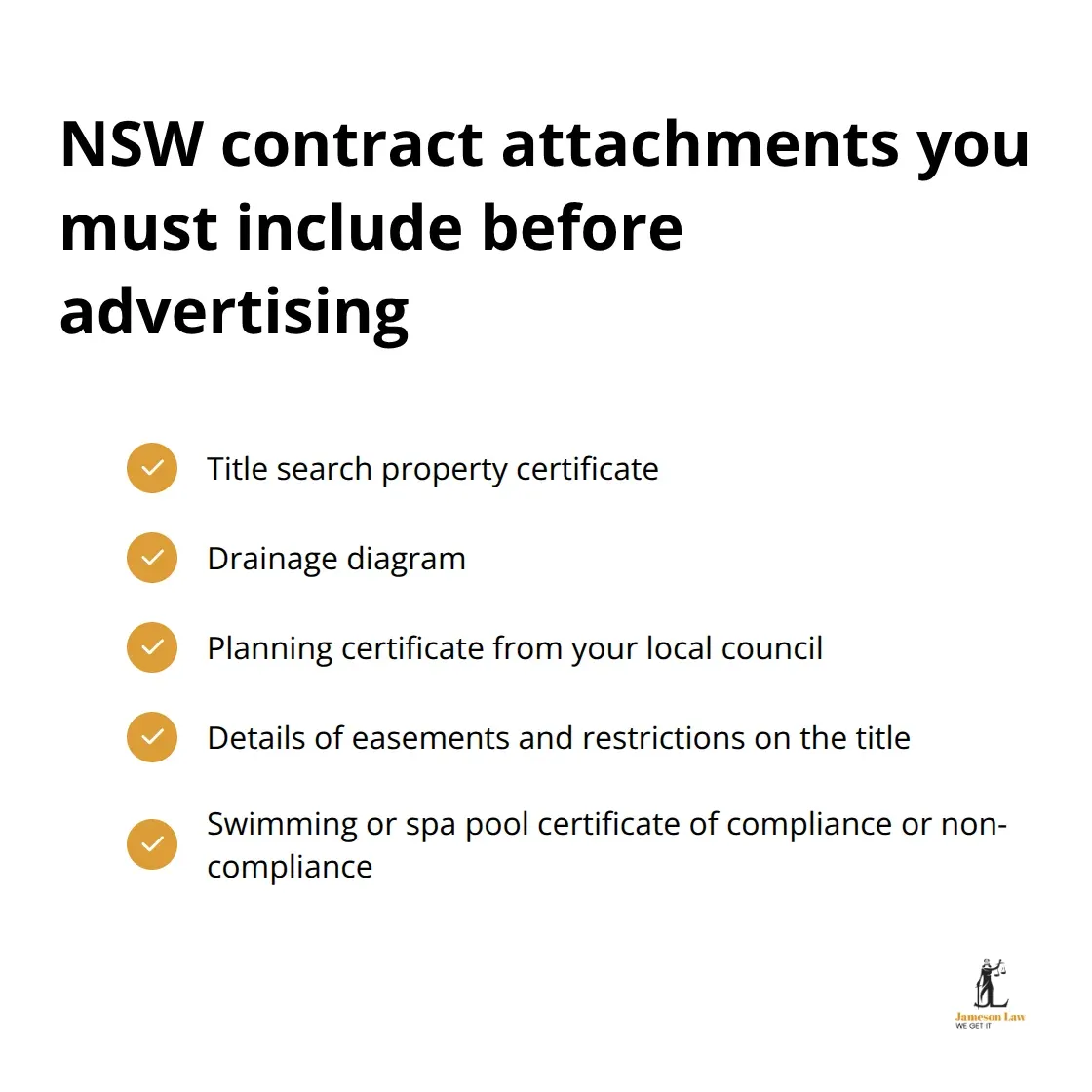
NSW legislation requires conveyancers to hold a licence with NSW Fair Trading and to carry professional indemnity insurance. The Conveyancing Act 1919 and the Conveyancing (Sale of Land) Regulation 2022 set out exactly what documents must accompany the contract before you advertise it. These include a property certificate from the title search, drainage diagrams, a planning certificate from your local council, and details of any easements or restrictions on the title. If you sell a property with a swimming or spa pool, you must attach a current certificate of compliance from the NSW Swimming Pool Register or a certificate of non-compliance. If any required documents are missing when the buyer signs the contract, they have the right to rescind within 14 days of exchange.

Required contract documents for NSW property sales in New South Wales

This means you could lose the sale. The strict requirements exist because property transactions involve significant money and legal rights-incorrect paperwork costs time and money for everyone involved.

Who Handles the Conveyancing Work

Licenced conveyancers in NSW handle the full conveyancing transaction for both buyers and sellers. They review contracts, conduct searches, manage settlement, and liaise with banks, agents, and the other party’s legal representative. Solicitors can also perform conveyancing, though many specialise in more complex legal issues. Both must carry professional indemnity insurance to protect you if errors occur. The key difference is that conveyancers specialise exclusively in property transactions and typically charge fixed fees, while solicitors may charge hourly rates and handle broader legal matters. NSW Fair Trading maintains a register of licenced conveyancers, and the Law Society of NSW maintains a register of solicitors. When you choose someone to handle your sale, verify their licensing status directly with these bodies rather than relying on their word. The person handling your conveyancing should understand your local council’s planning requirements and any local issues that might affect the property’s value or saleability.

What Documents You Must Prepare

Before you advertise your property, you need to prepare a complete contract package. This package includes the contract itself, a property certificate from the title search, drainage diagrams, and a planning certificate from your local council. You must also disclose any easements, restrictions, or other dealings that affect the title. If your property has a pool, you must include either a current certificate of compliance or a certificate of non-compliance from the NSW Swimming Pool Register. Missing any of these documents gives the buyer grounds to rescind the contract after exchange, which can derail your sale. The contract must also clearly state what’s included in the sale and what’s excluded (such as chattels or fixtures), and it must contain the prescribed cooling-off period statement. Preparing these documents correctly from the start prevents costly delays and disputes later.

How Professional Conveyancing Protects You

A licenced conveyancer or solicitor brings knowledge of NSW law and local requirements that protects you throughout the transaction. They ensure your contract complies with legislation, that all required documents are attached, and that the buyer cannot rescind on technical grounds. They also conduct the necessary searches to identify any issues with the title, council requirements, or planning restrictions before settlement. Professional indemnity insurance protects you if errors occur during the process. If you attempt to handle conveyancing yourself, you become personally liable for any problems that arise, and obtaining insurance becomes much harder. The cost of professional conveyancing is typically far less than the cost of fixing a problem that emerges after settlement. With your conveyancer in place and the contract package prepared, you’re ready to move into the pre-settlement phase where searches, inspections, and finance approvals take centre stage.

Between Contract and Settlement

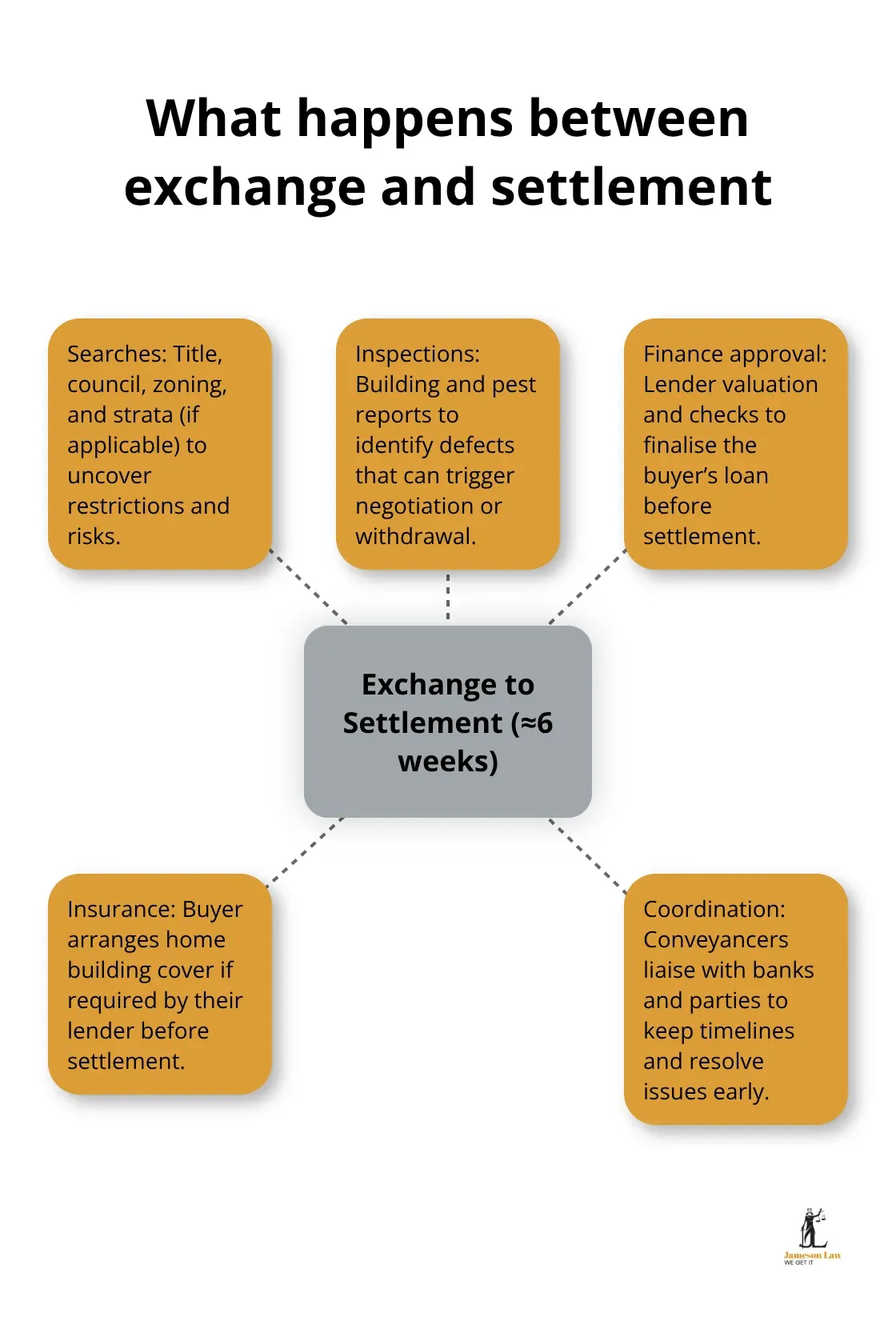
Once the buyer signs the contract, the real work begins. The period between exchange of contracts and settlement typically runs about six weeks, according to NSW Fair Trading. This window is when searches happen, inspections occur, and the buyer’s finance gets finalised. You need to understand what happens during this phase because delays here directly affect your settlement date and your access to the sale funds.

Key activities during the six-week period between exchange and settlement in NSW - selling property conveyancing nsw

The Exchange of Contracts and What It Means

The exchange of contracts marks the legal turning point. At this moment, the buyer pays a deposit, usually 10 per cent of the purchase price, and the cooling-off period begins. For residential property, the buyer has five working days to walk away without penalty. After exchange, your conveyancer must provide copies of the signed contract to all parties within two business days. From this point forward, both you and the buyer are legally bound to the transaction.

Searches That Reveal Hidden Issues

The buyer’s conveyancer now conducts a series of searches that weren’t done before exchange. These include title searches to confirm ownership and identify any easements or restrictions, council searches to reveal planning restrictions or development notices, zoning searches to confirm the property’s permitted use, and strata searches if the property is in a strata scheme. Each of these searches costs money and takes time. A strata search reveals whether the building has outstanding defects, what the levies are, and whether the owners’ corporation is in dispute.

Building and Pest Inspections

Building and pest inspections also happen during this phase. The buyer arranges and pays for these, but you need to understand their importance. Building and pest inspections identify termites, structural defects, roof problems, or major repairs needed. These reports can make or break a sale. If the inspection reveals significant defects, the buyer may negotiate a price reduction or walk away entirely if the defects are serious enough. You should prepare for this conversation.

Finance Approval and Valuation

Finance approval represents another critical element during this period. The buyer’s lender conducts their own valuation and assessment of the property. If the finance approval valuation comes in lower than the purchase price, the lender bases the loan amount on the lower figure. This happens more often than sellers expect, particularly in slower markets. Your conveyancer liaises with the buyer’s bank to confirm finance is on track. If the buyer’s finance falls through, they can still be forced to complete the purchase, but in practice this rarely happens because the buyer simply cannot access the funds. Your conveyancer should push for confirmation of finance approval well before settlement.

Insurance and Final Coordination

Insurance finalisation also occurs during this period. The buyer arranges home building insurance if they’re obtaining a mortgage. Some lenders require this insurance to be in place before settlement. You should not arrange insurance on the buyer’s behalf. Your role is to ensure your conveyancer keeps the buyer’s conveyancer updated on progress and flags any issues early. If searches reveal title defects, council restrictions, or other problems, these need to be addressed before settlement happens. A missing easement on the title or a planning breach discovered at this stage can derail the entire transaction. This is why a skilled conveyancer matters-they know what problems are fixable and which ones are deal-breakers. They also know how to negotiate solutions if issues emerge. Once all searches are complete, finance is approved, and inspections pass, you move toward the final phase where funds transfer and the title officially changes hands.

Finalising the Sale and Completing the Transfer

Final Checks Before Settlement Day

Settlement day marks the end of your involvement as a property seller. NSW Fair Trading indicates that settlement typically occurs about six weeks after contracts are exchanged, though this timeline depends on how quickly finance is approved and searches are completed. Before settlement happens, your conveyancer must conduct final checks to confirm nothing has changed since exchange and that all conditions have been met. These checks include verifying that the buyer’s finance remains approved, that no new caveats or restrictions have appeared on the title, and that you have cleared any outstanding land tax with Revenue NSW.

Outstanding land tax represents a critical issue because the buyer’s lender will not settle if you owe money to the state, and the sale proceeds cannot be released until this is resolved. Your conveyancer should contact Revenue NSW well before settlement to obtain a clearance certificate confirming no liability exists. If land tax is owed, you must pay it from the sale proceeds before settlement completes. As of 30 June 2025, if you are selling a property in NSW under contract you must apply for a clearance certificate and give the buyer a copy at least 14 days before settlement.

Adjustments and Title Verification

Your conveyancer must confirm that all council rates and water charges have been adjusted between you and the buyer, calculated up to the settlement date. These adjustments happen at settlement and appear in the final settlement statement. Your conveyancer will also request a final search of the title to confirm no new easements, mortgages, or restrictions have been registered since exchange. Any new entries discovered at this stage can delay settlement or require negotiation. Final checks prevent surprises on settlement day that could push the transaction back weeks.

Electronic Settlement and Fund Transfer

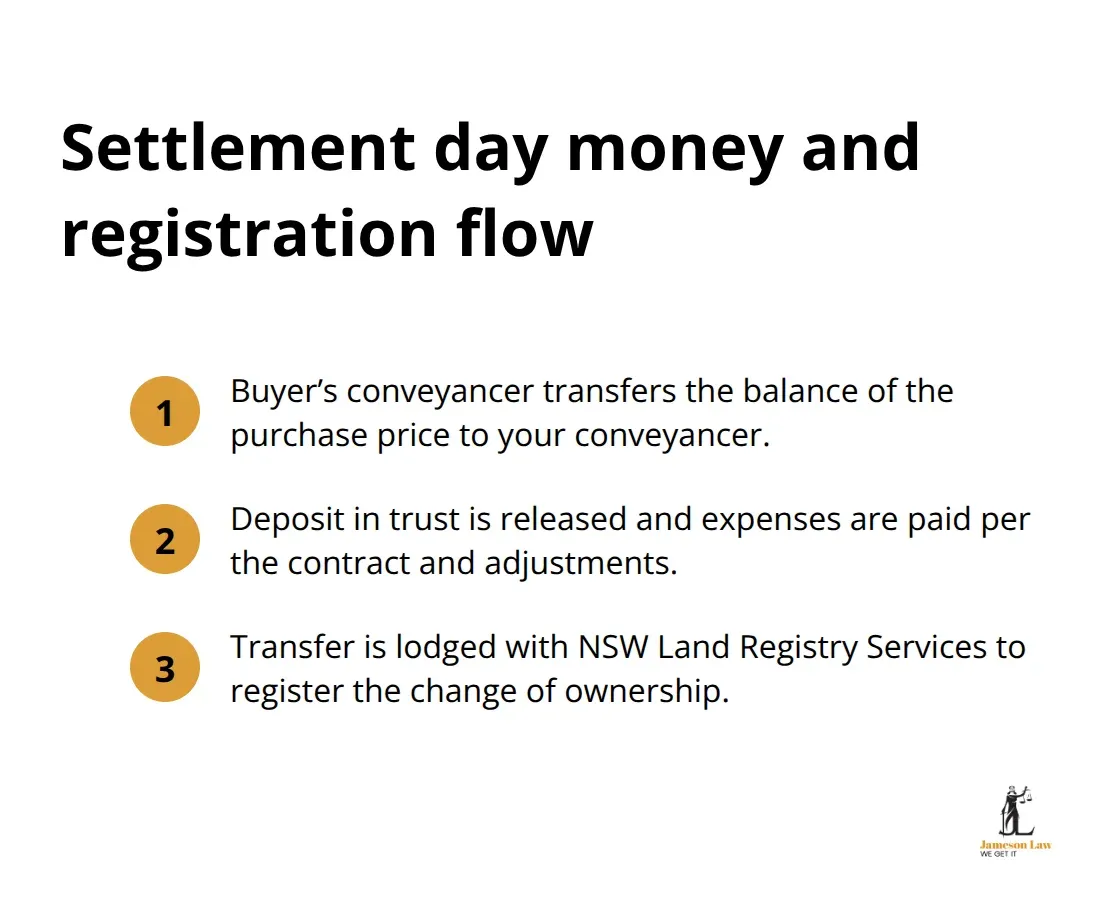
On settlement day itself, the electronic transfer of funds occurs via eConveyancing, which NSW now uses for most residential settlements. The buyer’s conveyancer transfers the balance of the purchase price to your conveyancer. Your conveyancer simultaneously transfers the deposit held in trust and releases funds to pay all outstanding expenses including mortgage discharge fees, agent commissions, council rates adjustments, and any other disbursements agreed in the contract. Once cleared funds are confirmed in your account, your conveyancer lodges the transfer document with NSW Land Registry Services to register the change of ownership.

Steps for funds transfer and title registration on settlement day in NSW - selling property conveyancing nsw

Registration and Completion of Transfer

Registration with NSW Land Registry Services typically takes one to two business days, after which the buyer becomes the legal owner and you no longer hold any interest in the property. Your conveyancer will provide you with a settlement statement showing exactly how much you receive, what was deducted, and when funds will reach your bank account. Do not expect immediate access to all funds if outstanding mortgages or other liabilities exist; your conveyancer must discharge these first. If you have questions about any deduction on the settlement statement, ask your conveyancer to explain before settlement occurs rather than discovering confusion afterwards. Once the transfer is registered with Land Registry Services, your obligations as seller are complete and the buyer holds full legal title to the property.

Final Thoughts

Selling property conveyancing in NSW requires attention to detail at every stage, from preparing the contract package through to registration with NSW Land Registry Services. The process protects both you and the buyer by establishing clear legal obligations, conducting thorough searches, and ensuring all financial transactions occur correctly. A licenced conveyancer or solicitor brings knowledge of NSW legislation, local council requirements, and practical experience that prevents problems from emerging after settlement.

The cost of professional conveyancing remains modest compared to the value of your property and the risks involved in handling the process incorrectly. A missing document, an unregistered easement, or an outstanding land tax liability discovered at settlement can derail your transaction or cost you thousands in unexpected expenses. Your conveyancer prevents these problems by conducting proper due diligence and flagging issues early when they can still be resolved.

If you are selling property in NSW, engage a licenced conveyancer or solicitor before you advertise and verify their licensing status with NSW Fair Trading or the Law Society of NSW. We at Jameson Law provide conveyancing services across NSW and can guide you through the entire selling property conveyancing NSW process with practical, accessible advice. Contact us to discuss your property sale and ensure your conveyancing is handled correctly from start to finish.

Speak to an Expert Lawyer today

Laywers-Jameson-Law-The-best-law-firm-in-Sydney- Sydney Lawyers - Sydney
BOOK NOW

WE'RE IN IT TO WIN IT

Book your consultation

Book Now
Book Now Mobile 06 02 2025

This form submission is encrypted and secured to ensure your information remains confidential.

What our Clients

Related Publications:

What our clients say

.

Jameson Law - Voted the Best Law firm in Sydney Award

Legal Answers ... In Short

We're here to help

Our mission is to ensure our client matters are resolved successfully every time. Success to us does not simply involve winning, but moreover ensuring we take the most feasible, economic and stress-free path to help our clients achieve their goals. We fight hard for our clients, and always go by the motto: we’re in it to win it.

Jameson Law - Best Law Firm in Sydney

WE'RE IN IT TO WIN IT

Book your consultation

Call us now on (02) 8806 0866 or fill out the form below

Book Now Mobile

This form submission is encrypted and secured to ensure your information remains confidential.

WE'RE IN IT TO WIN IT

Book your consultation

Book Now Mobile 06 02 2025
lock

This form submission is encrypted and secured to ensure your information remains confidential.

Our Sydney Offices

Offices Parramatta and Sydney Jameson Law
Parramatta CBD - Head Office
jameson Law - Blacktown
jameson Law - Liverpool Office
Jameson Law - Bankstown
Court Houses We Frequent Jameson Law

Court Houses We Frequent

Balmain Local Court

Registry: Monday to Friday, 9:00am to 4:30pm

Bankstown Local Court

Court Operating Hours: 9:30am-4:30pm

Blacktown Local Court

Registry Hours: 9:00 – 4:30
Telephone Hours: 8:30 -4:30
Days open: Mon-Fri

Burwood Local Court

Registry Hours: 9:00 – 4:30
Telephone Hours: 8:30 – 4:30
Days open: Mon – Fri

Campbell Local Court

Registry Hours: 9:00 – 4:30
Telephone Hours: 8:30 – 4:30
Days open: Mon – Fri

Central Local Court

Registry Hours: 9:00 – 1:00 and 2:00 – 4:30
Telephone Hours: 8:30 – 4:30

Downing Local Court

Registry Hours: 9:00 – 1:00 and 2:00 – 4:30
Telephone Hours: 8:30 – 4:30

Wollongong Local Court

Registry Hours: 9:00 – 1:00 and 2:00 – 4:30
Telephone Hours: 8:30 – 4:30

Fairfield Local Court

Registry Hours: 9:00 – 1:00 and 2:00 – 4:30
Telephone Hours: 8:30 – 4:30

Hornsby Local Court

Registry Hours: 9:00 – 1:00 and 2:00 – 4:30
Telephone Hours: 8:30 – 4:30

Liverpool Local Court

Registry Hours: 9:00 – 1:00 and 2:00 – 4:30
Telephone Hours: 8:30 – 4:30

Manly Local Court

Registry Hours: 9:00 – 1:00 and 2:00 – 4:30
Telephone Hours: 8:30 – 4:30

Newtown Local Court

Registry Hours: 9:00 – 1:00 and 2:00 – 4:30
Telephone Hours: 8:30 – 4:30

Parramatta Local Court

Registry Hours: 9:00 – 1:00 and 2:00 – 4:30
Telephone Hours: 8:30 – 4:30

Penrith Local Court

Registry Hours: 9:00 – 1:00 and 2:00 – 4:30
Telephone Hours: 8:30 – 4:30

Sutherland Local Court

Registry Hours: 9:00 – 1:00 and 2:00 – 4:30
Telephone Hours: 8:30 – 4:30

Waverley Local Court

Registry Hours: 9:00 – 1:00 and 2:00 – 4:30
Telephone Hours: 8:30 – 4:30

Windsor Local Court

Registry Hours: 9:00 – 1:00 and 2:00 – 4:30
Telephone Hours: 8:30 – 4:30

Wollongong Local Court

Registry Hours: 9:00 – 1:00 and 2:00 – 4:30
Telephone Hours: 8:30 – 4:30

Downing Centre District Court

Registry Hours: 9:00 – 4:30
Telephone Hours: 8:30 – 4:30
Days open: Mon – Fri

Parramatta District Court

Registry Hours: 9:00 – 4:30
Days open: Mon-Fri

Penrith District Court

Registry Hours: 9:00 – 4:30
Days open: Mon-Fri

Campbelltown District Court

Registry Hours: 9:00 – 4:30
Days open: Mon – Fri

Liverpool District Court

Registry Hours: 9:00 – 4:30
Days open: Mon – Fri

Wollongong District Court

Registry Hours: 9:00 – 1:00 and 2:00 – 4:30
Telephone Hours: 8:30 – 4:30

Supreme Court New South Wales

Registry Hours: 9:00 AM – 4:30 PM
Telephone Hours: 8:30 AM – 4:30 PM
Days Open: Monday to Friday

Federal Circuit and Family Court of Australia

Registry Hours: 9:00 AM – 4:30 PM
Telephone Hours: 8:30 AM – 5:00 PM
Days Open: Monday to Friday

Federal Court

Monday to Friday, 8:30 AM – 4:30 PM

High Court

Monday to Friday, 8:30 AM – 5:00 PM

Children’s Court of New South Wales

Registry Hours: 9:00 AM – 4:30 PM
Telephone Hours: 8:30 AM – 4:30 PM
Days Open: Monday to Friday

Coroner’s Court New South Wales

Registry Hours: 9:00 AM – 4:30 PM
Telephone Hours: 8:30 AM – 4:30 PM
Days Open: Monday to Friday

Industrial Relations Commission of New South Wales

Registry Hours: 9:00 AM – 4:30 PM
Telephone Hours: 8:30 AM – 4:30 PM
Days Open: Monday to Friday

Land and Environment Court of New South Wales

Registry Hours: 9:00 AM – 4:30 PM
Telephone Hours: 8:30 AM – 4:30 PM
Days Open: Monday to Friday

WE'RE IN IT TO WIN IT

Book your consultation

Book Now
Book Now Mobile 06 02 2025
lock

This form submission is encrypted and secured to ensure your information remains confidential.