Family law disputes drain time, money, and emotional energy. Consent orders in Australia offer a smarter path forward-one where you and your former partner agree on the terms rather than leaving decisions to a judge.
At Jameson Law, we’ve seen how this approach transforms outcomes. When both parties reach agreement, settlements happen faster and with far less cost than contested court battles.
What Consent Orders Actually Achieve
A consent order is a legally binding court order that formalises an agreement you and your former partner have already reached. The Family Law Act 1975 governs how these orders work, requiring that parenting orders serve the best interests of the child and that financial or property orders are just and equitable. The key distinction between a consent order and a standard court order is that a judge does not decide your case. Instead, the court simply approves an agreement you’ve both negotiated, provided it meets legal requirements. This means you retain control over the outcome rather than submitting to a judge’s decision.
What Consent Orders Cover
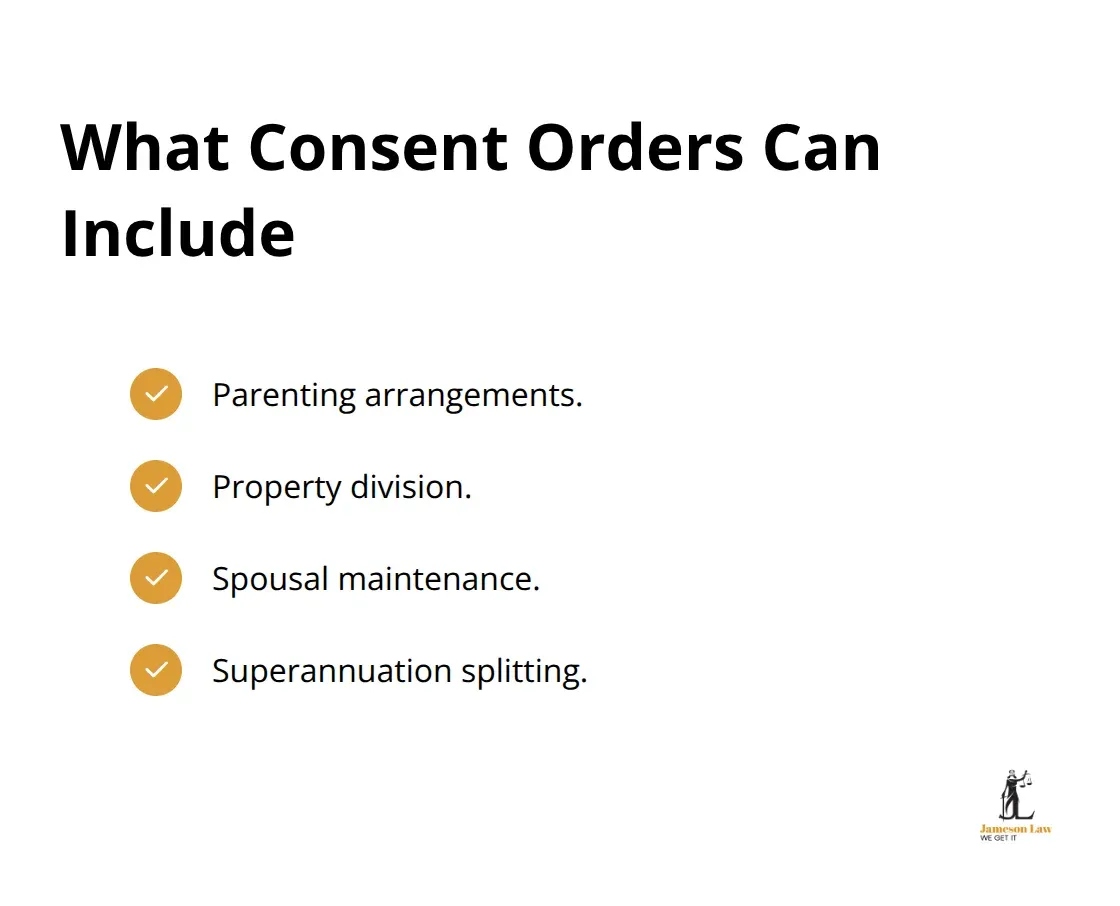
Consent orders address parenting arrangements, property division, maintenance, and superannuation splitting in a single application. For parenting, you can specify where children live, contact arrangements with the other parent, and involvement of other important people such as grandparents. The court must confirm these arrangements serve the best interests of the children, which is a non-negotiable threshold. For financial and property matters, consent orders handle asset division, maintenance obligations, and superannuation splitting.

The Family Law Act sections 79 and 90SM establish the framework for what’s just and equitable, and consent orders formalise how you’ve applied these principles to your situation.
Tax Efficiency and Cost Advantages
A significant practical advantage emerges when you transfer property under consent orders. Capital gains tax rollover relief applies to property transferred under consent orders, which the Australian Taxation Office confirms. This means your settlement can be tax-efficient without requiring separate applications or additional court processes. You can file for consent orders even if no court proceedings have started, or you can file them during existing proceedings once you’ve reached agreement.
How You File and What Happens Next
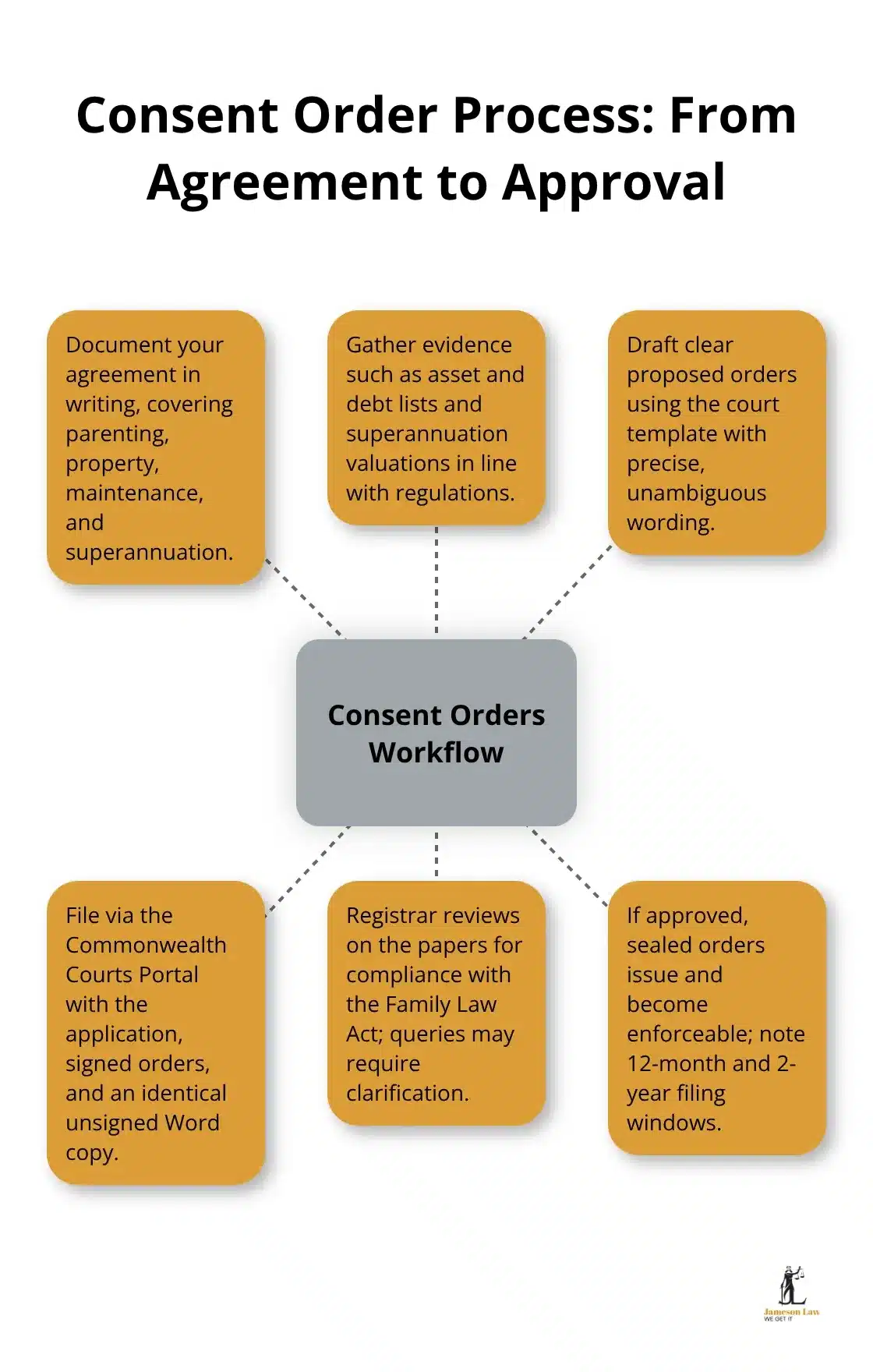
The Commonwealth Courts Portal handles electronic filing, and you’ll need to submit an Application for Consent Orders alongside a signed copy of the proposed orders plus an identical unsigned Word version for the court’s review. The timing for filing matters considerably. For marriages, you have 12 months after divorce to apply for spousal maintenance consent orders; for de facto relationships, the window is two years from when the relationship ended. If you miss these windows, you’ll need to obtain leave from the court to proceed, which adds complexity and cost.
The court’s Registrar then reviews your application and either grants it, requests further information, or dismisses it. Sealed orders become available through the Commonwealth Courts Portal, and you’ll receive an email notification with your file number. The entire process typically moves faster than contested litigation because there’s no need for evidence hearings or judicial determination of disputed facts. Once you understand what consent orders can achieve and how they work, the next step involves reaching that initial agreement with your former partner-a process that requires clarity about what you both want and what the law allows.
Why Consent Orders Cost Far Less Than Court Battles
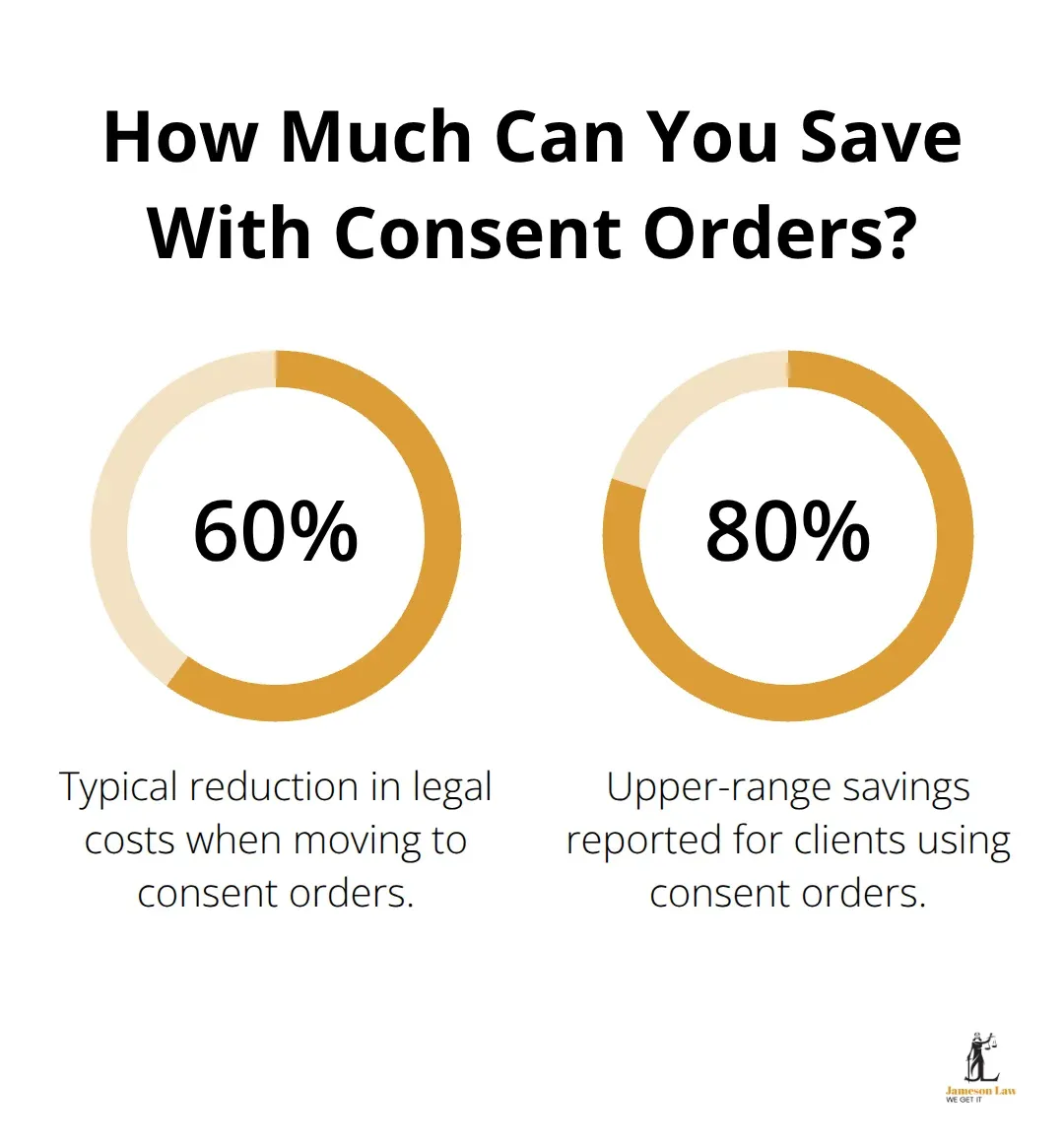
Contested family law litigation in Australia consumes substantial financial resources. A typical contested property settlement involves significant legal fees depending on complexity and duration. Consent orders eliminate most of this expense because you avoid paying lawyers to prepare evidence, cross-examine witnesses, or argue your position before a judge. You and your former partner have already agreed on the terms, so the legal work narrows to drafting documents that reflect your agreement and lodging them with the Family Court of Australia. Clients who move from contested proceedings to consent orders typically reduce their legal costs by 60 to 80 per cent. The court filing fee applies regardless, but that represents a one-time cost under $1,000 compared to months of hourly billing.

The financial pressure of litigation also forces many people into unfavourable settlements simply to stop the expense. Consent orders eliminate that dynamic because you’ve already negotiated terms you can both accept.
Speed Transforms Your Timeline
Contested cases routinely take 12 to 24 months or longer to resolve, particularly when property values are substantial or parenting disputes are complex. During that time, your life remains in limbo. You cannot refinance, remarry, or move forward with certainty about your financial position. Consent orders typically move through the court within 4 to 8 weeks once filed, provided all documents are accurate and complete.
The Registrar reviews your application on papers without requiring a hearing, so you avoid waiting for court dates or scheduling conflicts. This speed translates directly into lower legal costs because your lawyer spends less time on your matter. More importantly, the faster your settlement finalises, the sooner you can move forward. If you’re selling property as part of your agreement, the sooner you file consent orders, the sooner the sale can proceed without legal uncertainty hanging over it.
The Commonwealth Courts Portal now handles electronic filing, which accelerates processing compared to paper-based submissions. Delays do occur if the Registrar requests clarification or additional information, but these are typically minor issues that resolve within days rather than weeks.
You Retain Control Over the Outcome
A judge’s decision in contested proceedings is binding but unpredictable. Family law judges apply the same legal framework, but they exercise discretion when applying principles like just and equitable division or best interests of the children. Two judges might reach different conclusions on identical facts. Consent orders eliminate that uncertainty because you and your former partner decide what’s fair, not a judge.
This control extends to timing and flexibility. You can structure maintenance payments in a way that suits your actual circumstances rather than accepting a judge’s standard formula. You can arrange parenting time around school holidays, work commitments, or your children’s preferences rather than fitting into rigid court-ordered schedules. You can include provisions for what happens if circumstances change (such as if one parent loses their job or decides to relocate).
The court must still confirm that parenting orders serve the best interests of the children and that financial orders are just and equitable, but you’re not gambling on a judge’s interpretation. This control also reduces post-settlement conflict. When both parties negotiate and agree on terms, they’re far more likely to comply voluntarily because they designed the arrangement themselves. Contested orders sometimes breed resentment that leads to enforcement disputes or applications to vary the orders later, generating additional legal costs and emotional strain.
What Happens When You Reach Agreement
Once you and your former partner have negotiated terms you both accept, the path forward becomes clear. The next step involves preparing the actual consent order application and understanding exactly what documents the court requires from you.
From Agreement to Court Approval
Reaching agreement with your former partner is the foundation, but the legal work that follows determines whether your settlement actually becomes binding. Most people underestimate how specific and detailed consent orders need to be, which is why many applications get sent back for corrections or clarification.
Documenting Your Agreement Before Filing
You must document exactly what you and your former partner have agreed to in writing before you draft formal court documents. This includes parenting arrangements such as which parent the child lives with, contact schedules with the other parent, and involvement of grandparents or other important people. For financial matters, list all assets and debts you have identified, the agreed division, and any maintenance arrangements including amounts and duration.

If superannuation splitting forms part of your agreement, you will need proof of current value from each superannuation fund and calculations under the Family Law Superannuation Regulations 2025. The court requires these documents because they verify that both parties understood what they were agreeing to and that the division complies with tax legislation.
Drafting Orders That Meet Court Standards
Once this groundwork is complete, you will use the court’s Proposed Orders template to draft formal orders that clearly set out each arrangement in numbered paragraphs. The template language matters because vague wording creates ambiguity later, forcing you back to court to clarify what you actually meant.
For parenting orders, specify days and times rather than writing something like “contact as agreed” because the court needs to understand exactly what the arrangement is. For property division, state which party receives which asset and whether any transfer or sale is required. Include superannuation orders separately with clear reference to the fund and member details. Each page must be signed and dated by both parties, and you must provide an editable Word copy to the court.
Filing Through the Commonwealth Courts Portal
Filing happens through the Commonwealth Courts Portal, where you upload your Application for Consent Orders, signed proposed orders, and the unsigned Word version. The Commonwealth Courts Portal requires an identical unsigned Word version without tracked changes, images, or macros. The filing fee applies unless you qualify for an exemption based on financial hardship, which requires evidence such as a health care card.
The Registrar typically responds within 4 to 8 weeks if your documents are complete and accurate. The court’s Registrar reviews these documents against the Family Law Act 1975 to confirm parenting orders serve the best interests of the children and that financial or property orders are just and equitable. This review happens on papers, meaning no hearing occurs unless the Registrar identifies issues that need addressing.
Understanding Critical Timing Deadlines
The timing for filing matters considerably because an Application for Consent Orders can be filed any time after separation but should be filed within 12 months of a divorce or two years since the end of a de facto relationship. Missing these deadlines requires you to apply for leave from the court to file out of time, which adds cost and uncertainty to your settlement.
If the Registrar grants your application, sealed orders download through the Commonwealth Courts Portal, and you receive an email confirmation with your file number. These sealed orders then become enforceable, meaning either party can take action if the other fails to comply. If your application is incomplete or the orders lack clarity about how you have divided assets or arranged parenting time, the Registrar will request further information, which delays finalisation by several weeks. Accuracy at the filing stage matters enormously because corrections and resubmissions destroy the speed advantage that makes consent orders attractive.
Final Thoughts
Consent orders Australia represent a fundamentally different approach to family law settlements. Rather than submitting your future to a judge’s decision, you and your former partner retain control over outcomes that affect your finances, property, and parenting arrangements. The benefits compound across every dimension of your case: lower costs, faster resolution, and arrangements tailored to your actual circumstances rather than generic court formulas.
The speed alone transforms your situation. Contested litigation stretches across 12 to 24 months, while consent orders typically finalise within 4 to 8 weeks once filed. That difference means you can sell property sooner, refinance your home, or move forward with certainty about your financial position. The cost savings prove equally significant, with most people reducing their legal expenses by 60 to 80 per cent by avoiding the evidence preparation, witness cross-examination, and judicial argument that contested cases demand.
Consent orders only work when both parties genuinely agree on the terms, and legal advice before finalisation protects you from overlooking critical issues (particularly when superannuation splitting or complex property transfers are involved). Contact Jameson Law to discuss your circumstances and understand what legal support makes sense for your situation.