Facing criminal charges in NSW can feel overwhelming, but understanding your options makes a real difference. A strong criminal law defence NSW starts with knowing your rights and the system you’re navigating.
At Jameson Law, we’ve helped countless clients build effective defence strategies that challenge weak prosecution cases and protect their interests. This guide walks you through the key tactics that work.
Criminal Law Defence NSW: Understanding Your Charges and Rights
What Criminal Charges Are You Actually Facing?
Criminal charges in NSW fall into two main categories: summary offences and indictable offences. Summary offences are the least serious and stay in the Local Court before a magistrate. These include minor drug possession or common assault.
Indictable offences are more serious and can be heard in the District or Supreme Court with a jury present. Aggravated assault, major drug trafficking, and serious theft fall here. Strictly indictable offences are the most severe—such as murder and serious armed robbery—and must go to the Supreme Court.

Different offences carry vastly different intent requirements. Some offences are “strict liability”, meaning the prosecution doesn’t need to prove intent—they only need to show the act occurred. Others require specific intent, where the prosecution must prove you acted with a particular purpose.
The Path Your Case Will Take
Nearly all criminal cases in NSW start in the Local Court. The magistrate decides whether sufficient evidence exists to proceed—a process called committal. During this time, the prosecution builds its case through police investigations and evidence collection.
The fundamental rule is that guilt must be proven beyond reasonable doubt. The burden of proof rests on the Crown, and you don’t have to prove your innocence.
Your Rights Start Before Court
The moment police approach you, your rights activate. You have the right to silence. Anything you say can be used against you, and early legal advice prevents costly interview mistakes. Legal Aid NSW strongly advises understanding your entitlements before speaking to authorities.
When devices are seized, police must follow strict chain-of-custody procedures under the Law Enforcement (Powers and Responsibilities) Act 2002. Furthermore, you have the right to seek bail in most circumstances, though the prosecution may argue against it in serious cases.
Building Your Defence From Day One
Early legal advice transforms your case. A criminal defence lawyer assesses which defences apply to your facts. For instance, self-defence requires proportionate force to prevent imminent harm. An honest and reasonable mistake of fact can defeat charges where the prosecution must prove specific intent.
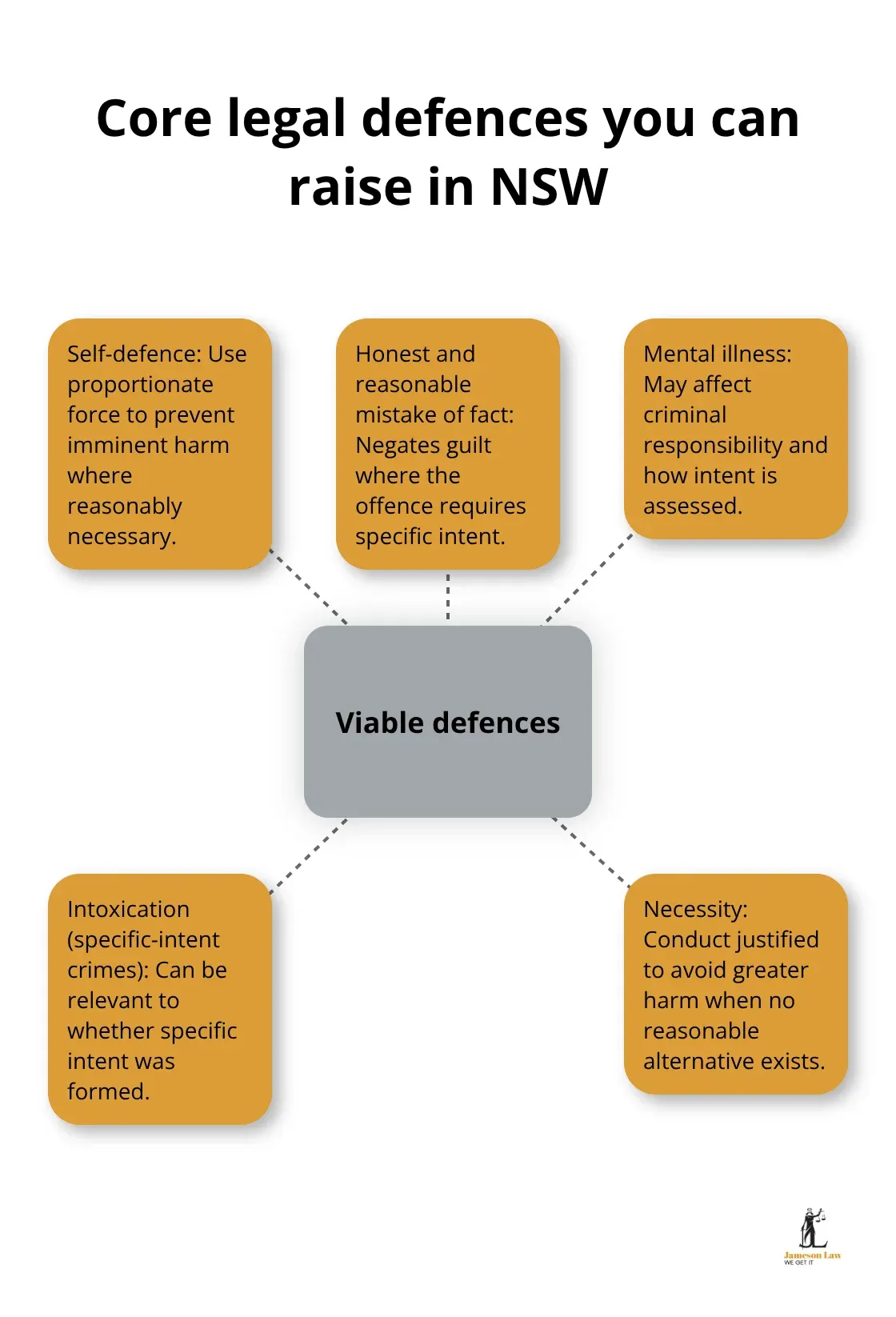
Building Your Defence Strategy
Request and Examine the Full Brief of Evidence
The moment you engage a lawyer, the focus shifts to identifying gaps in the prosecution’s case. Your legal team will request the full brief of evidence. Many defendants assume the prosecution has an airtight case, but police investigations often contain procedural errors, or witness statements contradict each other.
Challenge Digital Evidence and Chain of Custody
NSW courts require rigorous authentication of digital evidence under the Evidence Act 1995 (NSW). If police obtained phone data without proper warrants, that evidence can be excluded entirely. Chain-of-custody documentation matters enormously.
Expose Weaknesses in Witness Statements
If a witness claims they saw something clearly but their statement contains vague details, cross-examination will expose those weaknesses. We check whether key witnesses have motives to lie or ongoing disputes, particularly in domestic violence or assault allegations.
Negotiating Settlement or Preparing for Trial
Assess Your Position Against the Evidence
You face a critical decision: negotiate a settlement or proceed to trial. The Early Appropriate Guilty Plea (EAGP) reforms reward defendants who resolve matters quickly. Courts offer a mandatory 25% sentencing discount for guilty pleas entered before committal in the Local Court.

The Australian Bureau of Statistics reports a high conviction rate for matters that reach a final trial judgment. This means if the prosecution has strong evidence, negotiating a guilty plea to a lesser charge can deliver substantially better outcomes than gambling on a trial. However, if evidence was unlawfully obtained, a trial becomes a highly viable strategy.
Map Both Paths Before Deciding
Your lawyer should map both paths clearly. Crown Prosecutors know which cases are weak. If they’re offering significant concessions, they’re worried about trial. The negotiation process requires skilled advocacy and a clear understanding of legal principles.
Build Your Defence Narrative Around Reasonable Doubt
Your job is not to prove your innocence; your job is to create reasonable doubt. If the prosecution’s timeline doesn’t fit the facts, highlight that gap. Anticipate the prosecution’s strongest arguments and address them head-on rather than hoping the judge or jury won’t notice them.
Final Thoughts
A strong criminal law defence NSW requires strategy, evidence, and realistic decision-making from the moment you face charges. Most cases resolve through negotiation rather than trial, but you need solid preparation to negotiate from a position of strength.
We at Jameson Law have spent years building criminal defence strategies that work in NSW courts. We scrutinise the prosecution’s evidence systematically and challenge procedural errors. Contact Jameson Law for expert criminal law advice today. The sooner you engage, the sooner we can protect your rights and your future.