PUBLICATION

Family Law Act 1975 NSW: Your Complete Guide

"Explore the Family Law Act 1975 NSW with expert insights. Understand its impact, rights, and obligations to navigate family law effectively."
Family Law Act 1975 NSW: Your Complete Guide

The Family Law Act 1975 NSW governs how Australian families navigate separation, divorce, and parenting disputes. This federal legislation applies across all states, including New South Wales, setting the legal framework for property settlements and child custody arrangements.

We at Jameson Law see families grappling with these complex legal requirements daily. Understanding your rights and obligations under this Act can make the difference between a smooth resolution and costly court battles.

What Does the Family Law Act Actually Cover?

The Family Law Act 1975 operates as federal legislation across Australia through the Federal Circuit and Family Court of Australia (FCFCOA) system. This Act handles three main areas: marriage dissolution, property division, and parenting arrangements. Unlike state-based laws, this federal framework applies identical legal principles whether you separate in Sydney or Perth.
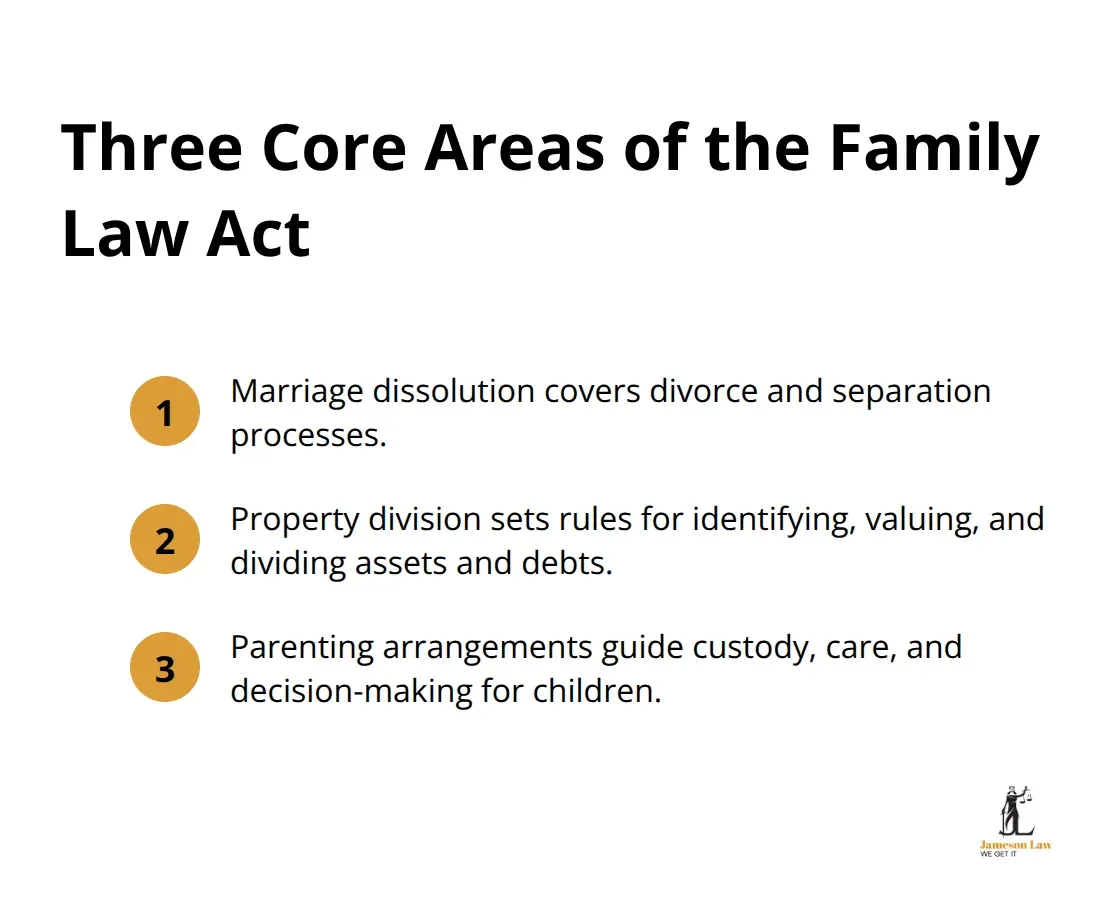
Overview of the Family Law Act’s three core areas in Australia

The Act introduced Australia’s no-fault divorce system, which requires only 12 months of separation rather than proof of wrongdoing. Courts process approximately 47,000 divorce applications annually, with most cases now resolved through alternative dispute resolution.

NSW Court System Integration

NSW residents access family law services through the Federal Circuit and Family Court. This federal system handles complex property disputes and all parenting matters. The Act mandates Family Dispute Resolution (FDR) before court applications, which has significantly reduced parenting order filings.

Legal Aid NSW provides support for qualifying applicants, though most property settlements require private legal representation. The federal system becomes particularly important when matters involve substantial assets or interstate complications.

Major 2024 Legislative Changes

The Family Law Amendment Act 2023 (effective May 2024) introduced significant changes. Courts must now consider economic abuse as family violence when they divide property. The Act removes the presumption of equal shared parental responsibility and prioritises child safety over parental rights.

New disclosure obligations require complete financial transparency from case commencement. These amendments reflect recognition that family violence extends beyond physical harm.

Property and Asset Coverage

The Act covers all forms of property acquired before, during, and after relationships. This includes real estate, business interests, and superannuation funds. Courts can make orders about companion animals, though they cannot order joint ownership of family pets.

Financial agreements (like Binding Financial Agreements) allow couples to determine asset division. These agreements require independent legal advice to become enforceable.

How Are Assets Actually Divided in Property Settlements?

Property settlement under the Family Law Act follows a strict four-step process that courts apply to achieve just and equitable outcomes.
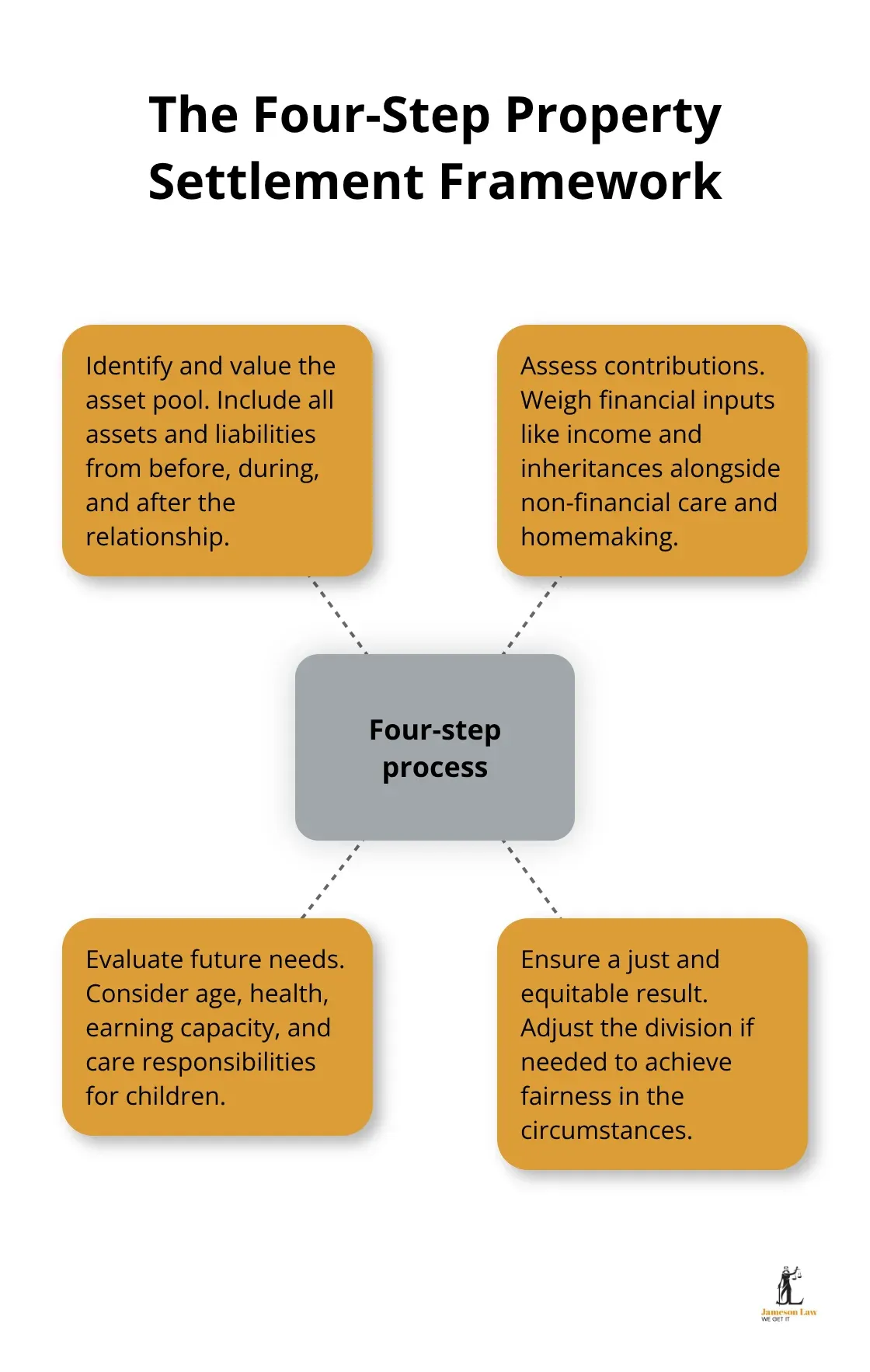
Hub-and-spoke visual of the four-step property settlement approach - family law act 1975 nsw

The Four-Step Assessment Process

Courts evaluate financial contributions (income, inheritance) alongside non-financial contributions such as homemaking. “Future needs” assessment considers age, health, and earning capacity. The Australian Bureau of Statistics shows that many children live in single-parent families, making future needs calculations significant for primary caregivers.

Courts then determine if the proposed division produces a just and equitable result. This systematic approach prevents arbitrary decisions.

Superannuation Division Rules

Superannuation splitting is available, with courts treating superannuation as property. The recipient party establishes their own account through this process. Financial agreements can also address superannuation division.

Economic Abuse Recognition

The amendments now recognise economic abuse as family violence. This includes situations where one party controlled finances or accumulated debt in the other party’s name. Courts can now adjust property settlements to account for financial abuse patterns.

How Do Courts Decide Child Custody?

Child custody decisions under the Family Law Act prioritise safety. Courts examine factors such as child safety, meaningful relationships, and the child’s views. Most separated parents do not go to court to decide their parenting arrangements.
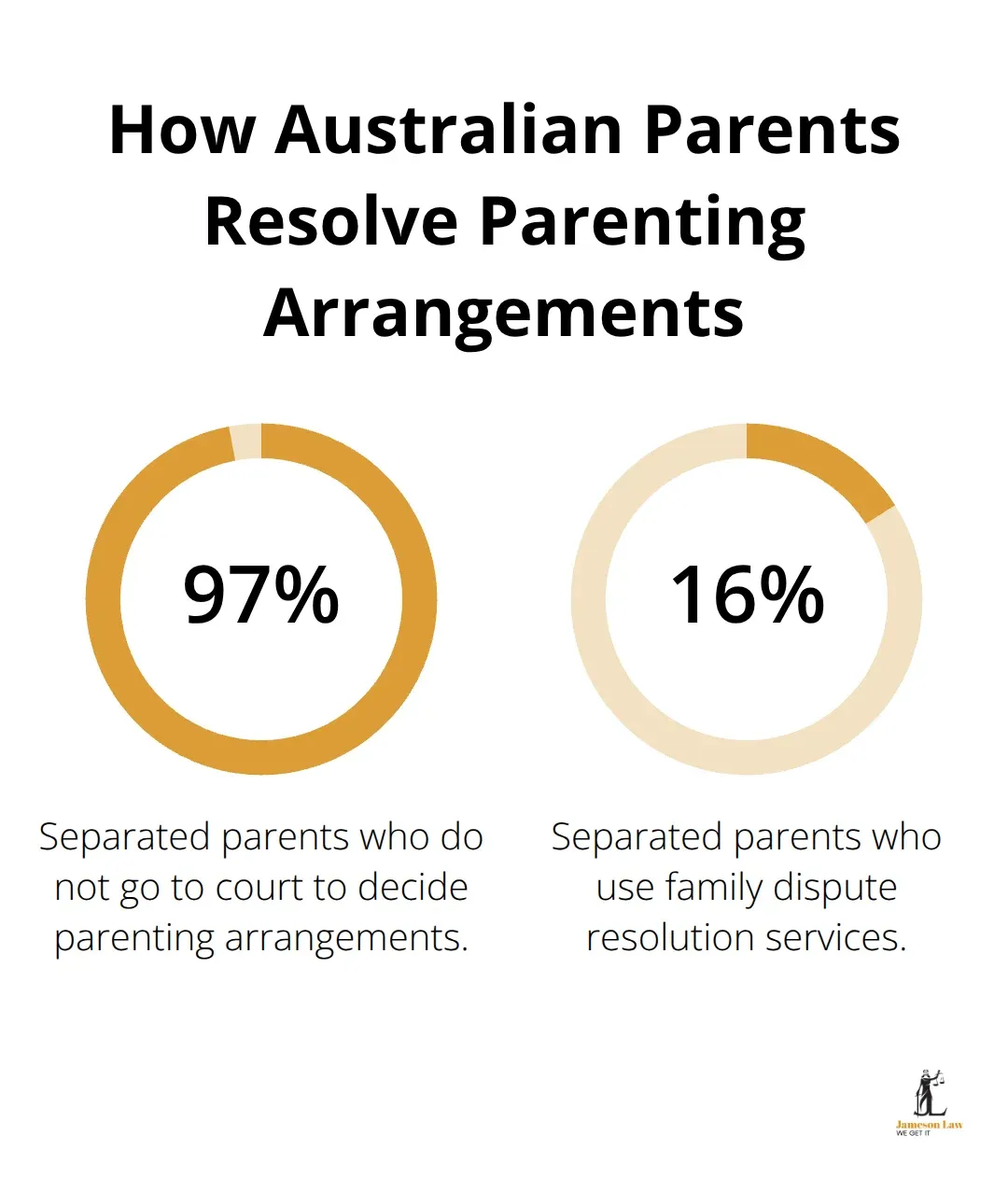
Percentages showing court versus dispute resolution usage by separated parents in Australia - family law act 1975 nsw

Safety Takes Priority Over Parental Rights

The 2024 amendments removed the presumption of equal shared parental responsibility. Courts will make parenting orders in the best interests of the child, assessing safety risks. This change recognises that relationships should never compromise child safety.

Parenting Plans Versus Court Orders

Parenting plans represent voluntary agreements but lack legal enforceability. Consent Orders provide binding legal frameworks. Parents must attempt family dispute resolution before seeking court orders unless an exemption applies.

Final Thoughts

The Family Law Act 1975 NSW provides comprehensive frameworks for property settlements, parenting arrangements, and divorce proceedings. Recent amendments prioritise child safety and recognise economic abuse.

Professional legal assistance becomes essential when substantial assets are involved or family violence allegations arise. We at Jameson Law provide expert family law services across NSW. Contact us today to discuss your family law matter with qualified professionals.


Speak to an Expert Lawyer today

Laywers-Jameson-Law-The-best-law-firm-in-Sydney- Sydney Lawyers - Sydney
BOOK NOW

WE'RE IN IT TO WIN IT

Book your consultation

Book Now
Book Now Mobile 06 02 2025

This form submission is encrypted and secured to ensure your information remains confidential.

What our Clients

Related Publications:

What our clients say

.

Jameson Law - Voted the Best Law firm in Sydney Award

Legal Answers ... In Short

We're here to help

Our mission is to ensure our client matters are resolved successfully every time. Success to us does not simply involve winning, but moreover ensuring we take the most feasible, economic and stress-free path to help our clients achieve their goals. We fight hard for our clients, and always go by the motto: we’re in it to win it.

Jameson Law - Best Law Firm in Sydney

WE'RE IN IT TO WIN IT

Book your consultation

Call us now on (02) 8806 0866 or fill out the form below

Book Now Mobile

This form submission is encrypted and secured to ensure your information remains confidential.

WE'RE IN IT TO WIN IT

Book your consultation

Book Now Mobile 06 02 2025
lock

This form submission is encrypted and secured to ensure your information remains confidential.

Our Sydney Offices

Offices Parramatta and Sydney Jameson Law
Parramatta CBD - Head Office
jameson Law - Blacktown
jameson Law - Liverpool Office
Jameson Law - Bankstown
Court Houses We Frequent Jameson Law

Court Houses We Frequent

Balmain Local Court

Registry: Monday to Friday, 9:00am to 4:30pm

Bankstown Local Court

Court Operating Hours: 9:30am-4:30pm

Blacktown Local Court

Registry Hours: 9:00 – 4:30
Telephone Hours: 8:30 -4:30
Days open: Mon-Fri

Burwood Local Court

Registry Hours: 9:00 – 4:30
Telephone Hours: 8:30 – 4:30
Days open: Mon – Fri

Campbell Local Court

Registry Hours: 9:00 – 4:30
Telephone Hours: 8:30 – 4:30
Days open: Mon – Fri

Central Local Court

Registry Hours: 9:00 – 1:00 and 2:00 – 4:30
Telephone Hours: 8:30 – 4:30

Downing Local Court

Registry Hours: 9:00 – 1:00 and 2:00 – 4:30
Telephone Hours: 8:30 – 4:30

Wollongong Local Court

Registry Hours: 9:00 – 1:00 and 2:00 – 4:30
Telephone Hours: 8:30 – 4:30

Fairfield Local Court

Registry Hours: 9:00 – 1:00 and 2:00 – 4:30
Telephone Hours: 8:30 – 4:30

Hornsby Local Court

Registry Hours: 9:00 – 1:00 and 2:00 – 4:30
Telephone Hours: 8:30 – 4:30

Liverpool Local Court

Registry Hours: 9:00 – 1:00 and 2:00 – 4:30
Telephone Hours: 8:30 – 4:30

Manly Local Court

Registry Hours: 9:00 – 1:00 and 2:00 – 4:30
Telephone Hours: 8:30 – 4:30

Newtown Local Court

Registry Hours: 9:00 – 1:00 and 2:00 – 4:30
Telephone Hours: 8:30 – 4:30

Parramatta Local Court

Registry Hours: 9:00 – 1:00 and 2:00 – 4:30
Telephone Hours: 8:30 – 4:30

Penrith Local Court

Registry Hours: 9:00 – 1:00 and 2:00 – 4:30
Telephone Hours: 8:30 – 4:30

Sutherland Local Court

Registry Hours: 9:00 – 1:00 and 2:00 – 4:30
Telephone Hours: 8:30 – 4:30

Waverley Local Court

Registry Hours: 9:00 – 1:00 and 2:00 – 4:30
Telephone Hours: 8:30 – 4:30

Windsor Local Court

Registry Hours: 9:00 – 1:00 and 2:00 – 4:30
Telephone Hours: 8:30 – 4:30

Wollongong Local Court

Registry Hours: 9:00 – 1:00 and 2:00 – 4:30
Telephone Hours: 8:30 – 4:30

Downing Centre District Court

Registry Hours: 9:00 – 4:30
Telephone Hours: 8:30 – 4:30
Days open: Mon – Fri

Parramatta District Court

Registry Hours: 9:00 – 4:30
Days open: Mon-Fri

Penrith District Court

Registry Hours: 9:00 – 4:30
Days open: Mon-Fri

Campbelltown District Court

Registry Hours: 9:00 – 4:30
Days open: Mon – Fri

Liverpool District Court

Registry Hours: 9:00 – 4:30
Days open: Mon – Fri

Wollongong District Court

Registry Hours: 9:00 – 1:00 and 2:00 – 4:30
Telephone Hours: 8:30 – 4:30

Supreme Court New South Wales

Registry Hours: 9:00 AM – 4:30 PM
Telephone Hours: 8:30 AM – 4:30 PM
Days Open: Monday to Friday

Federal Circuit and Family Court of Australia

Registry Hours: 9:00 AM – 4:30 PM
Telephone Hours: 8:30 AM – 5:00 PM
Days Open: Monday to Friday

Federal Court

Monday to Friday, 8:30 AM – 4:30 PM

High Court

Monday to Friday, 8:30 AM – 5:00 PM

Children’s Court of New South Wales

Registry Hours: 9:00 AM – 4:30 PM
Telephone Hours: 8:30 AM – 4:30 PM
Days Open: Monday to Friday

Coroner’s Court New South Wales

Registry Hours: 9:00 AM – 4:30 PM
Telephone Hours: 8:30 AM – 4:30 PM
Days Open: Monday to Friday

Industrial Relations Commission of New South Wales

Registry Hours: 9:00 AM – 4:30 PM
Telephone Hours: 8:30 AM – 4:30 PM
Days Open: Monday to Friday

Land and Environment Court of New South Wales

Registry Hours: 9:00 AM – 4:30 PM
Telephone Hours: 8:30 AM – 4:30 PM
Days Open: Monday to Friday

WE'RE IN IT TO WIN IT

Book your consultation

Book Now
Book Now Mobile 06 02 2025
lock

This form submission is encrypted and secured to ensure your information remains confidential.