Family law orders need to be accurate. When a court order contains errors—whether a typo, missing information, or procedural mistake—the slip rule offers a way to fix them without starting over.
At Jameson Law, we help clients navigate slip rule applications in family law cases. This guide walks you through identifying errors and understanding when this remedy applies to your Consent Orders.
What the Slip Rule Actually Does?
Rule 10.13 of the Federal Circuit and Family Court of Australia Rules 2021 gives courts the power to correct orders after they’re made. The slip rule allows courts to correct accidental errors, such as clerical mistakes, without requiring a lengthy appeal.
It does not offer a second chance to argue your case. The distinction matters because courts are functus officio after making final orders, meaning they’ve exhausted their power to decide the case.
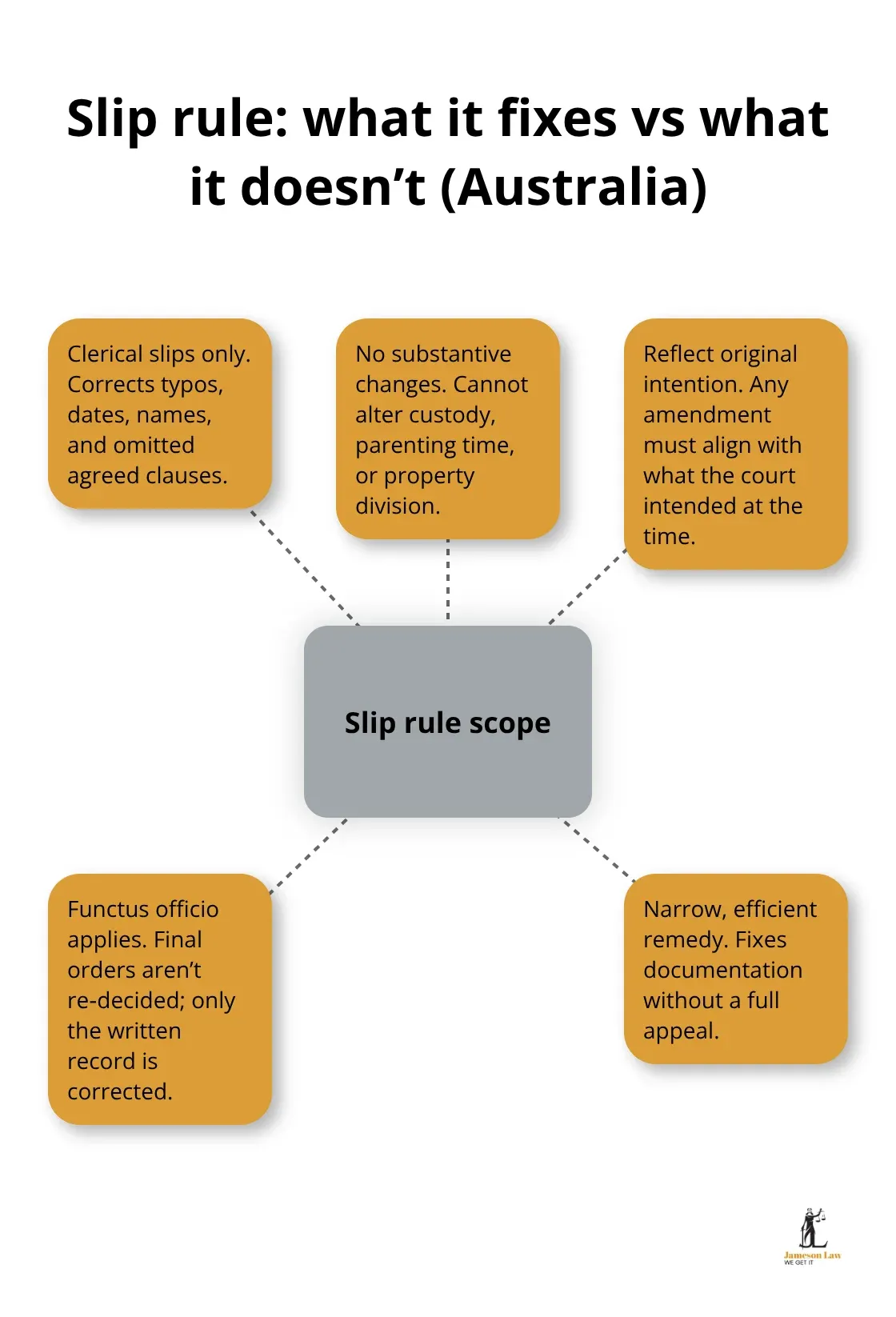
Recent decisions like Aubert & Cranmore (No 3) [2024] confirm that slip rule applications remain a practical tool. The key test comes from Pawley v Pawley (2017), which established that the slip rule applies only where the amendment reflects the court’s original intention.
Clerical Errors Versus Substantive Changes
Courts take a strict approach. Misspelled names, wrong dates, and missing superannuation details qualify. However, if you want to shift parenting schedules or property division, the slip rule won’t help. This would require a formal appeal to the Federal Circuit and Family Court.
What Errors Qualify for Slip Rule Correction?
The slip rule exists to fix genuine mistakes. The types of errors that qualify fall into three distinct categories:
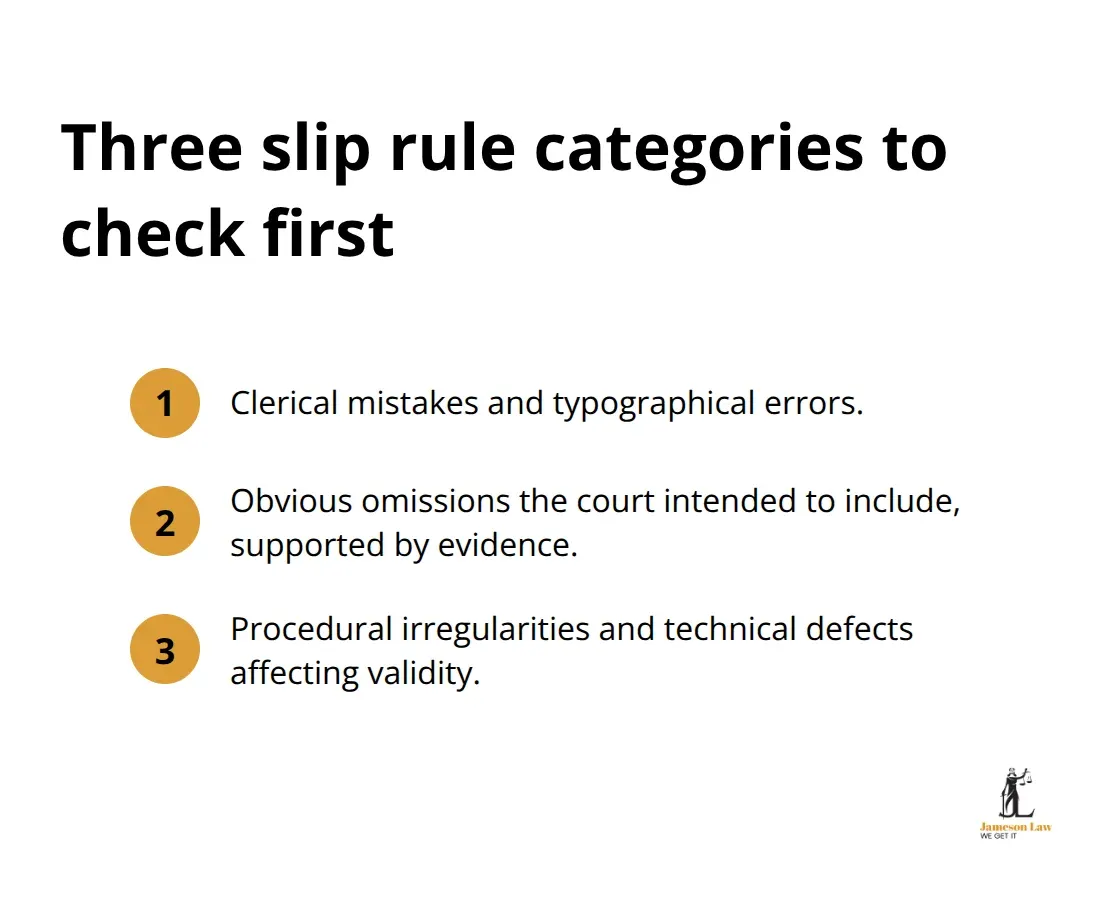
Clerical Mistakes and Typographical Errors
Misspelled party names, transposed numbers in dollar amounts, and incorrect dates qualify. If a judge ordered you to pay $150,000 in property settlement but the order states $15,000, that’s a clerical error the slip rule handles efficiently.
Obvious Omissions in Court Orders
If the court made an order about parenting arrangements but failed to include a clause that both parties agreed on, the slip rule can apply. This requires evidence, such as hearing transcripts, to prove the court’s intention.
Procedural Irregularities and Technical Defects
Procedural irregularities like missing signatures or incorrect case references affect validity. These corrections are necessary because an order with a defect may be unenforceable. Before filing, you must be certain your error falls into one of these categories.
How to Build Your Slip Rule Application?
Obtain and Review the Exact Court Order
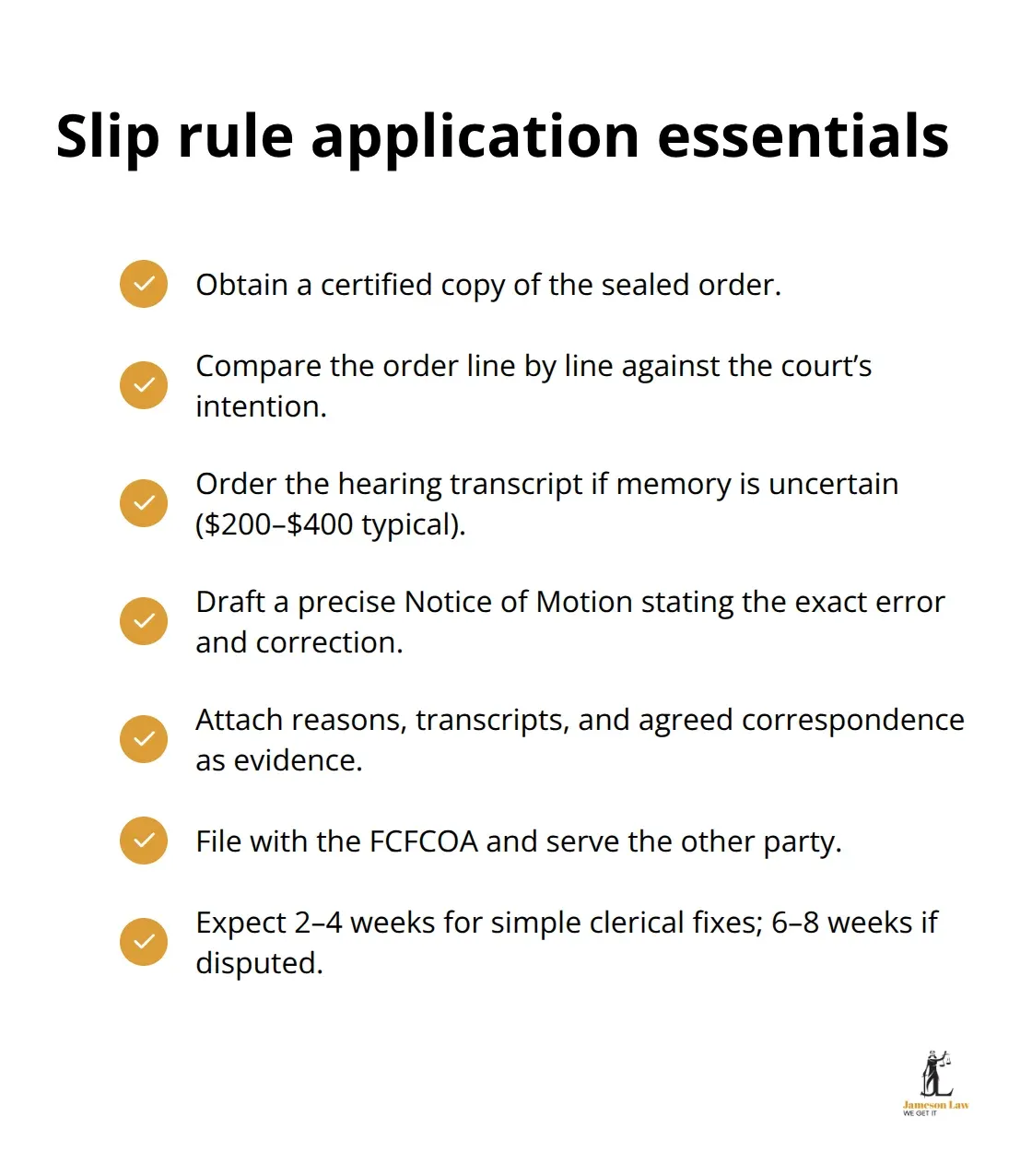
Start with a certified copy of the order. Request this from the Commonwealth Courts Portal. Read it line by line against what the court intended. If you’re working from memory, obtain the hearing transcript to provide evidence.
Prepare Your Notice of Motion With Precision
Prepare an Application in a Proceeding that clearly states what needs correcting. Include the exact wording of the error and the proposed correction. Attach copies of supporting documents that prove the error exists.
File Your Application and Manage the Timeline
File your application ensuring the other party receives notice. Most registrars decide straightforward clerical corrections within weeks. If the other party objects, additional submissions may be requested.
Final Thoughts
The slip rule in family law corrects genuine mistakes without reopening settled disputes. If your court order contains a clerical error, this remedy offers a faster path than an appeal.
If you’ve identified an error in your order, contact Jameson Law immediately. Our family law team can assess whether your error qualifies for correction and help you file the necessary application.