PUBLICATION

How to Navigate Dispute Resolution in Family Law

"Navigate dispute resolution in family law effectively with our expert tips and insights for peaceful solutions and better outcomes."
How to Navigate Dispute Resolution in Family Law

Family disputes can tear relationships apart and create lasting emotional scars. When marriages end or custody battles begin, the path forward often feels overwhelming and uncertain. However, dispute resolution family law processes offer a dignified way to resolve conflicts.

We at Jameson Law understand that resolving these matters requires both legal expertise and emotional intelligence. The right approach can save you time, money, and preserve important family relationships for the future.

Which Dispute Resolution Method Works Best?

Family Dispute Resolution (FDR) becomes mandatory under Section 60I of the Family Law Act 1975 before you apply for parenting orders in court. This requirement exists because the Australian Government recognises that families achieve better outcomes when they control their own agreements. Statistics show that mediation resolves over 70% of family disputes without court intervention.

Mediation Delivers Real Results

Mediation through accredited practitioners costs significantly less than litigation. Government-subsidised services are available through Family Relationship Centres. Private mediation typically costs far less than court proceedings that can average tens of thousands per case.
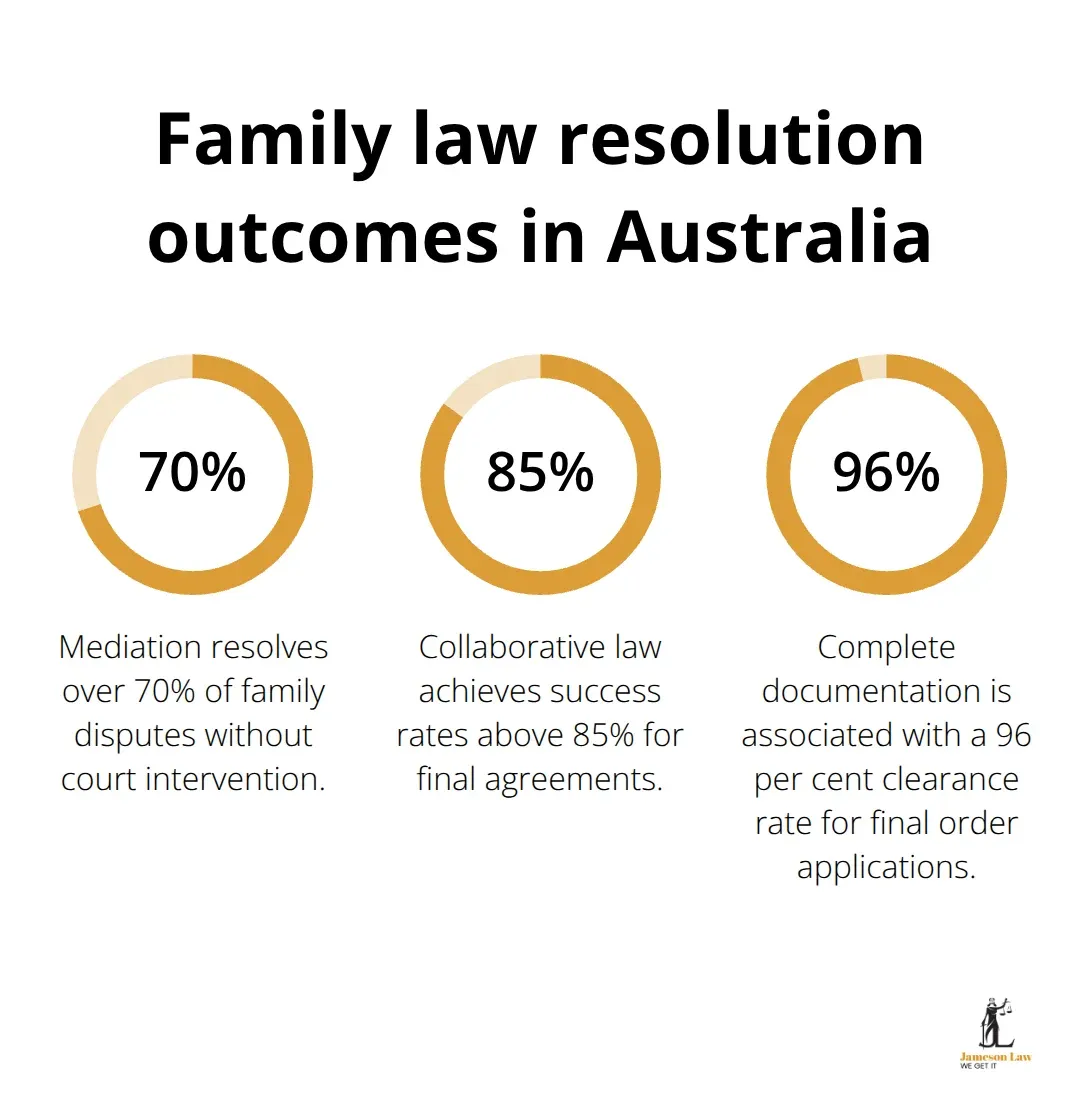
Percentages highlighting mediation, collaborative law, and documentation success in Australian family law

The process takes hours rather than the 12-18 months typical of court cases. Confidentiality protections mean discussions cannot be used against you later in court, encouraging honest negotiation.

Collaborative Law Prevents Court Battles

Collaborative law requires both parties and their lawyers to sign agreements preventing court action. If negotiations fail, everyone must withdraw, and new lawyers handle any litigation. This commitment forces genuine settlement efforts. Success rates exceed 85% for final agreements, making it highly effective for complex property disputes.

Arbitration Provides Binding Decisions

When mediation fails but court seems too expensive, arbitration offers a middle ground. Retired judges or senior barristers make binding decisions after hearing evidence privately. Arbitration works best for property settlements where legal precedents apply clearly.

How Do You Prepare for Dispute Resolution?

Success depends on preparation quality. Parties who arrive with organised documentation achieve better outcomes. The difference between positive and negative outcomes often comes down to preparation factors most people overlook.

Document Everything Before You Start

Financial records form the backbone of property settlements and child support calculations. Gather tax returns, bank statements, and superannuation statements. Property valuations must be current. Child-related expenses need detailed records.
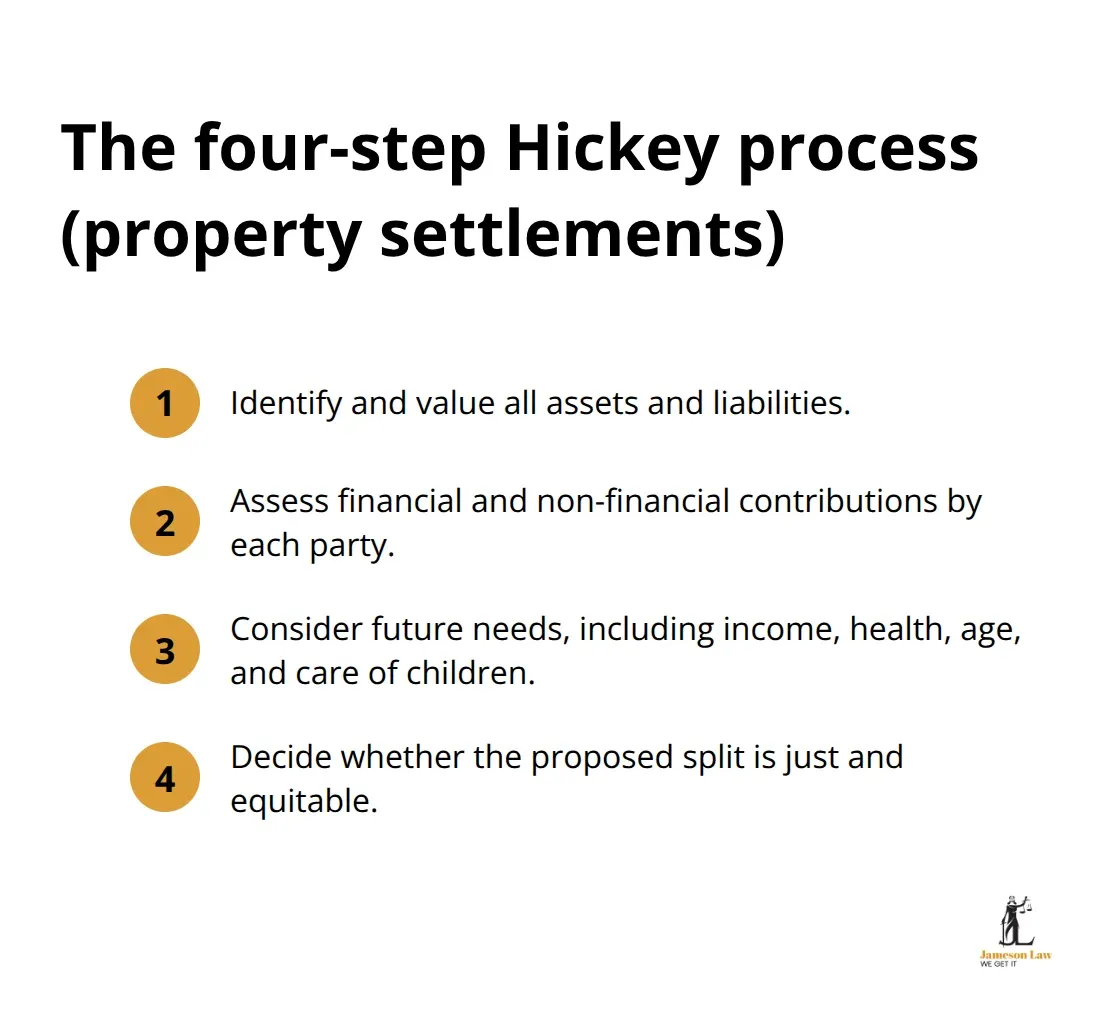
Ordered list of the Hickey four-step process used in Australian family law property settlements - dispute resolution family law

Know Your Legal Position Before Negotiations

Property settlement follows the four-step process: identify assets, assess contributions, consider future needs, then determine if the split is just and equitable. Parenting arrangements prioritise children’s best interests over parental preferences. Understanding these frameworks prevents unrealistic expectations.

Choose the Right Legal Representation

The type of dispute resolution determines the legal support you need. Mediation allows self-representation, but complex matters benefit from legal advice beforehand. Arbitration demands experienced practitioners who understand evidence rules. The right lawyer matches your budget and dispute complexity.

What Separates Successful Resolution from Failure?

The difference lies in how you handle communication. Research shows that parties who follow structured protocols reach agreement more often. Cases with proper emotional management settle for less cost.

Focus on Interests Rather Than Positions

State what you need rather than demanding specific actions. Explain that you need meaningful time with children rather than demanding “weekend access.” This approach reduces defensive responses. Interest-based negotiation improves settlement outcomes compared to positional bargaining.
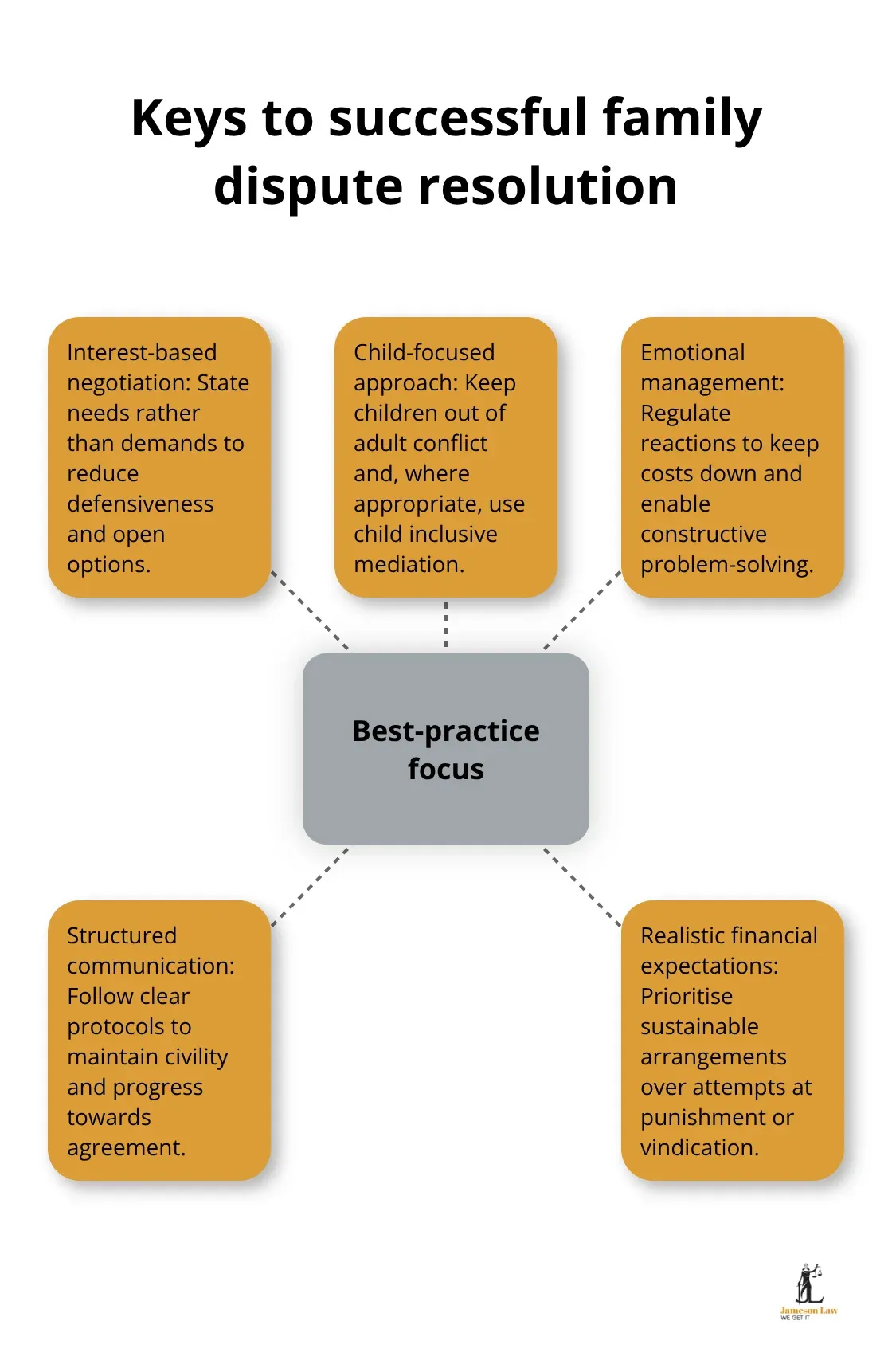
Hub-and-spoke showing best-practice factors that improve agreement rates in Australian family disputes - dispute resolution family law

Keep Children Out of Adult Conflicts

Never discuss settlement details with children. Focus discussions on practical arrangements like school pickups. Child-inclusive mediation allows professionals to gather children’s views safely. This protects children while maintaining parental coordination.

Set Realistic Financial Expectations

Property settlements rarely achieve 50-50 splits when future needs differ significantly. The court considers earning capacity and care responsibilities. Child support payments follow strict formula calculations. Focus on sustainable long-term solutions rather than punishment.

Final Thoughts

Successful dispute resolution family law demands preparation and realistic expectations. The system favours negotiated settlements, with mediation resolving most disputes at lower costs. Thorough documentation and emotional management determine positive outcomes.

Professional legal assistance becomes necessary for complex property values or safety concerns. We at Jameson Law provide expert family law services across NSW. Contact Jameson Law today to achieve practical outcomes that protect your future.


Speak to an Expert Lawyer today

Laywers-Jameson-Law-The-best-law-firm-in-Sydney- Sydney Lawyers - Sydney
BOOK NOW

WE'RE IN IT TO WIN IT

Book your consultation

Book Now
Book Now Mobile 06 02 2025

This form submission is encrypted and secured to ensure your information remains confidential.

What our Clients

Related Publications:

What our clients say

.

Jameson Law - Voted the Best Law firm in Sydney Award

Legal Answers ... In Short

We're here to help

Our mission is to ensure our client matters are resolved successfully every time. Success to us does not simply involve winning, but moreover ensuring we take the most feasible, economic and stress-free path to help our clients achieve their goals. We fight hard for our clients, and always go by the motto: we’re in it to win it.

Jameson Law - Best Law Firm in Sydney

WE'RE IN IT TO WIN IT

Book your consultation

Call us now on (02) 8806 0866 or fill out the form below

Book Now Mobile

This form submission is encrypted and secured to ensure your information remains confidential.

WE'RE IN IT TO WIN IT

Book your consultation

Book Now Mobile 06 02 2025
lock

This form submission is encrypted and secured to ensure your information remains confidential.

Our Sydney Offices

Offices Parramatta and Sydney Jameson Law
Parramatta CBD - Head Office
jameson Law - Blacktown
jameson Law - Liverpool Office
Jameson Law - Bankstown
Court Houses We Frequent Jameson Law

Court Houses We Frequent

Balmain Local Court

Registry: Monday to Friday, 9:00am to 4:30pm

Bankstown Local Court

Court Operating Hours: 9:30am-4:30pm

Blacktown Local Court

Registry Hours: 9:00 – 4:30
Telephone Hours: 8:30 -4:30
Days open: Mon-Fri

Burwood Local Court

Registry Hours: 9:00 – 4:30
Telephone Hours: 8:30 – 4:30
Days open: Mon – Fri

Campbell Local Court

Registry Hours: 9:00 – 4:30
Telephone Hours: 8:30 – 4:30
Days open: Mon – Fri

Central Local Court

Registry Hours: 9:00 – 1:00 and 2:00 – 4:30
Telephone Hours: 8:30 – 4:30

Downing Local Court

Registry Hours: 9:00 – 1:00 and 2:00 – 4:30
Telephone Hours: 8:30 – 4:30

Wollongong Local Court

Registry Hours: 9:00 – 1:00 and 2:00 – 4:30
Telephone Hours: 8:30 – 4:30

Fairfield Local Court

Registry Hours: 9:00 – 1:00 and 2:00 – 4:30
Telephone Hours: 8:30 – 4:30

Hornsby Local Court

Registry Hours: 9:00 – 1:00 and 2:00 – 4:30
Telephone Hours: 8:30 – 4:30

Liverpool Local Court

Registry Hours: 9:00 – 1:00 and 2:00 – 4:30
Telephone Hours: 8:30 – 4:30

Manly Local Court

Registry Hours: 9:00 – 1:00 and 2:00 – 4:30
Telephone Hours: 8:30 – 4:30

Newtown Local Court

Registry Hours: 9:00 – 1:00 and 2:00 – 4:30
Telephone Hours: 8:30 – 4:30

Parramatta Local Court

Registry Hours: 9:00 – 1:00 and 2:00 – 4:30
Telephone Hours: 8:30 – 4:30

Penrith Local Court

Registry Hours: 9:00 – 1:00 and 2:00 – 4:30
Telephone Hours: 8:30 – 4:30

Sutherland Local Court

Registry Hours: 9:00 – 1:00 and 2:00 – 4:30
Telephone Hours: 8:30 – 4:30

Waverley Local Court

Registry Hours: 9:00 – 1:00 and 2:00 – 4:30
Telephone Hours: 8:30 – 4:30

Windsor Local Court

Registry Hours: 9:00 – 1:00 and 2:00 – 4:30
Telephone Hours: 8:30 – 4:30

Wollongong Local Court

Registry Hours: 9:00 – 1:00 and 2:00 – 4:30
Telephone Hours: 8:30 – 4:30

Downing Centre District Court

Registry Hours: 9:00 – 4:30
Telephone Hours: 8:30 – 4:30
Days open: Mon – Fri

Parramatta District Court

Registry Hours: 9:00 – 4:30
Days open: Mon-Fri

Penrith District Court

Registry Hours: 9:00 – 4:30
Days open: Mon-Fri

Campbelltown District Court

Registry Hours: 9:00 – 4:30
Days open: Mon – Fri

Liverpool District Court

Registry Hours: 9:00 – 4:30
Days open: Mon – Fri

Wollongong District Court

Registry Hours: 9:00 – 1:00 and 2:00 – 4:30
Telephone Hours: 8:30 – 4:30

Supreme Court New South Wales

Registry Hours: 9:00 AM – 4:30 PM
Telephone Hours: 8:30 AM – 4:30 PM
Days Open: Monday to Friday

Federal Circuit and Family Court of Australia

Registry Hours: 9:00 AM – 4:30 PM
Telephone Hours: 8:30 AM – 5:00 PM
Days Open: Monday to Friday

Federal Court

Monday to Friday, 8:30 AM – 4:30 PM

High Court

Monday to Friday, 8:30 AM – 5:00 PM

Children’s Court of New South Wales

Registry Hours: 9:00 AM – 4:30 PM
Telephone Hours: 8:30 AM – 4:30 PM
Days Open: Monday to Friday

Coroner’s Court New South Wales

Registry Hours: 9:00 AM – 4:30 PM
Telephone Hours: 8:30 AM – 4:30 PM
Days Open: Monday to Friday

Industrial Relations Commission of New South Wales

Registry Hours: 9:00 AM – 4:30 PM
Telephone Hours: 8:30 AM – 4:30 PM
Days Open: Monday to Friday

Land and Environment Court of New South Wales

Registry Hours: 9:00 AM – 4:30 PM
Telephone Hours: 8:30 AM – 4:30 PM
Days Open: Monday to Friday

WE'RE IN IT TO WIN IT

Book your consultation

Book Now
Book Now Mobile 06 02 2025
lock

This form submission is encrypted and secured to ensure your information remains confidential.