PUBLICATION

How to Navigate Family Law Financial Agreements

"Understand family law financial agreements with practical tips on settlements, support obligations, and protecting your assets."
How to Navigate Family Law Financial Agreements

Family law financial agreements shape how assets, income, and liabilities are divided when relationships change. Getting these agreements right from the start protects both parties and prevents costly property disputes later.

At Jameson Law, we’ve seen how proper financial agreements give people clarity and control over their financial future. This guide walks you through the types available (often called Binding Financial Agreements or BFAs), what you need to know, and the steps to get it done properly.

What Financial Agreements Actually Cover?

A Financial Agreement under Australian family law isn’t a one-size-fits-all document. It addresses the specific financial matters you and your partner decide to include. The agreement can tackle property division, spousal maintenance, and superannuation splitting depending on your circumstances.

Checklist of key areas a Financial Agreement can include in Australia - family law financial agreements

This flexibility matters because it lets you protect what’s important to you. The Family Law Act 1975 sets the framework for marriages under Part VIIIA and de facto relationships under Part VIIIAB.

What Makes an Agreement Legally Binding?

For your agreement to hold up in court, it must meet strict technical requirements. Both parties must receive independent legal advice from an Australian legal practitioner. The lawyer must certify they’ve covered the prescribed matters with you. Courts have set aside poorly drafted agreements due to lack of proper advice or disclosure.

Why You Need Professional Help From the Start

Attempting to draft a Financial Agreement without a lawyer typically costs more money later. The independent legal advice requirement is your protection. A lawyer reviews the other party’s financial disclosure, identifies hidden liabilities, and checks whether future assets like inheritances are addressed.
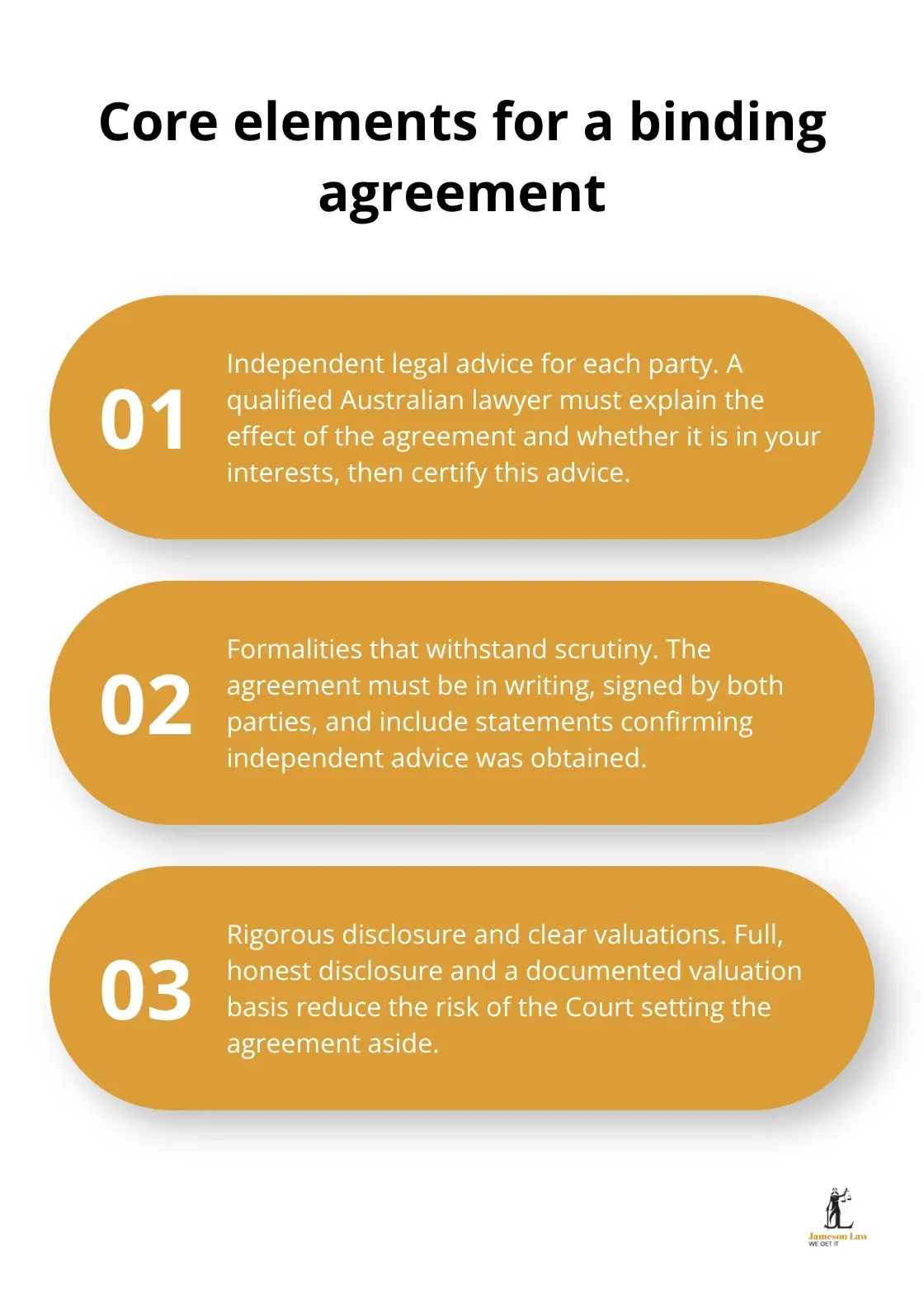
Three key legal requirements to make a Financial Agreement binding

When to Enter a Financial Agreement?

The timing of your Financial Agreement changes what you can protect. If you’re planning to marry, a “prenuptial agreement” (under Section 90B of the Act) locks in protections while both parties are still cooperative. This allows you to address asset protection and business interests without the emotional weight of conflict.

Financial Agreements During Your Relationship

During an active relationship, a Financial Agreement under Section 90C serves a different purpose. You might enter one when circumstances change significantly, such as receiving an inheritance. This prevents future disputes by documenting your intentions now. It is often simpler than renegotiating a Consent Order later.

Post-Separation Agreements and Your Deadline

After separation, you have a window to enter a Financial Agreement (under Section 90UD for de facto couples). Formalising your agreement immediately protects both parties. Delays introduce new variables—asset values shift, and the motivation to cooperate fades.

Making Financial Disclosure Work for You

Full financial disclosure is non-negotiable. The Family Law Act requires both parties to disclose everything honestly. When disclosure is incomplete, courts can set aside the agreement under Section 90K.

Gathering and Organising Your Financial Information

You need to collect tax returns, payslips, and bank statements. The valuation date matters enormously in volatile markets. Check your credit file to identify hidden liabilities. Our Sydney family lawyers can assist you in compiling this evidence to ensure full compliance.
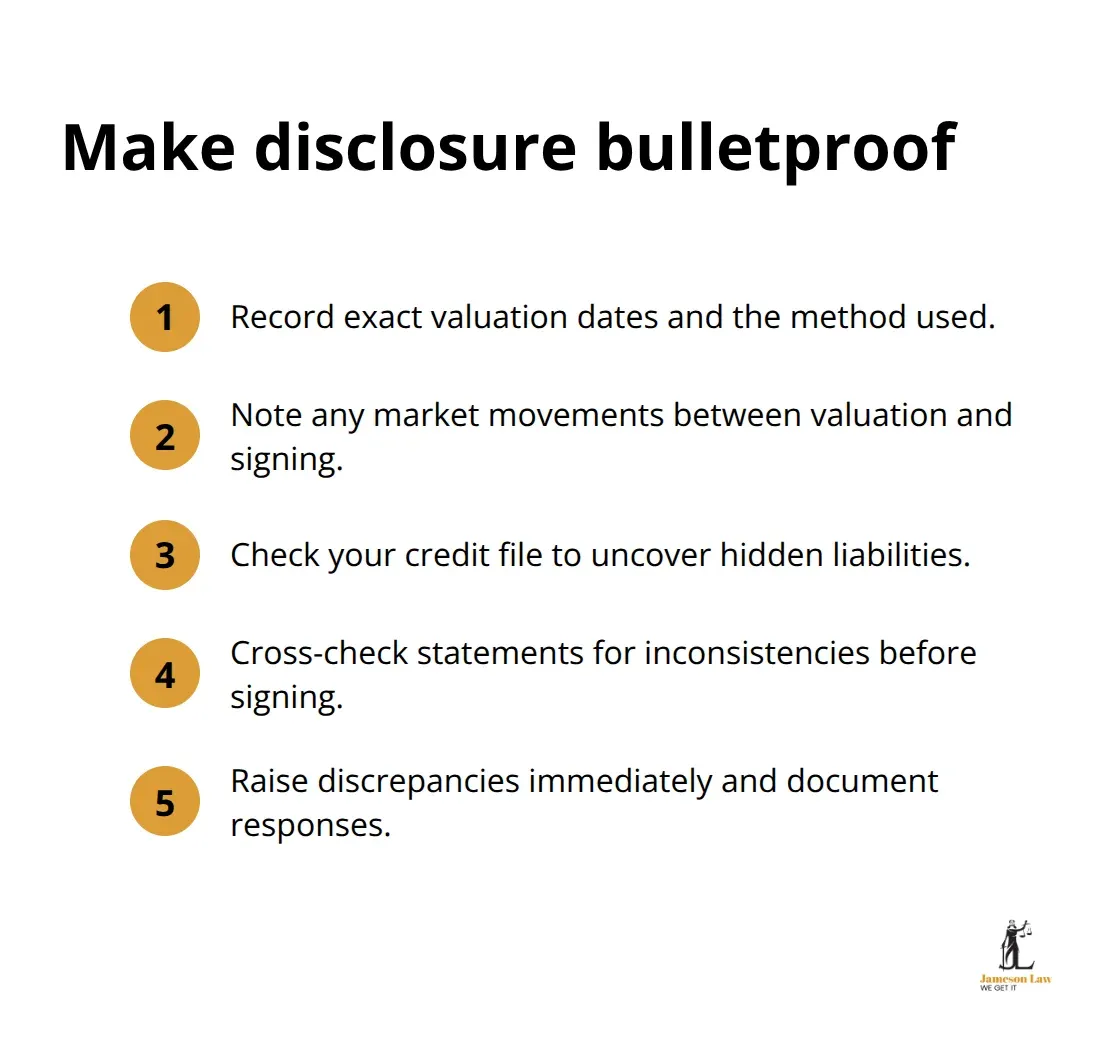
Practical steps to strengthen financial disclosure in Australian Financial Agreements - family law financial agreements

Negotiating Terms That Reflect Your Reality

Negotiating terms requires separating emotional wants from financial reality. Courts divide property based on contributions and future needs. If one party made significant non-financial contributions (like raising children), this must be reflected. You can also agree on how to handle superannuation, which is optional to split but often crucial for retirement security.

Getting Independent Legal Advice Done Right

Independent legal advice isn’t a box-ticking exercise. Your lawyer must review the agreement to ensure it protects your interests. Section 90G requires your lawyer to provide a signed statement confirming they’ve advised you. Choose a lawyer who specialises in family law rather than a generalist to ensure your Binding Financial Agreement is watertight.

Final Thoughts

Getting a family law financial agreement right from the start saves you money and stress. The agreements work because they rest on honest disclosure and proper legal advice. Whether you are marrying, separating, or managing new assets, acting early gives you control.

Gather your financial documents and arrange independent legal advice. Contact Jameson Law for guidance tailored to your specific circumstances. Getting this right now protects your financial future and gives you genuine peace of mind.


Speak to an Expert Lawyer today

Laywers-Jameson-Law-The-best-law-firm-in-Sydney- Sydney Lawyers - Sydney
BOOK NOW

WE'RE IN IT TO WIN IT

Book your consultation

Book Now
Book Now Mobile 06 02 2025

This form submission is encrypted and secured to ensure your information remains confidential.

What our Clients

Related Publications: |

What our clients say

.

Jameson Law - Voted the Best Law firm in Sydney Award

Legal Answers ... In Short

We're here to help

Our mission is to ensure our client matters are resolved successfully every time. Success to us does not simply involve winning, but moreover ensuring we take the most feasible, economic and stress-free path to help our clients achieve their goals. We fight hard for our clients, and always go by the motto: we’re in it to win it.

Jameson Law - Best Law Firm in Sydney

WE'RE IN IT TO WIN IT

Book your consultation

Call us now on (02) 8806 0866 or fill out the form below

Book Now Mobile

This form submission is encrypted and secured to ensure your information remains confidential.

WE'RE IN IT TO WIN IT

Book your consultation

Book Now Mobile 06 02 2025
lock

This form submission is encrypted and secured to ensure your information remains confidential.

Our Sydney Offices

Offices Parramatta and Sydney Jameson Law
Parramatta CBD - Head Office
jameson Law - Blacktown
jameson Law - Liverpool Office
Jameson Law - Bankstown
Court Houses We Frequent Jameson Law

Court Houses We Frequent

Balmain Local Court

Registry: Monday to Friday, 9:00am to 4:30pm

Bankstown Local Court

Court Operating Hours: 9:30am-4:30pm

Blacktown Local Court

Registry Hours: 9:00 – 4:30
Telephone Hours: 8:30 -4:30
Days open: Mon-Fri

Burwood Local Court

Registry Hours: 9:00 – 4:30
Telephone Hours: 8:30 – 4:30
Days open: Mon – Fri

Campbell Local Court

Registry Hours: 9:00 – 4:30
Telephone Hours: 8:30 – 4:30
Days open: Mon – Fri

Central Local Court

Registry Hours: 9:00 – 1:00 and 2:00 – 4:30
Telephone Hours: 8:30 – 4:30

Downing Local Court

Registry Hours: 9:00 – 1:00 and 2:00 – 4:30
Telephone Hours: 8:30 – 4:30

Wollongong Local Court

Registry Hours: 9:00 – 1:00 and 2:00 – 4:30
Telephone Hours: 8:30 – 4:30

Fairfield Local Court

Registry Hours: 9:00 – 1:00 and 2:00 – 4:30
Telephone Hours: 8:30 – 4:30

Hornsby Local Court

Registry Hours: 9:00 – 1:00 and 2:00 – 4:30
Telephone Hours: 8:30 – 4:30

Liverpool Local Court

Registry Hours: 9:00 – 1:00 and 2:00 – 4:30
Telephone Hours: 8:30 – 4:30

Manly Local Court

Registry Hours: 9:00 – 1:00 and 2:00 – 4:30
Telephone Hours: 8:30 – 4:30

Newtown Local Court

Registry Hours: 9:00 – 1:00 and 2:00 – 4:30
Telephone Hours: 8:30 – 4:30

Parramatta Local Court

Registry Hours: 9:00 – 1:00 and 2:00 – 4:30
Telephone Hours: 8:30 – 4:30

Penrith Local Court

Registry Hours: 9:00 – 1:00 and 2:00 – 4:30
Telephone Hours: 8:30 – 4:30

Sutherland Local Court

Registry Hours: 9:00 – 1:00 and 2:00 – 4:30
Telephone Hours: 8:30 – 4:30

Waverley Local Court

Registry Hours: 9:00 – 1:00 and 2:00 – 4:30
Telephone Hours: 8:30 – 4:30

Windsor Local Court

Registry Hours: 9:00 – 1:00 and 2:00 – 4:30
Telephone Hours: 8:30 – 4:30

Wollongong Local Court

Registry Hours: 9:00 – 1:00 and 2:00 – 4:30
Telephone Hours: 8:30 – 4:30

Downing Centre District Court

Registry Hours: 9:00 – 4:30
Telephone Hours: 8:30 – 4:30
Days open: Mon – Fri

Parramatta District Court

Registry Hours: 9:00 – 4:30
Days open: Mon-Fri

Penrith District Court

Registry Hours: 9:00 – 4:30
Days open: Mon-Fri

Campbelltown District Court

Registry Hours: 9:00 – 4:30
Days open: Mon – Fri

Liverpool District Court

Registry Hours: 9:00 – 4:30
Days open: Mon – Fri

Wollongong District Court

Registry Hours: 9:00 – 1:00 and 2:00 – 4:30
Telephone Hours: 8:30 – 4:30

Supreme Court New South Wales

Registry Hours: 9:00 AM – 4:30 PM
Telephone Hours: 8:30 AM – 4:30 PM
Days Open: Monday to Friday

Federal Circuit and Family Court of Australia

Registry Hours: 9:00 AM – 4:30 PM
Telephone Hours: 8:30 AM – 5:00 PM
Days Open: Monday to Friday

Federal Court

Monday to Friday, 8:30 AM – 4:30 PM

High Court

Monday to Friday, 8:30 AM – 5:00 PM

Children’s Court of New South Wales

Registry Hours: 9:00 AM – 4:30 PM
Telephone Hours: 8:30 AM – 4:30 PM
Days Open: Monday to Friday

Coroner’s Court New South Wales

Registry Hours: 9:00 AM – 4:30 PM
Telephone Hours: 8:30 AM – 4:30 PM
Days Open: Monday to Friday

Industrial Relations Commission of New South Wales

Registry Hours: 9:00 AM – 4:30 PM
Telephone Hours: 8:30 AM – 4:30 PM
Days Open: Monday to Friday

Land and Environment Court of New South Wales

Registry Hours: 9:00 AM – 4:30 PM
Telephone Hours: 8:30 AM – 4:30 PM
Days Open: Monday to Friday

WE'RE IN IT TO WIN IT

Book your consultation

Book Now
Book Now Mobile 06 02 2025
lock

This form submission is encrypted and secured to ensure your information remains confidential.