PUBLICATION

How to Navigate Section 4aa Family Law Act Requirements

"Understand Section 4aa Family Law Act requirements and navigate custody, support, and compliance obligations effectively."
How to Navigate Section 4aa Family Law Act Requirements

Section 4AA of the Family Law Act sets out specific requirements that determine whether a relationship is legally recognised as “de facto.” Getting these requirements right from the start makes the entire process smoother and protects your interests in property settlements.

At Jameson Law, we’ve seen how confusion around Section 4AA compliance creates unnecessary delays. This guide walks you through the 9 statutory factors and the evidence you need.

What Section 4AA Actually Requires?

The Core Definition and Its Complexity

Section 4AA of the Family Law Act 1975 defines a de facto relationship as two people who are not married, not related by family, and who live together on a genuine domestic basis. The Federal Circuit and Family Court of Australia (FCFCOA) does not apply a simple checklist. Instead, courts weigh nine distinct factors.

The Nine Factors Courts Examine

Courts examine the duration of the relationship, common residence, sexual relationship, financial dependence, ownership of property, and the care of children. The High Court confirmed in Fairbairn v Radecki (2022) that living in the same house is not strictly mandatory if other factors demonstrate a shared life.
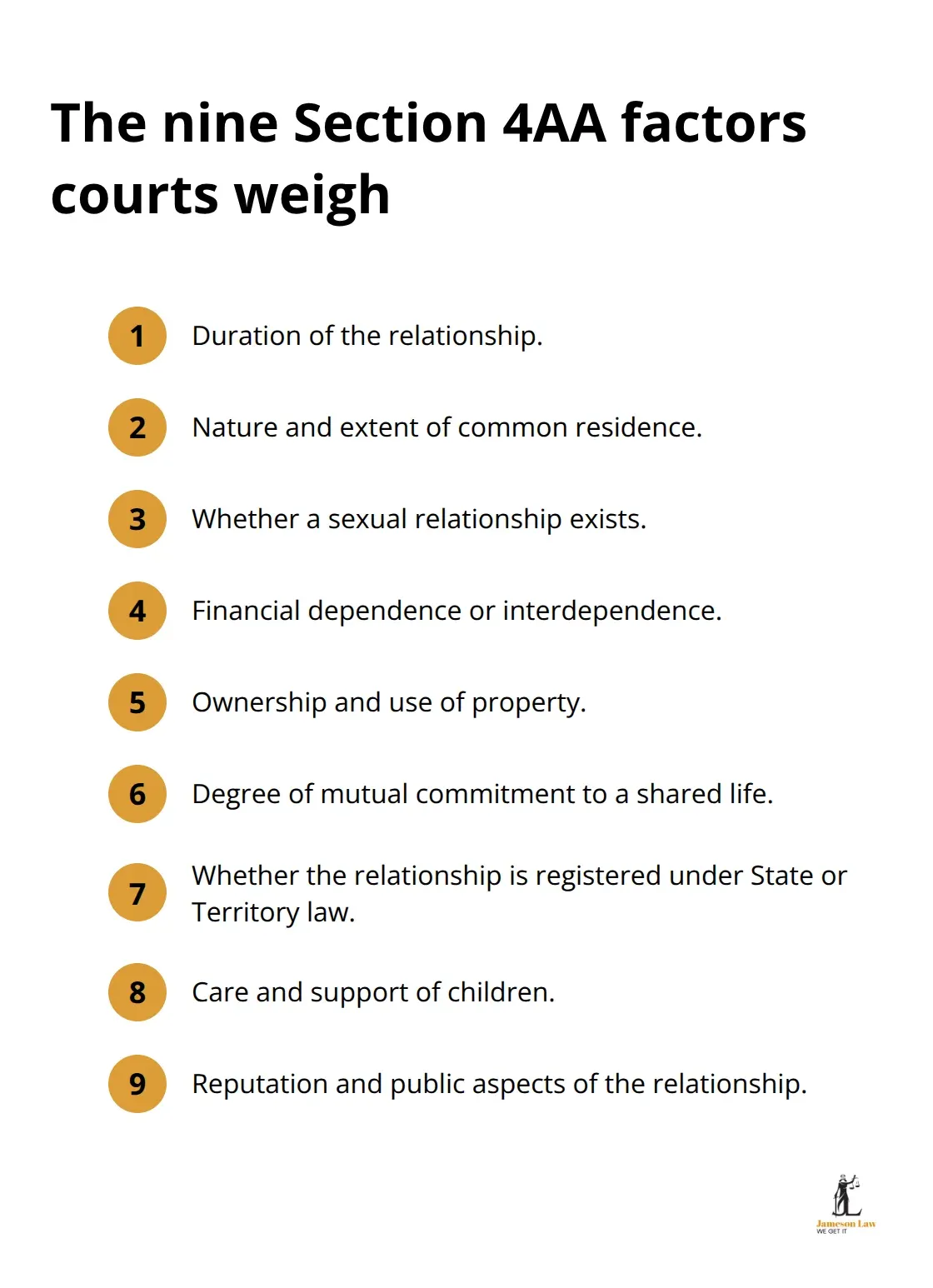
List of the nine statutory factors used to assess de facto relationships under Section 4AA in Australia - section 4aa family law act

What Evidence Actually Proves De Facto Status?

Evidence from Berrell & Tily (No 3) (2023) shows that shared financial arrangements alone do not prove a de facto relationship. Bank statements showing separate lodging can undermine cohabitation claims. You must present corroborating documentation to satisfy the court.

The Two-Year Rule and Its Exceptions

A two-year cohabitation period is a common indicator. However, you can establish de facto status earlier if you have a child (see parenting orders) or if you registered the relationship with NSW Births Deaths & Marriages.

Building Your Evidence and Getting Professional Support

Gather Evidence Across Multiple Domains

Collecting the right evidence determines success. Start by gathering documents that span multiple areas: joint bank accounts, lease agreements, and medical records. Photographs and social media posts provide public evidence of your reputation as a couple.

Checklist of key evidence types to prove a de facto relationship under Section 4AA

Why Financial Records Alone Fall Short

A critical mistake is treating financial records as sufficient proof. You need evidence across at least four distinct areas: residence, finances, property, and public reputation. Our family lawyers in Sydney can help you audit your evidence.

Work With a Family Law Specialist

A family law specialist identifies gaps before filing. The two-year deadline to bring a claim (Section 44 of the Act) is absolute. Missing this window requires court permission, which is difficult to obtain.

Understand Timeline and Procedural Expectations

Uncontested matters can resolve within months. Contested cases involving disputed cohabitation extend longer. Courts prioritise safety matters under Section 4AA when family violence is alleged. Legal Aid NSW may cover eligible applicants in these situations.

What Derails De Facto Claims Most Often?

Incomplete Evidence Across Key Domains

De facto applications fail most often because applicants submit incomplete evidence. If you cannot demonstrate cohabitation clearly, your application weakens. Lease agreements and utility bills carry more weight than simple bank transfers.
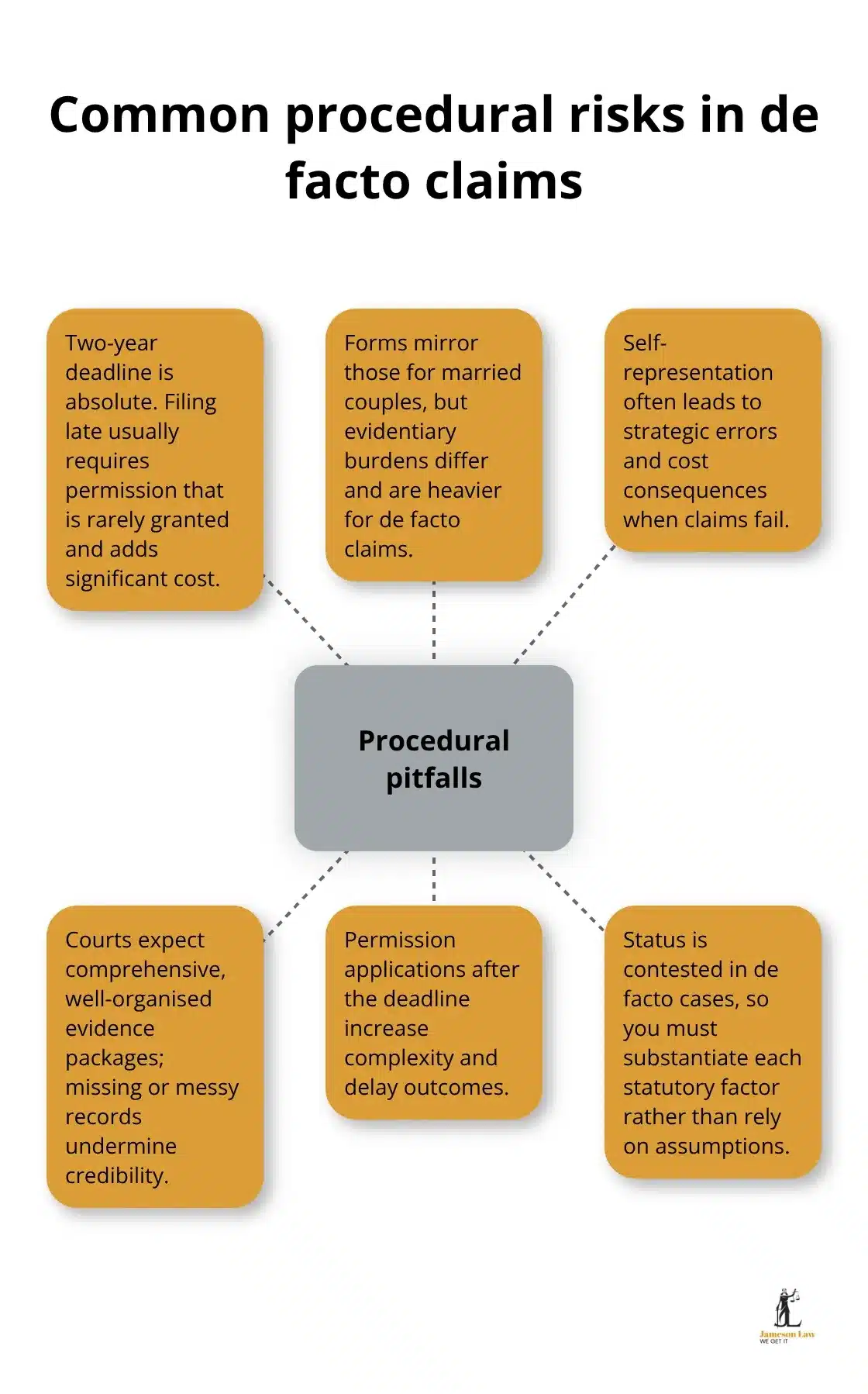
Hub-and-spoke diagram showing key procedural pitfalls in Section 4AA matters - section 4aa family law act

Procedural Mistakes That Cost Thousands

Procedural mistakes in de facto applications cost significantly more than in married couple matters. You must file within two years of relationship breakdown. Many applicants treat de facto applications as simpler than married proceedings, which is a dangerous assumption.

Final Thoughts

Section 4AA of the Family Law Act requires careful preparation. The nine statutory factors form the foundation of how courts determine your rights. Missing evidence in even one domain significantly weakens your application.

The complexity of de facto claims means professional legal guidance is not optional. Contact Jameson Law today to assess whether your relationship meets the legal criteria and protect your financial future.


Speak to an Expert Lawyer today

Laywers-Jameson-Law-The-best-law-firm-in-Sydney- Sydney Lawyers - Sydney
BOOK NOW

WE'RE IN IT TO WIN IT

Book your consultation

Book Now
Book Now Mobile 06 02 2025

This form submission is encrypted and secured to ensure your information remains confidential.

What our Clients

Related Publications:

What our clients say

.

Jameson Law - Voted the Best Law firm in Sydney Award

Legal Answers ... In Short

We're here to help

Our mission is to ensure our client matters are resolved successfully every time. Success to us does not simply involve winning, but moreover ensuring we take the most feasible, economic and stress-free path to help our clients achieve their goals. We fight hard for our clients, and always go by the motto: we’re in it to win it.

Jameson Law - Best Law Firm in Sydney

WE'RE IN IT TO WIN IT

Book your consultation

Call us now on (02) 8806 0866 or fill out the form below

Book Now Mobile

This form submission is encrypted and secured to ensure your information remains confidential.

WE'RE IN IT TO WIN IT

Book your consultation

Book Now Mobile 06 02 2025
lock

This form submission is encrypted and secured to ensure your information remains confidential.

Our Sydney Offices

Offices Parramatta and Sydney Jameson Law
Parramatta CBD - Head Office
jameson Law - Blacktown
jameson Law - Liverpool Office
Jameson Law - Bankstown
Court Houses We Frequent Jameson Law

Court Houses We Frequent

Balmain Local Court

Registry: Monday to Friday, 9:00am to 4:30pm

Bankstown Local Court

Court Operating Hours: 9:30am-4:30pm

Blacktown Local Court

Registry Hours: 9:00 – 4:30
Telephone Hours: 8:30 -4:30
Days open: Mon-Fri

Burwood Local Court

Registry Hours: 9:00 – 4:30
Telephone Hours: 8:30 – 4:30
Days open: Mon – Fri

Campbell Local Court

Registry Hours: 9:00 – 4:30
Telephone Hours: 8:30 – 4:30
Days open: Mon – Fri

Central Local Court

Registry Hours: 9:00 – 1:00 and 2:00 – 4:30
Telephone Hours: 8:30 – 4:30

Downing Local Court

Registry Hours: 9:00 – 1:00 and 2:00 – 4:30
Telephone Hours: 8:30 – 4:30

Wollongong Local Court

Registry Hours: 9:00 – 1:00 and 2:00 – 4:30
Telephone Hours: 8:30 – 4:30

Fairfield Local Court

Registry Hours: 9:00 – 1:00 and 2:00 – 4:30
Telephone Hours: 8:30 – 4:30

Hornsby Local Court

Registry Hours: 9:00 – 1:00 and 2:00 – 4:30
Telephone Hours: 8:30 – 4:30

Liverpool Local Court

Registry Hours: 9:00 – 1:00 and 2:00 – 4:30
Telephone Hours: 8:30 – 4:30

Manly Local Court

Registry Hours: 9:00 – 1:00 and 2:00 – 4:30
Telephone Hours: 8:30 – 4:30

Newtown Local Court

Registry Hours: 9:00 – 1:00 and 2:00 – 4:30
Telephone Hours: 8:30 – 4:30

Parramatta Local Court

Registry Hours: 9:00 – 1:00 and 2:00 – 4:30
Telephone Hours: 8:30 – 4:30

Penrith Local Court

Registry Hours: 9:00 – 1:00 and 2:00 – 4:30
Telephone Hours: 8:30 – 4:30

Sutherland Local Court

Registry Hours: 9:00 – 1:00 and 2:00 – 4:30
Telephone Hours: 8:30 – 4:30

Waverley Local Court

Registry Hours: 9:00 – 1:00 and 2:00 – 4:30
Telephone Hours: 8:30 – 4:30

Windsor Local Court

Registry Hours: 9:00 – 1:00 and 2:00 – 4:30
Telephone Hours: 8:30 – 4:30

Wollongong Local Court

Registry Hours: 9:00 – 1:00 and 2:00 – 4:30
Telephone Hours: 8:30 – 4:30

Downing Centre District Court

Registry Hours: 9:00 – 4:30
Telephone Hours: 8:30 – 4:30
Days open: Mon – Fri

Parramatta District Court

Registry Hours: 9:00 – 4:30
Days open: Mon-Fri

Penrith District Court

Registry Hours: 9:00 – 4:30
Days open: Mon-Fri

Campbelltown District Court

Registry Hours: 9:00 – 4:30
Days open: Mon – Fri

Liverpool District Court

Registry Hours: 9:00 – 4:30
Days open: Mon – Fri

Wollongong District Court

Registry Hours: 9:00 – 1:00 and 2:00 – 4:30
Telephone Hours: 8:30 – 4:30

Supreme Court New South Wales

Registry Hours: 9:00 AM – 4:30 PM
Telephone Hours: 8:30 AM – 4:30 PM
Days Open: Monday to Friday

Federal Circuit and Family Court of Australia

Registry Hours: 9:00 AM – 4:30 PM
Telephone Hours: 8:30 AM – 5:00 PM
Days Open: Monday to Friday

Federal Court

Monday to Friday, 8:30 AM – 4:30 PM

High Court

Monday to Friday, 8:30 AM – 5:00 PM

Children’s Court of New South Wales

Registry Hours: 9:00 AM – 4:30 PM
Telephone Hours: 8:30 AM – 4:30 PM
Days Open: Monday to Friday

Coroner’s Court New South Wales

Registry Hours: 9:00 AM – 4:30 PM
Telephone Hours: 8:30 AM – 4:30 PM
Days Open: Monday to Friday

Industrial Relations Commission of New South Wales

Registry Hours: 9:00 AM – 4:30 PM
Telephone Hours: 8:30 AM – 4:30 PM
Days Open: Monday to Friday

Land and Environment Court of New South Wales

Registry Hours: 9:00 AM – 4:30 PM
Telephone Hours: 8:30 AM – 4:30 PM
Days Open: Monday to Friday

WE'RE IN IT TO WIN IT

Book your consultation

Book Now
Book Now Mobile 06 02 2025
lock

This form submission is encrypted and secured to ensure your information remains confidential.