PUBLICATION

Section 60i Family Law Act Explained

"Understand Section 60i of the Family Law Act and how parenting orders protect your child's best interests in family disputes."
Section 60i Family Law Act Explained

Section 60I of the Family Law Act is one of the most important provisions Australian parents need to understand. It shapes how courts make decisions about parenting arrangements, custody, and your child’s welfare.

At Jameson Law, we’ve helped countless families navigate this section and its real-world implications. This guide breaks down what Section 60I means for you and your family.

What Section 60I Actually Requires?

The Mandatory FDR Requirement

Section 60I of the Family Law Act 1975 mandates that before you apply to court for parenting orders, you must attempt Family Dispute Resolution (FDR) with an accredited practitioner. This is a legal requirement. The legislation exists because Australian family law prioritises resolving disputes outside the Federal Circuit and Family Court of Australia.

If FDR fails, you obtain a Section 60I certificate proving you made a genuine effort. Only then can you proceed to court to seek child custody orders.

Understanding the Five Certificate Types

The certificate itself comes in five types:

  • Type A: The other party refused to attend.
  • Type B: FDR was not appropriate (e.g., due to family violence).
  • Type C: Genuine effort was made by all parties.
  • Type D: Parties attended but made no genuine effort.
  • Type E: FDR started but one party didn’t continue.
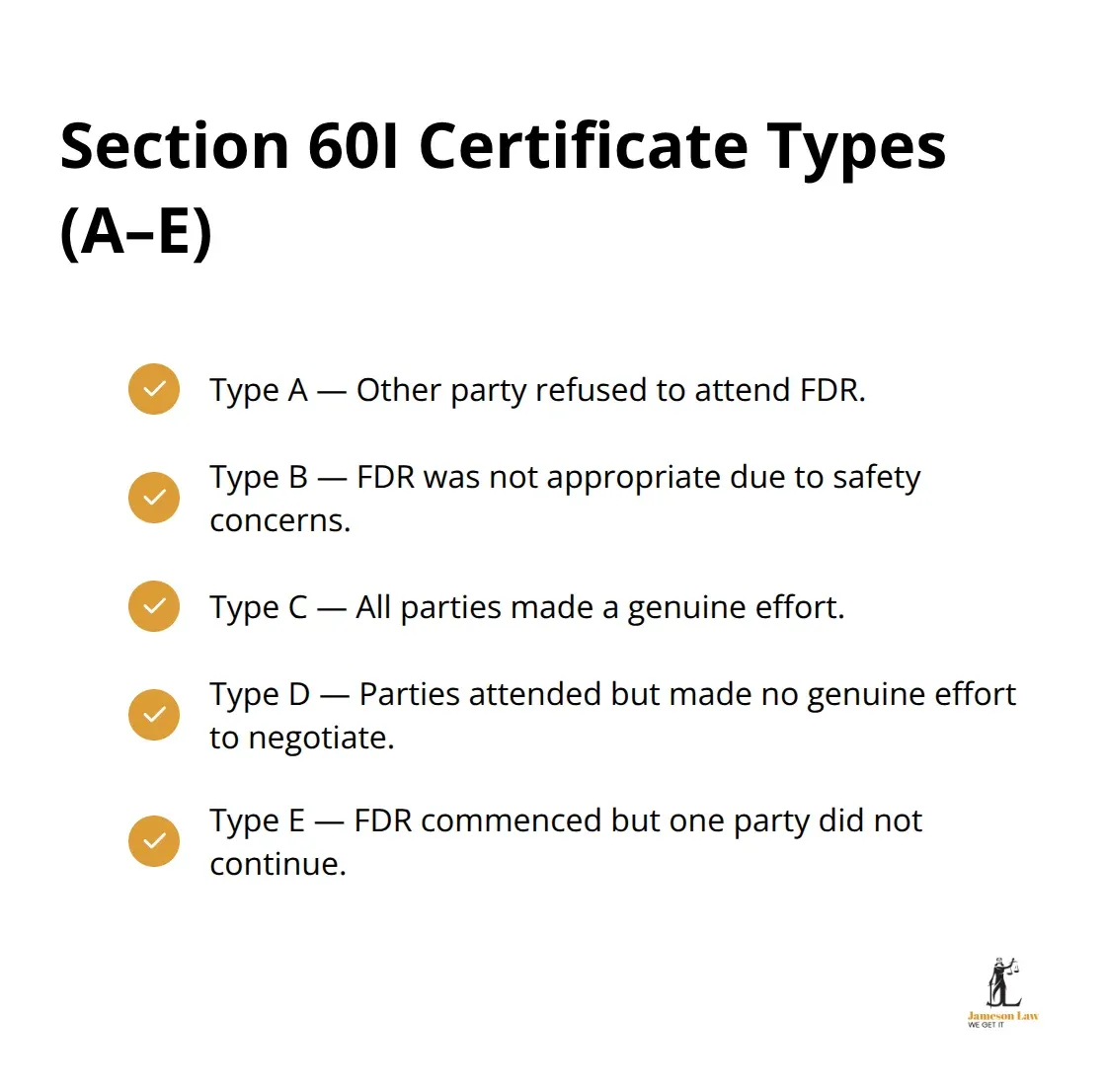
Five certificate types under Section 60I and what each indicates - section 60i family law act

The Six Exceptions to FDR

Exemptions exist where you can bypass FDR entirely. You don’t need a certificate if you apply for Consent Orders, respond to another party’s application, or have reasonable grounds to believe child abuse or family violence has occurred. Urgency is another valid ground.
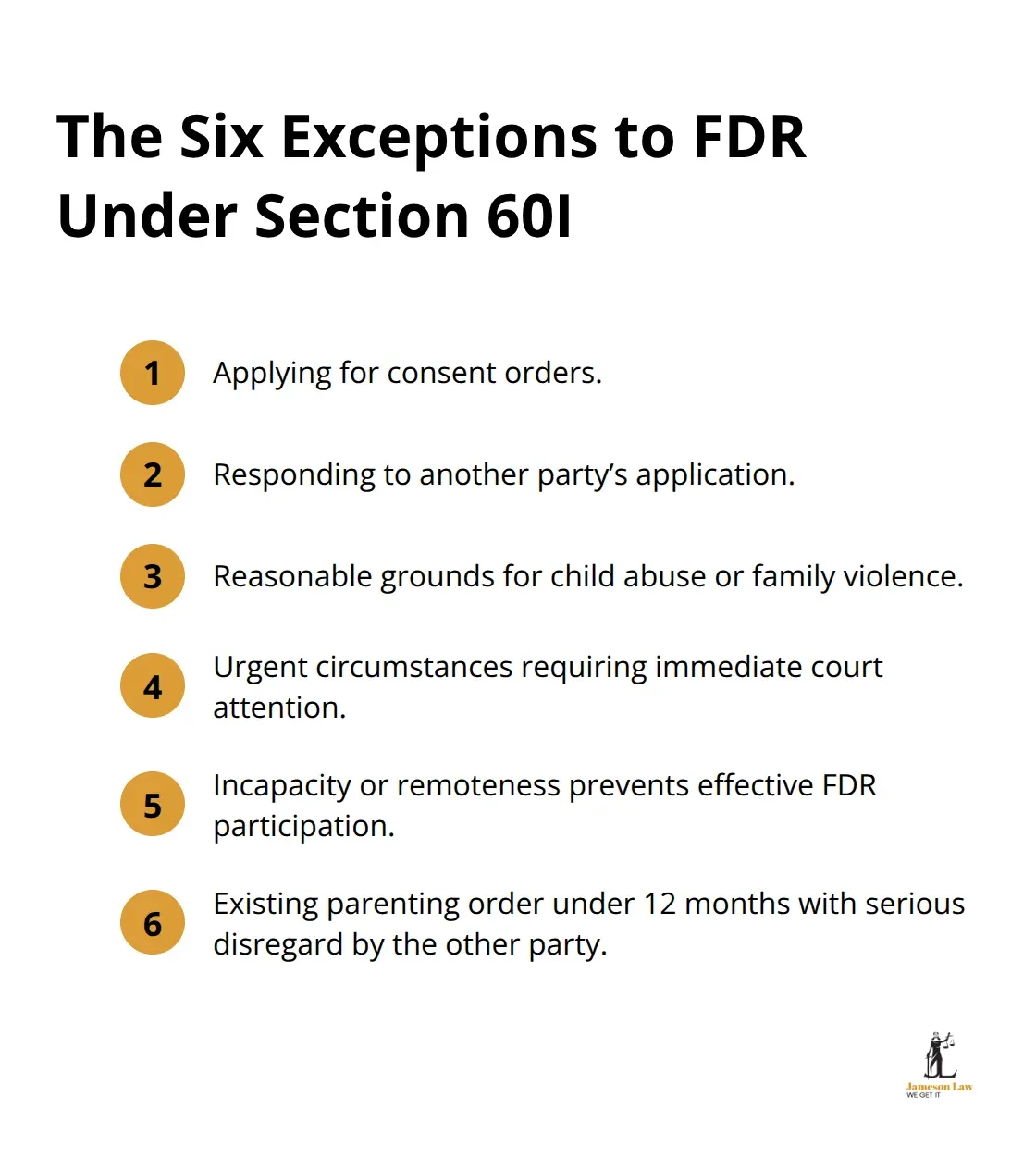
Six scenarios where you can bypass Family Dispute Resolution before filing

Accreditation and Cost Considerations

FDR practitioners must be accredited by the Attorney-General’s Department. Government-subsidised FDR through Family Relationship Centres costs very little. Genuine engagement with FDR significantly improves outcomes and compliance with future arrangements.

What Courts Actually Look At in Parenting Disputes?

The Best Interests Standard in Action

When courts assess parenting arrangements, they examine the best interests of the child. Your child’s physical safety and relationship with both parents matter most. Courts assess who has been the primary carer and whether there are any safety risks.
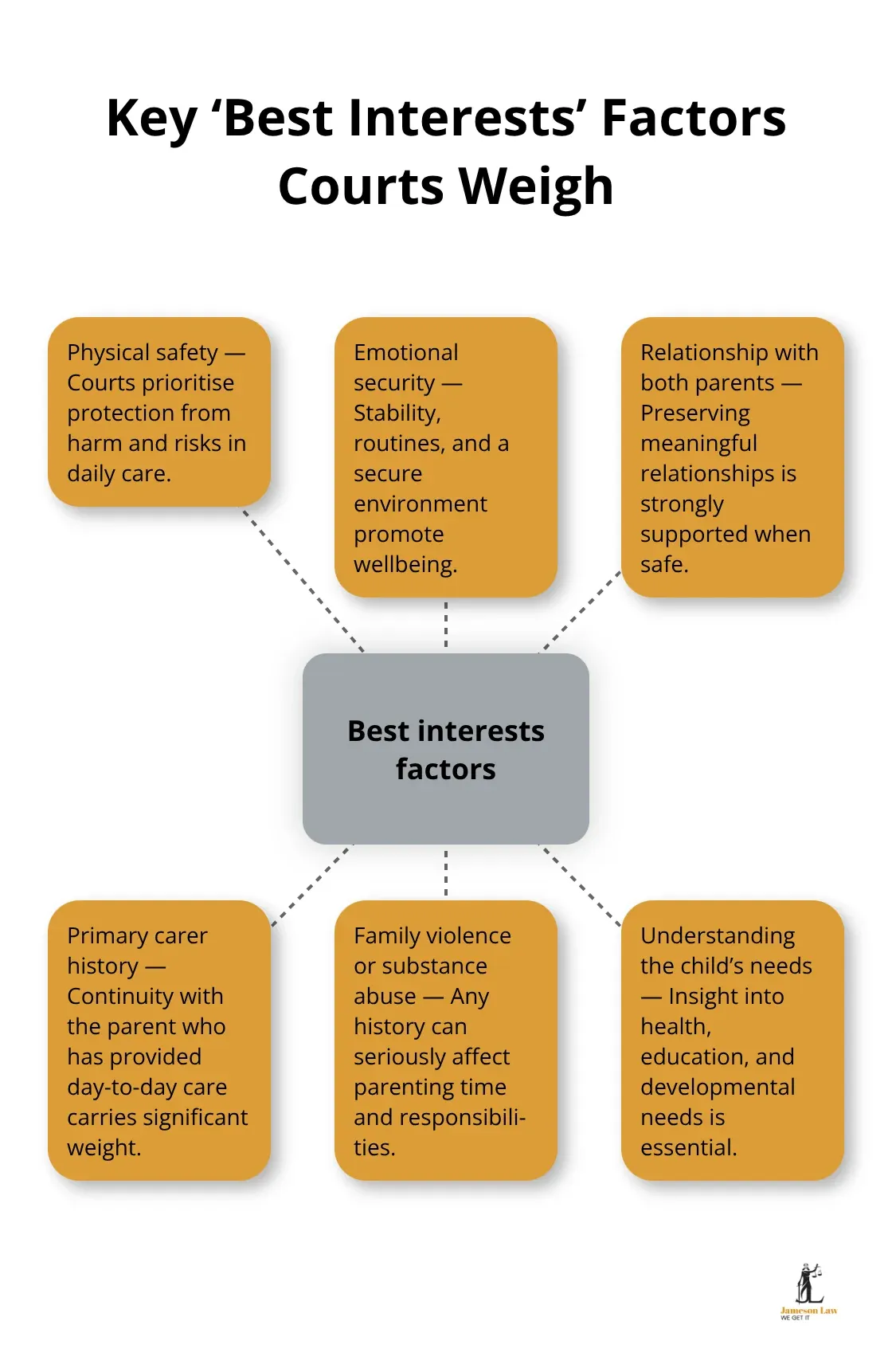
Hub-and-spoke visual of core best interests factors in Australian parenting disputes - section 60i family law act

Parental Conduct During FDR and Previous Proceedings

Courts heavily weigh your conduct. Type C certificates showing genuine effort improve your credibility. Type D certificates create a negative impression. Demonstrating that you support the child’s relationship with the other parent positions you as a child-focused parent.

Financial Capacity and Child Preferences

Courts examine financial capacity, but the wealthier parent doesn’t automatically win. Courts also assess the child’s own preferences, depending on their age and maturity. Older children’s views substantially impact decisions regarding relocation or living arrangements.

When Section 60I Applies to Your Parenting Situation?

Understanding When Section 60I Kicks In

Section 60I affects parenting orders from the moment you decide to formalise any arrangement. The Court won’t accept your application without a certificate unless an exemption applies. Engaging with mediation early often leads to better outcomes than litigation.

Relocation and Interstate Moves

When you relocate interstate or modify existing orders, Section 60I applies again. If you relocate with a child and the other parent objects, courts require fresh FDR. Courts favour parents who demonstrate flexibility during these negotiations.

Modifying Existing Orders

When you modify existing orders, the 12-month rule is critical. Your previous Section 60I certificate expires 12 months after your last FDR session. If you seek modifications beyond that timeframe, you must complete FDR again.

Final Thoughts

Section 60I of the Family Law Act fundamentally shapes how Australian parents access the court system. The mandatory Family Dispute Resolution process exists to reduce ongoing conflict.

Before filing any parenting application, you need an accredited FDR practitioner’s certificate. If you face parenting disputes or relocation questions, contact Jameson Law to discuss your family law matter with experienced practitioners.


Speak to an Expert Lawyer today

Laywers-Jameson-Law-The-best-law-firm-in-Sydney- Sydney Lawyers - Sydney
BOOK NOW

WE'RE IN IT TO WIN IT

Book your consultation

Book Now
Book Now Mobile 06 02 2025

This form submission is encrypted and secured to ensure your information remains confidential.

What our Clients

Related Publications:

What our clients say

.

Jameson Law - Voted the Best Law firm in Sydney Award

Legal Answers ... In Short

We're here to help

Our mission is to ensure our client matters are resolved successfully every time. Success to us does not simply involve winning, but moreover ensuring we take the most feasible, economic and stress-free path to help our clients achieve their goals. We fight hard for our clients, and always go by the motto: we’re in it to win it.

Jameson Law - Best Law Firm in Sydney

WE'RE IN IT TO WIN IT

Book your consultation

Call us now on (02) 8806 0866 or fill out the form below

Book Now Mobile

This form submission is encrypted and secured to ensure your information remains confidential.

WE'RE IN IT TO WIN IT

Book your consultation

Book Now Mobile 06 02 2025
lock

This form submission is encrypted and secured to ensure your information remains confidential.

Our Sydney Offices

Offices Parramatta and Sydney Jameson Law
Parramatta CBD - Head Office
jameson Law - Blacktown
jameson Law - Liverpool Office
Jameson Law - Bankstown
Court Houses We Frequent Jameson Law

Court Houses We Frequent

Balmain Local Court

Registry: Monday to Friday, 9:00am to 4:30pm

Bankstown Local Court

Court Operating Hours: 9:30am-4:30pm

Blacktown Local Court

Registry Hours: 9:00 – 4:30
Telephone Hours: 8:30 -4:30
Days open: Mon-Fri

Burwood Local Court

Registry Hours: 9:00 – 4:30
Telephone Hours: 8:30 – 4:30
Days open: Mon – Fri

Campbell Local Court

Registry Hours: 9:00 – 4:30
Telephone Hours: 8:30 – 4:30
Days open: Mon – Fri

Central Local Court

Registry Hours: 9:00 – 1:00 and 2:00 – 4:30
Telephone Hours: 8:30 – 4:30

Downing Local Court

Registry Hours: 9:00 – 1:00 and 2:00 – 4:30
Telephone Hours: 8:30 – 4:30

Wollongong Local Court

Registry Hours: 9:00 – 1:00 and 2:00 – 4:30
Telephone Hours: 8:30 – 4:30

Fairfield Local Court

Registry Hours: 9:00 – 1:00 and 2:00 – 4:30
Telephone Hours: 8:30 – 4:30

Hornsby Local Court

Registry Hours: 9:00 – 1:00 and 2:00 – 4:30
Telephone Hours: 8:30 – 4:30

Liverpool Local Court

Registry Hours: 9:00 – 1:00 and 2:00 – 4:30
Telephone Hours: 8:30 – 4:30

Manly Local Court

Registry Hours: 9:00 – 1:00 and 2:00 – 4:30
Telephone Hours: 8:30 – 4:30

Newtown Local Court

Registry Hours: 9:00 – 1:00 and 2:00 – 4:30
Telephone Hours: 8:30 – 4:30

Parramatta Local Court

Registry Hours: 9:00 – 1:00 and 2:00 – 4:30
Telephone Hours: 8:30 – 4:30

Penrith Local Court

Registry Hours: 9:00 – 1:00 and 2:00 – 4:30
Telephone Hours: 8:30 – 4:30

Sutherland Local Court

Registry Hours: 9:00 – 1:00 and 2:00 – 4:30
Telephone Hours: 8:30 – 4:30

Waverley Local Court

Registry Hours: 9:00 – 1:00 and 2:00 – 4:30
Telephone Hours: 8:30 – 4:30

Windsor Local Court

Registry Hours: 9:00 – 1:00 and 2:00 – 4:30
Telephone Hours: 8:30 – 4:30

Wollongong Local Court

Registry Hours: 9:00 – 1:00 and 2:00 – 4:30
Telephone Hours: 8:30 – 4:30

Downing Centre District Court

Registry Hours: 9:00 – 4:30
Telephone Hours: 8:30 – 4:30
Days open: Mon – Fri

Parramatta District Court

Registry Hours: 9:00 – 4:30
Days open: Mon-Fri

Penrith District Court

Registry Hours: 9:00 – 4:30
Days open: Mon-Fri

Campbelltown District Court

Registry Hours: 9:00 – 4:30
Days open: Mon – Fri

Liverpool District Court

Registry Hours: 9:00 – 4:30
Days open: Mon – Fri

Wollongong District Court

Registry Hours: 9:00 – 1:00 and 2:00 – 4:30
Telephone Hours: 8:30 – 4:30

Supreme Court New South Wales

Registry Hours: 9:00 AM – 4:30 PM
Telephone Hours: 8:30 AM – 4:30 PM
Days Open: Monday to Friday

Federal Circuit and Family Court of Australia

Registry Hours: 9:00 AM – 4:30 PM
Telephone Hours: 8:30 AM – 5:00 PM
Days Open: Monday to Friday

Federal Court

Monday to Friday, 8:30 AM – 4:30 PM

High Court

Monday to Friday, 8:30 AM – 5:00 PM

Children’s Court of New South Wales

Registry Hours: 9:00 AM – 4:30 PM
Telephone Hours: 8:30 AM – 4:30 PM
Days Open: Monday to Friday

Coroner’s Court New South Wales

Registry Hours: 9:00 AM – 4:30 PM
Telephone Hours: 8:30 AM – 4:30 PM
Days Open: Monday to Friday

Industrial Relations Commission of New South Wales

Registry Hours: 9:00 AM – 4:30 PM
Telephone Hours: 8:30 AM – 4:30 PM
Days Open: Monday to Friday

Land and Environment Court of New South Wales

Registry Hours: 9:00 AM – 4:30 PM
Telephone Hours: 8:30 AM – 4:30 PM
Days Open: Monday to Friday

WE'RE IN IT TO WIN IT

Book your consultation

Book Now
Book Now Mobile 06 02 2025
lock

This form submission is encrypted and secured to ensure your information remains confidential.