PUBLICATION

Family Law Amendment Act 2025: Key Changes Explained

"Explore the Family Law Amendment Act 2025 changes. Understand insights on reforms, impacts, and practical tips for navigating new family law regulations."
Family Law Amendment Act 2025: Key Changes Explained

The Family Law Amendment Act 2025 brings significant changes to Australian family law that will affect thousands of families across the country. These reforms reshape how courts handle custody disputes, property settlements, and family violence cases.

We at Jameson Law have analysed the new legislation to help you understand what these changes mean for your family’s future. The amendments take effect in stages throughout 2025, with some provisions already in force.

What Changes Affect Your Parenting Rights

The Family Law Amendment Act 2025 transforms how Australian courts approach parenting decisions, with new procedures that place child safety above traditional shared care arrangements. Courts must now reject Part VII parenting applications that lack proper documentation from accredited family dispute resolution practitioners, which creates a mandatory mediation barrier that affects families seeking court intervention. This procedural change means parents cannot bypass alternative dispute resolution, which forces most families into structured negotiations before they access court intervention.

Mandatory Mediation Requirements Block Court Access

Parents who file for parenting orders after June 10, 2025 face stricter documentation requirements that can delay court proceedings by months. The court gains discretionary power to reject applications without certificates from accredited practitioners, which makes mediation compulsory rather than optional. This shift impacts families who experience urgent safety concerns, as emergency applications remain the only pathway to bypass these requirements.

Checklist of key actions parents in Australia must take to meet mandatory mediation requirements before court - family law amendment act 2025

Secure mediation certificates early in separation proceedings to avoid procedural delays that can extend custody disputes.

Enhanced Safety Protocols Transform Court Proceedings

Family violence allegations appear in many parenting cases, which prompts courts to adopt less adversarial approaches that reduce intimidation and stress for vulnerable parties. Courts now possess expanded powers to protect sensitive information and communications (particularly health service records that might compromise party safety). These procedural changes mean judges can actively manage cases to minimise conflict, which includes restrictions on evidence disclosure that could endanger children or domestic violence survivors.

New Voucher System Restricts Contact Service Options

Children’s contact services now operate under stricter accreditation rules, with courts that only refer families to approved providers through a standardised voucher system. Non-compliance with accreditation requirements carries significant financial penalties, which forces many smaller providers out of the market. This consolidation limits parental choice but improves service quality and safety standards for supervised visitation arrangements (though it reduces available options for families).

These parenting procedure changes work alongside significant reforms to how courts handle property settlements and financial disclosure requirements.

How Do New Property Rules Change Your Settlement

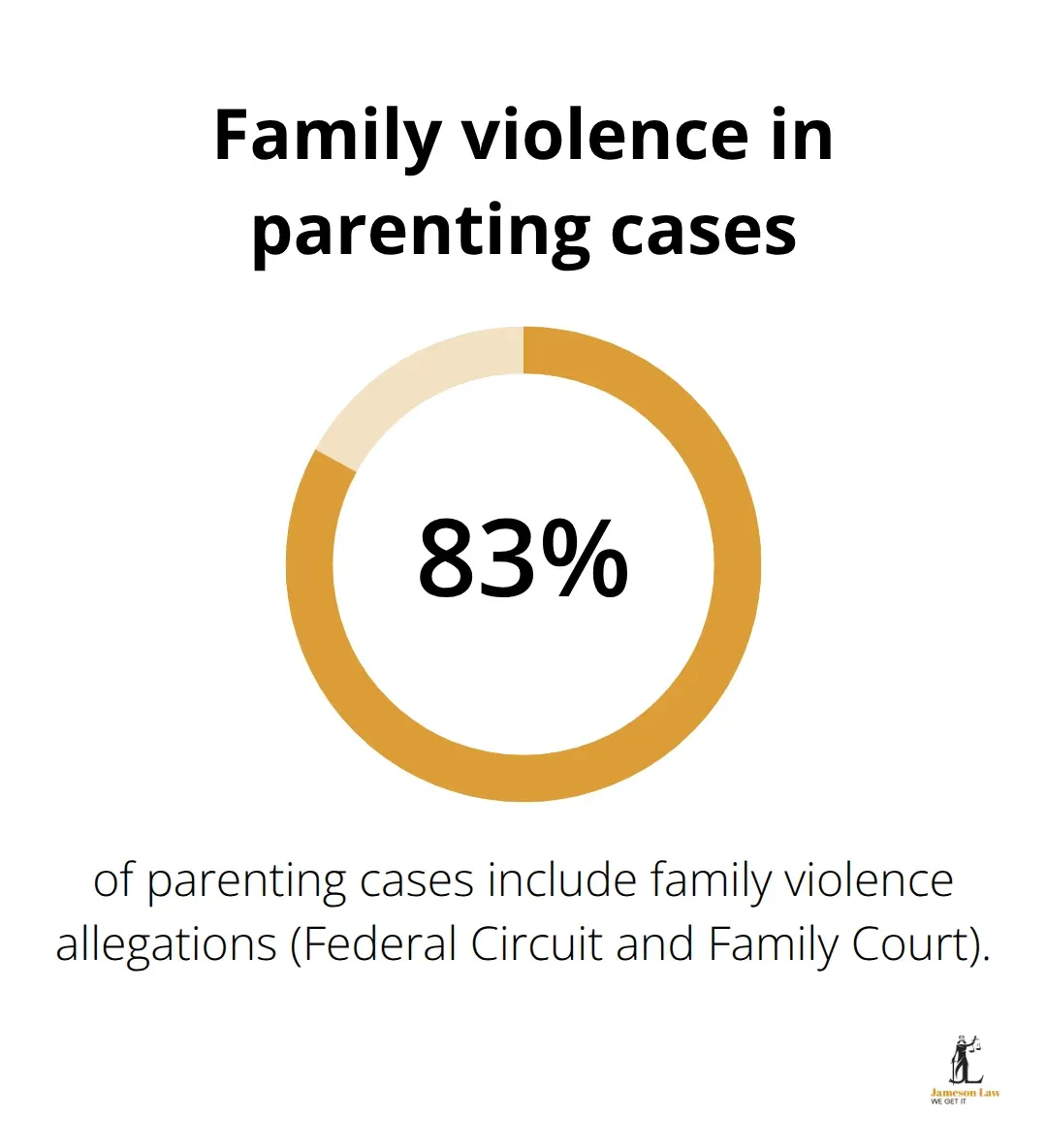
The Family Law Amendment Act 2025 fundamentally alters property settlement calculations by mandating courts consider family violence effects when they divide assets. Courts must now assess how economic abuse impacted each party’s financial contributions throughout the relationship, which means survivors of financial control can receive larger property shares than traditional 50-50 splits. The Federal Circuit and Family Court reports that family violence allegations appear in 83% of parenting cases, with over 10,000 new cases filed annually, which makes these property rule changes significant for most separating couples.

Percentage of Australian parenting cases that involve family violence allegations - family law amendment act 2025

Family Violence Now Determines Property Division

Economic or financial abuse qualifies as family violence under section 4AB, which transforms how courts calculate property contributions and future needs assessments. Courts examine how one partner’s control over finances, credit cards, or employment opportunities reduced the other party’s ability to build wealth during the relationship. Property wastage through reckless spending or deliberate asset destruction also factors into division calculations, which means abusive partners face reduced entitlements. Housing needs for children under 18 receive explicit consideration, which prioritises stable accommodation for primary carers over equal asset splits.

Mandatory Financial Disclosure Creates Legal Penalties

The duty of disclosure moves from court rules into the Family Law Act itself, which makes hiding assets or income a serious legal offence that carries contempt of court penalties. Both parties must provide complete financial information throughout settlement negotiations, not just at the start of proceedings. Non-compliance triggers automatic cost orders against the non-disclosing party, plus potential fines that can exceed thousands of dollars. Share bank statements, superannuation details, business records, and debt information immediately when separation begins to avoid these harsh penalties.

Spousal Maintenance Calculations Include Violence Impact

Maintenance assessments now factor in how family violence affected earning capacity, career progression, and future financial security. Courts consider whether abuse prevented one party from working, studying, or developing professional skills that would support financial independence. The economic effects of family violence extend maintenance periods beyond traditional timeframes (particularly when victims require retraining or therapy to rebuild careers damaged by controlling relationships).

These property settlement reforms work alongside expanded family violence definitions and enhanced safety measures that reshape how courts protect vulnerable parties throughout legal proceedings.

How Do New Violence Protections Change Court Safety

The Family Law Amendment Act 2025 expands family violence definitions beyond physical abuse to include economic and financial control that affects parenting cases according to Federal Circuit and Family Court data. Economic abuse now covers prevention of access to bank accounts, control of employment decisions, concealment of financial information, or use of money to intimidate partners into compliance with demands. This expanded definition means courts must consider financial manipulation when they assess protection needs and case management approaches. Dowry abuse receives specific recognition as family violence, which addresses cultural practises that use financial pressure to control women in marriage relationships.

Courts Gain Power to Shield Sensitive Information

Family law courts now possess discretionary authority to protect sensitive communications from health services, counselling records, and violence support agencies that could compromise party safety if disclosed during proceedings. Judges actively manage evidence disclosure to prevent re-traumatisation of domestic violence survivors (which includes restriction of cross-examination methods that mirror abusive control tactics). Commonwealth Information Orders expand to cover broader personnel categories when courts gather information about missing children or violence threats, which speeds up protective interventions. These information-gathering powers commenced, which means courts immediately access critical safety data from government agencies, schools, and healthcare providers without lengthy bureaucratic delays that previously endangered children in high-risk situations.

Less Adversarial Procedures Reduce Courtroom Intimidation

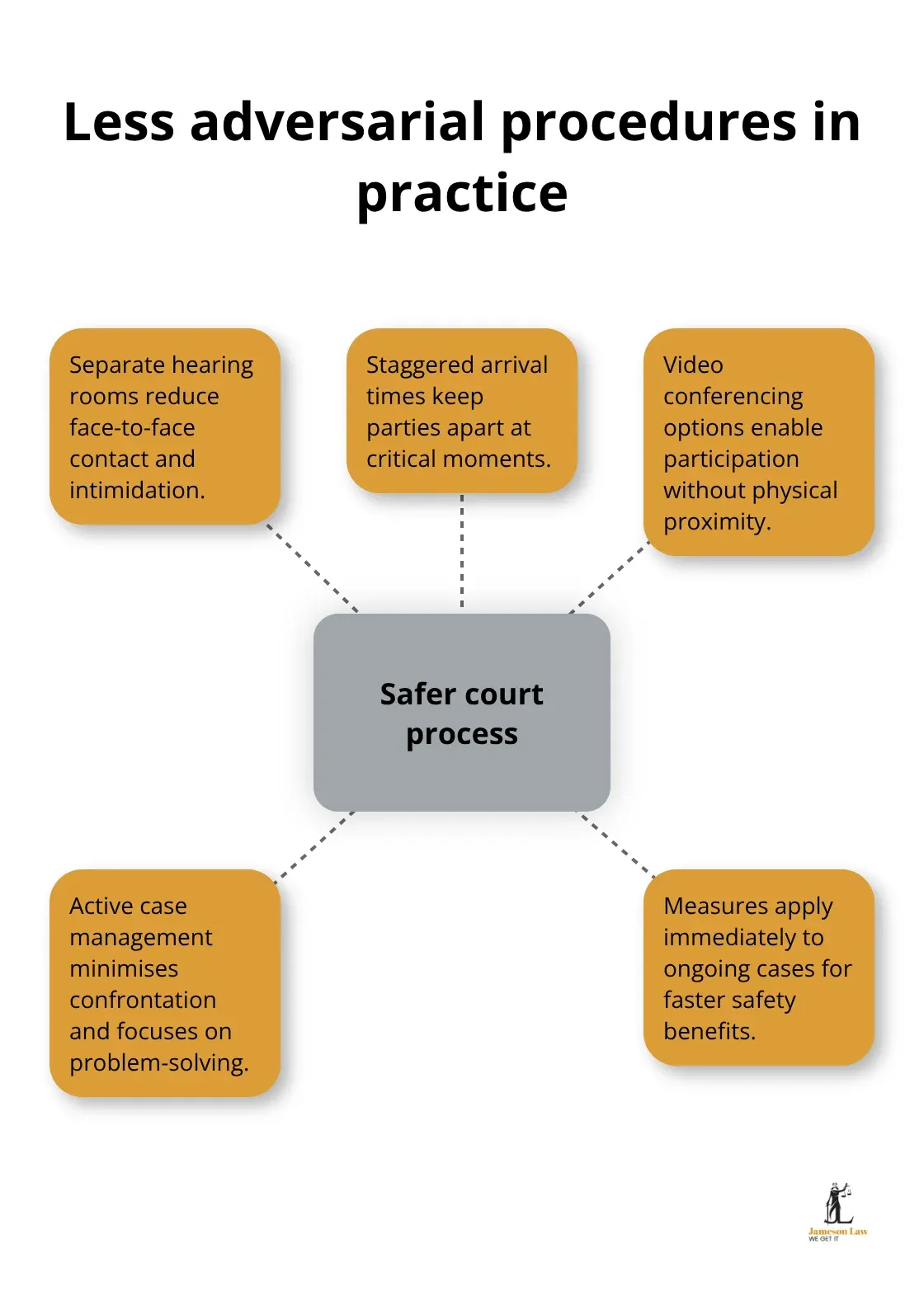
Courts must adopt less adversarial approaches in property and financial disputes that involve family violence allegations, which transforms traditional litigation into collaborative problem-solving sessions that minimise confrontation between parties. Active case management includes separate hearing rooms, staggered arrival times, and video conferencing options that prevent direct contact between abusers and survivors during proceedings. These procedural changes apply to ongoing cases that have not reached final hearings (which means thousands of current family law disputes benefit from enhanced safety protocols immediately rather than waiting for new case filings after June 2025).

Hub-and-spoke visual showing safer, less adversarial court procedures in Australian family law

Enhanced Protection Order Procedures Strengthen Safety Measures

The Amendment Act strengthens protection order procedures while clarifying that family law courts cannot impose criminal penalties for family violence or alter protection orders issued by state or territory courts. Courts now coordinate more effectively with state protection order systems to prevent conflicting orders that create safety gaps for vulnerable parties. The legislation mandates that courts consider existing protection orders when they make parenting and property decisions, which creates comprehensive safety frameworks that address all aspects of family breakdown rather than treating violence as a separate issue.

Final Thoughts

The Family Law Amendment Act 2025 represents the most significant reform to Australian family law in decades. Courts now handle parenting disputes, property settlements, and family violence cases with enhanced safety protocols and stricter procedural requirements. These changes take effect on June 10, 2025, with some provisions already operational since December 2024.

The new legislation prioritises child safety through mandatory mediation requirements while property settlements explicitly consider the economic impact of family violence. Survivors can receive fairer asset divisions that reflect their circumstances, and financial disclosure becomes a legal requirement with serious penalties for non-compliance. Australian families face stricter procedural requirements but gain stronger protections against economic abuse and intimidation (which courts address through less adversarial approaches that reduce stress for vulnerable parties).

These reforms affect all separating couples, regardless of whether they pursue court proceedings or private negotiations. The changes apply to ongoing cases that have not reached final hearings, which means immediate benefits for thousands of families currently in the system. We at Jameson Law help clients navigate these new requirements while protecting their rights throughout the separation process through our family law services.

Speak to an Expert Lawyer today

Laywers-Jameson-Law-The-best-law-firm-in-Sydney- Sydney Lawyers - Sydney
BOOK NOW

WE'RE IN IT TO WIN IT

Book your consultation

Book Now
Book Now Mobile 06 02 2025

This form submission is encrypted and secured to ensure your information remains confidential.

What our Clients

Related Publications:

What our clients say

.

Jameson Law - Voted the Best Law firm in Sydney Award

Legal Answers ... In Short

We're here to help

Our mission is to ensure our client matters are resolved successfully every time. Success to us does not simply involve winning, but moreover ensuring we take the most feasible, economic and stress-free path to help our clients achieve their goals. We fight hard for our clients, and always go by the motto: we’re in it to win it.

Jameson Law - Best Law Firm in Sydney

WE'RE IN IT TO WIN IT

Book your consultation

Call us now on (02) 8806 0866 or fill out the form below

Book Now Mobile

This form submission is encrypted and secured to ensure your information remains confidential.

WE'RE IN IT TO WIN IT

Book your consultation

Book Now Mobile 06 02 2025
lock

This form submission is encrypted and secured to ensure your information remains confidential.

Our Sydney Offices

Offices Parramatta and Sydney Jameson Law
Parramatta CBD - Head Office
jameson Law - Blacktown
jameson Law - Liverpool Office
Jameson Law - Bankstown
Court Houses We Frequent Jameson Law

Court Houses We Frequent

Balmain Local Court

Registry: Monday to Friday, 9:00am to 4:30pm

Bankstown Local Court

Court Operating Hours: 9:30am-4:30pm

Blacktown Local Court

Registry Hours: 9:00 – 4:30
Telephone Hours: 8:30 -4:30
Days open: Mon-Fri

Burwood Local Court

Registry Hours: 9:00 – 4:30
Telephone Hours: 8:30 – 4:30
Days open: Mon – Fri

Campbell Local Court

Registry Hours: 9:00 – 4:30
Telephone Hours: 8:30 – 4:30
Days open: Mon – Fri

Central Local Court

Registry Hours: 9:00 – 1:00 and 2:00 – 4:30
Telephone Hours: 8:30 – 4:30

Downing Local Court

Registry Hours: 9:00 – 1:00 and 2:00 – 4:30
Telephone Hours: 8:30 – 4:30

Wollongong Local Court

Registry Hours: 9:00 – 1:00 and 2:00 – 4:30
Telephone Hours: 8:30 – 4:30

Fairfield Local Court

Registry Hours: 9:00 – 1:00 and 2:00 – 4:30
Telephone Hours: 8:30 – 4:30

Hornsby Local Court

Registry Hours: 9:00 – 1:00 and 2:00 – 4:30
Telephone Hours: 8:30 – 4:30

Liverpool Local Court

Registry Hours: 9:00 – 1:00 and 2:00 – 4:30
Telephone Hours: 8:30 – 4:30

Manly Local Court

Registry Hours: 9:00 – 1:00 and 2:00 – 4:30
Telephone Hours: 8:30 – 4:30

Newtown Local Court

Registry Hours: 9:00 – 1:00 and 2:00 – 4:30
Telephone Hours: 8:30 – 4:30

Parramatta Local Court

Registry Hours: 9:00 – 1:00 and 2:00 – 4:30
Telephone Hours: 8:30 – 4:30

Penrith Local Court

Registry Hours: 9:00 – 1:00 and 2:00 – 4:30
Telephone Hours: 8:30 – 4:30

Sutherland Local Court

Registry Hours: 9:00 – 1:00 and 2:00 – 4:30
Telephone Hours: 8:30 – 4:30

Waverley Local Court

Registry Hours: 9:00 – 1:00 and 2:00 – 4:30
Telephone Hours: 8:30 – 4:30

Windsor Local Court

Registry Hours: 9:00 – 1:00 and 2:00 – 4:30
Telephone Hours: 8:30 – 4:30

Wollongong Local Court

Registry Hours: 9:00 – 1:00 and 2:00 – 4:30
Telephone Hours: 8:30 – 4:30

Downing Centre District Court

Registry Hours: 9:00 – 4:30
Telephone Hours: 8:30 – 4:30
Days open: Mon – Fri

Parramatta District Court

Registry Hours: 9:00 – 4:30
Days open: Mon-Fri

Penrith District Court

Registry Hours: 9:00 – 4:30
Days open: Mon-Fri

Campbelltown District Court

Registry Hours: 9:00 – 4:30
Days open: Mon – Fri

Liverpool District Court

Registry Hours: 9:00 – 4:30
Days open: Mon – Fri

Wollongong District Court

Registry Hours: 9:00 – 1:00 and 2:00 – 4:30
Telephone Hours: 8:30 – 4:30

Supreme Court New South Wales

Registry Hours: 9:00 AM – 4:30 PM
Telephone Hours: 8:30 AM – 4:30 PM
Days Open: Monday to Friday

Federal Circuit and Family Court of Australia

Registry Hours: 9:00 AM – 4:30 PM
Telephone Hours: 8:30 AM – 5:00 PM
Days Open: Monday to Friday

Federal Court

Monday to Friday, 8:30 AM – 4:30 PM

High Court

Monday to Friday, 8:30 AM – 5:00 PM

Children’s Court of New South Wales

Registry Hours: 9:00 AM – 4:30 PM
Telephone Hours: 8:30 AM – 4:30 PM
Days Open: Monday to Friday

Coroner’s Court New South Wales

Registry Hours: 9:00 AM – 4:30 PM
Telephone Hours: 8:30 AM – 4:30 PM
Days Open: Monday to Friday

Industrial Relations Commission of New South Wales

Registry Hours: 9:00 AM – 4:30 PM
Telephone Hours: 8:30 AM – 4:30 PM
Days Open: Monday to Friday

Land and Environment Court of New South Wales

Registry Hours: 9:00 AM – 4:30 PM
Telephone Hours: 8:30 AM – 4:30 PM
Days Open: Monday to Friday

WE'RE IN IT TO WIN IT

Book your consultation

Book Now
Book Now Mobile 06 02 2025
lock

This form submission is encrypted and secured to ensure your information remains confidential.