Section 4aa of the Family Law Act sets out specific requirements that affect how family law matters are handled. Getting these requirements right from the start makes the entire process smoother and protects your interests.
At Jameson Law, we’ve seen how confusion around Section 4aa compliance creates unnecessary delays and complications. This guide walks you through what you need to know and do.
What Section 4AA Actually Requires
The Core Definition and Its Complexity
Section 4AA of the Family Law Act 1975 defines a de facto relationship as two people who are not married, not related by family, and who live together on a genuine domestic basis. This definition sounds straightforward, but the reality is far more complex. The Federal Circuit and Family Court of Australia does not apply a checklist approach. Instead, courts weigh nine distinct factors across the full circumstances of each case.
The Nine Factors Courts Examine
Courts examine the duration of the relationship, the nature and extent of common residence, whether a sexual relationship exists, financial dependence or interdependence, ownership and use of property, degree of mutual commitment to a shared life, whether the relationship is registered under State or Territory law, care and support of children, and the reputation and public aspects of the relationship. No single factor is required or determinative. A de facto relationship can exist even if one party is legally married to someone else or in another de facto relationship.
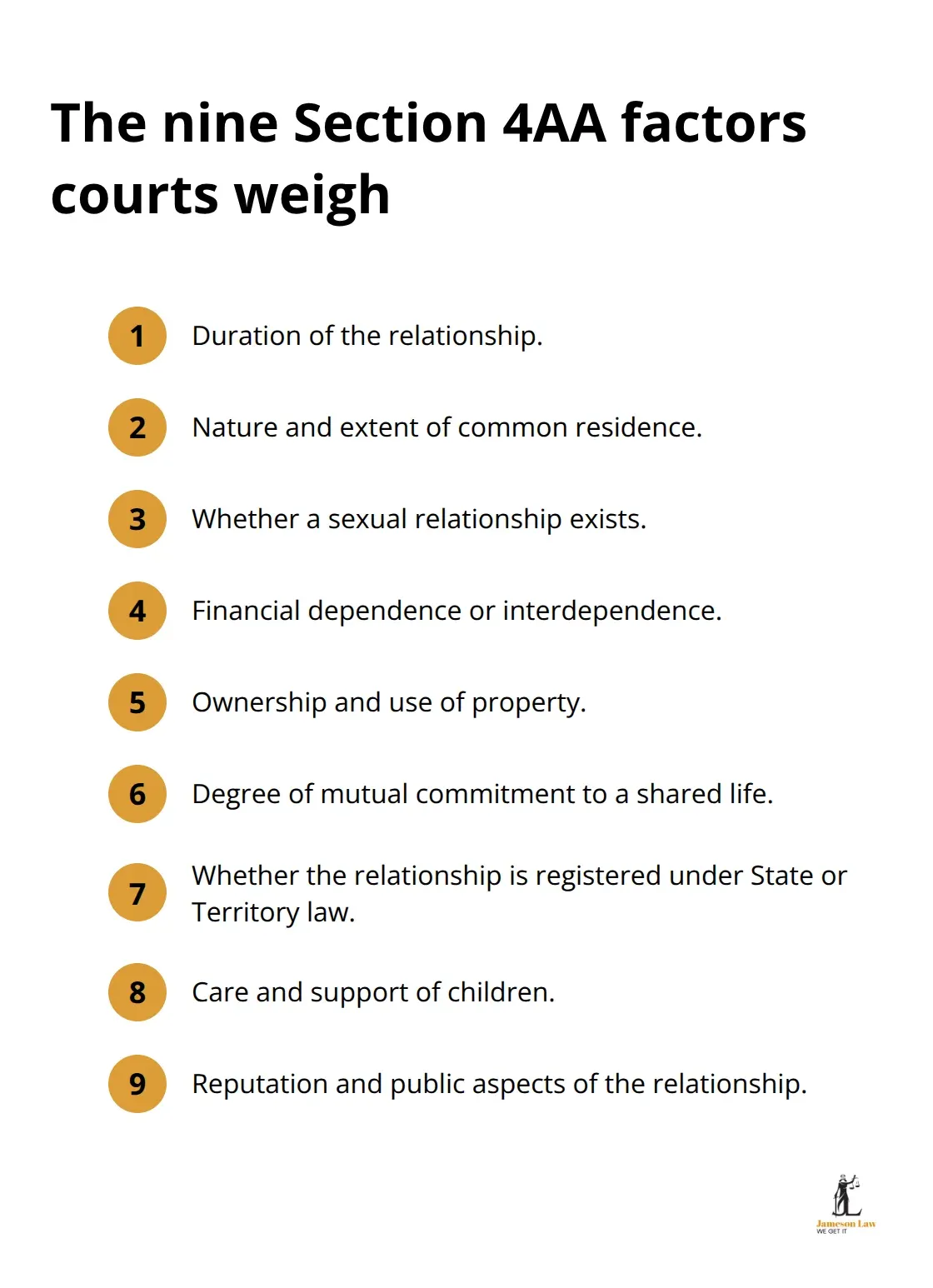
The High Court confirmed in Fairbairn and Radecki (2022) that cohabitation in a shared residence is not mandatory. De facto status can exist without sharing a residence if couples demonstrate they share life in other meaningful arrangements. Understanding which factors matter most in your specific circumstances is where most people struggle, because courts examine the totality of evidence to determine whether the relationship genuinely reflects a shared life.
What Evidence Actually Proves De Facto Status
Evidence from Berrell & Tily (No 3) (2023) shows that shared financial arrangements alone do not prove a de facto relationship if other factors point elsewhere. Bank statements showing separate lodging, email communications referencing independent relationships, or third-party testimony about travel patterns in twin rooms can undermine cohabitation claims. The court weighs reliability and consistency of evidence heavily, meaning you must present corroborating documentation rather than relying on one type of evidence.
The Two-Year Rule and Its Exceptions
A two-year cohabitation period is a common indicator but not mandatory. You can establish de facto status with shorter cohabitation if you have a child or can demonstrate substantial contributions that would cause serious injustice if unrecognised. The two-year time limit to bring a de facto claim from the date of relationship breakdown is rigid. Missing this deadline requires court permission and significantly increases costs and complexity.
Building Your Evidence Package
Documenting evidence across multiple domains from the start-cohabitation history, finances, property ownership, parenting arrangements, and public aspects of the relationship-strengthens your position considerably. This comprehensive approach means you gather bank statements, property records, witness statements, and documentation of shared commitments across different areas of your life. The more domains you cover with solid evidence, the stronger your case becomes when courts assess whether your relationship reflects a genuine domestic partnership. Your next step involves identifying exactly which evidence you need to collect and how to organise it effectively for your circumstances.
Building Your Evidence and Getting Professional Support
Gather Evidence Across Multiple Domains
Collecting the right evidence determines whether courts recognise your de facto relationship or reject your claim outright. Start by gathering documents that span multiple areas of your life together, not just one or two categories. Bank statements showing joint accounts or regular transfers between partners, utility bills and lease agreements in both names, property ownership documents, and tax returns filed together all demonstrate financial interdependence. Medical records, school enrolment documents for children, and insurance policies naming your partner as beneficiary show practical arrangements typical of couples sharing life. Photographs from shared holidays, social media posts, and communications with friends and family about your relationship provide public evidence of how you presented yourselves as a couple.

Under Section 4AA of the Family Law Act 1975, a de facto relationship is formally defined, and the law requires that you and your former partner demonstrate the nature of your connection through evidence across multiple domains.
Why Financial Records Alone Fall Short
One critical mistake people make is treating financial records as sufficient proof alone. The court in Berrell & Tily (No 3) (2023) specifically rejected a de facto claim where financial arrangements existed but other evidence pointed to separate lives. This means you need comprehensive evidence across at least four distinct areas: residence and cohabitation, finances, property, and public reputation. Keep originals in a secure location and maintain copies organised chronologically. This preparation takes time, but missing evidence during proceedings becomes impossible to recover later.
Work With a Family Law Specialist
A family law specialist who understands Section 4AA matters reviews your evidence against the statutory factors and identifies gaps before filing, saving thousands in wasted court time. Courts expect comprehensive evidence packages presented strategically, and self-representation in de facto disputes frequently results in cost consequences when claims fail. The two-year deadline from relationship breakdown is absolute, meaning your application must be filed within that window or you face expensive permission applications that rarely succeed.
Understand Timeline and Procedural Expectations
Timeline expectations vary considerably depending on whether your matter is contested. Uncontested matters where both parties agree on de facto status and financial arrangements can resolve within three to six months, while contested cases involving disputed cohabitation periods or evidence challenges extend to twelve months or longer. Courts prioritise safety matters under Section 4AA when family violence is alleged, which can fast-track interim orders but complicate overall proceedings. If safety concerns exist, duty lawyers at Federal Circuit and Family Court locations provide urgent assistance, and legal aid may cover eligible applicants.
Manage Applications and Procedural Requirements
Your lawyer advises on evidence collection strategy, drafts applications using correct court forms, and manages procedural requirements that differ from married couple proceedings despite appearing similar on the surface. The forms and procedures you use mirror those for married couples, yet de facto applications carry distinct evidentiary burdens that require careful navigation. Once you have gathered your evidence and secured professional guidance on your specific circumstances, the next step involves understanding what mistakes commonly derail de facto claims and how to position your case to avoid them.
What Derails De Facto Claims Most Often
Incomplete evidence across key domains
De facto applications fail most often because applicants submit incomplete evidence that leaves gaps courts cannot ignore. You might have strong bank statements showing joint accounts, but without documentation of shared residence, the court cannot establish cohabitation. In Berrell & Tily (No 3) (2023), the applicant presented financial interdependence and business collaboration, yet the court rejected the de facto claim entirely because third-party testimony about separate accommodation and travel patterns in twin rooms contradicted the cohabitation narrative. Courts will not fill evidence gaps with assumptions. If your evidence package omits key domains, your application will fail regardless of how strong the evidence you do provide actually is.
Map all nine statutory factors against your circumstances before filing and identify which evidence categories remain weak. Many people focus only on the factors they believe are strongest, overlooking that courts assess the totality of circumstances. Financial records alone mean nothing without property ownership documentation, residence proof, and witness statements about your shared life. Utility bills, lease agreements, and mortgage documents in both names carry far more weight than bank transfers, because they prove you maintained a shared residence together.
School enrolment documents for children, medical records listing your partner as next of kin, and insurance policies naming your partner as beneficiary all contribute to demonstrating a genuine domestic partnership rather than a business arrangement or close friendship.
Procedural Mistakes That Cost Thousands
Procedural mistakes in de facto applications cost significantly more than in married couple matters because courts have less discretion to overlook technical errors. You must file within two years of relationship breakdown, and this deadline is absolute. Applications submitted after two years require court permission, which courts rarely grant and which dramatically increases legal costs.
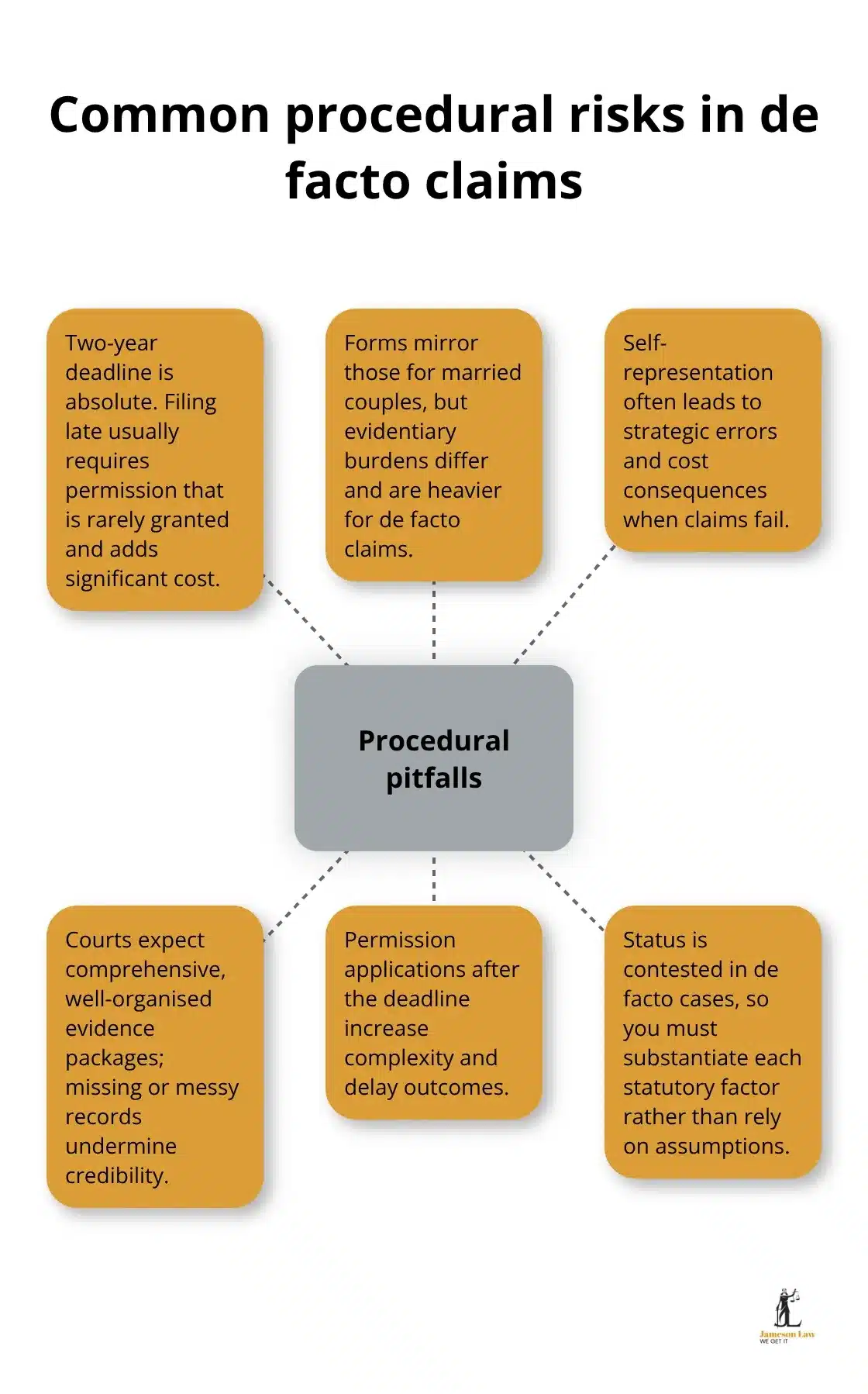
Your application forms must match those used for married couples, yet the evidentiary burden differs substantially. Many applicants treat de facto applications as simpler than married proceedings, assuming the identical forms mean identical requirements. Courts expect comprehensive evidence packages in de facto cases precisely because status itself is contested, whereas married status is proven by a marriage certificate. Missing evidence or poorly organised documentation signals to the court that your case lacks substance.
Witness Statements and Evidence Quality
Witness statements must be specific, dated, and address the nine statutory factors rather than offering vague character references. A witness statement saying you were a committed couple carries no weight; a statement describing how the witness observed you cohabiting for specific periods, how you managed finances together, and how you presented yourselves publicly holds considerable weight. Your lawyer should brief all witnesses on what evidence matters and ensure statements address those factors directly.
Failing to Address All Nine Statutory Factors
Courts do not excuse gaps by assuming factors are satisfied. If you cannot demonstrate financial interdependence clearly, your application weakens even if other factors are strong. The court in Fairbairn and Radecki (2022) confirmed that no single factor is determinative, meaning you must present a balanced case across multiple domains rather than relying on one or two strong areas. Present evidence that spans residence and cohabitation, finances, property ownership, parenting arrangements, and public reputation to strengthen your position considerably.
Final Thoughts
Section 4AA of the Family Law Act requires careful preparation and strategic evidence gathering from the moment your relationship breaks down. The nine statutory factors courts examine form the foundation of how courts determine whether your de facto relationship qualifies for legal recognition and financial protection. Missing evidence in even one domain significantly weakens your entire application, and courts will not fill gaps with assumptions or goodwill.
The complexity of de facto claims means professional legal guidance is not optional. A family law specialist identifies which evidence matters most in your circumstances, organises your documentation strategically, and ensures your application meets procedural requirements that differ substantially from married couple matters (despite using identical court forms). The two-year deadline from relationship breakdown is absolute, and applications filed after this window require expensive permission from the court, which rarely succeeds.
Your next step involves contacting a family law practitioner who understands Section 4AA requirements and can review your specific circumstances against the statutory factors. Jameson Law offers expert family law services across Australia and can assess whether your de facto relationship meets the legal criteria, identify evidence gaps before filing, and guide you through the entire process to protect your interests.