PUBLICATION

How to Navigate Section 52a Conveyancing Act Requirements

"Understand Section 52a Conveyancing Act requirements and avoid costly delays in your property transactions with practical compliance steps."
How to Navigate Section 52a Conveyancing Act Requirements

Section 52a of the Conveyancing Act creates real obligations that many property sellers misunderstand or overlook entirely. Getting this wrong can cost you thousands in compensation claims and legal fees.

We at Jameson Law have seen transactions derailed because sellers didn’t grasp what Section 52a requires. This guide walks you through the exact requirements, compliance steps, and serious risks of non-disclosure.

What Section 52a Actually Means for Your Sale

Section 52a of the Conveyancing Act 1919 mandates that you attach prescribed documents to every land contract before a buyer signs. This isn’t optional, and there’s no way around it. The Conveyancing (Sale of Land) Regulation 2022 commenced on 1 September 2022, defining exactly which documents you must provide.

Core Documents You Must Attach

The core list includes a Section 10.7 planning certificate from your local council, a current land tax certificate, title searches, Sydney Water sewerage diagrams, and survey plans. For strata properties, you’ll need additional documentation such as by-law changes and levy notices. The regulation treats these requirements as non-negotiable; any clause in your contract attempting to sidestep these obligations is invalid and unenforceable. About 10% of NSW property disputes relate to non-disclosure failures, according to industry data, which tells you how seriously courts and buyers treat incomplete documentation.

Infographic showing 10% of NSW property disputes relate to non-disclosure and buyers can claim up to 2% compensation.

What Happens When Documents Go Missing

If you fail to attach even one required document, your buyer has a 14-day rescission window to pull out of the sale entirely. This is far more damaging than the standard five-business-day cooling-off period most residential buyers receive. Outdated certificates compound the problem-a planning certificate that’s too old or a pool compliance certificate that’s expired triggers the same rescission right. The law also creates an implied warranty that your land isn’t subject to adverse affectations at the time of contract; if it is and you haven’t disclosed it, buyers can claim compensation instead of rescinding.

Managing Timelines and Validity Buffers

Off-the-plan buyers receive even longer cooling-off periods and additional protections, increasing your exposure during extended settlements. Council processing delays are a genuine compliance risk, which is why you should obtain all mandatory certificates simultaneously and maintain validity buffers before exchanging contracts. Starting the document collection process early protects your sale from last-minute complications and rescission triggers. The stakes are high enough that you cannot afford to treat this as a secondary task.

Getting Your Documents Ready in Time

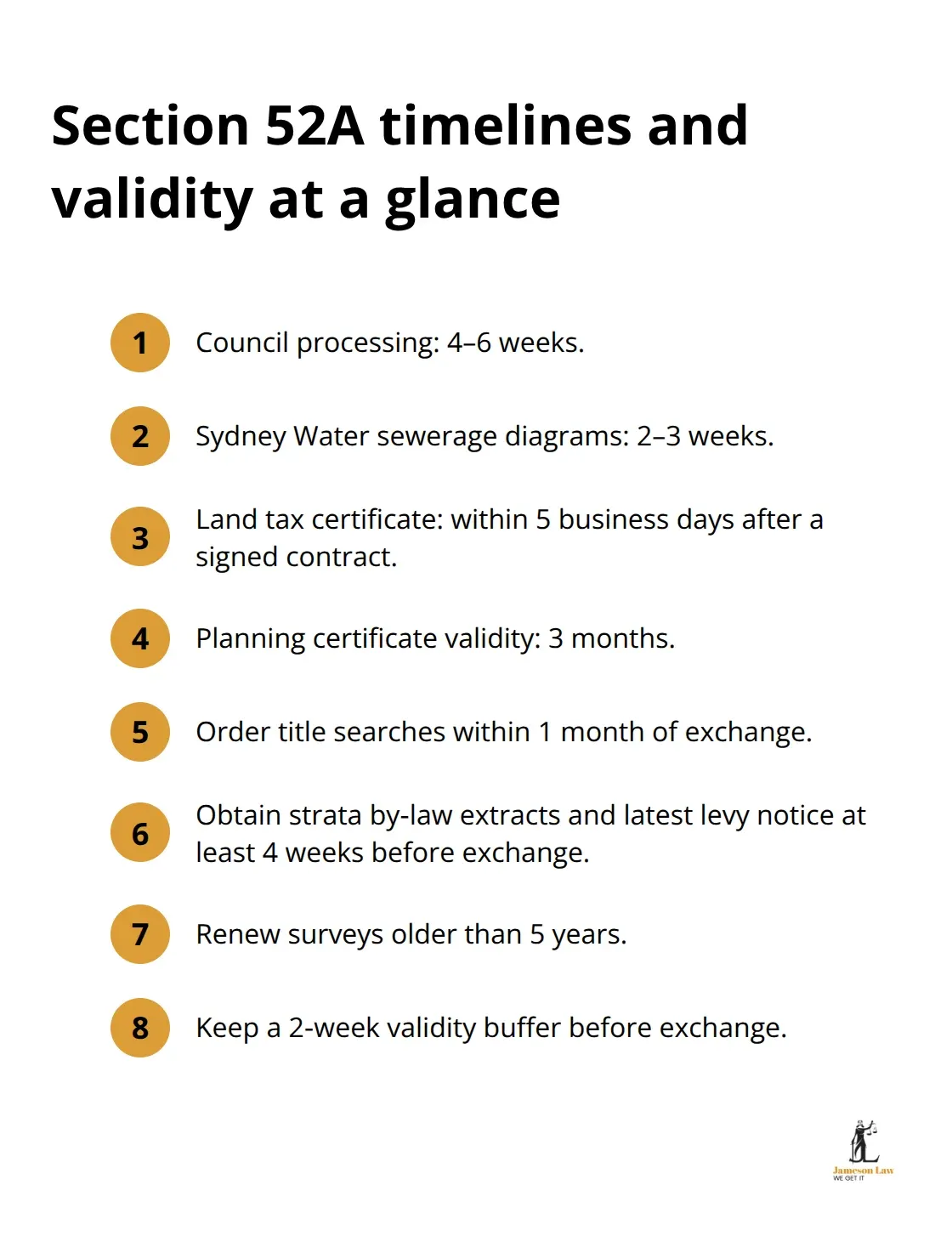
Assembling Section 52a documents demands action the moment you list your property, not two weeks before settlement. Council processing delays alone stretch to four to six weeks depending on your local authority. Contact your local council immediately and request the Section 10.7 planning certificate in writing rather than relying on phone calls-this creates a paper trail and often accelerates processing. Sydney Water sewerage diagrams take two to three weeks on average, so order these at the same time you request the planning certificate. Land tax certificates arrive within five business days, but you cannot obtain one until you have a signed contract with a completion date. This timing constraint means you need all other documents ready before exchange, leaving the land tax certificate for the final stage.

Certificate Validity Windows Create Hidden Risks

Sellers frequently underestimate how quickly certificates expire and lose their legal standing. A planning certificate remains valid for three months from issue; if you obtain it too early and exchange contracts after that window closes, the buyer can rescind. Pool compliance certificates must be current, and if your property has a pool, you must provide a current barrier compliance certificate-an expired one triggers the 14-day rescission right just as if you had attached nothing at all.

Compact list of key NSW Section 52A document timeframes and validity windows for sellers. - section 52a conveyancing act

For strata properties, obtain current by-law extracts and the latest levy notice directly from your strata manager at least four weeks before you plan to exchange, as these documents change frequently and outdated versions create non-compliance. Title searches from the NSW Land Registry Services should be ordered no more than one month before exchange to reflect the current ownership and encumbrances. Survey plans are less time-sensitive but must accurately represent the land you are selling; if your survey is older than five years, obtain a new one to avoid buyer disputes over boundary accuracy. Build a validity buffer of at least two weeks between obtaining each document and your planned exchange date-this protects you if a document expires or if the buyer requests updated information before signing.

Your Conveyancer Accelerates the Entire Process

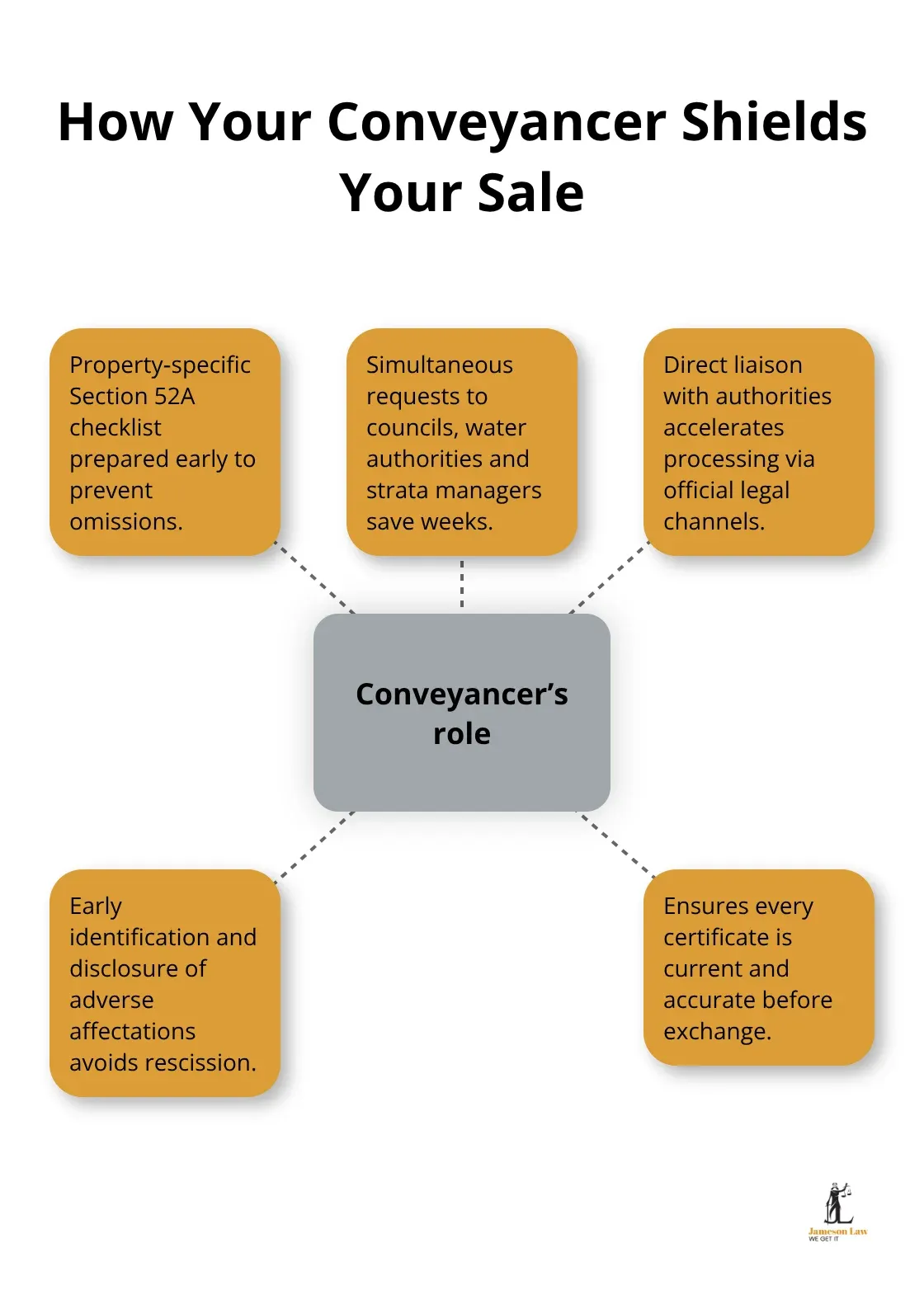
Your conveyancer functions as your compliance shield and should be engaged before you list the property. A competent conveyancer prepares a Section 52a checklist specific to your property type and requests all documents simultaneously rather than sequentially, saving weeks of time. They liaise directly with councils, water authorities, and strata managers, which typically accelerates processing because these organisations recognise official legal requests. Provide your conveyancer with a complete property history, including any past works, renovations, or disputes, because hidden information discovered during the document collection phase can trigger additional disclosure obligations and derail your sale.

Hub-and-spoke diagram showing key ways a conveyancer accelerates Section 52A compliance. - section 52a conveyancing act

If your property has any adverse affectations (such as a heritage listing, an easement, or a proposed road realignment), your conveyancer identifies these early and ensures they are properly disclosed before exchange. This proactive approach prevents the buyer from discovering these issues after exchange and exercising their rescission right.

Exchange Only When Documentation Is Complete

Exchange of contracts must never occur until every mandatory document sits in your conveyancer’s hands and verification confirms accuracy and currency. If you exchange with incomplete documentation, you hand the buyer a rescission right on a silver platter, and they will use it if settlement delays or if they have second thoughts about the purchase. The Conveyancing (Sale of Land) Regulation 2022 is explicit: prescribed documents must attach to the contract before the buyer signs. Many sellers rush to exchange because they fear the buyer will walk away, but exchanging with missing documents guarantees the buyer can walk away within 14 days and retain their deposit. Settlement timelines should allow at least 14 days from exchange to completion, giving you buffer time if a document expires or requires updating. Off-the-plan contracts demand even stricter timelines because disclosure statements must include sunset dates for off-the-plan specific terms, and these dates create additional rescission triggers if they pass without the buyer receiving an occupation certificate.

Start your document collection eight weeks before your target exchange date if you are selling a standard house and ten weeks if you are selling a strata property with multiple disclosure layers. This timeline accounts for council delays, water authority backlogs, and the inevitable request for updated information from the buyer’s conveyancer. Once your documents are verified and complete, you move into the critical phase where timing and accuracy determine whether your sale proceeds smoothly or stalls due to compliance failures.

What Happens When You Miss Section 52a Requirements

The Rescission Right Your Buyer Can Exercise

Non-compliance with Section 52a does not trigger a warning or a fine you can pay off. It hands your buyer a legal weapon they can deploy within 14 days of exchange, and they will use it if the sale no longer suits them or if settlement delays occur. The Conveyancing (Sale of Land) Regulation 2022 gives buyers an explicit rescission right if you fail to attach prescribed documents, attach outdated certificates, or breach any of the implied warranty about adverse affectations. Once a buyer issues a rescission notice, your sale collapses, their deposit gets refunded in full, and you return to square one with carrying costs, agent fees already paid, and no sale proceeds. That 10% of NSW property disputes relating to non-disclosure represents real transactions that fell apart because sellers underestimated the law’s strictness.

Financial Liability Beyond the Lost Sale

Your financial exposure extends far beyond losing the sale. If a buyer does not rescind but instead claims compensation, they can pursue you for up to 2% of the purchase price under the Conveyancing (Sale of Land) Regulation 2022, and you cannot contract out of this liability. On a $900,000 property, that amounts to $18,000 in compensation without the buyer having to prove they suffered additional loss. Courts take the implied warranty seriously-the law presumes your land is not subject to adverse affectations unless you disclose them. If a heritage listing, easement, or proposed road realignment emerges after settlement and you failed to disclose it despite knowing about it, the buyer can sue for damages that often exceed the 2% cap, particularly if the adverse affectation materially reduces the property’s value or development potential.

Hidden Defects and Undisclosed Works

Sellers who attempt to hide information-such as undisclosed renovations without permits or illegal building works-face claims for rectification costs. The buyer’s legal costs are also recoverable under the Act, meaning your own legal defence expenses stack on top of any compensation awarded. Settlement delays compound these costs because you remain liable for rates, taxes, and maintenance until completion, and if the transaction fails entirely, you have incurred legal fees with nothing to show for them.

How Early Professional Advice Prevents Catastrophe

A conveyancer identifies hidden obligations and adverse affectations before you list your property, giving you time to decide whether to disclose and proceed or withdraw the property before you have invested in marketing and agent commissions. This proactive approach protects you from discovering compliance gaps after you have already committed to the sale process. Your conveyancer also ensures that every document you attach meets the currency and accuracy standards the law demands, eliminating the risk that an outdated certificate triggers a rescission right weeks into the transaction.

Final Thoughts

Section 52A of the Conveyancing Act is not a technicality you can brush aside-it is a legal framework that protects buyers and creates serious consequences for sellers who fail to comply. The 14-day rescission right, the 2% compensation liability, and the implied warranty about adverse affectations mean that non-compliance costs you thousands of dollars and derails your entire transaction. Start your document collection eight to ten weeks before your target exchange date, engage a conveyancer early, and request all mandatory certificates simultaneously rather than sequentially.

We at Jameson Law have guided hundreds of property sellers through Section 52A compliance, and the sellers who succeed treat this obligation seriously from day one. Your conveyancer functions as your compliance shield, accelerating document collection and preventing the buyer from discovering undisclosed information after exchange. The cost of professional conveyancing support is negligible compared to the financial and emotional cost of a failed transaction or a compensation claim.

If you are selling property in NSW, contact Jameson Law to discuss your conveyancing needs and protect your transaction from compliance failures. The time you invest now in understanding Section 52A and assembling your documents correctly is the time you save later in legal disputes and settlement delays.

Speak to an Expert Lawyer today

Laywers-Jameson-Law-The-best-law-firm-in-Sydney- Sydney Lawyers - Sydney
BOOK NOW

WE'RE IN IT TO WIN IT

Book your consultation

Book Now
Book Now Mobile 06 02 2025

This form submission is encrypted and secured to ensure your information remains confidential.

What our Clients

Related Publications:

What our clients say

.

Jameson Law - Voted the Best Law firm in Sydney Award

Legal Answers ... In Short

We're here to help

Our mission is to ensure our client matters are resolved successfully every time. Success to us does not simply involve winning, but moreover ensuring we take the most feasible, economic and stress-free path to help our clients achieve their goals. We fight hard for our clients, and always go by the motto: we’re in it to win it.

Jameson Law - Best Law Firm in Sydney

WE'RE IN IT TO WIN IT

Book your consultation

Call us now on (02) 8806 0866 or fill out the form below

Book Now Mobile

This form submission is encrypted and secured to ensure your information remains confidential.

WE'RE IN IT TO WIN IT

Book your consultation

Book Now Mobile 06 02 2025
lock

This form submission is encrypted and secured to ensure your information remains confidential.

Our Sydney Offices

Offices Parramatta and Sydney Jameson Law
Parramatta CBD - Head Office
jameson Law - Blacktown
jameson Law - Liverpool Office
Jameson Law - Bankstown
Court Houses We Frequent Jameson Law

Court Houses We Frequent

Balmain Local Court

Registry: Monday to Friday, 9:00am to 4:30pm

Bankstown Local Court

Court Operating Hours: 9:30am-4:30pm

Blacktown Local Court

Registry Hours: 9:00 – 4:30
Telephone Hours: 8:30 -4:30
Days open: Mon-Fri

Burwood Local Court

Registry Hours: 9:00 – 4:30
Telephone Hours: 8:30 – 4:30
Days open: Mon – Fri

Campbell Local Court

Registry Hours: 9:00 – 4:30
Telephone Hours: 8:30 – 4:30
Days open: Mon – Fri

Central Local Court

Registry Hours: 9:00 – 1:00 and 2:00 – 4:30
Telephone Hours: 8:30 – 4:30

Downing Local Court

Registry Hours: 9:00 – 1:00 and 2:00 – 4:30
Telephone Hours: 8:30 – 4:30

Wollongong Local Court

Registry Hours: 9:00 – 1:00 and 2:00 – 4:30
Telephone Hours: 8:30 – 4:30

Fairfield Local Court

Registry Hours: 9:00 – 1:00 and 2:00 – 4:30
Telephone Hours: 8:30 – 4:30

Hornsby Local Court

Registry Hours: 9:00 – 1:00 and 2:00 – 4:30
Telephone Hours: 8:30 – 4:30

Liverpool Local Court

Registry Hours: 9:00 – 1:00 and 2:00 – 4:30
Telephone Hours: 8:30 – 4:30

Manly Local Court

Registry Hours: 9:00 – 1:00 and 2:00 – 4:30
Telephone Hours: 8:30 – 4:30

Newtown Local Court

Registry Hours: 9:00 – 1:00 and 2:00 – 4:30
Telephone Hours: 8:30 – 4:30

Parramatta Local Court

Registry Hours: 9:00 – 1:00 and 2:00 – 4:30
Telephone Hours: 8:30 – 4:30

Penrith Local Court

Registry Hours: 9:00 – 1:00 and 2:00 – 4:30
Telephone Hours: 8:30 – 4:30

Sutherland Local Court

Registry Hours: 9:00 – 1:00 and 2:00 – 4:30
Telephone Hours: 8:30 – 4:30

Waverley Local Court

Registry Hours: 9:00 – 1:00 and 2:00 – 4:30
Telephone Hours: 8:30 – 4:30

Windsor Local Court

Registry Hours: 9:00 – 1:00 and 2:00 – 4:30
Telephone Hours: 8:30 – 4:30

Wollongong Local Court

Registry Hours: 9:00 – 1:00 and 2:00 – 4:30
Telephone Hours: 8:30 – 4:30

Downing Centre District Court

Registry Hours: 9:00 – 4:30
Telephone Hours: 8:30 – 4:30
Days open: Mon – Fri

Parramatta District Court

Registry Hours: 9:00 – 4:30
Days open: Mon-Fri

Penrith District Court

Registry Hours: 9:00 – 4:30
Days open: Mon-Fri

Campbelltown District Court

Registry Hours: 9:00 – 4:30
Days open: Mon – Fri

Liverpool District Court

Registry Hours: 9:00 – 4:30
Days open: Mon – Fri

Wollongong District Court

Registry Hours: 9:00 – 1:00 and 2:00 – 4:30
Telephone Hours: 8:30 – 4:30

Supreme Court New South Wales

Registry Hours: 9:00 AM – 4:30 PM
Telephone Hours: 8:30 AM – 4:30 PM
Days Open: Monday to Friday

Federal Circuit and Family Court of Australia

Registry Hours: 9:00 AM – 4:30 PM
Telephone Hours: 8:30 AM – 5:00 PM
Days Open: Monday to Friday

Federal Court

Monday to Friday, 8:30 AM – 4:30 PM

High Court

Monday to Friday, 8:30 AM – 5:00 PM

Children’s Court of New South Wales

Registry Hours: 9:00 AM – 4:30 PM
Telephone Hours: 8:30 AM – 4:30 PM
Days Open: Monday to Friday

Coroner’s Court New South Wales

Registry Hours: 9:00 AM – 4:30 PM
Telephone Hours: 8:30 AM – 4:30 PM
Days Open: Monday to Friday

Industrial Relations Commission of New South Wales

Registry Hours: 9:00 AM – 4:30 PM
Telephone Hours: 8:30 AM – 4:30 PM
Days Open: Monday to Friday

Land and Environment Court of New South Wales

Registry Hours: 9:00 AM – 4:30 PM
Telephone Hours: 8:30 AM – 4:30 PM
Days Open: Monday to Friday

WE'RE IN IT TO WIN IT

Book your consultation

Book Now
Book Now Mobile 06 02 2025
lock

This form submission is encrypted and secured to ensure your information remains confidential.