Moving to Australia involves navigating multiple visa categories, eligibility requirements, and application steps. The migration to Australia process can feel overwhelming without clear guidance on what’s expected at each stage.
At Jameson Law, we’ve helped countless people understand their options and move forward with confidence. This guide breaks down the system into manageable sections so you know exactly what to prepare and when.
Which visa path matches your situation
Skilled migration pathways dominate Australia’s intake
Australia’s migration system offers distinct pathways rather than a one-size-fits-all approach, and understanding which route suits your circumstances is the first step toward a successful application. The Department of Home Affairs administers multiple visa categories, each designed for different professional backgrounds, family situations, and career goals. Skilled migration dominates Australia’s intake, with the system prioritising workers who fill labour market gaps. If you work in health, education, information technology, infrastructure, or engineering, you likely qualify for skilled visas that offer pathways to permanent residency.
The points-based system for skilled migration rewards factors like age, English language ability, work experience, and qualifications. Subclass 189 provides permanent residency without state sponsorship, while Subclass 190 requires nomination from your target state-typically New South Wales if you settle in Sydney or regional NSW. Subclass 491 offers a provisional visa for regional areas, with the potential to transition to permanent residency after three years if you meet specific conditions.
NSW nomination strengthens your application
NSW actively nominates highly skilled professionals in priority sectors including health, education, ICT, infrastructure, and agriculture, so your occupation and location preference significantly influence your chances of nomination and visa grant. State nomination pathways through NSW improve your visa prospects for skilled visas considerably, as state endorsement complements federal assessment and signals genuine local need for your skills. The alignment between your occupation and NSW’s priority list directly affects nomination likelihood and overall application success.
Family and partner visas operate outside the points system
Family sponsorship and partner visas follow a different framework entirely and operate outside the points system. If an Australian citizen or permanent resident relative sponsors you, you qualify for partner visas like Subclass 820 (onshore) or 309 (offshore), with permanent outcomes through Subclass 801 or 100 respectively. These visas involve character and health assessments but don’t depend on occupational demand or points.
Employer sponsorship creates alternative pathways
Employer-sponsored routes like Subclass 482 and 186 allow skilled workers to migrate when an Australian employer nominates them, though processing times and sponsorship costs vary considerably. This pathway suits professionals whose skills address immediate employer needs rather than broader labour market priorities. An employer’s willingness to sponsor you can sometimes offset lower points scores in other areas.
Comparing your options requires careful assessment
Before you select your pathway, compare federal visa options through the Department of Home Affairs visa finder tool and assess whether your occupation aligns with NSW’s priority list. Your professional background, family circumstances, and location preferences will determine which visa category offers the strongest prospects for approval and settlement success.
Building your application foundation
Preparing a migration application requires you to gather the right documents before you lodge anything with the Department of Home Affairs. Most visa refusals stem from incomplete or poorly organised evidence rather than ineligibility, so treating document preparation as your first priority directly improves your chances of approval. Start by using the Document Checklist tool specific to your visa type, then collect originals and certified copies of every document listed. For skilled visas, you need certified copies of birth certificates, passports, marriage certificates (if applicable), and educational qualifications. Police clearances from every country where you’ve lived for more than six months are mandatory, so request these early as some countries take weeks to issue them. Character assessment forms must be completed accurately and signed by appropriate witnesses depending on your visa category. The Department of Home Affairs processes applications faster when you organise documents logically and upload them in the correct file formats. Acceptable file types are PDF, JPEG, and PNG, with file sizes under 5MB per document. Poor quality scans or oversized files cause lodgement delays through ImmiAccount, so use a smartphone scanner app if necessary rather than attempting to photograph documents with your phone camera.
Skills assessment demands early action
Skills assessment is non-negotiable for skilled visas and you must complete it before you lodge your application. The assessing body for your occupation is specified on the Department of Home Affairs website, and processing times vary significantly depending on your field. Engineering occupations typically require assessment through Engineers Australia, which typically ranges from 4 to 8 weeks, whilst IT roles assessed through the Australian Computer Society often process faster at four to six weeks. You should contact the relevant assessing body as soon as you decide to migrate, as delays at this stage flow through to your entire application timeline.
English language tests must meet minimum standards
English language test results through IELTS, TOEFL, or PTE Academic must meet minimum scores set for your visa category, with skilled visas typically requiring an IELTS band score of 6.0 overall. Test results remain valid for three years from the test date, so you should plan your testing timeline to ensure results arrive before you lodge. Try to sit your English test early in your preparation phase, as retakes add weeks to your overall timeline if you don’t achieve the required score on your first attempt. Many applicants underestimate the time needed to prepare for these tests, particularly if English is not your first language.
Health assessments and character checks complete your foundation
Health assessments through panel doctors designated by the Department of Home Affairs are mandatory, particularly chest X-rays for tuberculosis screening regardless of your country of origin. Character checks involve you providing police clearances and completing the Department’s character assessment questionnaire honestly, as any dishonesty during application is grounds for refusal and can prevent future visa applications. The Department of Home Affairs maintains a list of panel doctors on its website, and you should schedule appointments early since panel doctors often have booking backlogs in major cities. Once you have completed skills assessment, English testing, health checks, and character clearances, you hold all the essential components needed to lodge your application through ImmiAccount-the next stage where timing and accuracy become critical to your visa outcome.
Submitting Your Application and Managing the Wait
Lodge your application through ImmiAccount with precision
Once you’ve gathered all required documents and completed skills assessments, health checks, and character clearances, you’re ready to lodge through ImmiAccount, the Department of Home Affairs’ online portal. Precision matters significantly at this stage. Upload documents in the correct order specified by the Document Checklist for your visa type, use only PDF, JPEG, or PNG formats with file sizes under 5MB each, and double-check that all text is legible before submission. Poor quality uploads cause the Department to request resubmission, which delays processing by weeks.
After you submit, the Department sends a transaction reference number-save this immediately and keep it accessible throughout your application. This reference number is your only reliable way to track progress and communicate with the Department about your specific case.
Understand processing timeframes for your visa type
Processing timeframes vary dramatically depending on visa type and application complexity. Skilled visas like Subclass 189 and 190 are processed in order of date of lodgement, though the Department of Home Affairs publishes median processing times on its website that you should check regularly since these change quarterly.
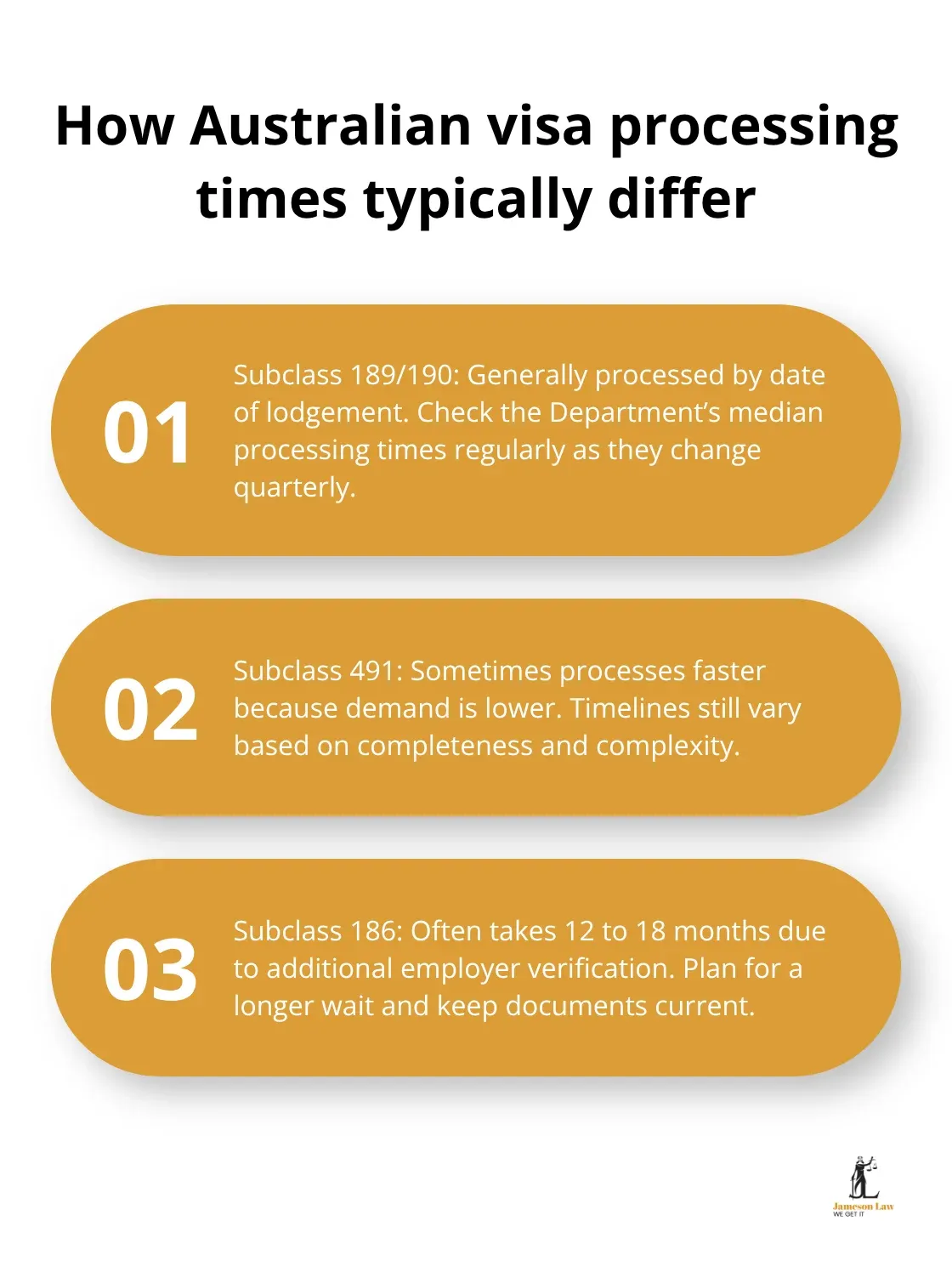
Regional visas like Subclass 491 sometimes process faster because demand is lower, whilst employer-sponsored visas like Subclass 186 often take 12 to 18 months due to additional employer verification steps.
These timeframes assume your application is complete when you lodge it-incomplete applications restart the clock once you provide missing information. The Department does not process applications in strict order, so submitting early provides no advantage over submitting later if both applications are complete.
Communicate with the Department through official channels
Communication with the Department happens exclusively through ImmiAccount messages or formal requests using your transaction reference number-avoid calling without an urgent, specific reason as phone queues are lengthy and staff cannot discuss individual cases without written documentation. If the Department requests additional information, respond within 28 days or your application may be refused without further notice.
Respond to refusals strategically
Refusals happen most often because applicants misunderstood requirements rather than failing to meet them, which means carefully reviewing the refusal letter’s reasons is your first step toward deciding whether to appeal or reapply. You have 21 days from the refusal date to lodge a formal review with the Administrative Appeals Tribunal if you believe the Department made an error in assessing your eligibility. This process requires legal evidence supporting your case and costs approximately AUD 1,000 in application fees alone, so seeking professional legal advice before appealing is genuinely worth the investment.
If your circumstances have changed since refusal-perhaps you’ve gained additional qualifications or work experience-reapplying with a stronger application sometimes succeeds where an appeal would fail. The Department’s refusal letter specifies which visa conditions you failed to meet, and this clarity tells you whether your situation is fixable or whether a different visa pathway suits you better.
Final Thoughts
Successful migration to Australia requires you to work through three distinct phases: selecting the right visa pathway, preparing comprehensive documentation, and lodging your application with precision. Most applicants who face refusal overlooked one of these stages rather than failing to meet eligibility criteria outright. The migration to Australia process rewards those who start early, gather documents systematically, and respond promptly to Department requests.
Common pitfalls emerge repeatedly in applications we review. Applicants delay skills assessment thinking they can lodge first and assess later, then face months of additional waiting. Others submit poor quality document scans or miss the 28-day response deadline for Department requests, triggering automatic refusal. Some choose the wrong visa pathway based on incomplete research, discovering too late that their occupation doesn’t align with NSW priority lists or that their points score falls short for Subclass 189.
The decision to seek professional legal guidance depends on your circumstances and confidence navigating the system independently. If your application involves complexity (such as previous visa refusals, character concerns, or unusual employment history), professional advice significantly improves your prospects. Our immigration law team can review your circumstances and advise on the strongest path forward.