Separation brings uncertainty about your rights, finances, and family arrangements. Getting clear answers early makes a real difference in protecting what matters to you.
At Jameson Law, we’ve helped countless people navigate this process. The questions to ask your lawyer about separation in Australia often determine whether you walk away with a fair outcome or regret missed opportunities.
Your Rights, Obligations and Maintenance
Property Division: What You’re Actually Entitled To
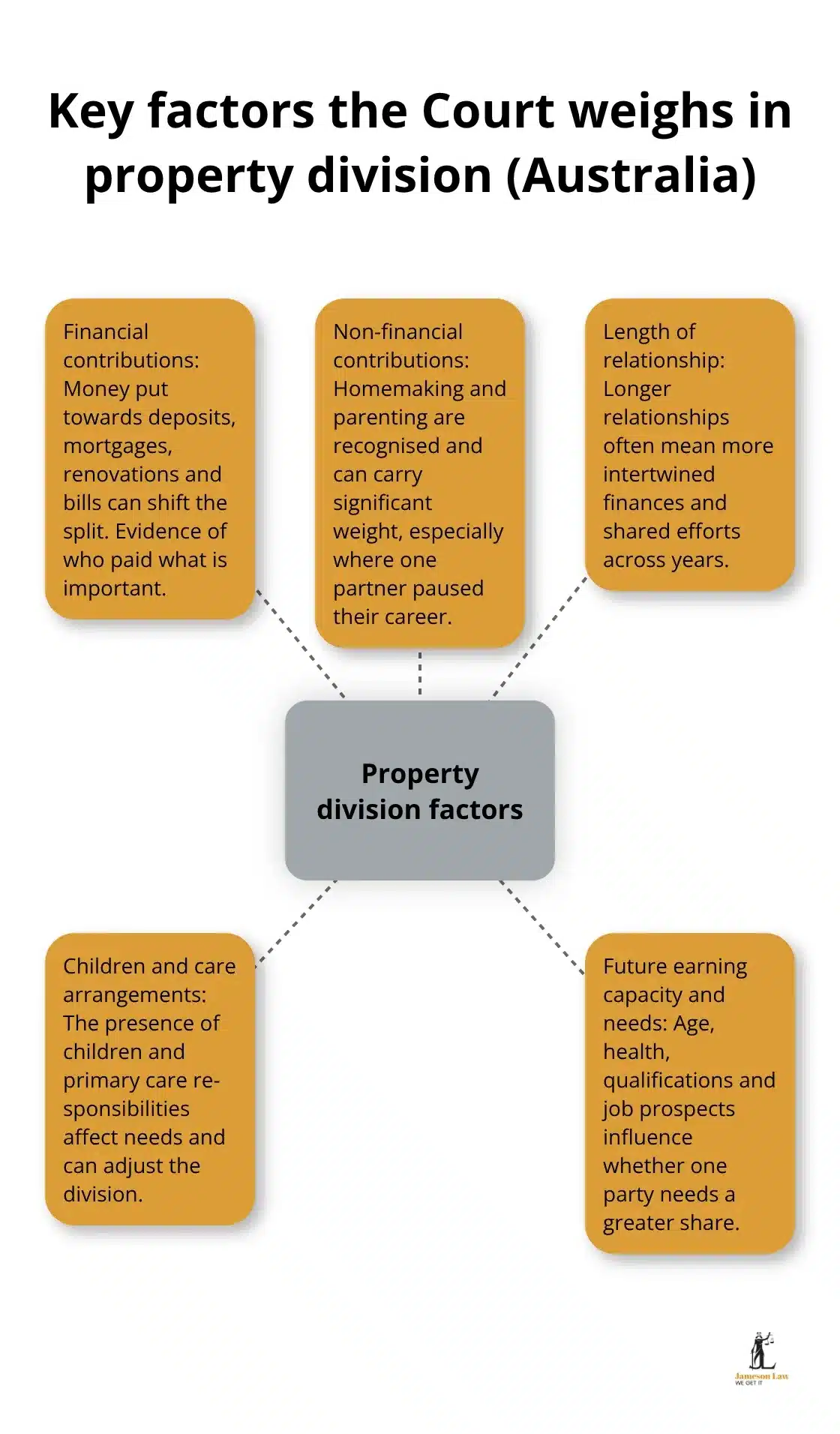
Separation in Australia requires courts to divide property and assets based on contribution, need, and future earning capacity under the Family Law Act 1975-not a simple 50-50 split. Your actual entitlement depends on factors specific to your situation: how long you were together, whether you have children, your financial contributions and non-financial contributions like homemaking, and your capacity to earn in the future. Ask your lawyer specifically how these factors apply to you and what percentage of the property pool you’re likely to receive, because two people in similar circumstances can walk away with significantly different outcomes based on how their lawyer frames their contributions.

Child Support: Understanding Your Monthly Obligation
If you have children, Services Australia calculates child support using the Child Support Assessment Tool, which considers both parents’ incomes, the number of children, and care arrangements. The current formula means that if you earn $80,000 annually and have one child in your care 50% of the time, your obligation differs substantially from someone earning $120,000 with the same arrangement. Ask your lawyer to run the numbers with your actual figures so you understand exactly what you’ll pay or receive monthly.
Spousal Maintenance: Eligibility and Duration
Spousal maintenance is where many people struggle because it’s not automatic and the criteria are strict. You qualify only if you cannot adequately support yourself financially after the relationship ends, and even then, the amount and duration depend on factors like the length of the marriage, your age, health, earning capacity, and whether you have parenting responsibilities. Under the spousal maintenance criteria and duration, you can ask the Court to make an order for spousal maintenance after you are divorced, but you must apply within 12 months of the divorce order taking effect. Your lawyer should explain whether spousal maintenance applies to your circumstances and, if so, roughly how long it would continue, because this significantly affects your post-separation budget and financial independence timeline.
These financial foundations shape your entire separation strategy. The next section covers the costs and timelines you’ll face as you move through the process.
What Costs and Timeline Should You Expect
How Much Your Separation Will Cost
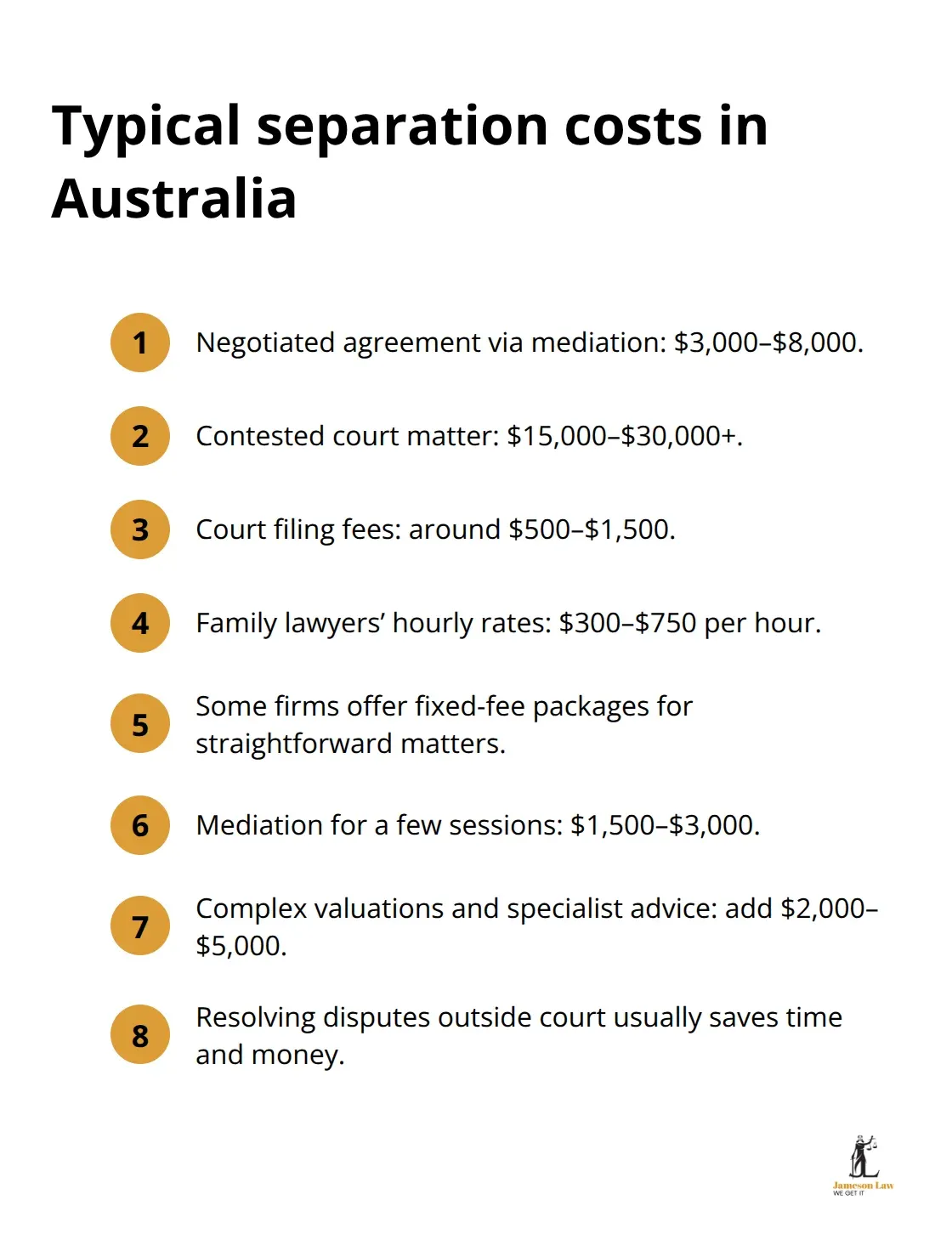
Separation costs in Australia vary wildly depending on how you resolve it. If you and your ex agree on property division and parenting arrangements, you might spend $3,000 to $8,000 on legal advice and paperwork through negotiation or mediation. If you end up in court fighting over assets or custody, costs escalate rapidly to $15,000, $30,000, or significantly more.

The Family Court charges filing fees around $500 to $1,500 depending on the application type, but the real expense comes from legal time. Most family lawyers in Australia charge between $300 and $750 per hour, though some offer fixed fees for straightforward matters. Ask your lawyer upfront whether they charge hourly, offer fixed-fee packages for your specific situation, or work on a retainer basis.
Mediation typically costs $1,500 to $3,000 for a few sessions with a qualified mediator, which often prevents far more expensive court battles. The Australian Government’s Attorney-General’s Department publishes resources on separating with debt and dividing property, emphasising that resolving disputes outside court saves time, reduces conflict, and cuts costs significantly.
Additional Costs for Complex Situations
If your separation involves a business, investment properties, or complex superannuation structures, add another $2,000 to $5,000 for valuations and specialist advice. Ask your lawyer to estimate costs for each pathway before you commit, because the difference between mediation and litigation can exceed $20,000.
How Long Your Separation Will Take
Timeline depends entirely on your path forward. Straightforward separations where both parties cooperate can be finalised in 3 to 6 months if you use mediation and then consent orders. Court-contested cases typically take 12 to 24 months, sometimes longer if you have children or significant assets.
The Family Law Act requires you to attempt family dispute resolution or mediation before filing certain court applications, which actually protects you by encouraging early settlement discussions. If your ex contests property division or parenting arrangements, expect delays at each stage: waiting for responses, scheduling court dates, obtaining valuations, and gathering evidence.
Factors That Affect Your Timeline
Cases involving children tend to take longer because courts must be satisfied that arrangements serve the child’s best interests under the Family Law Act. Ask your lawyer specifically whether your case is likely to settle quickly or proceed to trial, because this dramatically affects both timeline and cost.
Complex property pools with trusts, businesses, or interstate assets can add months to valuations alone. Your lawyer should give you realistic best-case and worst-case timelines with specific milestones so you understand what to expect month by month. Understanding these costs and timelines helps you prepare financially and emotionally for what lies ahead, but protecting your interests during separation requires more than just knowing the numbers.
Securing Your Assets During Separation
Gather and Protect Critical Documents Now
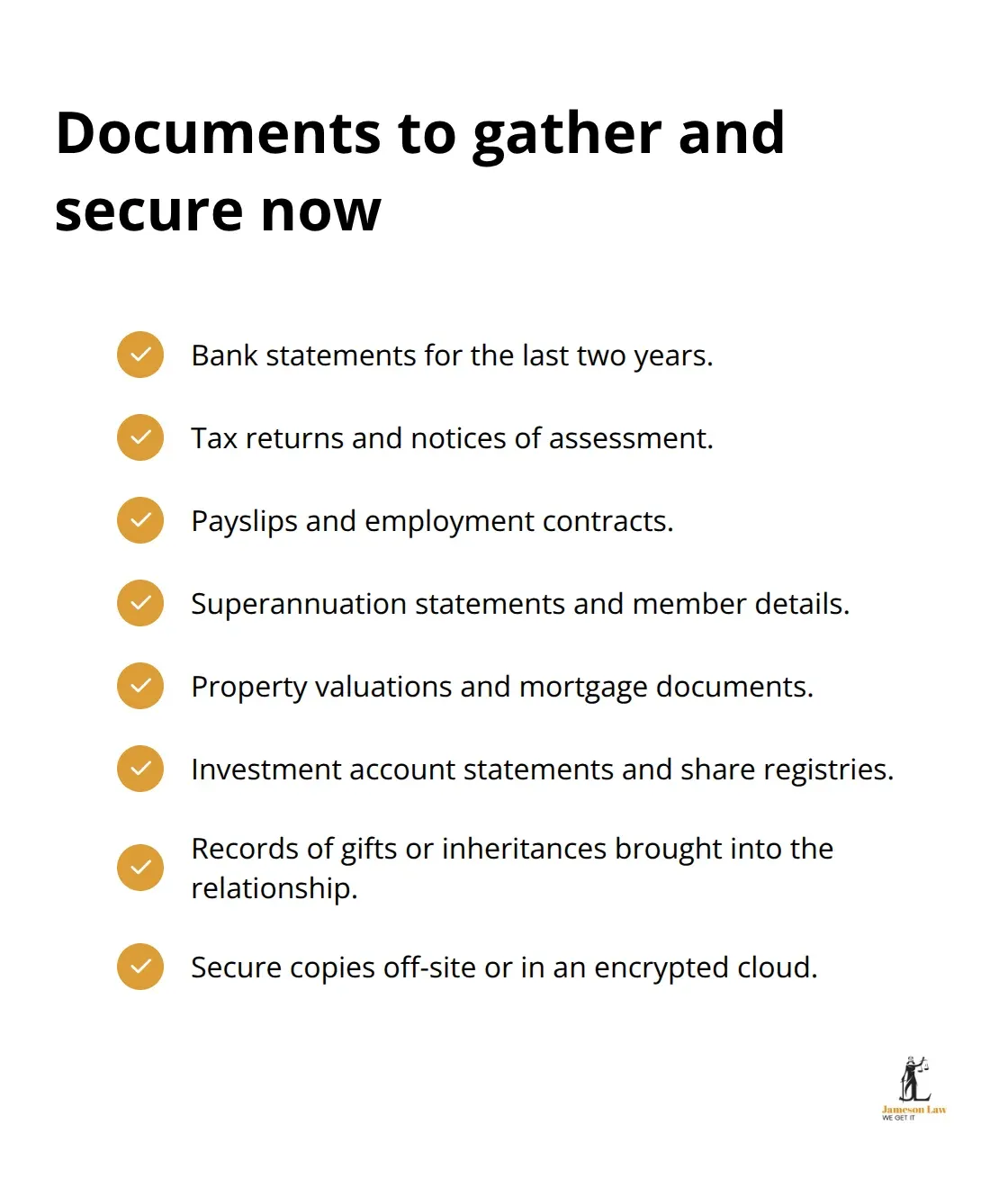
Protecting your interests during separation starts before you sign anything or make moves that look suspicious to the other party. The documents you collect now determine whether you can prove your financial position later, and financial abuse during separation occurs more often than most people realise. Ask your lawyer immediately which documents to collect and secure: bank statements from the last two years, tax returns, payslips, superannuation statements, property valuations, mortgage documents, investment account statements, and any records of gifts or inheritances you brought into the relationship.

The Australian Government’s Attorney-General’s Department publishes guidance on separating with debt that specifically addresses financial abuse, recognising that some people use debt or asset manipulation to control their ex-partner during separation. If you suspect this is happening to you, collect records of all communications, transfers, and account changes because courts take financial abuse seriously when determining property division. Store copies of critical documents separately from your home, either with your lawyer, in a secure cloud account, or with a trusted person outside the relationship.
Disclose Your Complete Financial Picture
Your lawyer needs to understand your complete financial picture, which means being honest about assets, debts, and income even if parts of it feel uncomfortable. Hiding information now creates problems later when the other party’s lawyer uncovers discrepancies through discovery. Full financial disclosure protects you because courts expect transparency, and withholding information can damage your credibility and affect how judges view your claims about property division or maintenance.
Understand Superannuation and Complex Assets
Protecting financial interests means understanding what happens to assets you might not immediately think of as jointly owned. Superannuation accumulated during your marriage forms part of the property pool, and splitting it incorrectly costs thousands in unnecessary tax and administration fees. If either of you owns a business, investment property, or holds interests in family trusts, valuations become essential and expensive, typically ranging from $2,000 to $5,000 per asset. Ask your lawyer whether a forensic accountant is needed to identify hidden assets or complex structures, because some separations involve deliberate concealment of income or assets.
Binding financial agreements can split superannuation directly, but only if you have consent orders that specifically address it-verbal agreements about super do not count. For business owners, separation often forces difficult decisions about selling, buying out your ex’s share, or continuing as co-owners, each with different tax and cash flow implications. Your lawyer should connect you with an accountant or financial planner who understands family law before you make any decisions about business structure or asset transfers, because the wrong move can trigger capital gains tax bills or attract scrutiny from the Australian Taxation Office.
Avoid Actions That Harm Your Position
Do not drain bank accounts, remove assets from the family home, or transfer property to other people during separation. Courts view these actions as attempts to hide assets, and they can result in orders against you that worsen your final settlement. Courts have power to set aside transactions made with the intention of defeating claims, so any suspicious financial moves now will likely be reversed later at significant cost to you.
Final Thoughts
The questions to ask your lawyer about separation in Australia determine your entire outcome. Whether you worry about property division, child support, costs, or protecting assets during the process, asking the right questions early prevents costly mistakes later. Your lawyer should explain your rights under the Family Law Act, provide realistic timelines and cost estimates, and help you understand which pathway-negotiation, mediation, or court-suits your situation best.
Early legal advice matters because separation decisions made in the first few weeks often determine your financial position for years afterward. Many people delay seeking advice hoping the situation resolves itself, then face far greater costs when problems compound. Getting clarity on your entitlements, obligations, and options now gives you control over the process rather than reacting to your ex-partner’s moves.
Your next step is scheduling a consultation with a family lawyer who understands your specific circumstances. We at Jameson Law offer expert family law services across Australia, helping people navigate separation, property settlement, and parenting arrangements with specialist family law expertise. During your initial consultation, bring the documents you’ve gathered, write down your key concerns, and ask the questions covered in this guide so a good lawyer can give you a realistic roadmap with specific milestones and next steps before you leave that first meeting.