Section 114 of the Family Law Act shapes how property and finances are divided when relationships end. Getting this right matters because mistakes can cost you thousands of dollars and years of legal battles.
At Jameson Law, we’ve seen families struggle through Section 114 disputes because they didn’t understand their rights from the start. This guide walks you through what Section 114 covers, how assets get valued, and how to protect yourself during negotiations.
What Section 114 Actually Covers
Section 114 of the Family Law Act gives the court power to issue injunctions that protect assets during family law proceedings. This isn’t about deciding who gets what in the end-it’s about stopping one party from emptying bank accounts, selling property, or transferring superannuation before a final agreement is reached. The court can restrain dealing with real estate, prevent disposal of shares or investment funds, restrict access to the family home, and stop superannuation transfers. What makes Section 114 different from other family law tools is its focus on preserving the asset pool right now, not settling disputes later.
Recognising When Assets Face Real Risk
You need an injunction when objective evidence shows that assets face real risk of dissipation-not just suspicion or conflict, but concrete signs like unusual bank withdrawals, property listings appearing suddenly, or transfers to third parties. The test is straightforward: the court weighs whether restricting someone’s freedom to deal with assets is just and convenient given the circumstances. An ex parte injunction can be granted urgently without the other party present, typically followed by a hearing within two to three weeks where both sides present evidence.

The Timing of Section 114 Applications
The timing matters enormously. Section 114 applies when you’ve started family law proceedings or reasonably anticipate needing them. If your partner mentions selling the investment property, refinancing the house, or moving superannuation offshore, that’s when you act. Courts have consistently upheld these injunctions in cases involving significant property disputes-the leading case involved a $377,000 property settlement where the husband’s passport was surrendered and he was placed on the Australian Federal Police watchlist to prevent departure.
Understanding the Financial Safeguard
The injunction requires an undertaking as to damages, meaning you’re financially liable if the court later finds the injunction caused unfair harm. This isn’t a penalty-it’s a safeguard that ensures you use this power responsibly. Superannuation protection requires particular attention because superannuation often represents the largest asset pool in family breakdowns. Without this protection, one party can trigger early release schemes or direct trustee payments that drain the fund before settlement discussions begin.
Protecting Superannuation and Complex Assets
Court decisions have shown that travel restrictions under Section 114 remain enforceable even on appeal when non-compliance risk is genuine. That precedent established how courts treat asset protection when substantial sums are at stake. Superannuation requires particular attention because it operates under different rules than other assets-trustees can act quickly, and once funds leave the superannuation environment, recovery becomes extremely difficult. The injunction mechanism stops these transfers before they happen, rather than trying to reverse them afterward.
Understanding what Section 114 protects sets the foundation for knowing how assets themselves get assessed and valued in your specific situation.
How Assets Get Valued and Divided
Understanding Asset Valuation in Family Law
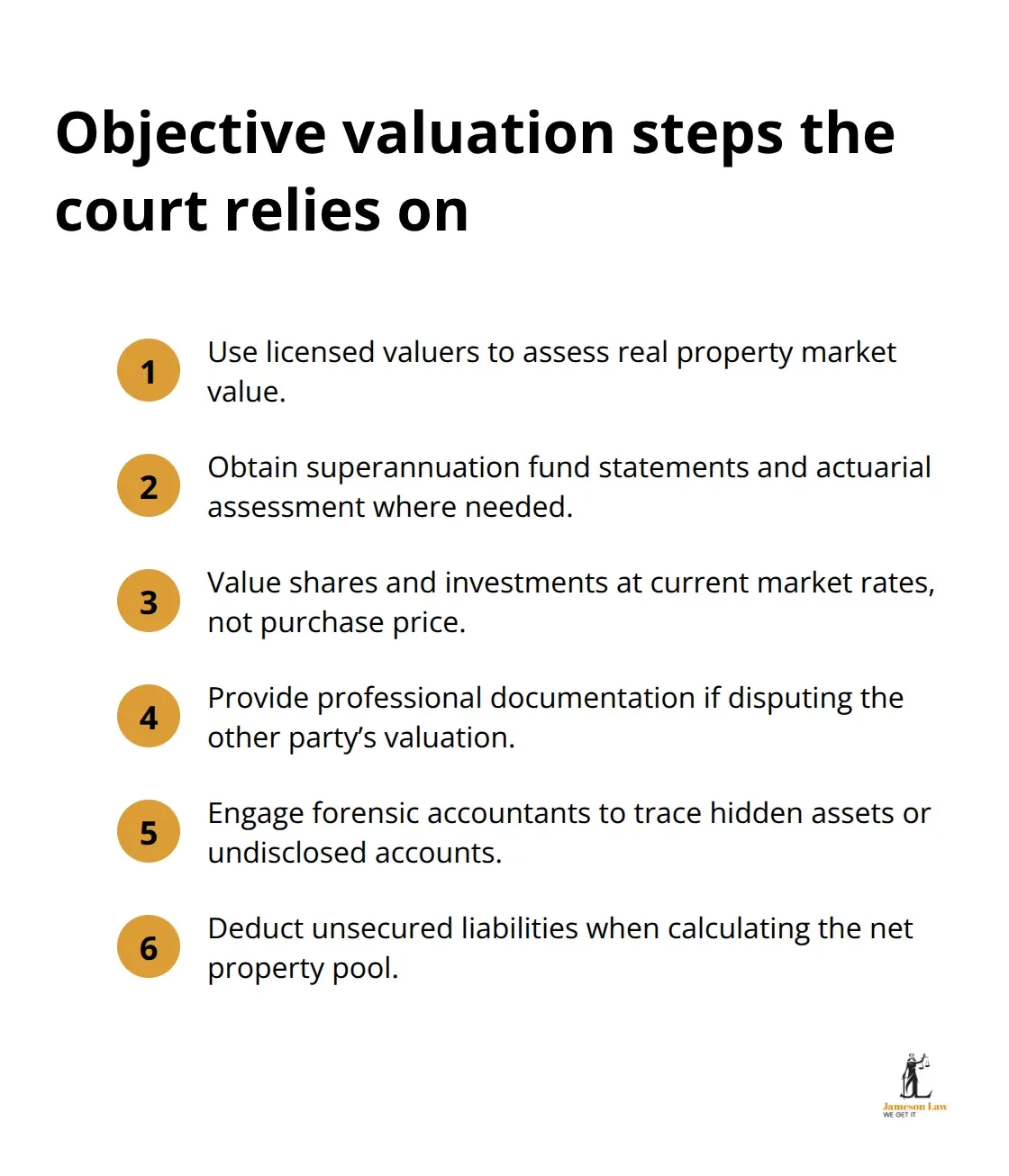
When the court assesses your asset pool under Section 114, it doesn’t simply add up bank balances and property values. The court examines what you own, what you owe, and what each asset is actually worth on the date of valuation-typically the date proceedings begin or when the court makes its decision. Real estate requires professional valuation because market value differs from what you think the property is worth. Superannuation needs actuarial assessment because early withdrawal penalties, tax implications, and splitting rules affect its true value. Investment portfolios must be valued at current market rates, not historical purchase prices.
The court uses objective evidence: licensed valuers for property, fund statements for superannuation, and current market data for shares and investments. If you’re claiming an asset is worth less than the other party believes, you need professional documentation to support that position. Conversely, if you suspect your partner is hiding assets or understating values, forensic accountants can trace financial movements and identify undisclosed accounts. Unsecured liabilities are deducted from the value of assets when ascertaining the value of a property.

The Timing and Impact of Valuation Dates
The timing of valuation matters because asset values fluctuate. A property valued at $650,000 three months into proceedings might be worth $680,000 by settlement, and that $30,000 difference directly affects how the pool gets divided. Courts have consistently held that valuation dates significantly influence final settlement amounts, particularly in volatile markets or when substantial assets are involved.
Spousal Maintenance: A Different Framework
Spousal maintenance is the weekly maintenance payable by one spouse from their income to support the other spouse, operating on a completely different framework from property division. The court examines each party’s income, earning capacity, financial resources, and living expenses to determine if one spouse should support the other. Courts look at actual income figures from tax returns and payslips, not assumed or potential earnings.

If you’ve reduced your hours to avoid higher maintenance obligations, courts see through this and may assess your capacity based on what you could earn, not what you currently do. The amount varies significantly based on your specific circumstances-there’s no standard percentage or formula like some people assume. Maintenance typically ranges from modest amounts for shorter marriages to substantial sums for long-term relationships where one party sacrificed career development.
Duration and Enforceability of Maintenance Orders
The duration of maintenance also matters: maintenance might be payable for a few years in a shorter marriage or indefinitely in a long marriage where one party is unlikely to become self-sufficient. Courts won’t revisit agreed arrangements simply because one party regrets the deal later.
Binding Financial Agreements and Consent Orders
Financial agreements and consent orders lock in your arrangements once both parties agree and the court approves them. It is mandatory to get independent legal advice before entering into a Financial Agreement. A consent order is court-enforceable from the moment a judge signs it, whereas a financial agreement requires both parties to have independent legal advice and meet strict formality requirements. Once these orders exist, changing them becomes extremely difficult-you’d need to prove a material change in circumstances that was unforeseen when the order was made.
Understanding how courts value assets and calculate maintenance payments sets the stage for recognising what disputes commonly arise during these assessments and how to address them effectively.
Common Challenges in Asset Disputes
Asset Classification and Hidden Funds
Asset classification disputes cause more delays and extra legal costs than any other Section 114 disagreement. One party claims an inheritance or gift is separate property outside the asset pool, while the other insists it has been mixed with joint finances and therefore divisible. Courts examine whether a party has control over trust assets to determine if they will be included in the property pool. If your partner received a $150,000 inheritance but deposited it into the joint mortgage account and used it to pay down the family home, courts treat it as part of the divisible pool because the funds became indistinguishable from joint assets.
Documentation matters enormously here. If inheritance funds went directly into a separate account and stayed there untouched, you have a clear argument for separation. If they got transferred, invested in joint names, or used for family expenses, you face an uphill battle. Keep meticulous records from day one of any relationship about where money comes from and where it goes, because courts decide these disputes based on transaction evidence, not on what you remember saying at the time.
Business Valuations and Investment Properties
Complex financial situations arise when one party owns a business, holds multiple investment properties, or has income from overseas sources. Business valuations require specialist accountants to understand the true value of the business. Investment properties complicate matters because the court must assess their current market value, outstanding mortgages, and potential capital growth, then determine whether one party should retain them or whether they should be sold to divide proceeds. Overseas income creates jurisdiction questions and enforcement challenges if the earning party tries to hide or understate foreign earnings.
Misconduct and Costs Consequences
Courts increasingly scrutinise financial conduct during proceedings, and if you are discovered hiding assets or providing false valuations, judges penalise this heavily through adverse costs orders and unfavourable property divisions. The 2025 cases Pierce & Pierce and Cosio & Cosio demonstrate that courts award costs against parties who engage in misleading conduct, sometimes imposing fixed-sum costs to discourage further disputes.
Protect yourself by hiring forensic accountants early if you suspect asset concealment, because forensic accountants assist lawyers in locating hidden assets and tracing funds. During negotiations, never accept valuations without independent verification, and never agree to maintenance amounts based on income figures you have not verified through tax returns and payslips.
Final Thoughts
Section 114 of the Family Law Act protects your assets during proceedings, but understanding this protection matters far less than acting on it quickly. We at Jameson Law have watched families lose tens of thousands of dollars because they waited too long to apply for injunctions or accepted valuations without independent verification. The cases throughout this guide show that courts reward parties who gather objective evidence early and penalise those who hide assets or provide false information.
Your situation determines what happens next. If you anticipate family law proceedings, start documenting your financial position now by collecting recent bank statements, property valuations, superannuation statements, and tax returns. If you suspect your partner is moving assets, contact a family lawyer immediately because timing controls everything with Section 114 applications. If you’re already in proceedings, review whether your current injunctions adequately protect your asset pool or whether additional restraints are needed.
Professional legal advice makes the difference between a settlement that protects your interests and one that leaves you financially vulnerable. We at Jameson Law have over 40 years of combined experience navigating family law disputes, and we help clients understand their rights, protect their assets, and achieve fair outcomes. Contact us today to discuss your situation and get clarity on how Section 114 applies to your circumstances.