PUBLICATION

How to Meet Student Visa English Language Requirements

"Meet student visa English language requirements with proven strategies, test prep tips, and qualification pathways to boost your application success."
How to Meet Student Visa English Language Requirements

Student visa English language requirements can feel overwhelming. At Jameson Law, we’ve helped countless students navigate these standards and find the right pathway for their situation.

Whether you’re preparing for a standardised test, exploring alternative qualifications, or considering a bridging program, this guide covers your options. We’ll walk you through accepted tests, minimum scores, and routes that don’t require traditional exams.

What Tests Does Australia Accept for Student Visas

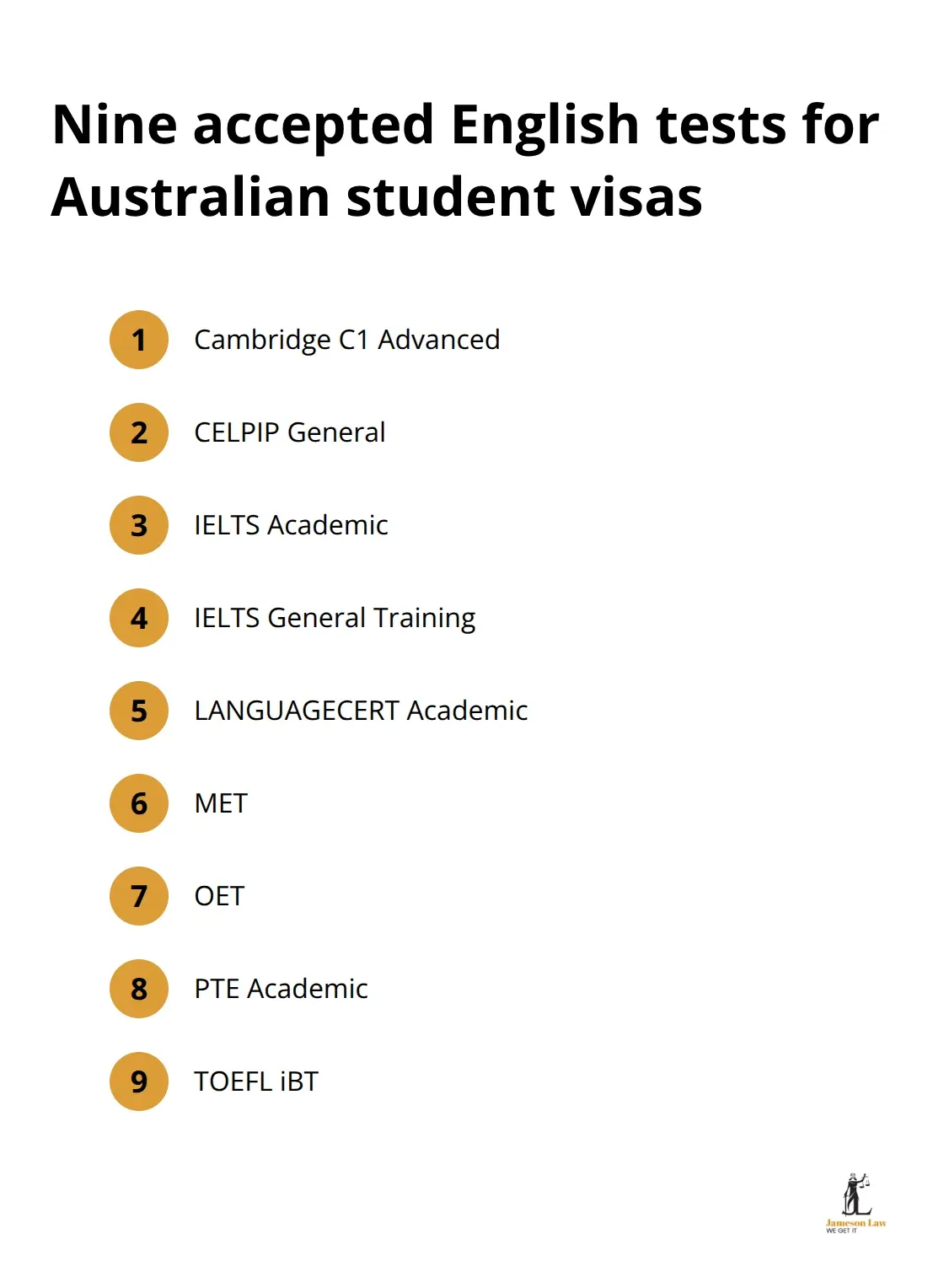
Australia accepts nine English language tests for student visa applications as of 7 August 2025. The Department of Home Affairs recognises Cambridge C1 Advanced, CELPIP General, IELTS Academic, IELTS General Training, LANGUAGECERT Academic, MET, OET, PTE Academic, and TOEFL iBT. This expansion from the previous list offers you genuine flexibility in selecting a test that suits your circumstances. The critical point here is that you must take your test at a secure testing centre-online or at-home versions simply don’t count. CELPIP Online, IELTS Online, TOEFL iBT Home Edition, and similar remote options won’t satisfy visa requirements, regardless of your score.

How long your test results stay valid

List of the nine English tests accepted by Australia’s Department of Home Affairs as of 7 August 2025 - student visa english language requirements

Your test results remain valid for 24 months from the date you sat the exam, so timing matters when you lodge your application. The TOEFL iBT minimum score increased from 64 to 67 to align with other accepted tests, so verify the exact minimums for your chosen test before you book. Plan your test date so your results stay current throughout your visa application process. If you took your test before 7 August 2025, your results may still count depending on your visa subclass and when you apply.

Why IELTS and PTE stand out

IELTS remains the most widely accepted option globally, with 12,500+ organisations recognising it and 100% of Australian, UK, New Zealand, and Canadian universities accepting IELTS scores. PTE Academic offers results within 48 hours and operates as a fully computer-based test with AI scoring, making it attractive if you need quick turnaround. IELTS Speaking involves a face-to-face interview with a trained human examiner, which many test-takers find fairer across different accents compared to computer-assessed speaking components.

Exemptions save time and money

You may not need to sit any test at all. If you completed your final year of secondary school or an undergraduate degree taught entirely in English at an approved institution in Australia, the United Kingdom, United States, Canada, or New Zealand, you qualify for an exemption. This exemption exists because these countries have established education systems conducted in English, so the Department of Home Affairs trusts the educational credential as proof of proficiency. The specifics vary by visa type and course level, so check the Department of Home Affairs website for your exact situation.

Your institution sets its own minimums

Different institutions set different minimums even when using the same test-a university offering a postgraduate research degree might require IELTS 6.5 overall with no band below 6.0, while another institution requires 7.0 overall. Your institution’s specific requirement takes precedence, so contact your university’s international office directly rather than relying on general Department of Home Affairs minimums. Some universities offer pathway programs or English language bridging courses that allow conditional admission if you fall slightly below the standard threshold, effectively providing an alternative route into your chosen degree without needing to resit an expensive test. These alternatives open doors for students who need additional support before they start their main course.

How to prepare for your English language test

Choose the right test for your situation

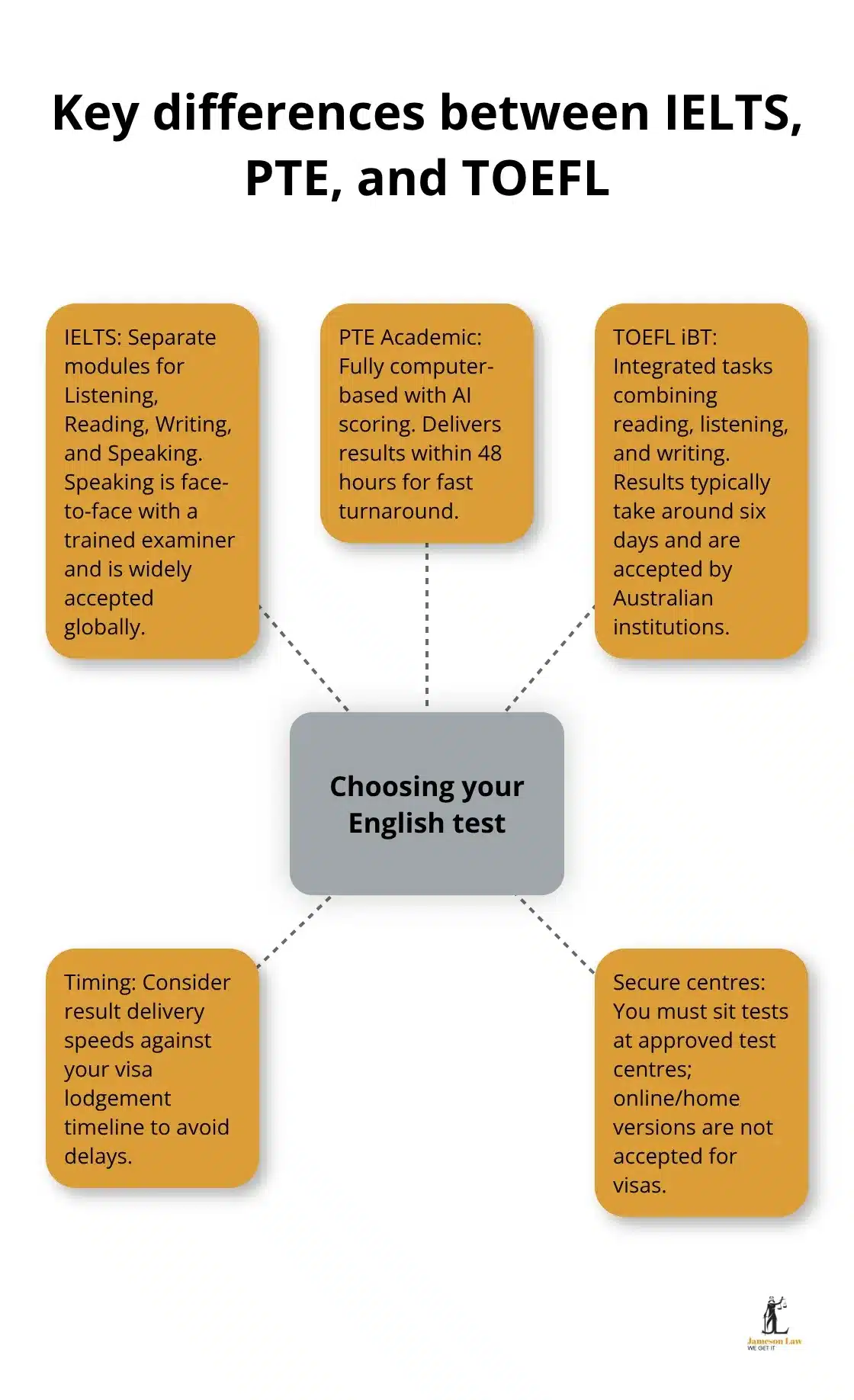
You must select a test that matches your strengths and timeline. IELTS results arrive in approximately one day, while TOEFL typically takes around six days and PTE delivers results within 48 hours-factor this timing into your application schedule. The key difference between tests matters: IELTS separates skills into distinct modules (Listening, Reading, Writing, Speaking), while TOEFL and PTE use integrated tasks where you might read a passage, listen to a lecture, and write about both. If you prefer modular skill-focused testing and human assessment for speaking, IELTS suits you better. If you want faster results and handle integrated tasks well, PTE delivers quicker turnaround. TOEFL works best if you’re targeting universities primarily in the United States, though Australian institutions accept it universally.

Access official practice materials and self-assessment tools

IELTS offers a free Prep Hub with practice tests and tutorials, plus an English self-assessment tool that gauges your current reading and listening skills and helps you tailor a focused study plan rather than studying everything equally. For TOEFL iBT, ETS provides official practice sets, and Pearson offers PTE sample tasks with AI-scored responses that mirror the actual test format. These resources let you identify weak areas before you commit to your test date, saving time and money on unnecessary preparation.

Plan your test date strategically

You should sit your test at least three months before your planned visa lodgement date, which gives you sufficient time to identify weak areas and strengthen them without rushing. English language test validity periods for visa applications mean your results may remain valid for up to 3 years depending on your visa subclass. You should book your test so results arrive with at least one month before you lodge your visa application, protecting yourself against unexpected delays. Popular test centres fill quickly, so register immediately once you’ve chosen which test suits you. IELTS offers numerous test centres worldwide with frequent test dates and flexible rescheduling, while PTE and TOEFL also maintain extensive centre networks across Australia.

Target your weakest areas and leverage retake options

If your institution requires IELTS 6.5 overall with no band below 6.0, you should focus your practice on your weakest module rather than attempting balanced improvement across all four. Higher IELTS scores correlate with better academic performance and more stable grades across semesters, especially in English-intensive majors-so investing time in reaching a strong score genuinely matters for your studies ahead. One Skill Retake for IELTS allows you to retake a single component like Speaking or Writing rather than the entire test, which saves money and time if you narrowly miss your target in one area only. This flexibility means you don’t need to repeat sections where you already performed well.

Verify your institution’s specific requirements

Hub-and-spoke diagram showing how IELTS, PTE Academic, and TOEFL iBT differ for Australian student visa applicants

Different institutions set different minimums even when using the same test-a university offering a postgraduate research degree might require IELTS 6.5 overall with no band below 6.0, while another institution requires 7.0 overall. Your institution’s specific requirement takes precedence, so you should contact your university’s international office directly rather than relying on general Department of Home Affairs minimums. Some universities offer pathway programs or English language bridging courses that allow conditional admission if you fall slightly below the standard threshold, effectively providing an alternative route into your chosen degree without needing to resit an expensive test. These alternatives open doors for students who need additional support before they start their main course, which leads us to explore the specific pathways available to you.

What if you don’t quite meet the test score?

Pathway programs offer a direct route into your degree

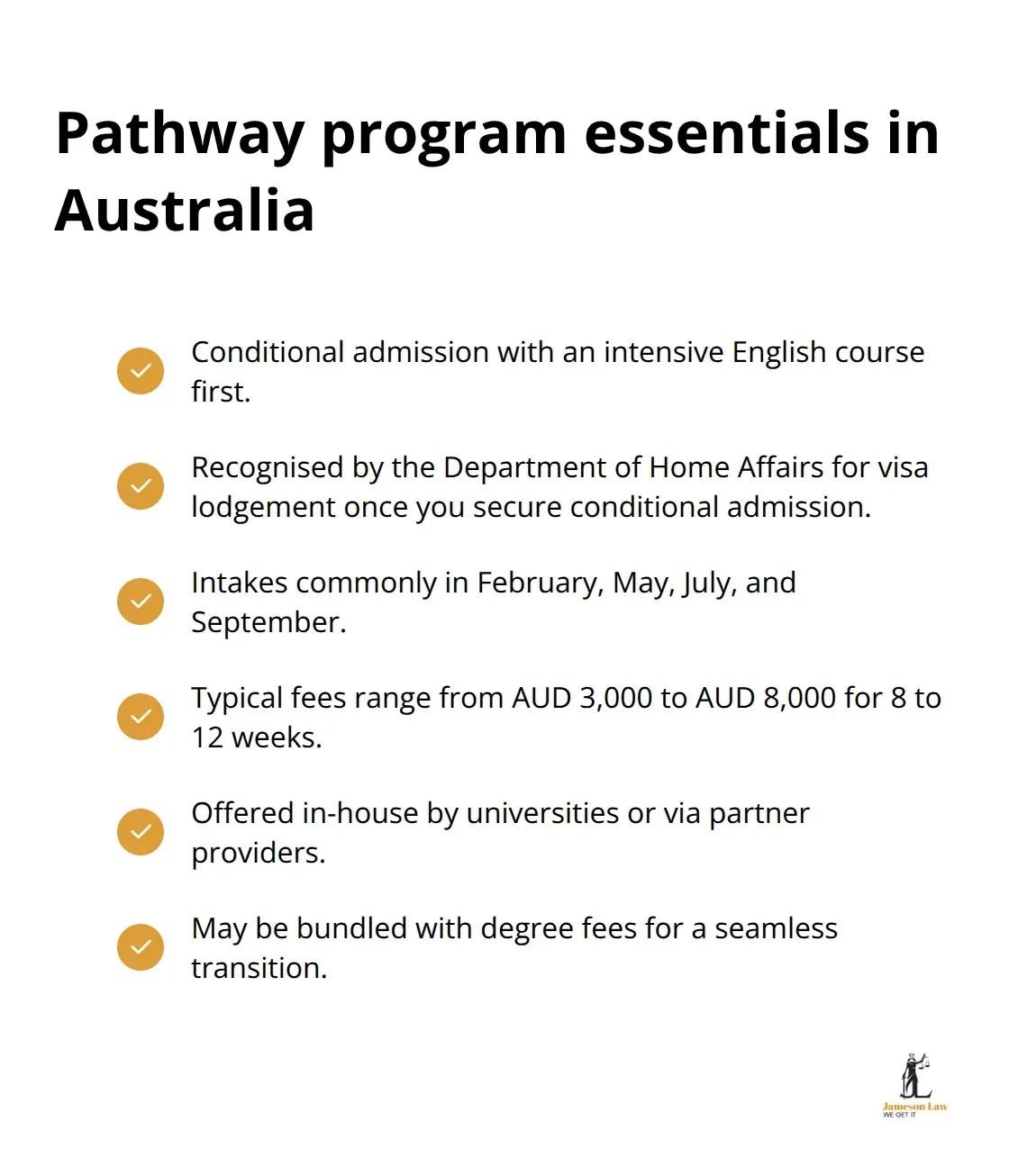
Not hitting your target English score stops nothing. Many Australian universities offer pathway programs and English language bridging courses specifically designed for international students who fall slightly below standard entry requirements. These programs function as conditional admission routes where you complete an intensive English course before starting your degree, allowing universities to support students with genuine potential who simply need additional language development. The Department of Home Affairs recognises this pathway approach, meaning you can lodge your visa application once you’ve secured conditional admission to a pathway program.

Universities across Australia operate these programs year-round, with intakes typically available in February, May, July, and September, so you’re not locked into a single annual deadline. The cost varies significantly-some universities charge between AUD 3,000 and AUD 8,000 for foundation English courses lasting 8 to 12 weeks, while others bundle pathway costs into your overall degree fees. Contact your institution’s international office to confirm whether they offer in-house programs or partner with external providers, as this affects both cost and the seamlessness of your transition into your main degree.

Checklist of key facts about Australian university pathway and English bridging programs for student visas - student visa english language requirements

English-medium qualifications exempt you from testing

If you completed your final year of secondary school or an entire undergraduate degree taught in English at an approved institution in Australia, the United Kingdom, United States, Canada, or New Zealand, you qualify for a complete English language exemption-no test required at all. This exemption exists because the Department of Home Affairs trusts education systems in these countries to deliver genuine English proficiency. The practical advantage here is substantial: you avoid test fees, preparation time, and the stress of sitting high-stakes exams.

However, the exemption applies only to specific qualifications completed within defined timeframes and at recognised institutions, so verify your eligibility directly on the Department of Home Affairs website rather than assuming your qualification qualifies. Some students hold degrees from English-medium universities in non-approved countries-for instance, an engineering degree taught entirely in English from a university in the Netherlands or United Arab Emirates. In these cases, you’ll need to sit an English test regardless, because the exemption applies only to approved nations. This distinction matters enormously when planning your visa timeline, so confirming your exact position early prevents wasted effort and application delays.

Final Thoughts

You now have multiple pathways to meet student visa English language requirements in Australia. The Department of Home Affairs accepts nine tests, exemptions apply if you completed education in English at approved institutions, and pathway programs offer support if you fall short of your institution’s minimum score. Your test results remain valid for 24 months, so timing your exam strategically protects your application timeline.

Your next step depends on your current position. If you haven’t sat an English test yet, access official practice materials from IELTS, TOEFL, or PTE and book your exam at least three months before your planned visa lodgement date. Contact your university’s international office to confirm their specific minimums and whether they offer in-house pathway programs that suit your needs.

We at Jameson Law understand that navigating student visa requirements involves far more than English language proficiency alone. Your overall visa application requires careful attention to documentation, financial evidence, and compliance with visa conditions, so contact our immigration team for expert support tailored to your circumstances.

Speak to an Expert Lawyer today

Laywers-Jameson-Law-The-best-law-firm-in-Sydney- Sydney Lawyers - Sydney
BOOK NOW

WE'RE IN IT TO WIN IT

Book your consultation

Book Now
Book Now Mobile 06 02 2025

This form submission is encrypted and secured to ensure your information remains confidential.

What our Clients

Related Publications:

What our clients say

.

Jameson Law - Voted the Best Law firm in Sydney Award

Legal Answers ... In Short

We're here to help

Our mission is to ensure our client matters are resolved successfully every time. Success to us does not simply involve winning, but moreover ensuring we take the most feasible, economic and stress-free path to help our clients achieve their goals. We fight hard for our clients, and always go by the motto: we’re in it to win it.

Jameson Law - Best Law Firm in Sydney

WE'RE IN IT TO WIN IT

Book your consultation

Call us now on (02) 8806 0866 or fill out the form below

Book Now Mobile

This form submission is encrypted and secured to ensure your information remains confidential.

WE'RE IN IT TO WIN IT

Book your consultation

Book Now Mobile 06 02 2025
lock

This form submission is encrypted and secured to ensure your information remains confidential.

Our Sydney Offices

Offices Parramatta and Sydney Jameson Law
Parramatta CBD - Head Office
jameson Law - Blacktown
jameson Law - Liverpool Office
Jameson Law - Bankstown
Court Houses We Frequent Jameson Law

Court Houses We Frequent

Balmain Local Court

Registry: Monday to Friday, 9:00am to 4:30pm

Bankstown Local Court

Court Operating Hours: 9:30am-4:30pm

Blacktown Local Court

Registry Hours: 9:00 – 4:30
Telephone Hours: 8:30 -4:30
Days open: Mon-Fri

Burwood Local Court

Registry Hours: 9:00 – 4:30
Telephone Hours: 8:30 – 4:30
Days open: Mon – Fri

Campbell Local Court

Registry Hours: 9:00 – 4:30
Telephone Hours: 8:30 – 4:30
Days open: Mon – Fri

Central Local Court

Registry Hours: 9:00 – 1:00 and 2:00 – 4:30
Telephone Hours: 8:30 – 4:30

Downing Local Court

Registry Hours: 9:00 – 1:00 and 2:00 – 4:30
Telephone Hours: 8:30 – 4:30

Wollongong Local Court

Registry Hours: 9:00 – 1:00 and 2:00 – 4:30
Telephone Hours: 8:30 – 4:30

Fairfield Local Court

Registry Hours: 9:00 – 1:00 and 2:00 – 4:30
Telephone Hours: 8:30 – 4:30

Hornsby Local Court

Registry Hours: 9:00 – 1:00 and 2:00 – 4:30
Telephone Hours: 8:30 – 4:30

Liverpool Local Court

Registry Hours: 9:00 – 1:00 and 2:00 – 4:30
Telephone Hours: 8:30 – 4:30

Manly Local Court

Registry Hours: 9:00 – 1:00 and 2:00 – 4:30
Telephone Hours: 8:30 – 4:30

Newtown Local Court

Registry Hours: 9:00 – 1:00 and 2:00 – 4:30
Telephone Hours: 8:30 – 4:30

Parramatta Local Court

Registry Hours: 9:00 – 1:00 and 2:00 – 4:30
Telephone Hours: 8:30 – 4:30

Penrith Local Court

Registry Hours: 9:00 – 1:00 and 2:00 – 4:30
Telephone Hours: 8:30 – 4:30

Sutherland Local Court

Registry Hours: 9:00 – 1:00 and 2:00 – 4:30
Telephone Hours: 8:30 – 4:30

Waverley Local Court

Registry Hours: 9:00 – 1:00 and 2:00 – 4:30
Telephone Hours: 8:30 – 4:30

Windsor Local Court

Registry Hours: 9:00 – 1:00 and 2:00 – 4:30
Telephone Hours: 8:30 – 4:30

Wollongong Local Court

Registry Hours: 9:00 – 1:00 and 2:00 – 4:30
Telephone Hours: 8:30 – 4:30

Downing Centre District Court

Registry Hours: 9:00 – 4:30
Telephone Hours: 8:30 – 4:30
Days open: Mon – Fri

Parramatta District Court

Registry Hours: 9:00 – 4:30
Days open: Mon-Fri

Penrith District Court

Registry Hours: 9:00 – 4:30
Days open: Mon-Fri

Campbelltown District Court

Registry Hours: 9:00 – 4:30
Days open: Mon – Fri

Liverpool District Court

Registry Hours: 9:00 – 4:30
Days open: Mon – Fri

Wollongong District Court

Registry Hours: 9:00 – 1:00 and 2:00 – 4:30
Telephone Hours: 8:30 – 4:30

Supreme Court New South Wales

Registry Hours: 9:00 AM – 4:30 PM
Telephone Hours: 8:30 AM – 4:30 PM
Days Open: Monday to Friday

Federal Circuit and Family Court of Australia

Registry Hours: 9:00 AM – 4:30 PM
Telephone Hours: 8:30 AM – 5:00 PM
Days Open: Monday to Friday

Federal Court

Monday to Friday, 8:30 AM – 4:30 PM

High Court

Monday to Friday, 8:30 AM – 5:00 PM

Children’s Court of New South Wales

Registry Hours: 9:00 AM – 4:30 PM
Telephone Hours: 8:30 AM – 4:30 PM
Days Open: Monday to Friday

Coroner’s Court New South Wales

Registry Hours: 9:00 AM – 4:30 PM
Telephone Hours: 8:30 AM – 4:30 PM
Days Open: Monday to Friday

Industrial Relations Commission of New South Wales

Registry Hours: 9:00 AM – 4:30 PM
Telephone Hours: 8:30 AM – 4:30 PM
Days Open: Monday to Friday

Land and Environment Court of New South Wales

Registry Hours: 9:00 AM – 4:30 PM
Telephone Hours: 8:30 AM – 4:30 PM
Days Open: Monday to Friday

WE'RE IN IT TO WIN IT

Book your consultation

Book Now
Book Now Mobile 06 02 2025
lock

This form submission is encrypted and secured to ensure your information remains confidential.