PUBLICATION

How to Become a Migration Agent in Australia

"Learn how to become a migration agent in Australia with our complete step-by-step guide to credentials and career success."
How to Become a Migration Agent in Australia

Australia’s migration sector is booming, with visa applications reaching record levels. If you’re considering how to become a migration agent in Australia, you’ll find it’s a structured but achievable path.

We at Jameson Law understand the steps involved because we work with migration professionals every day. This guide walks you through the requirements, registration process, and career-building strategies you need to succeed.

What You Need to Become a Migration Agent

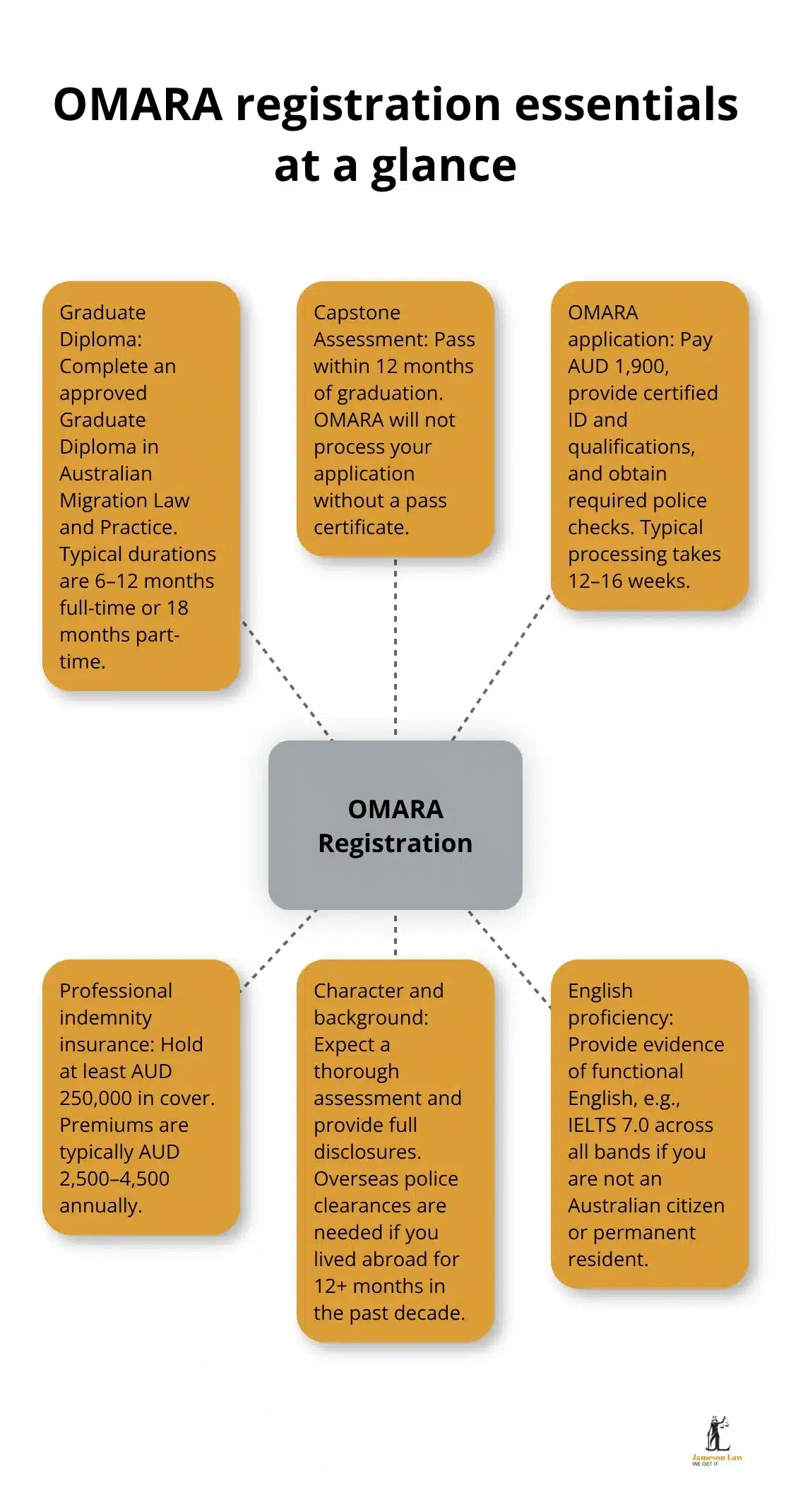
To work legally as a migration agent in Australia, you must meet three core requirements set by the Office of the Migration Agents Registration Authority (OMARA). First, you need formal education in migration law. OMARA requires a Graduate Diploma in Australian Migration Law and Practice from an approved provider, which typically takes 6–12 months full-time or 18 months part-time. Universities like Griffith University, Australian National University, and Victoria University offer these programs, with costs ranging from AUD 8,000–15,000. After you complete your studies, you must pass the Capstone Assessment within 12 months-an independent exam that verifies your knowledge meets professional standards. This is non-negotiable; OMARA will not process your registration application without a Capstone pass certificate. Second, you need to register with OMARA itself. The application fee is AUD 1,900 per year, and you’ll need certified copies of your diploma, Capstone results, a passport or birth certificate, and a National Police Check. If you’ve lived overseas for 12 months or more in the past 10 years, you’ll also need police clearances from those countries.

Diagram showing key requirements and checks to become a Registered Migration Agent in Australia - how to become migration agent in australia

OMARA’s processing typically takes 12–16 weeks, though complex cases take longer. Third, professional indemnity insurance is mandatory before OMARA grants registration. You must hold at least AUD 250,000 in coverage, with annual premiums typically running AUD 2,500–4,500 through providers like Lawcover or Professional Edge. Purchase this after provisional approval, not before. Beyond these three pillars, OMARA conducts character assessments where they scrutinise your background, and you must prove functional English proficiency equivalent to IELTS 7.0 across all bands if you’re not an Australian citizen or permanent resident. The entire pathway from education through registration typically costs AUD 15,000–25,000 and takes 12–18 months to complete.

Select a Course with Real Practice Components

Choose an education provider that includes practical elements like mock tribunal hearings, real case studies, and hands-on visa application experience. Theoretical knowledge alone won’t prepare you for client work. Griffith University and ANU programs emphasise practical training because employers value agents who can handle actual cases from day one. Programs with industry placement opportunities strengthen both your registration application and your job prospects when you start seeking positions.

Budget for the Full Cost Upfront

Many aspiring agents underestimate total expenses. Education costs AUD 8,000–15,000, the OMARA application fee is AUD 1,900, insurance runs AUD 2,500–4,500 annually, and the National Police Check adds a few hundred dollars. You should set aside at least AUD 15,000–25,000 before you enrol. Starting this financial planning early prevents delays when you reach the insurance stage, where many applicants stumble because they haven’t budgeted properly.

Prepare Your Character Documentation Early

OMARA’s character assessment is thorough. You’ll need statutory declarations, references, and full disclosure of any criminal history, bankruptcies, or professional misconduct. Minor traffic infringements may be acceptable, but serious offences require complete transparency. International applicants must gather overseas police clearances from every country where they lived for 12 months or more in the past decade. This can take weeks or months to obtain, so you should start requesting these documents immediately after you pass the Capstone Assessment, not after you’ve submitted your OMARA application.

Understand the Timeline and Processing Expectations

The Capstone Assessment typically takes 6–8 weeks to mark, though complex cases can extend this period. OMARA’s standard application processing runs around 12–16 weeks, with updates sent via email and requests for additional information as needed. You’ll receive communication at each stage, so monitor your inbox carefully.
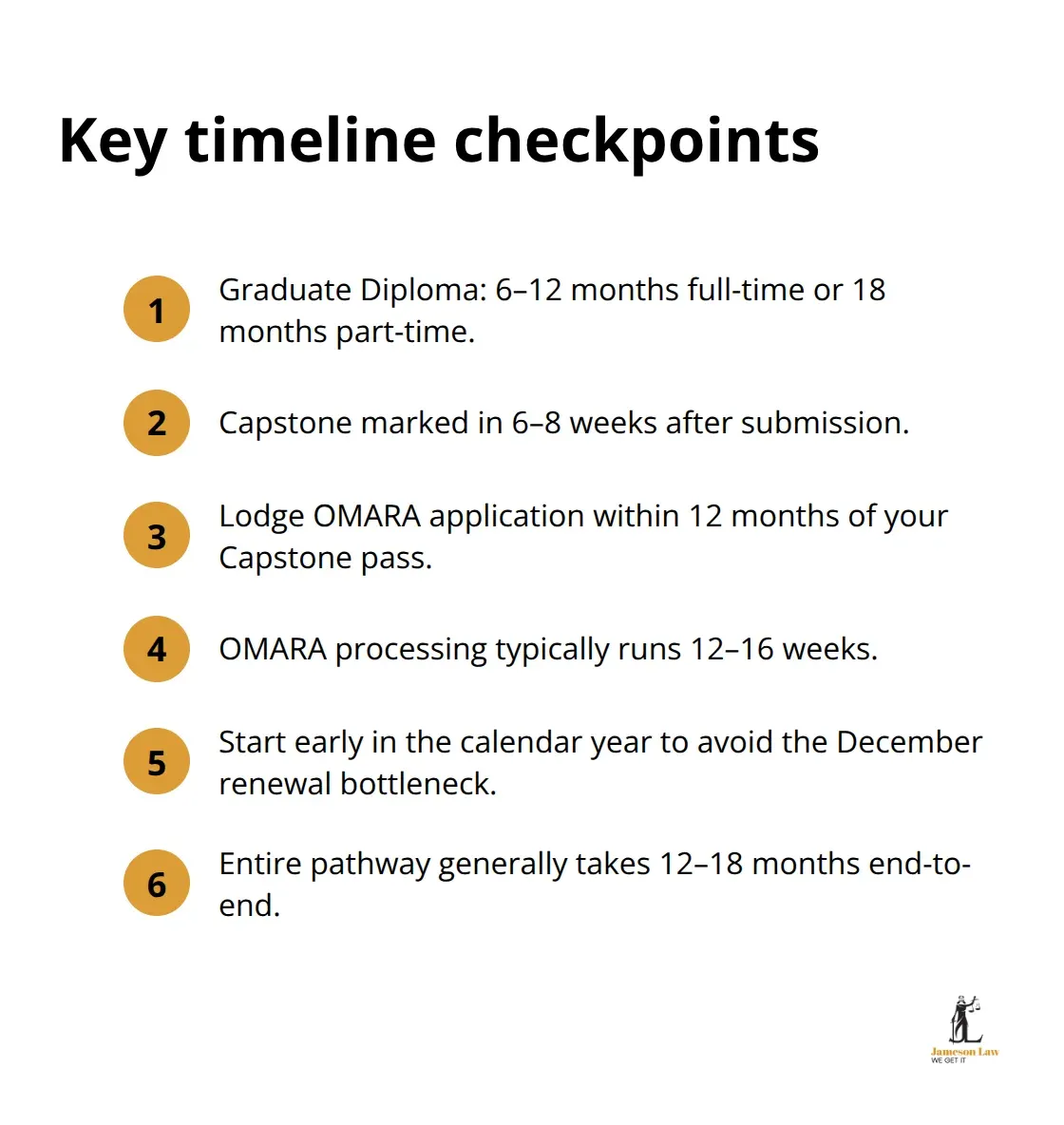
Ordered list summarising study, Capstone, application, and processing timelines for OMARA registration - how to become migration agent in australia

International applicants often face longer processing times due to overseas police clearance verification, so factor this into your planning. Starting your application process early in the calendar year gives you the best chance of completing registration before the December renewal deadline.

Once you understand these requirements and timelines, the next step involves taking action on your education and beginning the formal registration journey with OMARA.

Your Registration Timeline and Action Plan

Start Your Studies at the Right Time

You should enrol in an approved course through providers like Griffith University, Australian National University, or Victoria University. These institutions offer Graduate Diplomas in Australian Migration Law and Practice with flexible schedules that fit different lifestyles. Full-time study takes 6–12 months, while part-time stretches across 18 months, allowing you to work while learning. Try to enrol early in the calendar year because this timing aligns your Capstone completion with OMARA application windows and avoids the December processing bottleneck when renewal deadlines loom. During your studies, you should prioritise programs with practical components including mock tribunal hearings and real visa application experience. Theoretical knowledge alone fails in client work where timing, documentation accuracy, and procedural knowledge determine outcomes.

Pass the Capstone Assessment Within Your Window

After you graduate, you must pass the Capstone Assessment within 12 months or your qualification expires for registration purposes. OMARA marks Capstone papers within 6–8 weeks, though complex submissions take longer. The moment you receive your pass certificate, the clock starts ticking on your 12-month window to lodge your OMARA application. If you delay this step, you will face re-sitting the Capstone, which costs additional time and money.

Prepare Your OMARA Application Thoroughly

Your OMARA application submission demands meticulous preparation because incomplete or incorrect documentation triggers rejection and restarts the 12–16 week processing timeline. You should gather certified copies of your diploma and Capstone results before you apply. You must obtain your National Police Check early, as these typically take a few days if you apply online. International applicants should request overseas police clearances immediately after passing the Capstone, not after lodging your application, since some countries take 8–12 weeks to issue these documents. You should prepare your character documentation including statutory declarations and professional references, then submit everything together rather than trickling documents in afterward. OMARA reviews applications systematically and requests additional information via email, so you must monitor your inbox constantly during processing.

Secure Guarantee and Complete Registration

Once OMARA grants provisional approval, you should purchase professional indemnity insurance through providers like Lawcover or Professional Edge. Insurance premiums typically cost AUD 2,500–4,500 annually for the mandatory AUD 250,000 minimum coverage. You must submit your certificate of currency to OMARA immediately upon policy activation because they will not finalise registration without proof of active insurance. The entire sequence from course enrolment through final registration takes 12–18 months when you execute it without delays, positioning you to start practising as a Registered Migration Agent and building your client base.

With your registration complete, you can now focus on the practical side of your career-developing specialisations that set you apart in the competitive migration services market.

How to Build a Profitable Migration Practice

Once you’re registered with OMARA, the real work begins. Most new migration agents make the mistake of treating their practice as a generalist operation, accepting every visa category and client type that walks through the door. This approach spreads you thin, damages your reputation when you make mistakes outside your expertise, and kills your profitability. The agents who thrive specialise deeply in specific visa streams where they develop genuine expertise.

Choose Your Specialisation Strategically

Family visa specialists understand partner sponsorships inside out and spot issues in relationship evidence that generalists miss entirely. Skilled migration agents who focus on engineering or healthcare visas build relationships with employers and recruitment agencies, creating a steady referral pipeline. Business visa specialists command higher fees because they navigate complex investment structures and state sponsorship requirements that require deep knowledge.

You should pick one or two visa categories based on market demand in your location and your existing network. Sydney has enormous demand for family and skilled migration because of population density and international recruitment. Melbourne’s market leans toward business visas given corporate headquarters concentration. Regional areas need agents who understand employer sponsorship and regional migration schemes.

Start building your specialisation immediately after registration by subscribing to Migration Institute of Australia CPD programs focused on your chosen area. Attend every webinar, read every policy update, and join online forums where specialists discuss edge cases. This investment in deep knowledge separates you from agents who treat migration law as a commodity service.

Build Client Relationships That Generate Referrals

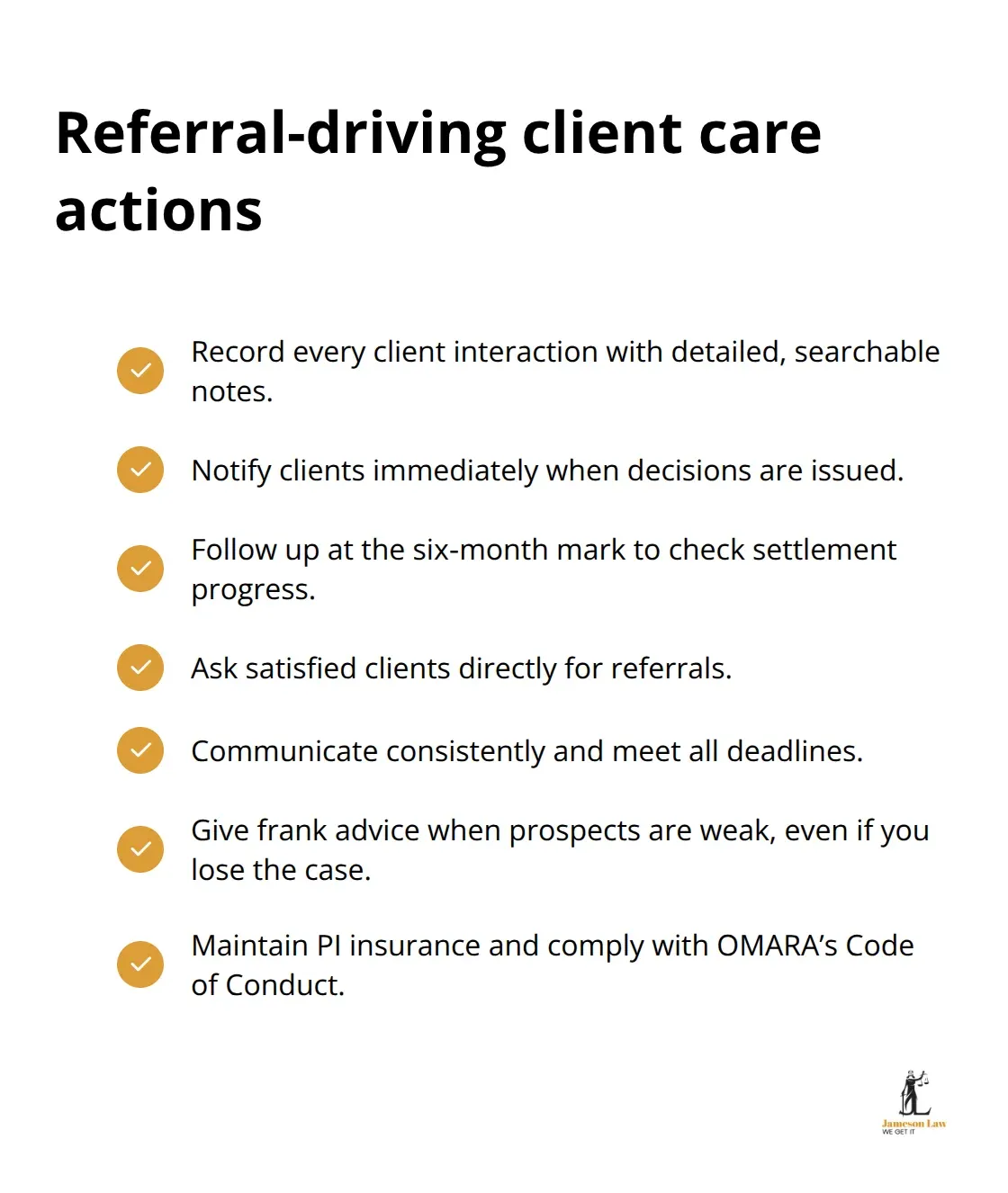
Most agents focus on winning new clients, but retaining existing clients and generating referrals costs far less and generates higher lifetime value. Start tracking every client interaction in your practice management system with detailed notes about their situation, preferences, and outcomes. When visa processing completes successfully, contact them immediately with the good news rather than letting them discover it themselves.

Checklist of relationship practices that increase referrals for migration agents in Australia

Follow up six months later asking how their settlement is progressing and whether they know others who need migration assistance. Clients who feel genuinely supported refer their friends, family, and colleagues at rates exceeding 40 per cent according to migration service industry benchmarks. Your professional reputation depends on consistent communication, meeting deadlines, and honest advice even when it costs you a case.

If a client’s visa application has weak prospects, tell them directly rather than taking their money and hoping circumstances improve. This honesty builds trust that translates into referrals and positive reviews. Maintain your professional indemnity insurance and understand OMARA’s Code of Conduct thoroughly because violations destroy reputations faster than anything else.

Maintain Compliance and Detailed Records

The 2023 OMARA suspension data showed that record-keeping failures and poor client communication drove most enforcement actions. Keep detailed file notes documenting every conversation, every piece of advice, and every document you reviewed. Written fee disclosures must be provided before you commence work, not buried in email threads.

Immigration law changes constantly. OMARA requires 10 CPD points annually, but this minimum barely keeps you current. Department of Home Affairs policy updates arrive regularly, visa conditions shift, processing times fluctuate, and tribunal decisions reshape interpretation of the Migration Act 1958. Subscribe to Home Affairs email alerts and join the Migration Institute of Australia to access immediate updates when policy changes occur. Your clients depend on you knowing law that didn’t exist six months ago.

Final Thoughts

Becoming a migration agent in Australia demands commitment, but the pathway is clear and achievable. You need formal education through an OMARA-approved Graduate Diploma, you must pass the Capstone Assessment, and you must secure professional indemnity insurance before registration. The entire process takes 12–18 months and costs between AUD 15,000–25,000, positioning you to enter a sector where about 7,000 registered agents earn average salaries around AUD 110,000 annually.

Your success depends on what you do after registration. Agents who specialise in specific visa categories and build strong client relationships significantly outperform generalists who accept every visa type that walks through the door. You must maintain meticulous client records, stay current with constant policy changes through continuous professional development, and choose a specialisation aligned with your location’s market demand (Sydney favours family and skilled migration, while Melbourne leans toward business visas).

Start your journey by researching OMARA-approved education providers and enrolling in a Graduate Diploma that emphasises practical components like mock tribunal hearings and real visa application experience. Enrol early in the calendar year to align your Capstone completion with optimal OMARA application windows, and immediately after passing the Capstone, begin gathering character documentation and requesting overseas police clearances if needed. If you need guidance on how to become a migration agent in Australia or want to understand the legal framework surrounding migration practice, Jameson Law offers expert immigration law services to support your journey.

Speak to an Expert Lawyer today

Laywers-Jameson-Law-The-best-law-firm-in-Sydney- Sydney Lawyers - Sydney
BOOK NOW

WE'RE IN IT TO WIN IT

Book your consultation

Book Now
Book Now Mobile 06 02 2025

This form submission is encrypted and secured to ensure your information remains confidential.

What our Clients

Related Publications:

What our clients say

.

Jameson Law - Voted the Best Law firm in Sydney Award

Legal Answers ... In Short

We're here to help

Our mission is to ensure our client matters are resolved successfully every time. Success to us does not simply involve winning, but moreover ensuring we take the most feasible, economic and stress-free path to help our clients achieve their goals. We fight hard for our clients, and always go by the motto: we’re in it to win it.

Jameson Law - Best Law Firm in Sydney

WE'RE IN IT TO WIN IT

Book your consultation

Call us now on (02) 8806 0866 or fill out the form below

Book Now Mobile

This form submission is encrypted and secured to ensure your information remains confidential.

WE'RE IN IT TO WIN IT

Book your consultation

Book Now Mobile 06 02 2025
lock

This form submission is encrypted and secured to ensure your information remains confidential.

Our Sydney Offices

Offices Parramatta and Sydney Jameson Law
Parramatta CBD - Head Office
jameson Law - Blacktown
jameson Law - Liverpool Office
Jameson Law - Bankstown
Court Houses We Frequent Jameson Law

Court Houses We Frequent

Balmain Local Court

Registry: Monday to Friday, 9:00am to 4:30pm

Bankstown Local Court

Court Operating Hours: 9:30am-4:30pm

Blacktown Local Court

Registry Hours: 9:00 – 4:30
Telephone Hours: 8:30 -4:30
Days open: Mon-Fri

Burwood Local Court

Registry Hours: 9:00 – 4:30
Telephone Hours: 8:30 – 4:30
Days open: Mon – Fri

Campbell Local Court

Registry Hours: 9:00 – 4:30
Telephone Hours: 8:30 – 4:30
Days open: Mon – Fri

Central Local Court

Registry Hours: 9:00 – 1:00 and 2:00 – 4:30
Telephone Hours: 8:30 – 4:30

Downing Local Court

Registry Hours: 9:00 – 1:00 and 2:00 – 4:30
Telephone Hours: 8:30 – 4:30

Wollongong Local Court

Registry Hours: 9:00 – 1:00 and 2:00 – 4:30
Telephone Hours: 8:30 – 4:30

Fairfield Local Court

Registry Hours: 9:00 – 1:00 and 2:00 – 4:30
Telephone Hours: 8:30 – 4:30

Hornsby Local Court

Registry Hours: 9:00 – 1:00 and 2:00 – 4:30
Telephone Hours: 8:30 – 4:30

Liverpool Local Court

Registry Hours: 9:00 – 1:00 and 2:00 – 4:30
Telephone Hours: 8:30 – 4:30

Manly Local Court

Registry Hours: 9:00 – 1:00 and 2:00 – 4:30
Telephone Hours: 8:30 – 4:30

Newtown Local Court

Registry Hours: 9:00 – 1:00 and 2:00 – 4:30
Telephone Hours: 8:30 – 4:30

Parramatta Local Court

Registry Hours: 9:00 – 1:00 and 2:00 – 4:30
Telephone Hours: 8:30 – 4:30

Penrith Local Court

Registry Hours: 9:00 – 1:00 and 2:00 – 4:30
Telephone Hours: 8:30 – 4:30

Sutherland Local Court

Registry Hours: 9:00 – 1:00 and 2:00 – 4:30
Telephone Hours: 8:30 – 4:30

Waverley Local Court

Registry Hours: 9:00 – 1:00 and 2:00 – 4:30
Telephone Hours: 8:30 – 4:30

Windsor Local Court

Registry Hours: 9:00 – 1:00 and 2:00 – 4:30
Telephone Hours: 8:30 – 4:30

Wollongong Local Court

Registry Hours: 9:00 – 1:00 and 2:00 – 4:30
Telephone Hours: 8:30 – 4:30

Downing Centre District Court

Registry Hours: 9:00 – 4:30
Telephone Hours: 8:30 – 4:30
Days open: Mon – Fri

Parramatta District Court

Registry Hours: 9:00 – 4:30
Days open: Mon-Fri

Penrith District Court

Registry Hours: 9:00 – 4:30
Days open: Mon-Fri

Campbelltown District Court

Registry Hours: 9:00 – 4:30
Days open: Mon – Fri

Liverpool District Court

Registry Hours: 9:00 – 4:30
Days open: Mon – Fri

Wollongong District Court

Registry Hours: 9:00 – 1:00 and 2:00 – 4:30
Telephone Hours: 8:30 – 4:30

Supreme Court New South Wales

Registry Hours: 9:00 AM – 4:30 PM
Telephone Hours: 8:30 AM – 4:30 PM
Days Open: Monday to Friday

Federal Circuit and Family Court of Australia

Registry Hours: 9:00 AM – 4:30 PM
Telephone Hours: 8:30 AM – 5:00 PM
Days Open: Monday to Friday

Federal Court

Monday to Friday, 8:30 AM – 4:30 PM

High Court

Monday to Friday, 8:30 AM – 5:00 PM

Children’s Court of New South Wales

Registry Hours: 9:00 AM – 4:30 PM
Telephone Hours: 8:30 AM – 4:30 PM
Days Open: Monday to Friday

Coroner’s Court New South Wales

Registry Hours: 9:00 AM – 4:30 PM
Telephone Hours: 8:30 AM – 4:30 PM
Days Open: Monday to Friday

Industrial Relations Commission of New South Wales

Registry Hours: 9:00 AM – 4:30 PM
Telephone Hours: 8:30 AM – 4:30 PM
Days Open: Monday to Friday

Land and Environment Court of New South Wales

Registry Hours: 9:00 AM – 4:30 PM
Telephone Hours: 8:30 AM – 4:30 PM
Days Open: Monday to Friday

WE'RE IN IT TO WIN IT

Book your consultation

Book Now
Book Now Mobile 06 02 2025
lock

This form submission is encrypted and secured to ensure your information remains confidential.