PUBLICATION

Requirements for a Successful Migration Application: What You Need to Know

"Learn the key requirements for a successful migration application and boost your chances of approval with our practical guide."
Requirements for a Successful Migration Application: What You Need to Know

Migration applications involve multiple moving parts, and missing even one requirement can derail your entire process. We at Jameson Law have seen countless applications delayed or rejected simply because applicants didn’t understand what documentation and assessments were actually needed.

This guide walks you through the requirements for a successful migration application step by step. You’ll learn exactly what documents to prepare, what health and character checks to expect, and how to navigate the visa application timeline without costly mistakes.

Document Preparation and Requirements

Migration applications involve multiple moving parts, and missing even one requirement can derail your entire process. We at Jameson Law have seen countless applications delayed or rejected simply because applicants didn’t understand what documentation and assessments were actually needed.

This guide walks you through the requirements for a successful migration application step by step. You’ll learn exactly what documents to prepare, what health and character checks to expect, and how to navigate the visa application timeline without costly mistakes.

Identity Documents Form Your Foundation

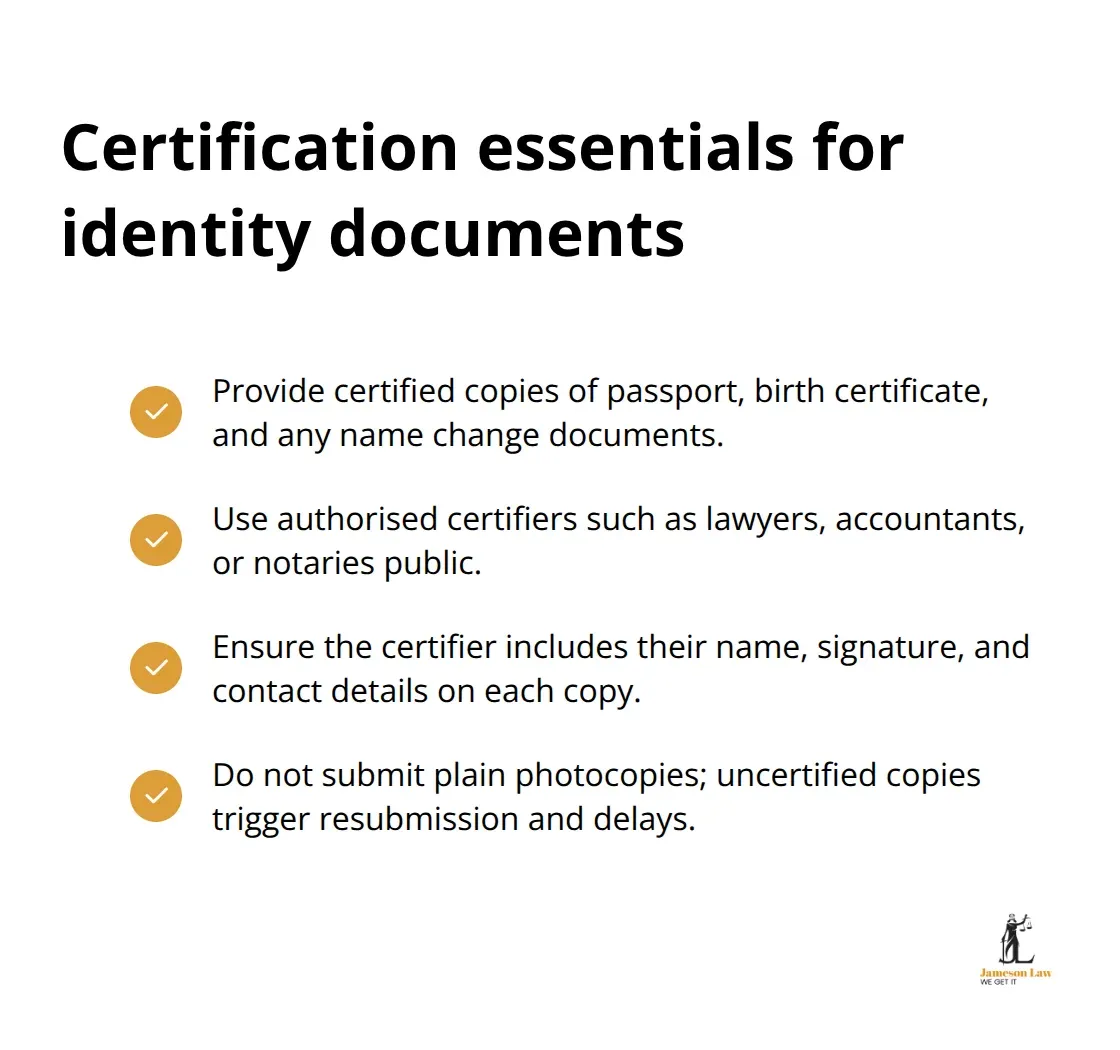
The Department of Home Affairs requires specific documents, and submitting incomplete or poorly organised files is one of the top reasons applications stall. Identity documents form the foundation, so you’ll need certified copies of your passport, birth certificate, and any name change documents if applicable. Certification matters more than most applicants realise. A standard photocopy won’t suffice. The Department of Home Affairs accepts certified copies from specific professionals including lawyers, accountants, or notaries public. Many applicants waste weeks resubmitting documents because they didn’t certify them correctly the first time.

Checklist of key certification requirements for identity documents in Australian migration applications - requirements for a successful migration application

Financial Records Demand Equal Attention

You must prove you have sufficient funds to support yourself and any dependants during your stay. The Department typically expects evidence of bank statements covering the last three to six months, proof of employment income, investment statements, or sponsorship declarations if someone else is funding your move. Vague financial documentation creates suspicion and invites requests for further evidence, extending your processing timeline significantly.

Financial documents need to be recent and unambiguous about who owns the money. Bank statements from six months ago won’t demonstrate you currently have the funds. If funds are held in a partner’s name or belong to a sponsor, you need statutory declarations explaining the relationship and confirming the money is available for your migration. Vague statements create doubt, and doubt leads to refusal.

Employment History and Qualifications Require Detailed Records

You must gather certified copies of your educational qualifications, any professional licences or registrations, and comprehensive work references from previous employers. If you’re claiming skilled migration points, your employment history must be specific and documented with dates, roles, and responsibilities clearly outlined. Generic references won’t cut it. The Department cross-checks employment claims with tax records and employer verification, so inconsistencies between your application and what employers can confirm lead to immediate rejection.

Certification Errors Create Preventable Delays

When documents are certified, the professional certifying them must verify they’re genuine and provide their name, signature, and contact details. Many applicants skip this step or use uncertified photocopies, forcing the Department to request resubmission. This single mistake can add four to eight weeks to your timeline. The professional certifying your documents carries responsibility for their authenticity, so the Department takes certification seriously and won’t accept poorly executed versions.

Once your documents are prepared and certified correctly, your attention shifts to the health and character assessments that run parallel to your application. These assessments operate on their own timeline and require advance planning to avoid bottlenecks later in the process.

Health and Character Assessments

Panel Doctors and Health Examination Requirements

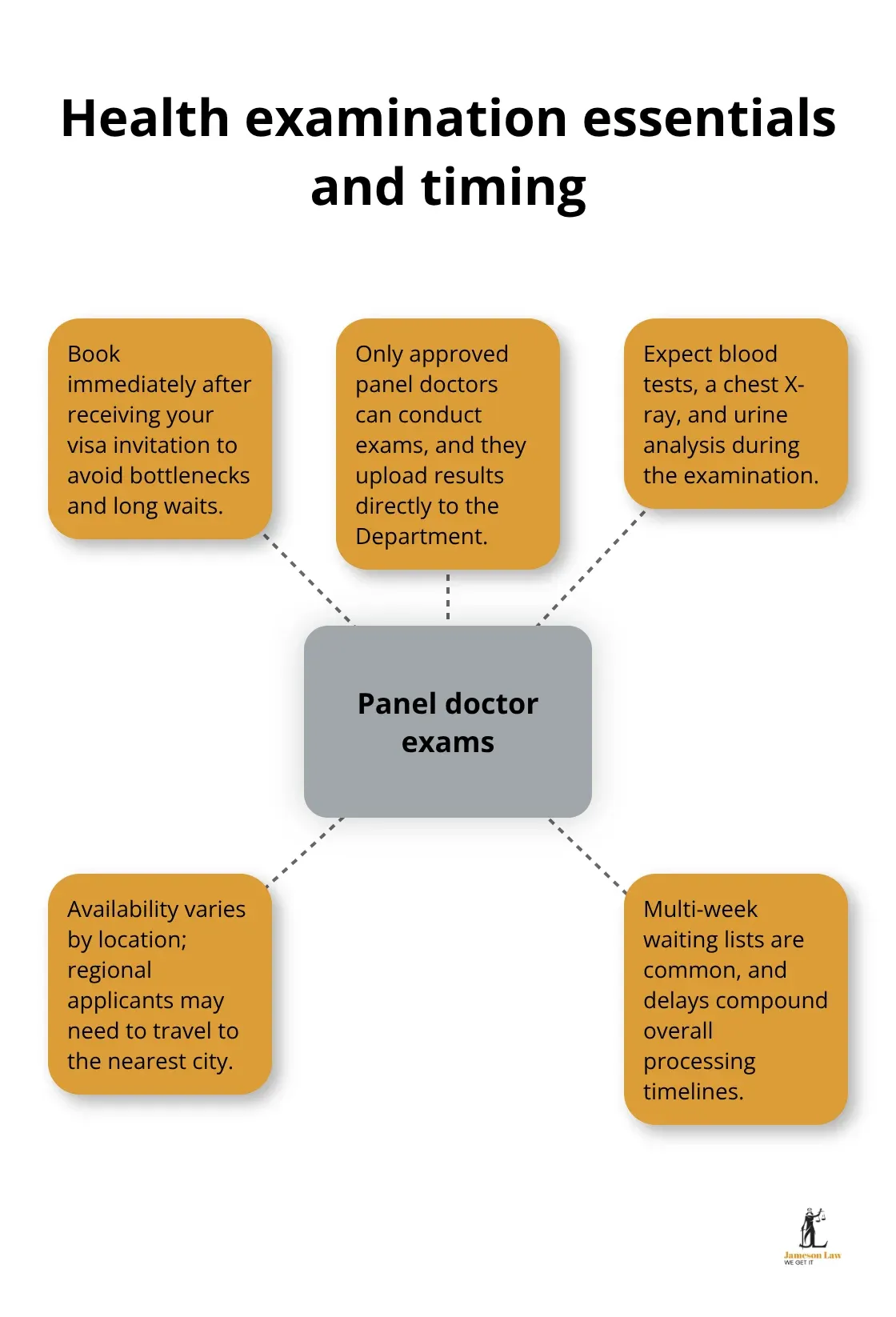
Health examinations and character checks run parallel to your document verification, and timing these correctly makes the difference between a smooth application and months of unnecessary delays. The Department of Home Affairs requires health assessments for most visa classes, and these aren’t simple check-ups. You’ll attend an approved panel doctor who conducts a thorough examination including blood tests, chest X-rays, and urine analysis. The panel doctor uploads results directly to the Department’s system, so you cannot simply request your results and submit them yourself.

Finding an approved panel doctor in your area matters more than applicants realise. The Department maintains a list of accredited doctors, but availability varies significantly by location. In regional areas, you may need to travel to the nearest city, and some panel doctors operate with multi-week waiting lists. Start your health assessment immediately after receiving your visa invitation to prevent this bottleneck. Many applicants delay booking their panel doctor appointment, then panic when they discover a six-week wait.

Hub-and-spoke visual showing panel doctor exams and timing tips for Australian visa health checks - requirements for a successful migration application

Police Clearance Certificates and Timing

Police clearance certificates and character references operate on their own timelines. You’ll need police clearance from every country where you’ve lived for more than six months as an adult, and obtaining these from overseas authorities can take weeks or months. Some countries process applications slowly, and requesting expedited processing often costs extra.

Start police clearance applications as soon as you know you’ll apply for migration. Don’t wait until after your visa invitation arrives. This advance planning prevents the situation where overseas processing delays hold up your entire application in the final stages.

Character References and Supporting Statements

For character references, the Department expects statements from people who know your character and can speak to your integrity, such as employers, community leaders, or professional colleagues. Generic references carry little weight. Your references need to be specific about how long they’ve known you, in what capacity, and provide concrete examples of your character and reliability.

Background Verification and Disclosure

Background verification extends beyond police checks. The Department cross-references your application against character concerns flagged in your health examination, police records, immigration history, and any previous visa refusals. Inconsistencies between your stated employment history and police records, or gaps in your timeline that cannot be explained, trigger additional scrutiny.

If you’ve had previous visa refusals, the Department reviews the original reasons and assesses whether your current application addresses those concerns. Transparency works better than omission here. If you’ve had minor offences or previous visa issues, address them upfront with clear explanations. This approach prevents the Department from discovering them later and rejecting your application outright. Once you’ve submitted your health assessments and character documentation, your focus shifts to understanding the visa application process itself and managing the timeline that follows submission.

Visa Application Process and Timeline

Lodging Your Application Through Official Channels

The Department of Home Affairs operates ImmiAccount and VEVO as the primary online portals for migration applications. Submitting through these systems ensures your application reaches the correct department with proper documentation tracking. Paper applications still exist, but they process slower and create higher rejection rates because physical documents get lost or misfiled. The Department’s online system automatically timestamps your submission, creates an application reference number, and sends immediate confirmation to your email. This confirmation serves as proof of lodgement, which matters if processing takes longer than expected and you need to demonstrate your application was submitted on time.

When you submit your application, every document must appear in the correct order and format. The Department specifies file size limits, acceptable formats like PDF or JPEG, and requires documents to be legible. Uploading blurry scans or documents in the wrong order forces the Department to request resubmission, adding four to twelve weeks to your timeline. Upload documents in the exact sequence the Department specifies on its checklist, and label each file clearly with the document type and date. This organisation prevents the Department from requesting clarification or resubmission.

Understanding Processing Times and Realistic Expectations

Processing times vary significantly depending on visa subclass and application complexity. General Skilled Migration visas like subclass 189 or 190 are updated monthly with indicative timeframes, though actual processing depends on application complexity. Employer-sponsored visas like subclass 186 or 482 can take six to nine months because employer verification and labour market testing add layers to the assessment. Regional visas such as subclass 491 sometimes process faster due to lower application volumes, but you cannot rely on this. The Department publishes processing time statistics regularly, and checking these figures before submitting helps set realistic expectations rather than assuming timeframes from someone else’s application.

Why Applications Stall in the Processing Queue

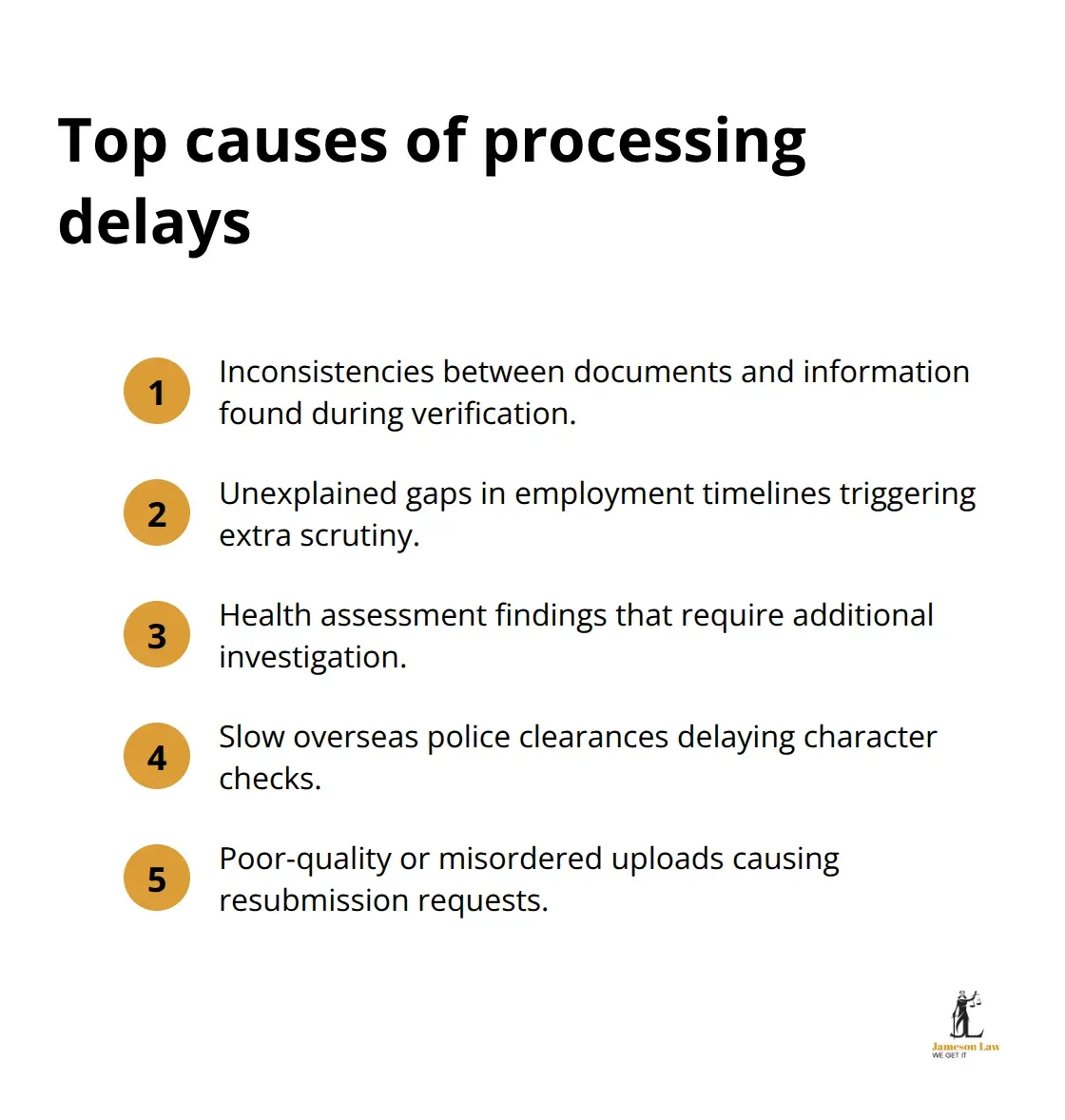
Applications sit in the processing queue longer than necessary when the Department identifies inconsistencies between your submitted documents and information it receives during verification. If your employment history claims you worked at a company for five years but tax records show only three years, the Department flags this discrepancy and requests explanation. This single inconsistency can add six to eight weeks while you compile statutory declarations and contact previous employers for clarification.

Compact list of common reasons Australian visa applications are delayed

The Department cross-references your application against multiple databases including tax records from the Australian Taxation Office, police records, and immigration history. Gaps in your employment timeline or unexplained periods of unemployment trigger additional scrutiny. If you’ve been unemployed, studying, or caring for family, document these periods explicitly in your application rather than leaving gaps. The Department interprets unexplained gaps as potential red flags and investigates further.

Health assessment delays also hold up processing. If your panel doctor reports findings requiring additional investigation (such as tuberculosis screening or further blood work), your application pauses until these results arrive. This process can extend your timeline by four to twelve weeks depending on the investigation required. Character assessment delays operate similarly. If police clearances from overseas take longer than expected, your entire application waits. Initiate all health and character assessments within two weeks of submitting your visa application rather than waiting for the Department to formally request them.

Common Rejection Patterns You Can Prevent

Applications fail for preventable reasons far more often than for genuine ineligibility. The Department refuses applications when applicants misrepresent their employment history, submit fraudulent documents, or fail to meet the genuine temporary entrant requirements. Misrepresentation doesn’t always mean deliberate dishonesty. If you claim work experience that cannot be verified through employment records or references, the Department treats this as misrepresentation and refuses your visa. This refusal also triggers a character concern that affects your eligibility for future visas.

Fraudulent documents result in immediate refusal and potential criminal referral. Applications have been rejected because applicants used forged educational certificates or fabricated employment references. These rejections carry consequences extending far beyond a single visa. The Department records fraudulent submissions and uses this history to refuse future applications.

Skills assessment mismatches cause rejections for skilled migration applicants. Matching your skills and credentials to the correct ANZSCO occupation code is crucial because all assessment criteria and visa eligibility depend on it. This happens when applicants choose the wrong assessing authority or submit insufficient documentation to the skills assessor. Selecting the correct assessing authority from the start prevents this costly mistake. The Department maintains a list of approved assessing authorities for each occupation, and choosing the wrong one means your assessment won’t be recognised for visa purposes.

Financial documentation rejections occur when applicants cannot demonstrate sufficient funds at the time of decision. Showing money in your account three months ago doesn’t prove you have it now. The Department requires recent bank statements dated within the last month of its decision. If you’ve spent your savings between application and decision, you fail the financial requirement even if you had sufficient funds when you applied. Maintaining your funds throughout the processing period matters as much as proving you have them initially.

Final Thoughts

A successful migration application rests on three foundations: accurate documentation, timely health and character assessments, and honest disclosure throughout your submission. Most rejections stem from preventable mistakes rather than genuine ineligibility-certification errors, unexplained employment gaps, and delayed health assessments extend your timeline by months. Start your health examination and police clearance immediately after visa invitation to prevent these bottlenecks.

The requirements for a successful migration application demand attention to detail and advance planning. Organise your documents in the exact sequence the Department specifies, upload legible files in correct formats, and maintain financial records that prove your funds exist at the time of decision. Monitor your ImmiAccount regularly for Department requests and respond within the specified timeframes, as delays in responding compound processing delays and can result in refusal.

We at Jameson Law understand that migration applications involve complex requirements and tight timelines. If you’re uncertain about any aspect of your application, professional migration assistance can prevent costly mistakes and strengthen your submission.

Speak to an Expert Lawyer today

Laywers-Jameson-Law-The-best-law-firm-in-Sydney- Sydney Lawyers - Sydney
BOOK NOW

WE'RE IN IT TO WIN IT

Book your consultation

Book Now
Book Now Mobile 06 02 2025

This form submission is encrypted and secured to ensure your information remains confidential.

What our Clients

Related Publications:

What our clients say

.

Jameson Law - Voted the Best Law firm in Sydney Award

Legal Answers ... In Short

We're here to help

Our mission is to ensure our client matters are resolved successfully every time. Success to us does not simply involve winning, but moreover ensuring we take the most feasible, economic and stress-free path to help our clients achieve their goals. We fight hard for our clients, and always go by the motto: we’re in it to win it.

Jameson Law - Best Law Firm in Sydney

WE'RE IN IT TO WIN IT

Book your consultation

Call us now on (02) 8806 0866 or fill out the form below

Book Now Mobile

This form submission is encrypted and secured to ensure your information remains confidential.

WE'RE IN IT TO WIN IT

Book your consultation

Book Now Mobile 06 02 2025
lock

This form submission is encrypted and secured to ensure your information remains confidential.

Our Sydney Offices

Offices Parramatta and Sydney Jameson Law
Parramatta CBD - Head Office
jameson Law - Blacktown
jameson Law - Liverpool Office
Jameson Law - Bankstown
Court Houses We Frequent Jameson Law

Court Houses We Frequent

Balmain Local Court

Registry: Monday to Friday, 9:00am to 4:30pm

Bankstown Local Court

Court Operating Hours: 9:30am-4:30pm

Blacktown Local Court

Registry Hours: 9:00 – 4:30
Telephone Hours: 8:30 -4:30
Days open: Mon-Fri

Burwood Local Court

Registry Hours: 9:00 – 4:30
Telephone Hours: 8:30 – 4:30
Days open: Mon – Fri

Campbell Local Court

Registry Hours: 9:00 – 4:30
Telephone Hours: 8:30 – 4:30
Days open: Mon – Fri

Central Local Court

Registry Hours: 9:00 – 1:00 and 2:00 – 4:30
Telephone Hours: 8:30 – 4:30

Downing Local Court

Registry Hours: 9:00 – 1:00 and 2:00 – 4:30
Telephone Hours: 8:30 – 4:30

Wollongong Local Court

Registry Hours: 9:00 – 1:00 and 2:00 – 4:30
Telephone Hours: 8:30 – 4:30

Fairfield Local Court

Registry Hours: 9:00 – 1:00 and 2:00 – 4:30
Telephone Hours: 8:30 – 4:30

Hornsby Local Court

Registry Hours: 9:00 – 1:00 and 2:00 – 4:30
Telephone Hours: 8:30 – 4:30

Liverpool Local Court

Registry Hours: 9:00 – 1:00 and 2:00 – 4:30
Telephone Hours: 8:30 – 4:30

Manly Local Court

Registry Hours: 9:00 – 1:00 and 2:00 – 4:30
Telephone Hours: 8:30 – 4:30

Newtown Local Court

Registry Hours: 9:00 – 1:00 and 2:00 – 4:30
Telephone Hours: 8:30 – 4:30

Parramatta Local Court

Registry Hours: 9:00 – 1:00 and 2:00 – 4:30
Telephone Hours: 8:30 – 4:30

Penrith Local Court

Registry Hours: 9:00 – 1:00 and 2:00 – 4:30
Telephone Hours: 8:30 – 4:30

Sutherland Local Court

Registry Hours: 9:00 – 1:00 and 2:00 – 4:30
Telephone Hours: 8:30 – 4:30

Waverley Local Court

Registry Hours: 9:00 – 1:00 and 2:00 – 4:30
Telephone Hours: 8:30 – 4:30

Windsor Local Court

Registry Hours: 9:00 – 1:00 and 2:00 – 4:30
Telephone Hours: 8:30 – 4:30

Wollongong Local Court

Registry Hours: 9:00 – 1:00 and 2:00 – 4:30
Telephone Hours: 8:30 – 4:30

Downing Centre District Court

Registry Hours: 9:00 – 4:30
Telephone Hours: 8:30 – 4:30
Days open: Mon – Fri

Parramatta District Court

Registry Hours: 9:00 – 4:30
Days open: Mon-Fri

Penrith District Court

Registry Hours: 9:00 – 4:30
Days open: Mon-Fri

Campbelltown District Court

Registry Hours: 9:00 – 4:30
Days open: Mon – Fri

Liverpool District Court

Registry Hours: 9:00 – 4:30
Days open: Mon – Fri

Wollongong District Court

Registry Hours: 9:00 – 1:00 and 2:00 – 4:30
Telephone Hours: 8:30 – 4:30

Supreme Court New South Wales

Registry Hours: 9:00 AM – 4:30 PM
Telephone Hours: 8:30 AM – 4:30 PM
Days Open: Monday to Friday

Federal Circuit and Family Court of Australia

Registry Hours: 9:00 AM – 4:30 PM
Telephone Hours: 8:30 AM – 5:00 PM
Days Open: Monday to Friday

Federal Court

Monday to Friday, 8:30 AM – 4:30 PM

High Court

Monday to Friday, 8:30 AM – 5:00 PM

Children’s Court of New South Wales

Registry Hours: 9:00 AM – 4:30 PM
Telephone Hours: 8:30 AM – 4:30 PM
Days Open: Monday to Friday

Coroner’s Court New South Wales

Registry Hours: 9:00 AM – 4:30 PM
Telephone Hours: 8:30 AM – 4:30 PM
Days Open: Monday to Friday

Industrial Relations Commission of New South Wales

Registry Hours: 9:00 AM – 4:30 PM
Telephone Hours: 8:30 AM – 4:30 PM
Days Open: Monday to Friday

Land and Environment Court of New South Wales

Registry Hours: 9:00 AM – 4:30 PM
Telephone Hours: 8:30 AM – 4:30 PM
Days Open: Monday to Friday

WE'RE IN IT TO WIN IT

Book your consultation

Book Now
Book Now Mobile 06 02 2025
lock

This form submission is encrypted and secured to ensure your information remains confidential.