PUBLICATION

Property Conveyancing Steps NSW: From Offer to Settlement

"Learn the essential property conveyancing steps in NSW from initial offer through to settlement with our practical guide."
Property Conveyancing Steps NSW: From Offer to Settlement

Buying property in NSW involves multiple steps, legal requirements, and important decisions that can feel overwhelming without proper guidance. At Jameson Law, we’ve helped countless clients navigate property conveyancing steps NSW with confidence and clarity.

This guide walks you through each stage, from submitting your offer through to settlement day, so you know exactly what to expect and when.

What Conveyancing Actually Involves

Understanding the Core Process

Conveyancing transfers property ownership from one person to another, and it’s far more than just paperwork. NSW Fair Trading requires that a licensed conveyancer or solicitor prepare your contract of sale before the property is even marketed, which tells you how central this process is to protecting your interests. The conveyancing process moves through four distinct stages: initial contract review, exchange of contracts, pre-settlement preparation, and settlement itself. Most transactions take 30 to 90 days from offer to settlement, though this varies depending on how quickly documents are prepared, your finance is approved, and any title issues are resolved.

You’ll work with either a licensed conveyancer or a solicitor, and both carry professional indemnity insurance to protect you if something goes wrong. The key difference is that conveyancers specialise specifically in property transactions and identifying your obligations, while solicitors handle broader legal matters. Many buyers try to save money by reviewing contracts themselves, but this creates personal liability if you miss something critical like an unregistered easement or a missing disclosure.

Costs You Need to Know

The cost of conveyancing typically ranges from $800 to $2,000 depending on property value and complexity, plus additional costs for searches, inspections, and stamp duty. Stamp duty alone can be substantial-for a $750,000 property in NSW, you’d pay around $31,000. The top cause of conveyancing delays is an incomplete or missing contract of sale, often missing the property’s legal description, correct vendor information, unsigned pages, or outdated council certificates. Start the finance process early; secure pre-approval before you even make an offer, and have your pay slips, bank statements, and proof of deposit ready immediately.

The Professionals Who Handle Your Transaction

Your conveyancer or solicitor handles the legal side, conducting title searches to identify easements or caveats that could affect your use of the property, and checking for government interests like Section 10.7 certificates from your local council. Your real estate agent or the seller’s agent coordinates timing and negotiations but doesn’t provide legal advice. Your lender’s settlement team ensures mortgage funds arrive on time and handles discharge of any existing mortgages.

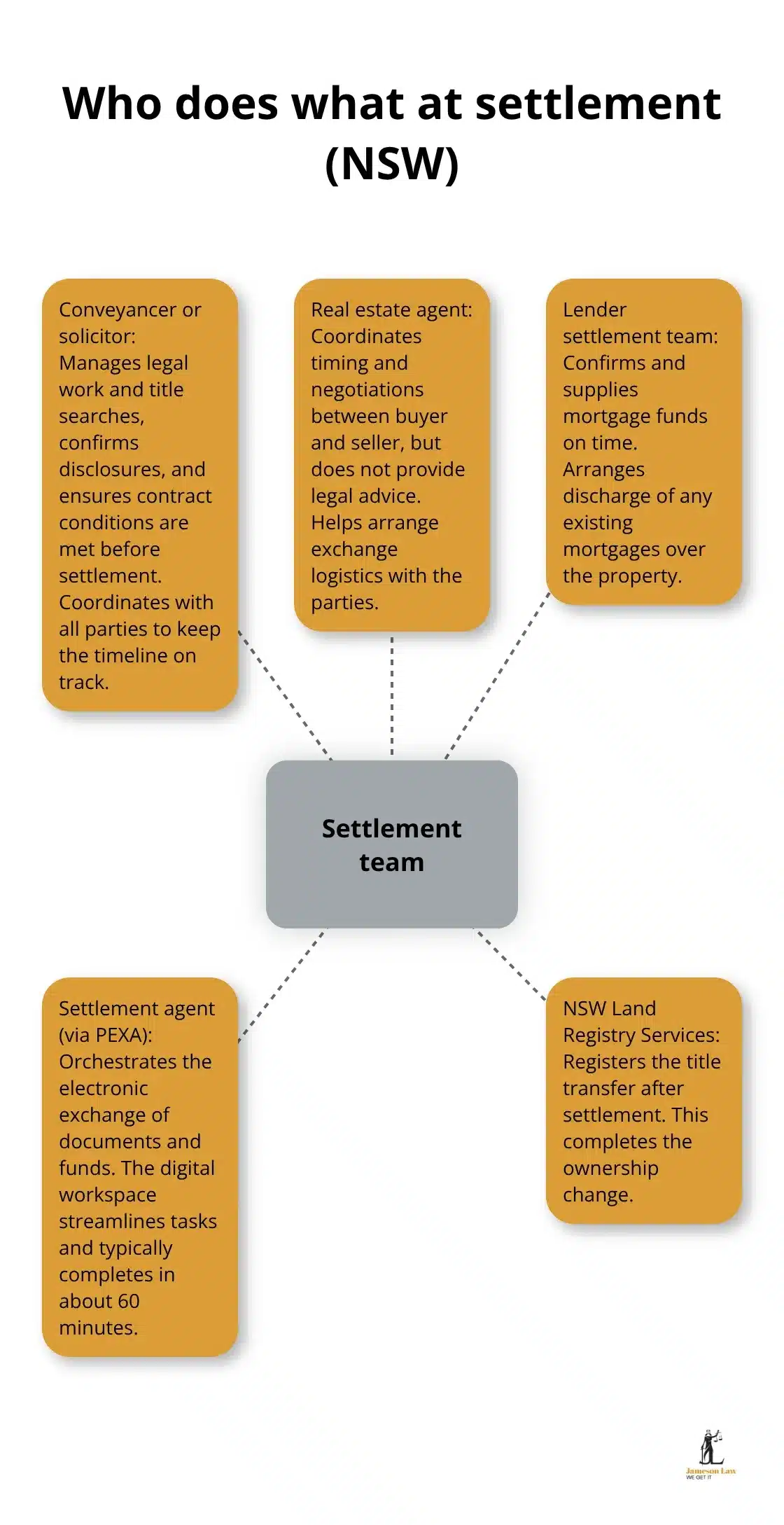
The settlement agent, usually employed through PEXA (the Electronic Lodgment Network), coordinates the actual exchange of documents and funds electronically on settlement day, which typically takes around 60 minutes. NSW Land Registry Services then registers the title transfer after settlement, completing your ownership change. Electronic settlement through PEXA has made the process significantly faster and more secure than the old cheque-based system, eliminating delays from lost documents or late payments.

Roles involved in NSW property settlement using PEXA

Coordination Across Multiple Parties

If you’re buying and selling simultaneously, coordination between all parties becomes even more critical because your sale proceeds must arrive in time to fund your purchase. This is where a responsive conveyancer who communicates regularly with all parties makes the difference between a smooth settlement and a delayed one. You should order building and pest inspections immediately after your offer is accepted, not weeks later, because delays here cascade into delays at settlement. For apartments, obtain a strata report early to assess the building’s financial health and identify any major issues that might affect settlement terms.

With these professionals and processes in place, you’re ready to move forward with your offer and understand what happens next.

Making Your Offer and Understanding Contract Terms

What the Contract of Sale Actually Contains

Submitting an offer on a NSW property requires strategy, not just price. The contract of sale is the binding document that outlines everything-property details, deposit amount, settlement date, and what’s included or excluded from the sale. NSW Fair Trading requires a licensed conveyancer or solicitor to prepare this contract before marketing even begins, which means you review a legally sound document from the start. Request the contract as early as possible from the seller or agent to allow sufficient review time; rushing through this stage is where buyers make costly mistakes.

The contract must contain specific items: a copy of the title search, registered plan, any dealings recorded on title such as easements, a drainage diagram, and a current Zoning Certificate issued by your local council. For properties with a swimming or spa pool, the seller must attach a valid certificate of compliance issued within the past three years, plus evidence the pool is registered on the NSW Swimming Pool Register. When you review the contract, check the deposit amount and due date, settlement details, and special conditions like whether the home will be vacant or tenanted. Verify that inclusions are listed-floor coverings, appliances, and outdoor items are common sources of dispute if not specified in writing.

Why Professional Review Protects You

You can review the contract yourself, but this creates personal liability if you miss something critical. A licensed conveyancer specialises in identifying obligations, explaining clauses, and helping you make an informed decision without the risk of personal liability. The conveyancer spots unregistered easements, missing disclosures, and title issues that affect your use of the property. This professional protection is worth far more than the cost of their fees.

The Cooling-Off Period and Your Rights

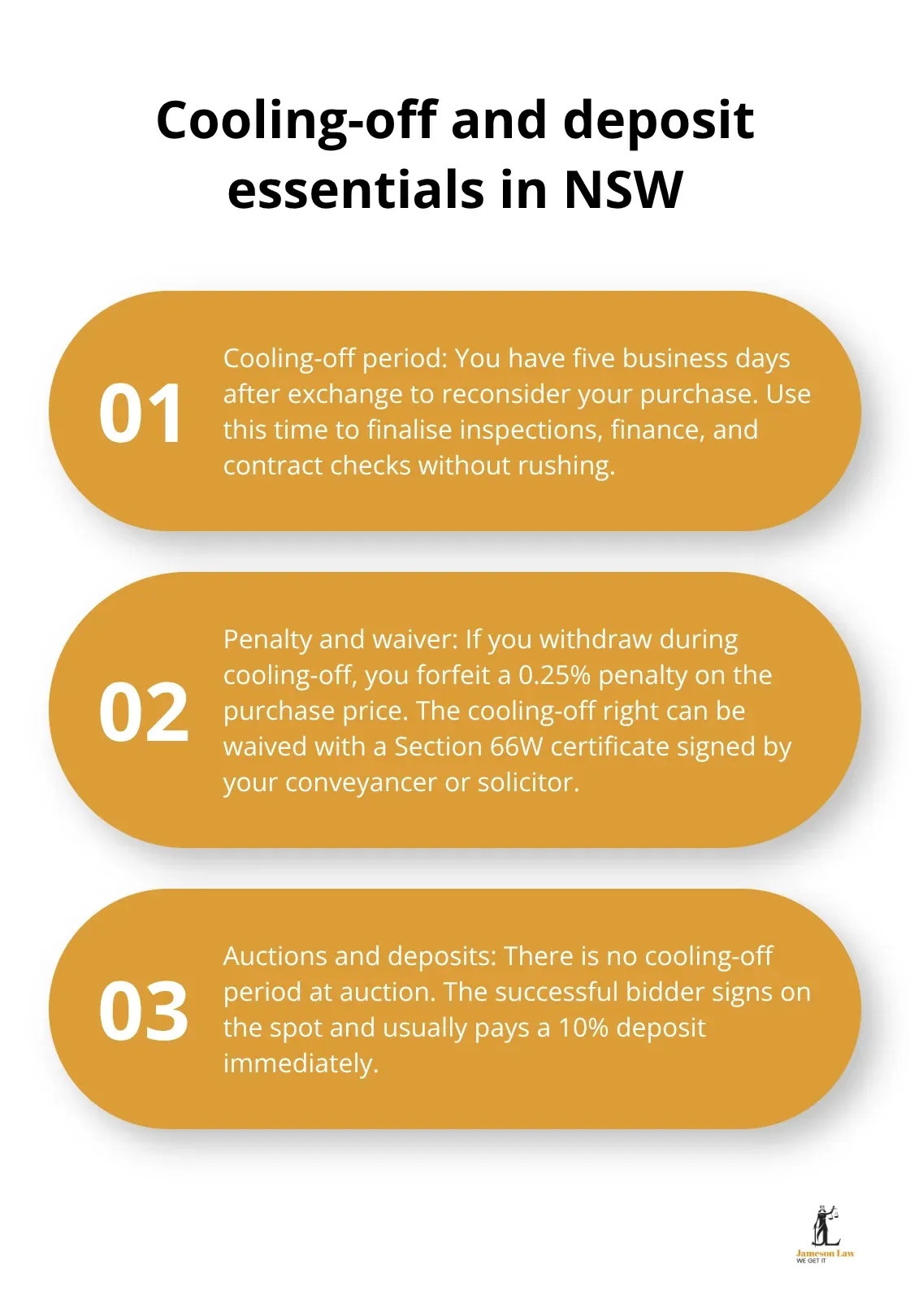
NSW Fair Trading grants you five business days after exchange of contracts to reconsider your purchase. However, this right comes with a cost: if you withdraw during the cooling-off period, you forfeit a 0.25% penalty on the purchase price. The cooling-off period can be waived through a Section 66W certificate signed by your conveyancer or solicitor. In auction sales, there is no cooling-off period at all-the successful bidder signs the contract and pays the deposit on the spot, usually 10% of the purchase price.

Key cooling-off rules, penalties and auction differences for NSW property purchases - property conveyancing steps NSW

Deposits and Exchange of Contracts

At exchange of contracts, you typically pay a 10% deposit if cooling-off applies; if you use the cooling-off period, you may pay just 0.25% at exchange with the balance due before the cooling-off period ends. This deposit sits in trust and applies to your purchase price at settlement. Exchange itself is the legally binding moment when two signed copies of the contract are exchanged, usually electronically through the PEXA system. If your agent arranges exchange, they must provide both parties with copies within two business days.

Timeline From Exchange to Settlement

Settlement typically occurs about six weeks after exchange, though this timeframe can be negotiated between parties and varies depending on finance approval speed and title issues. Once exchange occurs, your conveyancer begins pre-settlement preparation-ordering building and pest inspections, conducting final title searches, and coordinating with your lender to confirm mortgage funds will arrive on time.

Searches, Inspections and Settlement Preparation

Title Searches and What They Reveal

After exchange of contracts, you have approximately six weeks before settlement, and this window is critical for uncovering problems that could derail your purchase or affect its value. Your conveyancer will conduct title searches to identify easements, caveats, or unregistered interests that affect your use of the property, and they’ll check for government interests through Section 10.7 certificates from your local council. These searches reveal whether previous owners registered any restrictions on the land, whether utilities companies hold easements across the property, or whether the local council has flagged any planning issues. Your conveyancer conducts a final title search days before settlement to confirm no new caveats or interests have been registered since exchange.

Building, Pest and Strata Inspections

You must order building and pest inspections immediately after exchange, not weeks later, because delays cascade directly into settlement delays. Building inspections should be thorough and conducted by a licensed inspector who checks structural integrity, roofing, walls, plumbing, electrical systems, and evidence of water damage or pest activity. Pest inspections specifically look for termites, borers, and other damaging insects that can cost thousands to treat. For apartments, obtain a strata report early to assess the building’s financial health, identify any major issues, and understand what special levies or structural problems might affect settlement terms or your willingness to proceed. A strata report typically costs $200 to $400 and reveals whether the building’s sinking fund is adequately maintained or if owners face unexpected costs.

Negotiating Defects Before Settlement

If either inspection reveals defects, you have a limited window to negotiate repairs or price reductions before settlement becomes locked in. Many buyers delay these inspections thinking they can negotiate after settlement, but once settlement occurs, the property is yours with all its problems. If you’re buying a new home, confirm all works are finished, appliances are installed, and consider a defects inspection if you’re uncertain about construction quality. Your conveyancer will advise you on which defects are negotiable and which ones fall within normal wear and tear.

Final Walkthrough and Settlement Adjustments

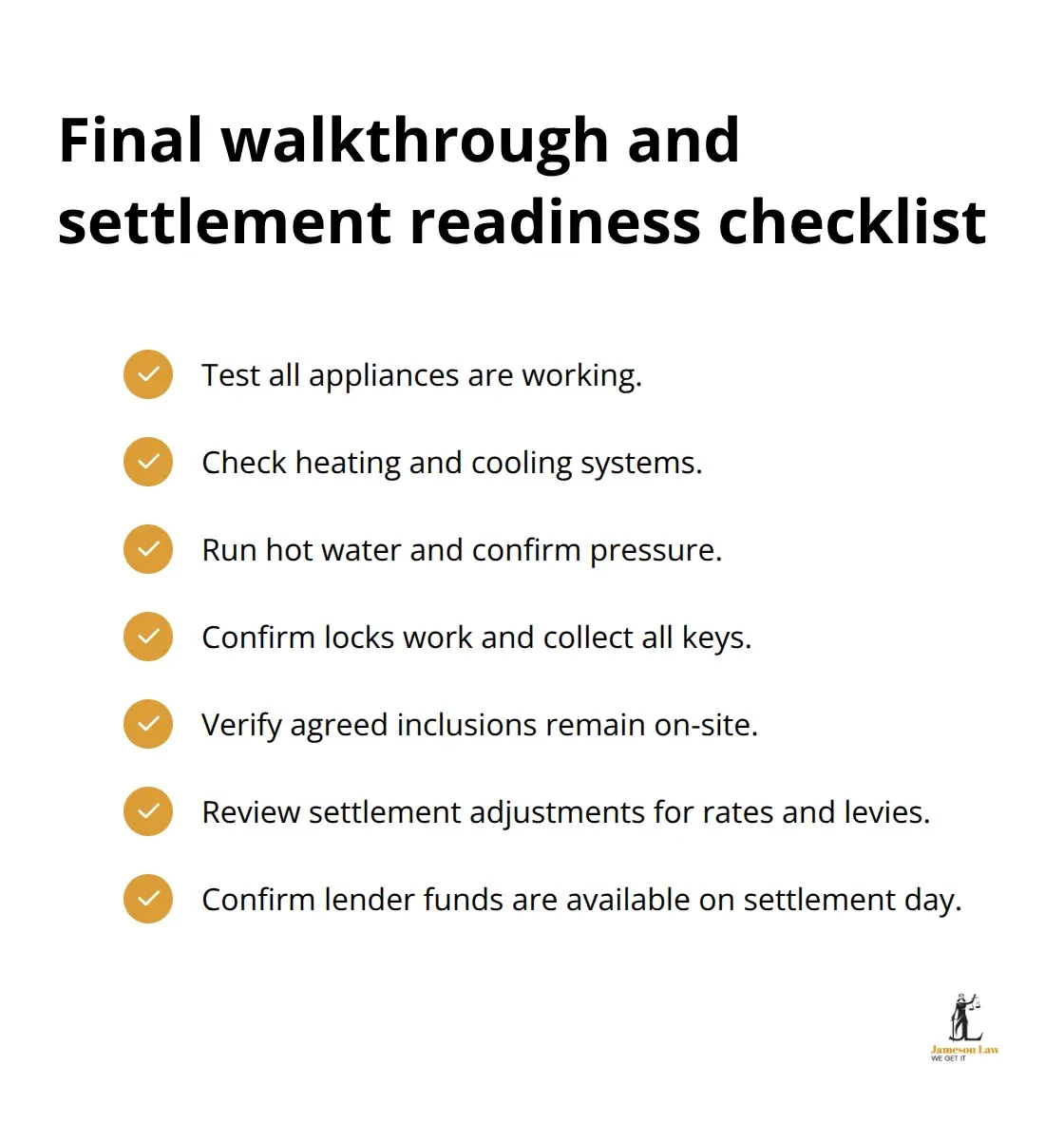
You should arrange a final walkthrough on the morning of settlement to verify the property remains in the same condition as when contracts were exchanged, checking appliances, heating and cooling systems, hot water, locks, keys, and that agreed inclusions like floor coverings or outdoor fixtures remain. Settlement adjustments for council rates, water rates, land tax, and body corporate levies are calculated by your conveyancer and appear on your settlement statement, so review these figures several days before settlement to confirm accuracy and ensure your available funds cover the adjusted amount. Coordinate with your lender to confirm mortgage funds will be available on settlement day, as delayed fund transfers are a common cause of settlement postponement.

Checklist to confirm property condition and funds before NSW settlement - property conveyancing steps NSW

Final Thoughts

The property conveyancing steps NSW follows a clear path from your initial offer through to settlement day, but success depends on staying organised and avoiding common pitfalls. Rushing through contract review to save money, delaying building and pest inspections until weeks after exchange, and failing to coordinate with your lender early enough to confirm mortgage funds will arrive on time are the mistakes we see buyers make most often. Another frequent error is not conducting a final title search days before settlement, which occasionally reveals new caveats or interests registered after exchange.

After settlement completes and you receive the keys, you need to notify electricity and gas providers of the ownership change, arrange home and contents insurance from the settlement date forward, and retain all contracts and certificates for your records. Your lender typically registers your mortgage with NSW Land Registry Services automatically, though you should confirm this has occurred. Keep your settlement statement and title documents in a safe place, as you will need them for future refinancing, renovations requiring council approval, or if you sell the property later.

If you are navigating property conveyancing in NSW and want professional guidance tailored to your situation, Jameson Law provides practical legal advice on conveyancing and property matters across New South Wales. An experienced conveyancer or solicitor in your corner from offer through settlement removes stress and protects your interests at every stage.

Speak to an Expert Lawyer today

Laywers-Jameson-Law-The-best-law-firm-in-Sydney- Sydney Lawyers - Sydney
BOOK NOW

WE'RE IN IT TO WIN IT

Book your consultation

Book Now
Book Now Mobile 06 02 2025

This form submission is encrypted and secured to ensure your information remains confidential.

What our Clients

Related Publications:

What our clients say

.

Jameson Law - Voted the Best Law firm in Sydney Award

Legal Answers ... In Short

We're here to help

Our mission is to ensure our client matters are resolved successfully every time. Success to us does not simply involve winning, but moreover ensuring we take the most feasible, economic and stress-free path to help our clients achieve their goals. We fight hard for our clients, and always go by the motto: we’re in it to win it.

Jameson Law - Best Law Firm in Sydney

WE'RE IN IT TO WIN IT

Book your consultation

Call us now on (02) 8806 0866 or fill out the form below

Book Now Mobile

This form submission is encrypted and secured to ensure your information remains confidential.

WE'RE IN IT TO WIN IT

Book your consultation

Book Now Mobile 06 02 2025
lock

This form submission is encrypted and secured to ensure your information remains confidential.

Our Sydney Offices

Offices Parramatta and Sydney Jameson Law
Parramatta CBD - Head Office
jameson Law - Blacktown
jameson Law - Liverpool Office
Jameson Law - Bankstown
Court Houses We Frequent Jameson Law

Court Houses We Frequent

Balmain Local Court

Registry: Monday to Friday, 9:00am to 4:30pm

Bankstown Local Court

Court Operating Hours: 9:30am-4:30pm

Blacktown Local Court

Registry Hours: 9:00 – 4:30
Telephone Hours: 8:30 -4:30
Days open: Mon-Fri

Burwood Local Court

Registry Hours: 9:00 – 4:30
Telephone Hours: 8:30 – 4:30
Days open: Mon – Fri

Campbell Local Court

Registry Hours: 9:00 – 4:30
Telephone Hours: 8:30 – 4:30
Days open: Mon – Fri

Central Local Court

Registry Hours: 9:00 – 1:00 and 2:00 – 4:30
Telephone Hours: 8:30 – 4:30

Downing Local Court

Registry Hours: 9:00 – 1:00 and 2:00 – 4:30
Telephone Hours: 8:30 – 4:30

Wollongong Local Court

Registry Hours: 9:00 – 1:00 and 2:00 – 4:30
Telephone Hours: 8:30 – 4:30

Fairfield Local Court

Registry Hours: 9:00 – 1:00 and 2:00 – 4:30
Telephone Hours: 8:30 – 4:30

Hornsby Local Court

Registry Hours: 9:00 – 1:00 and 2:00 – 4:30
Telephone Hours: 8:30 – 4:30

Liverpool Local Court

Registry Hours: 9:00 – 1:00 and 2:00 – 4:30
Telephone Hours: 8:30 – 4:30

Manly Local Court

Registry Hours: 9:00 – 1:00 and 2:00 – 4:30
Telephone Hours: 8:30 – 4:30

Newtown Local Court

Registry Hours: 9:00 – 1:00 and 2:00 – 4:30
Telephone Hours: 8:30 – 4:30

Parramatta Local Court

Registry Hours: 9:00 – 1:00 and 2:00 – 4:30
Telephone Hours: 8:30 – 4:30

Penrith Local Court

Registry Hours: 9:00 – 1:00 and 2:00 – 4:30
Telephone Hours: 8:30 – 4:30

Sutherland Local Court

Registry Hours: 9:00 – 1:00 and 2:00 – 4:30
Telephone Hours: 8:30 – 4:30

Waverley Local Court

Registry Hours: 9:00 – 1:00 and 2:00 – 4:30
Telephone Hours: 8:30 – 4:30

Windsor Local Court

Registry Hours: 9:00 – 1:00 and 2:00 – 4:30
Telephone Hours: 8:30 – 4:30

Wollongong Local Court

Registry Hours: 9:00 – 1:00 and 2:00 – 4:30
Telephone Hours: 8:30 – 4:30

Downing Centre District Court

Registry Hours: 9:00 – 4:30
Telephone Hours: 8:30 – 4:30
Days open: Mon – Fri

Parramatta District Court

Registry Hours: 9:00 – 4:30
Days open: Mon-Fri

Penrith District Court

Registry Hours: 9:00 – 4:30
Days open: Mon-Fri

Campbelltown District Court

Registry Hours: 9:00 – 4:30
Days open: Mon – Fri

Liverpool District Court

Registry Hours: 9:00 – 4:30
Days open: Mon – Fri

Wollongong District Court

Registry Hours: 9:00 – 1:00 and 2:00 – 4:30
Telephone Hours: 8:30 – 4:30

Supreme Court New South Wales

Registry Hours: 9:00 AM – 4:30 PM
Telephone Hours: 8:30 AM – 4:30 PM
Days Open: Monday to Friday

Federal Circuit and Family Court of Australia

Registry Hours: 9:00 AM – 4:30 PM
Telephone Hours: 8:30 AM – 5:00 PM
Days Open: Monday to Friday

Federal Court

Monday to Friday, 8:30 AM – 4:30 PM

High Court

Monday to Friday, 8:30 AM – 5:00 PM

Children’s Court of New South Wales

Registry Hours: 9:00 AM – 4:30 PM
Telephone Hours: 8:30 AM – 4:30 PM
Days Open: Monday to Friday

Coroner’s Court New South Wales

Registry Hours: 9:00 AM – 4:30 PM
Telephone Hours: 8:30 AM – 4:30 PM
Days Open: Monday to Friday

Industrial Relations Commission of New South Wales

Registry Hours: 9:00 AM – 4:30 PM
Telephone Hours: 8:30 AM – 4:30 PM
Days Open: Monday to Friday

Land and Environment Court of New South Wales

Registry Hours: 9:00 AM – 4:30 PM
Telephone Hours: 8:30 AM – 4:30 PM
Days Open: Monday to Friday

WE'RE IN IT TO WIN IT

Book your consultation

Book Now
Book Now Mobile 06 02 2025
lock

This form submission is encrypted and secured to ensure your information remains confidential.