A bridging visa keeps you in Australia legally while your permanent visa application is being processed. It’s the safety net between your current visa expiring and a decision on your next visa.
At Jameson Law, we’ve helped hundreds of people navigate bridging visa requirements in Australia. Understanding which type suits your situation and what documents you need makes the process straightforward.
What a Bridging Visa Actually Does
A bridging visa maintains your legal status while you transition between substantive visas. The Department of Home Affairs administers five types, each designed for different circumstances. The key point is this: a bridging visa is not a path to permanent residency, and it’s not a visa you want to hold longer than necessary. It exists solely to keep you lawful while something else is being processed or decided. If your current visa expires and you haven’t applied for another visa, you become an unlawful non-citizen. That status can trigger detention and removal from Australia, and ineligibility for future visas for years. The cost of removal is also your responsibility. A bridging visa prevents this situation by maintaining your lawful status during the gap between visas.
When you actually need a bridging visa
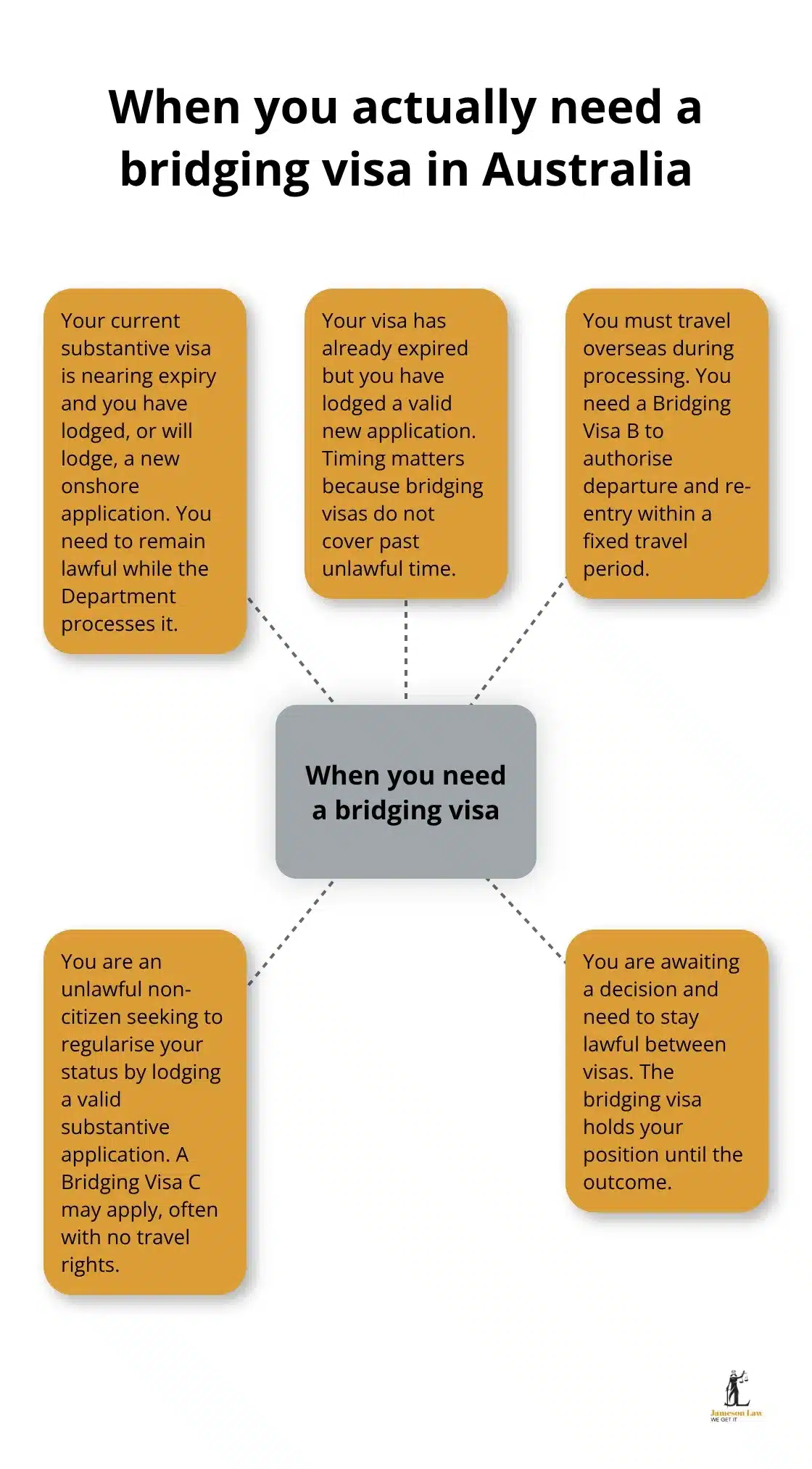
You need a bridging visa when your current substantive visa is about to expire and you want to stay in Australia while a new visa application is being processed. The most common scenario involves lodging a permanent migration application while still holding a temporary visa. If you’re on a skilled migration visa or student visa expiring soon, you cannot simply wait for your new application to be decided without a bridging visa in place. Another situation arises when your visa has already expired but you’ve lodged a valid application. The Department of Home Affairs won’t grant a bridging visa retroactively to cover time you’ve already spent unlawfully, so timing matters. You also need a bridging visa if you want to travel overseas during processing. Your original visa may not let you re-enter Australia, so a Bridging Visa B authorises travel and re-entry. Without it, leaving Australia while your application is pending can mean you cannot get back in.

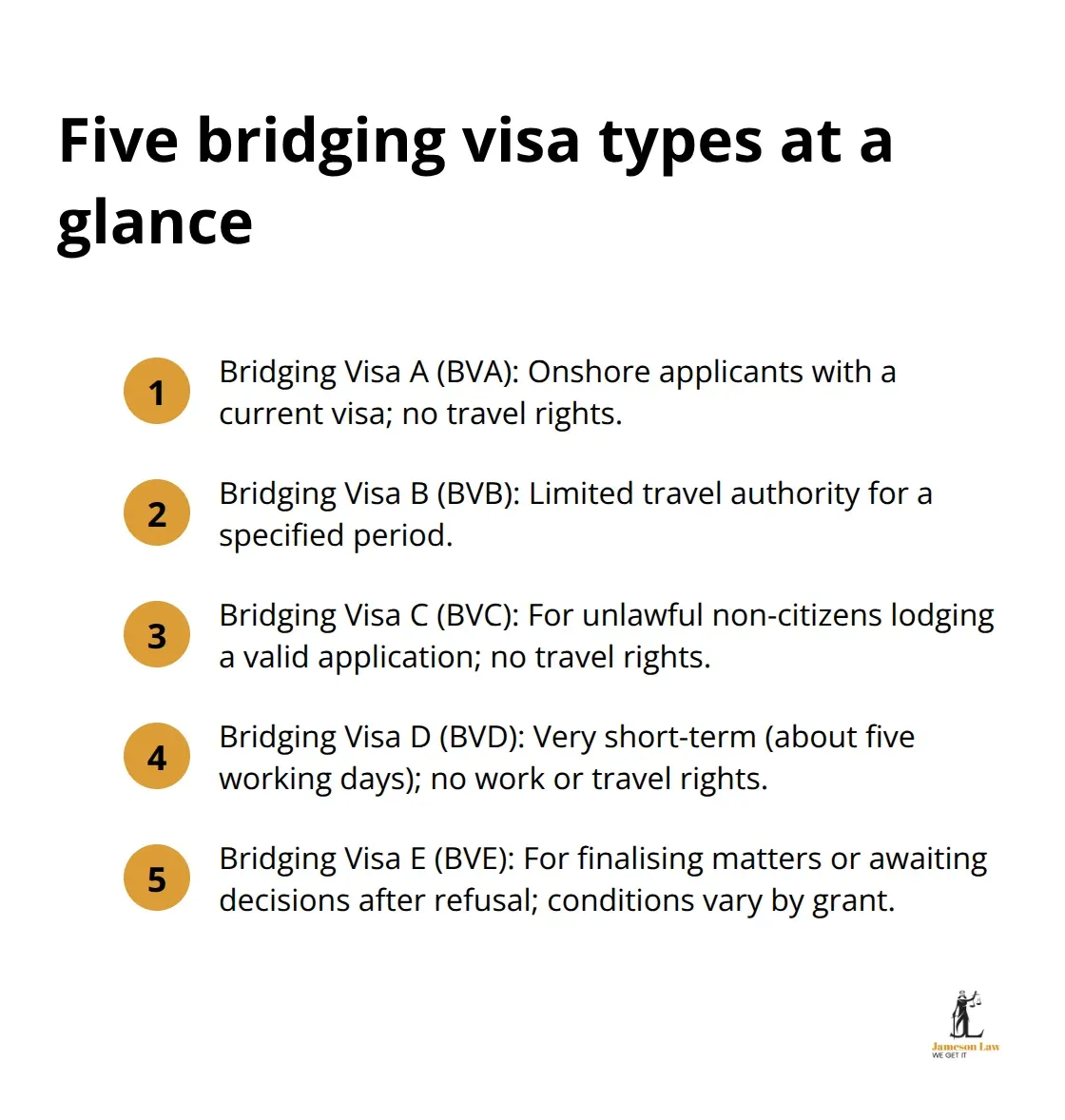
The five bridging visa types each address different needs: Bridging Visa A for onshore applicants with a current visa, Bridging Visa B for travel, Bridging Visa C for unlawful non-citizens, Bridging Visa D for when your visa has expired but you’re applying for something new, and Bridging Visa E for finalising your immigration matter after a decision has been made or while you’re waiting for one.
How bridging visas differ from your main visa
A substantive visa is any visa that isn’t a bridging visa, and it’s what you’re actually trying to obtain. Substantive visas come with defined rights: work entitlements, study permissions, travel rights, and a set expiry date. A bridging visa provides none of these automatically. Your bridging visa conditions depend on the visa type and your specific circumstances. A Bridging Visa A typically grants no travel rights, so leaving Australia means losing that visa. A Bridging Visa B grants travel rights for a limited period. A Bridging Visa C for unlawful non-citizens also has no travel rights. Most importantly, bridging visas are temporary holding positions. The Department of Home Affairs processes your substantive visa application while you’re on a bridging visa, but the bridging visa itself never becomes permanent. If your substantive application is refused, your bridging visa ends immediately. If it’s approved, you transition to your substantive visa.
Why bridging visas don’t strengthen your case
Many people mistakenly think holding a bridging visa for an extended period strengthens their case or gives them rights they don’t have. It doesn’t. The visa itself is purely administrative. Your rights, your ability to work, your ability to travel, and your pathway forward all depend on what substantive visa you’re pursuing and whether that application succeeds. The bridging visa simply holds your position while the Department of Home Affairs assesses your substantive application. A longer bridging visa period doesn’t improve your chances of approval. What matters is the strength of your substantive visa application itself-your qualifications, your circumstances, and how well you meet the criteria for the visa you’re seeking. Understanding this distinction helps you focus on what actually counts: preparing a strong substantive application rather than relying on the bridging visa to do the work for you.
Types of Bridging Visas Available in Australia
Bridging Visa A: The automatic option for onshore applicants
Bridging Visa A is the most common type you’ll encounter. The Department of Home Affairs automatically grants a BVA when you lodge another substantive visa application while still holding a current substantive visa onshore. You don’t need to apply separately-it happens as part of your substantive application process. The critical limitation is travel. A BVA grants no travel rights, which means if you leave Australia, your BVA ceases immediately and you cannot re-enter under that visa. This creates a real problem for people with family overseas or business commitments abroad. If you need to travel while your substantive application is processing, you must apply for Bridging Visa B before you depart.
Bridging Visa B: Your travel solution during processing
A BVB allows you to leave and return to Australia during a specified travel period while your substantive application is being processed. The timing here matters enormously. You should apply for a BVB two to three weeks before your planned departure to allow processing time. If you leave on a BVB and return before it expires, your BVA continues running in the background. However, if you overstay the BVB period or fail to re-enter before expiry, you lose both visas and become unlawful. You can hold a BVA and BVB simultaneously, but the travel period is fixed, so international travel during processing requires careful planning.
Bridging Visa C: For unlawful non-citizens with a new application
A BVC is granted to unlawful non-citizens who lodge a valid substantive visa application. If you’ve overstayed your previous visa or entered Australia without authorisation, you’re unlawful unless you apply for a new visa immediately. A BVC provides lawful status while that application is processed, but it carries severe restrictions. Travel rights are zero, so leaving Australia on a BVC means you cannot return under that visa. Work rights depend on your intended substantive visa subclass. If your target visa allows work, your BVC will too. If it doesn’t, you can apply for work rights by demonstrating financial hardship to the Department of Home Affairs. This hardship assessment is subjective and often fails, leaving people unable to work while their application is pending.
Bridging Visa D and E: Short-term and finalisation options
Bridging Visa D applies when your substantive visa has expired but you’re lodging a new application. A BVD is extremely short-term, valid for only five working days after grant or the visa’s end date. It provides no travel or work rights and exists purely to give you time to lodge a valid new application, arrange departure, or transition to a Bridging Visa E if circumstances change. Bridging Visa E is the final type, granted when you’re finalising your immigration matter or waiting for a decision after your substantive visa has been refused or your circumstances have changed significantly.

A BVE’s travel and work rights vary based on your grant letter, so you must check the conditions carefully. Some BVEs allow work and travel, others restrict both. The Department of Home Affairs specifies your exact entitlements in the visa grant documentation, so reading it thoroughly prevents costly mistakes.
Understanding which bridging visa type applies to your situation shapes everything that follows-from your ability to travel to your work entitlements and the timeline you’re working within. The next section walks you through the step-by-step application process, starting with the documentation you’ll need to gather.
How to Apply for a Bridging Visa
Applying for a bridging visa requires specific documentation and timing that most people mishandle. We see applicants submit incomplete applications regularly, which delays processing and creates unnecessary stress. The Department of Home Affairs processes bridging visa applications through ImmiAccount, their online portal, and the speed of your application depends entirely on how thoroughly you prepare before you lodge.
Gather the right evidence for your circumstances
Start with evidence that directly supports your situation. If you apply for a Bridging Visa A because you have lodged a permanent migration application, you need proof that your substantive visa application was actually lodged-this is the ImmiAccount receipt or confirmation email from the Department. You also need evidence of your current visa status, which you can verify through VEVO Visa Entitlement Verification Online on the Department of Home Affairs website. This shows your visa grant details, conditions, and expiry date.
For any bridging visa application, include your passport, proof of identity, and documentation of your circumstances. If you apply for a Bridging Visa B to travel, you must provide evidence of your travel plans-flight bookings, accommodation confirmations, or letters from family overseas explaining why you need to travel. The Department assesses BVB applications based on genuine need, so vague travel intentions result in refusal.
If you apply for a Bridging Visa C as an unlawful non-citizen with a hardship claim for work rights, you need financial documentation: bank statements, rent or mortgage statements, utility bills, and a statutory declaration explaining your financial situation. Without this evidence, the Department will grant a BVC with no work rights, leaving you unable to support yourself during processing.
Complete Form 1007 accurately and thoroughly
The application form itself is Form 1007, available on the Department of Home Affairs website, and you must complete it accurately and entirely. Do not leave sections blank or write N/A unless genuinely not applicable-incomplete forms are returned, which causes delays of weeks. Section by section, provide your personal details exactly as they appear in your passport, your visa information, and your contact details.
If you have changed your address since you lodged your substantive visa application, update this in your bridging visa application because the Department sends all correspondence to the address listed in ImmiAccount. Many applicants miss correspondence simply because they moved house.
Submit through ImmiAccount and track your progress
When you submit your application through ImmiAccount, you receive a transaction reference number immediately-save this. The Department of Home Affairs publishes processing time indicators on their website, which are updated monthly to provide an indicative timeframe for processing applications.
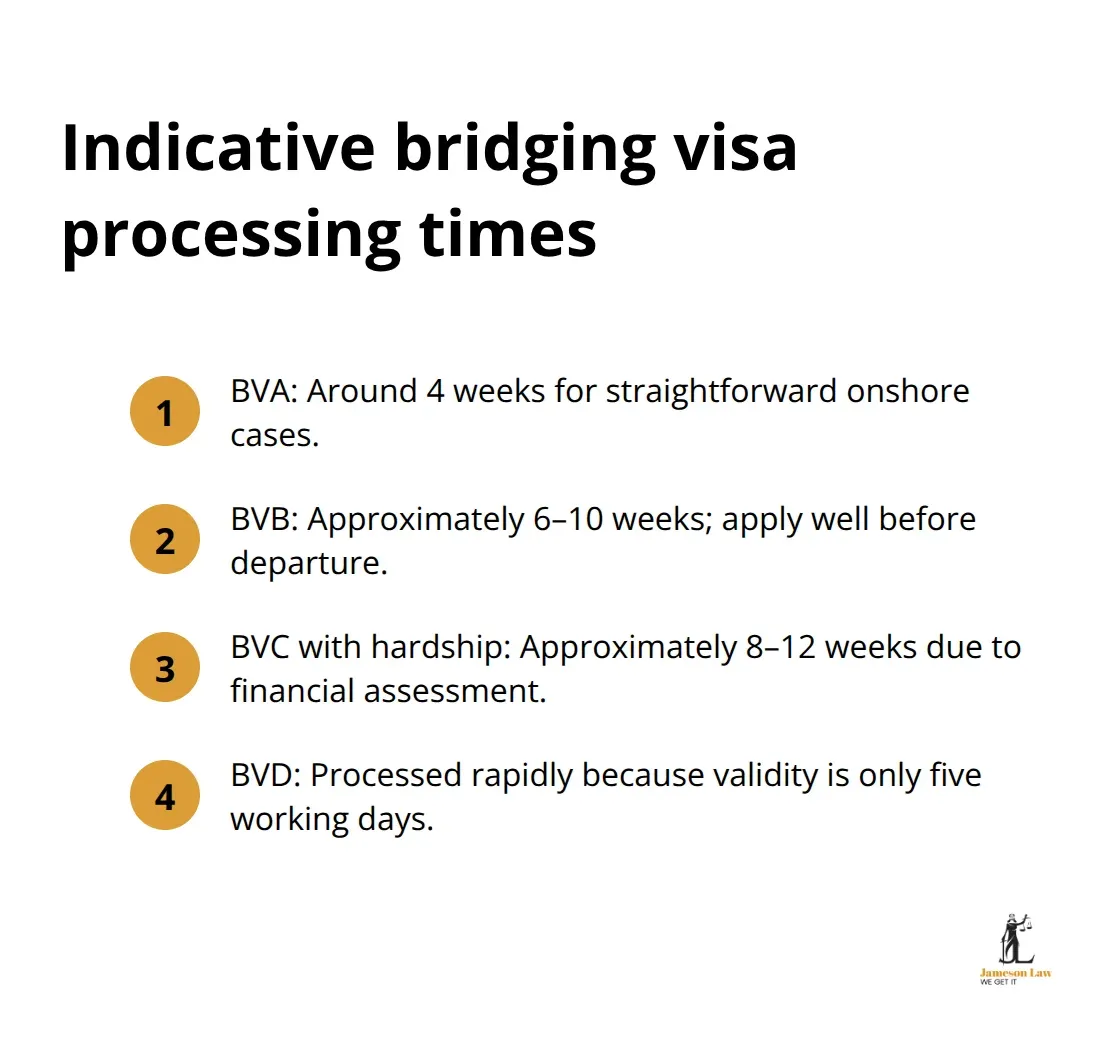
A Bridging Visa A for a straightforward onshore applicant with a current visa usually processes within four weeks. A Bridging Visa B for travel can take six to ten weeks, so apply well before your travel date. A Bridging Visa C with a hardship claim for work rights often takes eight to twelve weeks because the Department assesses your financial circumstances in detail. A Bridging Visa D is processed rapidly because it is only valid for five working days anyway.

Throughout processing, check ImmiAccount regularly for requests for further information-the Department will not call you unless there is a serious issue. If they request documents, respond within 28 days or your application may be refused.
Receive and secure your visa grant notification
Once your bridging visa is granted, you receive a visa grant notification email with your visa number, conditions, and expiry date. Print this immediately and keep it with your passport because employers and landlords will ask for proof of your visa status.
Final Thoughts
A bridging visa keeps you lawful while your substantive application processes, but it’s not a permanent solution and it’s not a safety net for poor planning. Understanding bridging visa requirements Australia means knowing which type applies to your situation, gathering the right evidence, and submitting your application before your current visa expires. The five types each serve different circumstances, and choosing the wrong one or missing critical deadlines creates unnecessary complications.
After you submit your application through ImmiAccount, your role shifts to monitoring and responding promptly. Check ImmiAccount regularly for requests for further information, and respond within 28 days if the Department asks for documents. Processing times vary considerably: a straightforward Bridging Visa A takes around four weeks, while a Bridging Visa B for travel can take six to ten weeks, and a Bridging Visa C with a hardship claim for work rights often takes eight to twelve weeks because the Department assesses your financial circumstances thoroughly.
If your circumstances are complex, your substantive visa application has been refused previously, or you’re unsure which bridging visa type applies to you, professional legal assistance makes a real difference. We at Jameson Law have helped hundreds of people navigate bridging visa applications across Australia, and we can guide you on your specific situation before you lodge. Contact Jameson Law to discuss your options and get clarity on your next steps.