


NSW skilled migration points determine whether you meet the federal points threshold for a points-tested visa, but 65 points does not guarantee an invitation or NSW nomination.
At Jameson Law, we assist skilled professionals in understanding the framework administered by the Department of Home Affairs and Investment NSW. This guide explains the points test, SkillSelect and the additional points available through state nomination.
NSW Skilled Migration Points: How the Points Test Works
The 65-Point Minimum Threshold and SkillSelect
Under the statutory points test (Schedule 6D of the Migration Regulations 1994), applicants must reach a minimum threshold of 65 points to lodge an Expression of Interest (EOI) through the Commonwealth’s SkillSelect system.
It is vital to understand that achieving 65 points is an eligibility baseline to submit an EOI, not an invitation guarantee. Selection rounds are competitive. For many high-demand occupations, the actual score required to receive an invitation from the Commonwealth or a state government can be substantially higher depending on labour market demand and program quotas.
Points-Tested Visa Subclasses and State Nomination Points
Points-tested skilled migration encompasses three main visa streams, with state nomination providing an immediate point uplift:
| Visa Subclass | Visa Type & Residency | Nomination Points Added |
|---|---|---|
| Skilled Independent (Subclass 189) | Permanent residency; independent pathway. | 0 points (applicant relies solely on personal points). |
| Skilled Nominated (Subclass 190) | Permanent residency; nominated by NSW Government. | +5 points added automatically upon state nomination. |
| Skilled Work Regional (Subclass 491) | 5-year provisional visa; regional NSW pathway. | +15 points added automatically upon state/regional nomination. |
For more information on the federal allocation framework, refer directly to the Department of Home Affairs points table.
Core Point Categories: Age, English, and Experience
Age Requirements at Time of Invitation
To be invited to apply for a points-tested skilled visa, you must be under 45 years of age at the date of invitation. If you turn 45 before receiving an invitation, you are no longer eligible. Points for age are allocated as follows:
- 18–24 years: 25 points
- 25–32 years: 30 points (maximum age points)
- 33–39 years: 25 points
- 40–44 years: 15 points
- 45 years and over: 0 points (ineligible for invitation)
English Language Proficiency and NSW Skilled Migration Points
Competent English is generally the minimum for these skilled visas and attracts no points. Proficient English attracts 10 points and Superior English attracts 20 points. Accepted tests, scores and validity rules can change, so use the current Home Affairs English-language guidance rather than relying on an old test conversion.
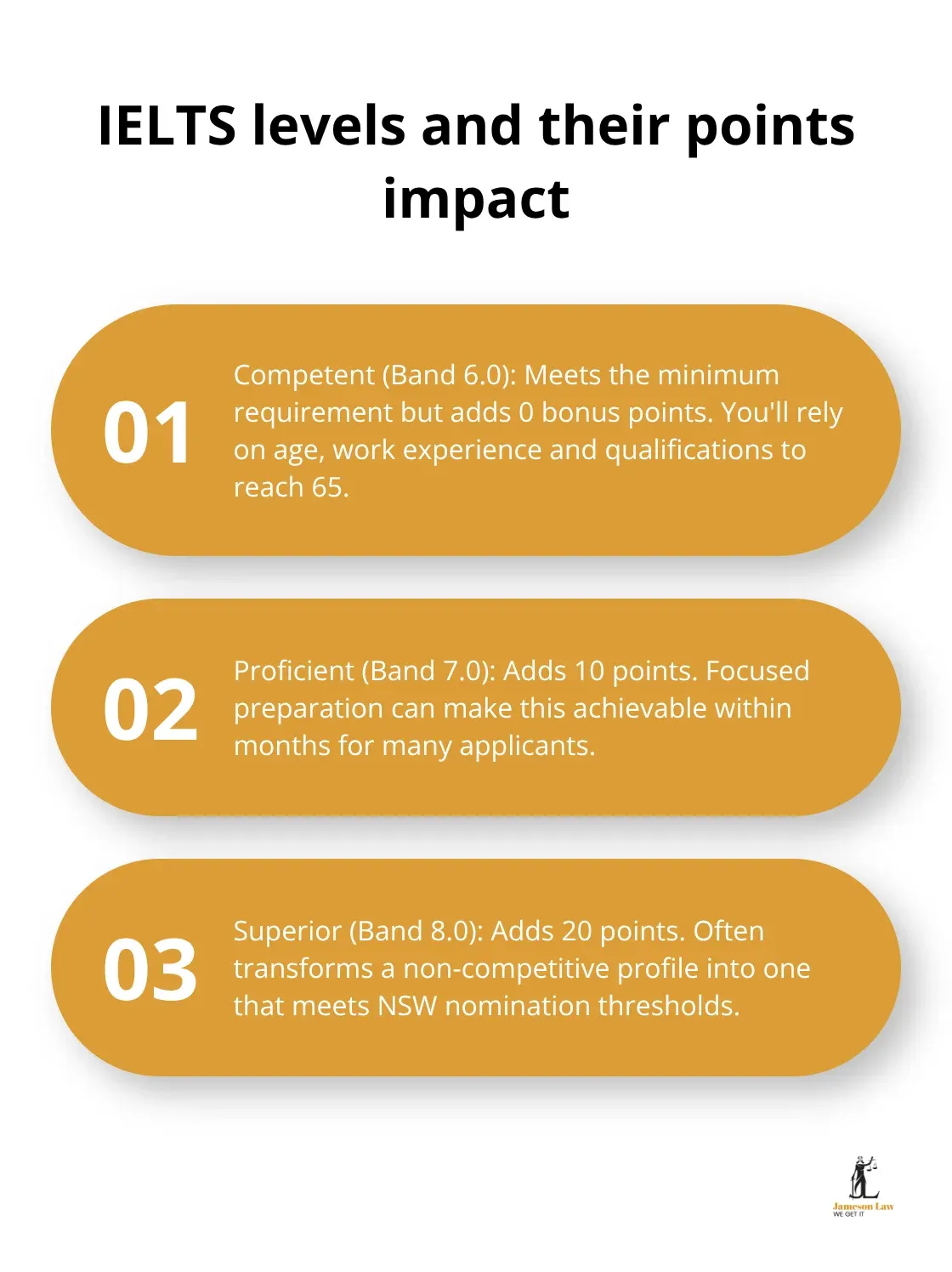
- Competent English: 0 points.
- Proficient English: 10 points.
- Superior English: 20 points.
Skills Assessment and Skilled Employment
You need a valid skills assessment for your nominated occupation when required by the relevant visa rules and must be able to substantiate every SkillSelect claim. For NSW nomination, employment points should only be claimed from the “deemed skilled” date stated by the assessing authority, or after the qualifying study was completed if no such date is stated. Federal and NSW validity rules must both be checked at the time of invitation and application.
- Australian skilled employment: up to 20 points, depending on eligible years claimed.
- Overseas skilled employment: up to 15 points, depending on eligible years claimed.
- Combined cap: no more than 20 employment points in total.
Check the current Home Affairs points calculator and the NSW evidence requirements before updating an EOI.
Recognised Educational Qualifications
Points are awarded for your highest recognised educational qualification, verified as equivalent to Australian standards:
- Doctorate degree (PhD): 20 points
- Bachelor or Master degree: 15 points
- Diploma or trade qualification: 10 points
- Australian Study Requirement: 5 points (if eligible)
- STEM Specialist Educational Qualification: 10 points (for eligible Master by research or PhD programs in Australia)
NSW Nomination Status and Selection Criteria
Current program status: as at 24 August 2026, the NSW Government pages for both Subclass 190 and Subclass 491 state that applications are closed for the current program year because nomination places have been allocated. Program settings and eligibility criteria are under review. Applicants should check the live NSW pages before acting.
NSW nomination is separate from the federal SkillSelect EOI. The Subclass 190 NSW page describes a selection-based, exceptionally competitive process. The Subclass 491 NSW page sets out regional pathways and their separate requirements.
- Occupation eligibility: the occupation must be eligible for the visa and fall within the relevant NSW Skills List.
- Evidence: every points claim in the EOI must be supported by valid documents when NSW invites an application.
- Selection: 65 points is only the federal threshold. NSW considers factors such as points, English, education and skilled experience, and an invitation remains discretionary.
- Visa decision: NSW nomination does not guarantee a visa; Home Affairs alone decides the visa application.
Frequently Asked Questions
What is the minimum score required for NSW skilled migration points?
To submit an Expression of Interest (EOI) in SkillSelect for a points-tested skilled migration visa, you must reach a minimum threshold of 65 points. However, scoring 65 points only establishes baseline eligibility to lodge an EOI; it does not guarantee an invitation to apply for visa nomination.
How many nomination points do Subclass 190 and Subclass 491 provide in NSW?
State nomination by New South Wales for the Skilled Nominated visa (Subclass 190) provides 5 additional points towards your total score. Nomination for the Skilled Work Regional (Provisional) visa (Subclass 491) adds 15 nomination points.
What are the age and skills assessment requirements for skilled migration?
You must be under 45 years of age at the time an invitation to apply is issued. You must also hold a valid, positive skills assessment in your nominated occupation from the relevant assessing authority and demonstrate at least Competent English.
Final Thoughts
Understanding your points tally under the Australian skilled migration system is critical for setting realistic expectations and identifying viable pathways. While the 65-point baseline enables you to register an EOI, competitive candidates focus on maximising points across English language testing, recognized work experience, and state nomination allocations.
Because skilled migration policies, occupation lists, and NSW state nomination criteria are subject to frequent changes, obtaining tailored legal advice ensures your application aligns with current regulatory requirements.
To assess your visa eligibility and develop a strategic migration plan, contact the immigration team at Jameson Law.