

Civil disputes happen to businesses and individuals every day in NSW. Whether it is a contract gone wrong, a property boundary issue, or unpaid debts, understanding NSW civil litigation basics helps you know exactly what to expect before taking legal action.
At Jameson Law, our expert team has guided countless clients through the NSW civil court system. This comprehensive 2026 guide breaks down the legal process into plain language so you can make highly informed, strategic decisions about your situation.
What is Civil Litigation in NSW?
Civil Litigation vs Criminal Law
Civil litigation handles disputes between people, businesses, and government organisations regarding rights and financial compensation. Unlike criminal cases where the state prosecutes an individual for breaking the law, civil disputes are initiated by private parties seeking to enforce a legal or financial obligation.
The standard of proof differs significantly. Civil cases use the balance of probabilities (meaning your claim is more likely than not to be true), whereas criminal cases require proof beyond a reasonable doubt. This lower threshold makes civil litigation accessible for resolving commercial and personal disagreements.
Types of Civil Cases and 2026 Court Jurisdictions
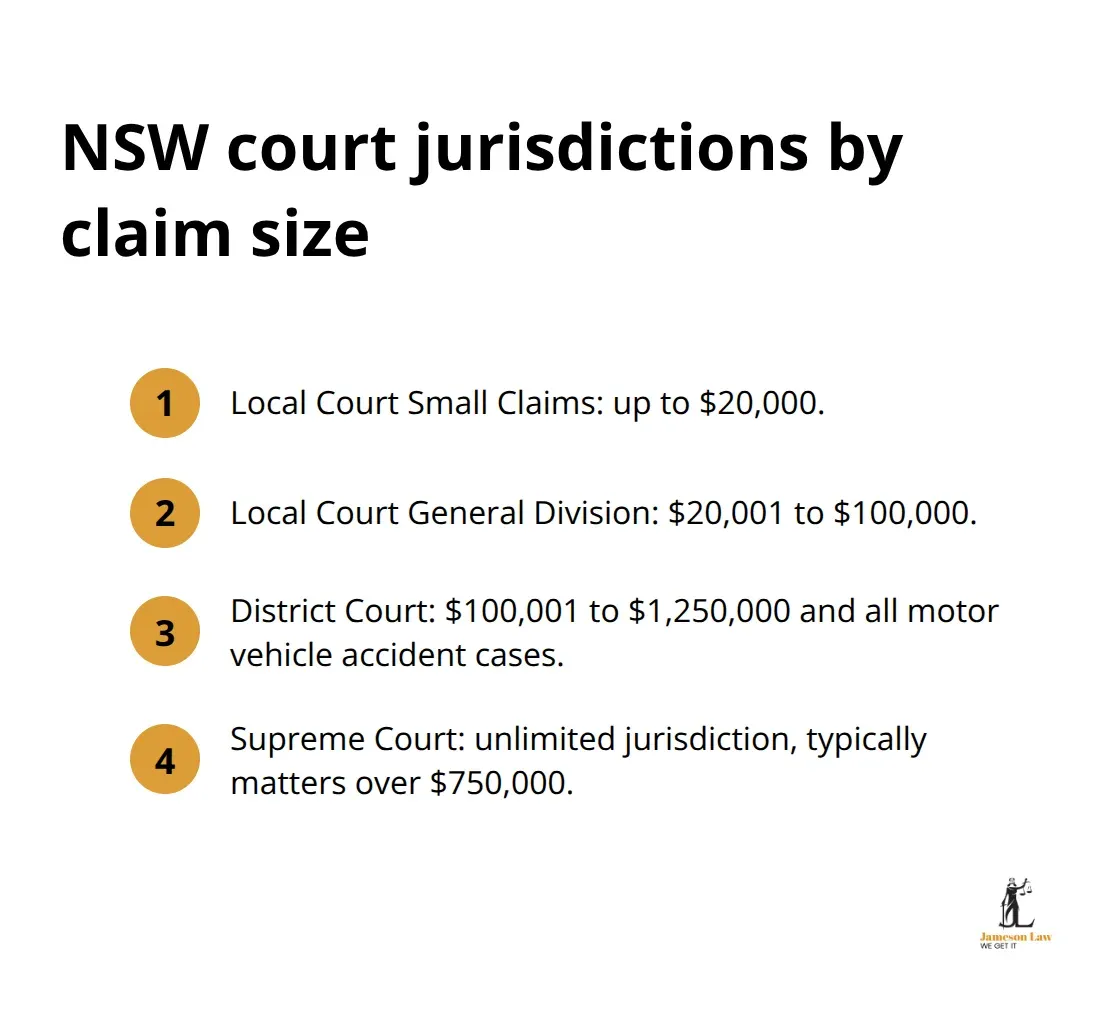
You might pursue civil action for contract breaches, unpaid debts, property disagreements, or personal injury claims. NSW has carefully structured its court system by claim value and subject matter to manage caseloads efficiently.
| NSW Court / Division | Monetary Jurisdiction (Claim Value) |
|---|---|
| Local Court (Small Claims) | Up to $20,000 |
| Local Court (General Division) | $20,001 to $100,000 |
| District Court | $100,001 to $1,250,000 (Unlimited for motor accidents) |
| Supreme Court | Unlimited (Generally handles complex claims exceeding $1,250,000) |
Filing in the correct jurisdiction is essential. Initiating a $50,000 contract dispute in the District Court instead of the Local Court wastes time and triggers entirely unnecessary legal costs.
Specialist Courts and Tribunals
Specialist courts exist for highly specific dispute types. The Land and Environment Court handles planning disputes and boundary issues involving local councils. The NSW Civil and Administrative Tribunal (NCAT) covers tenancy disputes, building works, and consumer claims, offering significantly faster resolution timelines than traditional courts.
How Civil Litigation Actually Unfolds in NSW
Resolving Disputes Before Court
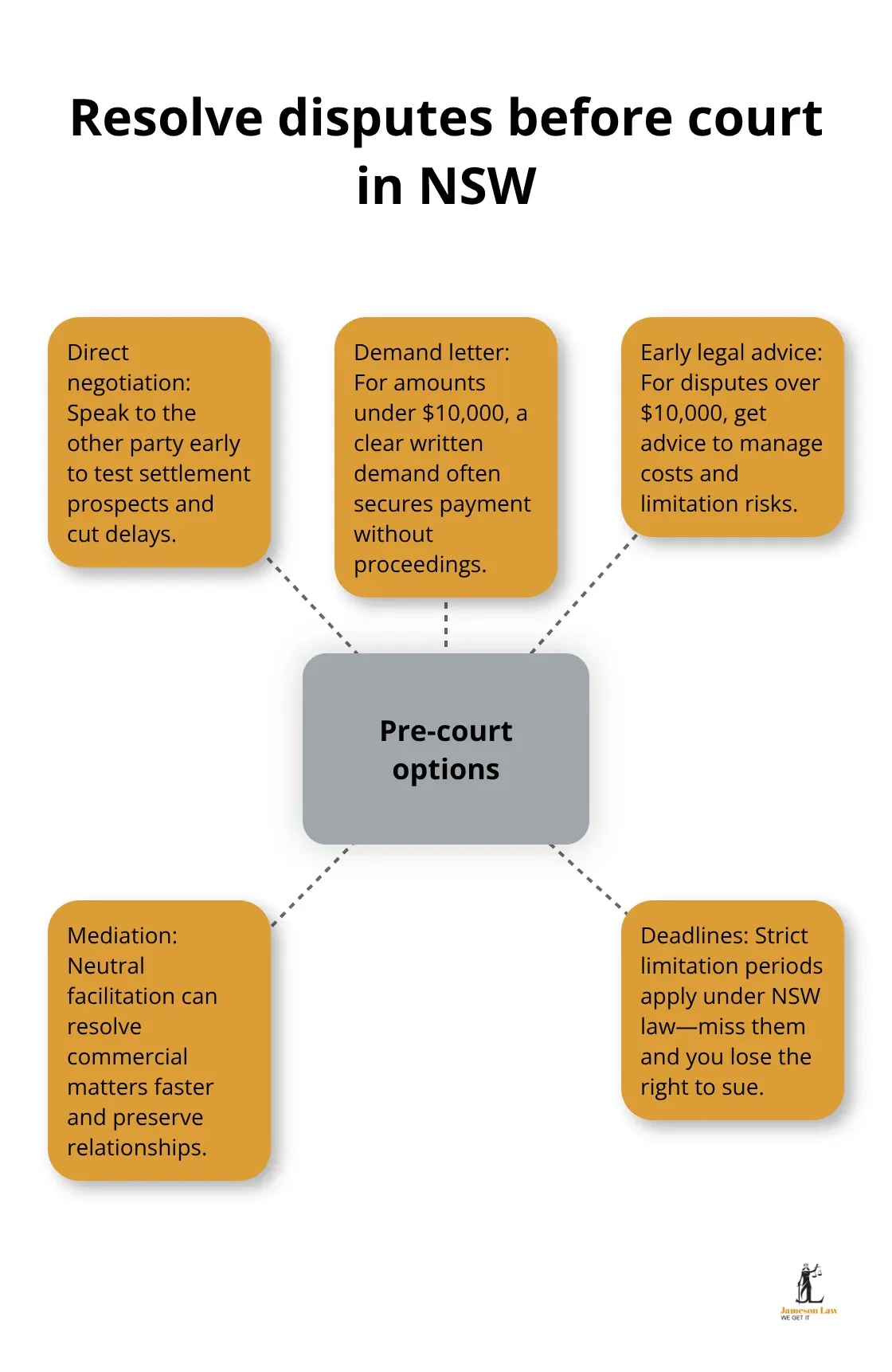
Before filing court documents, you must exhaust practical, cost-effective options. For debts under $10,000, a formal written demand letter drafted by a lawyer often resolves the issue without judicial intervention. For larger disputes, the Civil Procedure Act 2005 (NSW) sets strict limitation deadlines—missing them means permanently forfeiting your right to sue.
If direct negotiation fails, alternative dispute resolution (such as formal mediation) can settle commercial disputes without a judge. Mediation saves thousands in legal fees and preserves critical business relationships.
Filing Your Claim in Court
Filing your claim requires absolute procedural precision. In the District Court, you must lodge a Statement of Claim or Summons that rigorously details the dispute. The defendant then has 28 days to respond with a formal Defence. If they ignore this deadline, you can apply for a default judgment to win the case automatically.
Once a defence is filed, the case enters active case management. The NSW courts heavily emphasise pre-trial conferences to encourage settlement, as the vast majority of civil matters never proceed to a full trial.
Evidence, Discovery, and Enforcement
During the “discovery” phase, both sides legally exchange relevant documents. At trial, the judge reviews affidavits, hears cross-examinations, and assesses the evidence against the balance of probabilities.
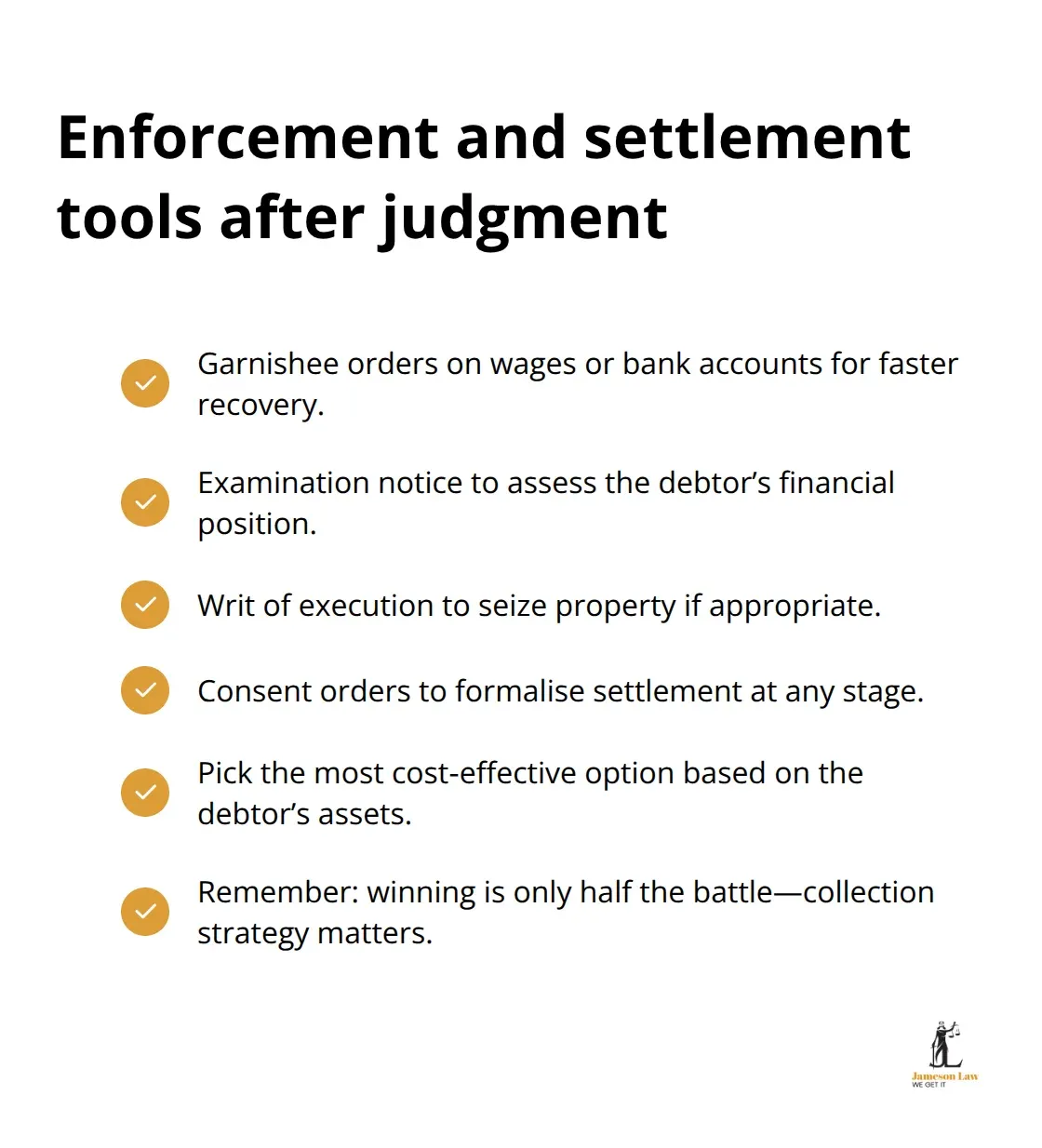
If you win, obtaining a judgment is only half the battle. Enforcement options to secure your money include:
- Garnishee Orders: Deducting owed money directly from the debtor’s wages or bank accounts.
- Examination Notices: Legally forcing the debtor to disclose their entire financial position.
- Writs of Execution: Authorising the Sheriff to seize and sell the debtor’s property.
Common Civil Disputes in NSW and How to Handle Them
Contract Breaches and Commercial Disagreements
Contract disputes form the bulk of civil litigation in NSW. The core issue usually stems from vague terms regarding payment schedules or service deliverables. A contract dispute worth $150,000 can easily consume tens of thousands in legal fees to litigate.
Written communications—such as emails, purchase orders, and signed invoices—matter far more than verbal promises. Courts require concrete proof. Gathering every written exchange immediately provides your legal team with the ammunition needed to secure a favourable settlement.
Property Disputes and Boundary Disagreements
Property disputes involve land rights, which courts treat with extreme formality. Boundary disagreements often escalate unnecessarily when neighbours fail to obtain professional surveys. Resolving a minor boundary issue through the Land and Environment Court is often disproportionately expensive, making early mediation the smartest tactical approach.
Debt Recovery and Time Limits
Debt recovery demands a precise tactical approach because statutory time limits apply rigidly under the Limitation Act 1969 (NSW). For most standard debt recovery matters, you have six years from the date the debt became due to commence proceedings. Acting immediately with a professionally drafted letter of demand is highly effective.
Final Thoughts
Understanding NSW civil litigation basics proves that going to court does not have to be an overwhelming process. The vast majority of disputes are resolved before trial through strategic negotiation, formal mediation, or early settlement discussions, saving both parties significant time and expense.
Timing is critical. Missing a limitation period permanently extinguishes your right to sue, and pursuing litigation in the wrong jurisdictional tier wastes valuable resources. By understanding the balance of probabilities and the robust enforcement tools available post-judgment, you can realistically assess the commercial viability of your claim.
When facing a civil dispute, securing highly experienced legal advice early is your greatest protection against costly procedural errors. At Jameson Law, our expert Sydney team provides practical, authoritative advice tailored to your specific commercial or personal circumstances. Contact us today to determine the most effective legal strategy to resolve your dispute.