


Navigating bridging visa requirements Australia is critical to maintaining your lawful status when transitioning between substantive visas. If your current visa expires before a decision is made on your new application, a bridging visa serves as the legal safety net that prevents you from becoming an unlawful non-citizen.
At Jameson Law, we guide applicants through the complex rules enforced by the Department of Home Affairs. This 2026 guide explains the core differences between Bridging Visas A, B, C, D, and E, clarifying travel limitations, work rights, and cessation events.
What a Bridging Visa Actually Does
Under Australian migration law, a bridging visa is not a substantive visa (like a Student, Skilled, or Partner visa). It is a temporary, transitional visa designed strictly to allow a person to remain lawfully in Australia under specified circumstances while an immigration matter is resolved.
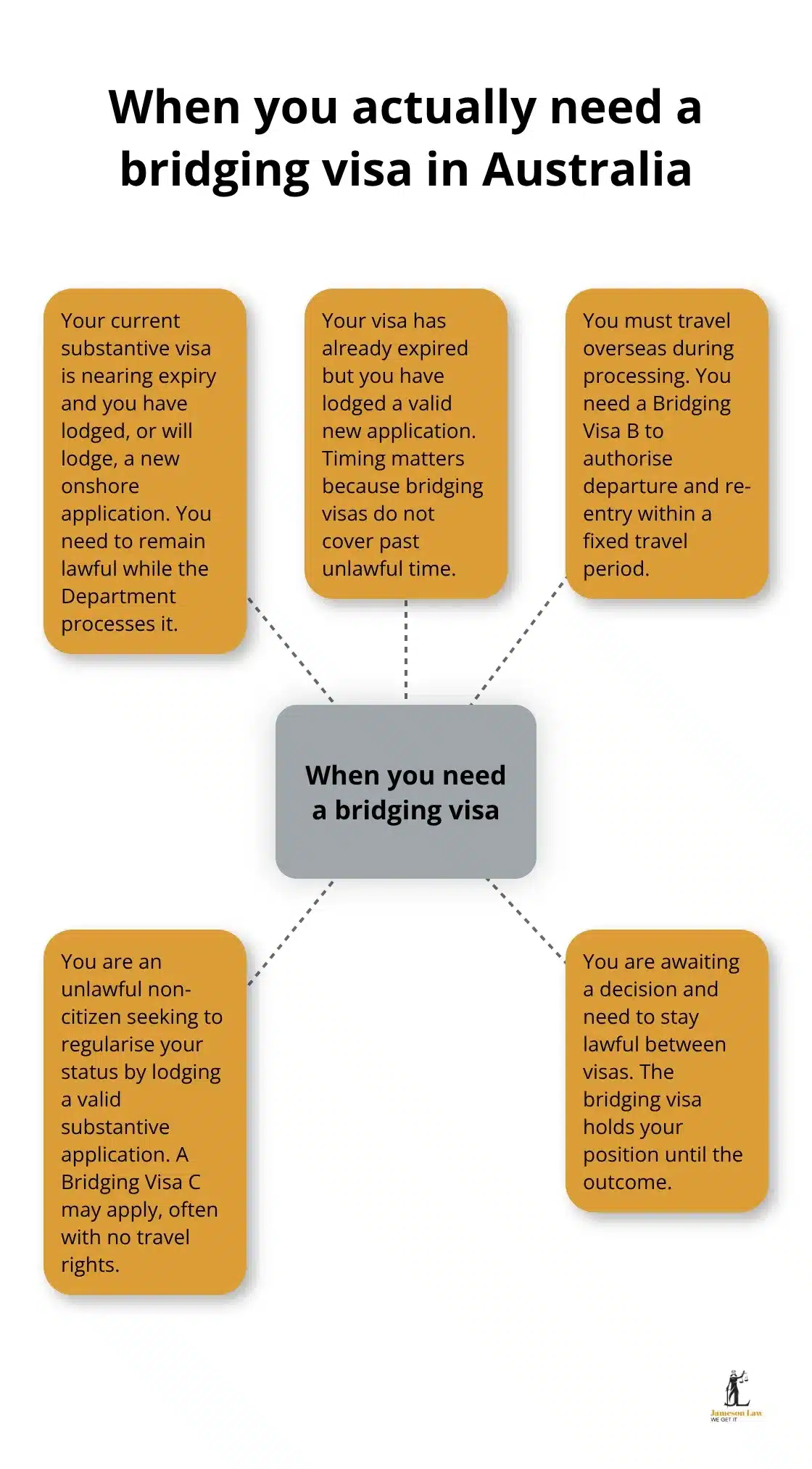
If your substantive visa expires and you do not hold an active bridging visa, you immediately become an unlawful non-citizen. This exposes you to mandatory immigration detention under the Migration Act 1958, removal from Australia, and potential multi-year exclusion periods (re-entry bans) affecting future visa applications.
Bridging Visas Do Not Strengthen Your Substantive Case
Holding a bridging visa for an extended period does not increase the likelihood that your substantive visa application will be approved. The bridging visa is purely administrative. Your long-term future in Australia depends entirely on whether your substantive application meets the strict legislative criteria required for a grant.
The Five Types of Australian Bridging Visas
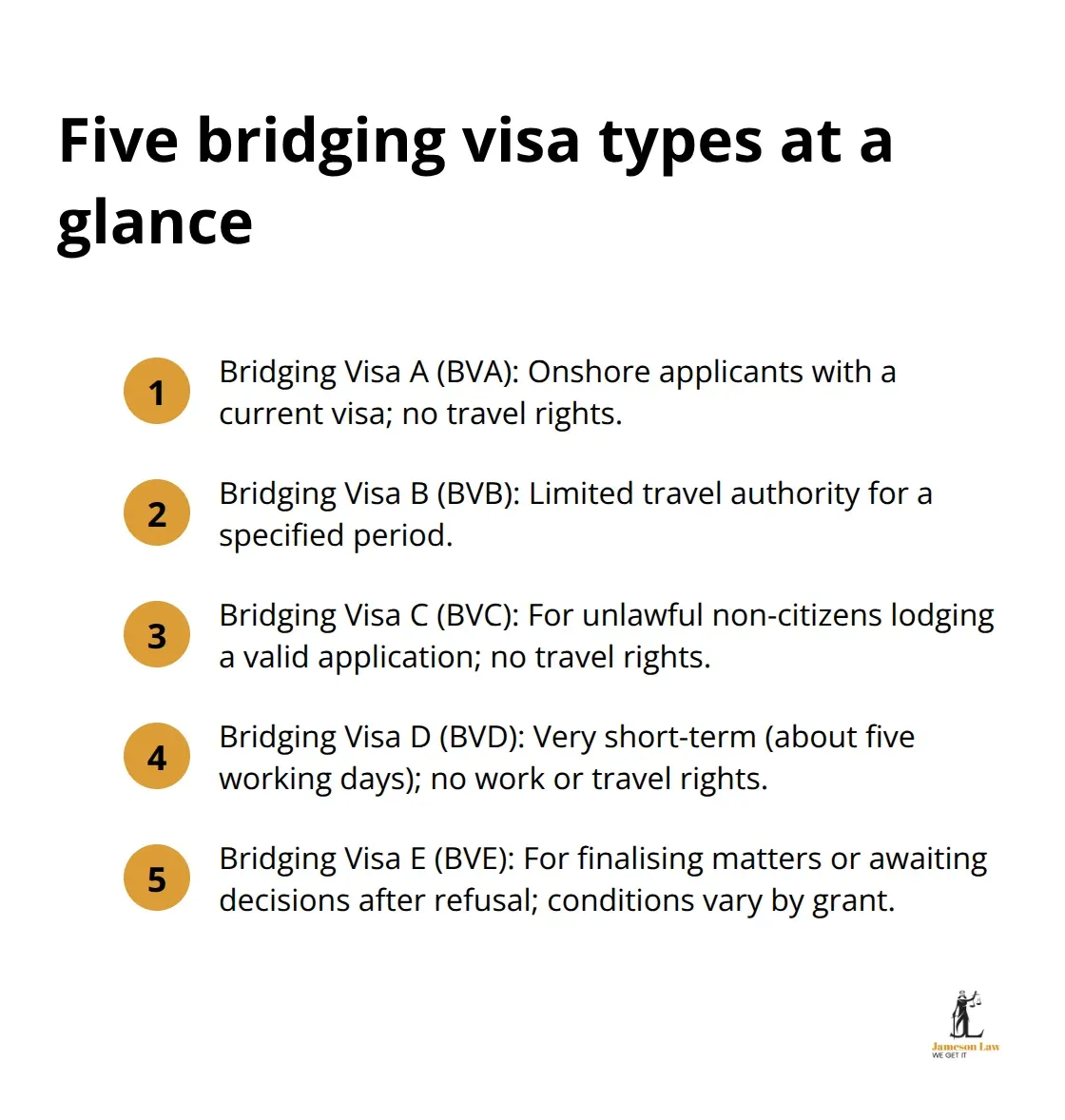
The Department of Home Affairs administers five distinct classes of bridging visas. The specific visa you receive, its conditions, and its cessation events depend entirely on your individual circumstances at the time of grant.
| Visa Type | When It Is Generally Granted | Travel Rights |
|---|---|---|
| Bridging Visa A (BVA) | May be granted in connection with an onshore substantive visa application while you hold a substantive visa; check the grant notice. | No. Departure generally causes the visa to cease. |
| Bridging Visa B (BVB) | Applied for before travel when an eligible bridging visa holder needs to depart and return during a specified travel period. | Yes. Valid for a specified travel period. |
| Bridging Visa C (BVC) | Granted when you apply for a substantive visa onshore but do not hold a substantive visa (e.g., you are an unlawful non-citizen). | No. |
| Bridging Visa D (BVD) | A short-term bridging visa used in limited circumstances while a person prepares a valid application or makes departure arrangements. | No. |
| Bridging Visa E (BVE) | May be granted in specified circumstances to an unlawful non-citizen while departure or another immigration process is being addressed. | No. Highly restrictive conditions. |
Key Conditions: Work Rights and Travel Limits
Work Rights Are Not Guaranteed
A common misconception is that bridging visas automatically confer full work rights. This is incorrect. The conditions depend on the bridging visa class, the person’s circumstances and the conditions imposed in the grant notice.
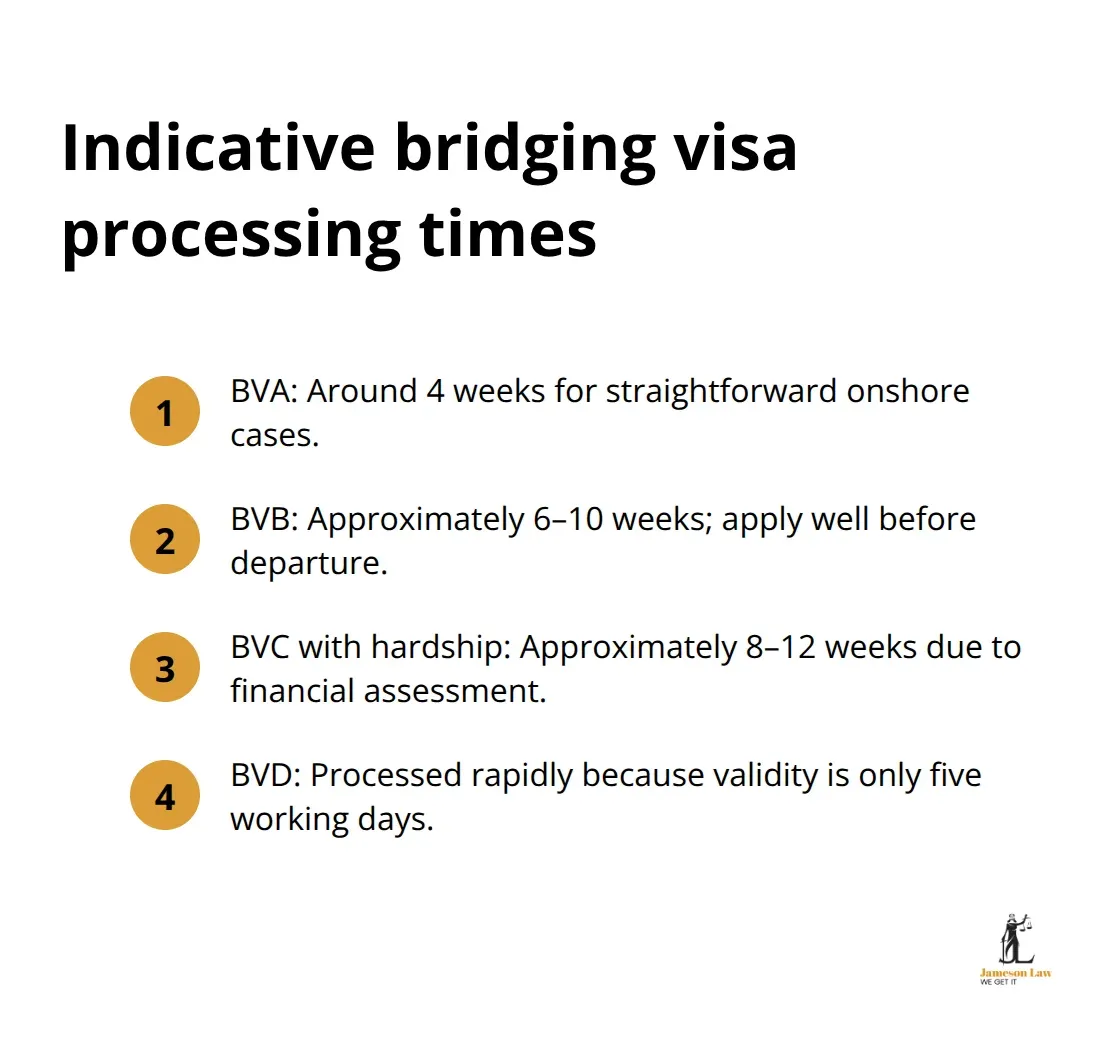
Some bridging visa holders may be able to apply for a different bridging visa or permission with work rights if the relevant legal criteria are met. Evidence requirements depend on the visa class and circumstances. You must always verify your specific work rights using the Visa Entitlement Verification Online (VEVO) system or your official grant notice before undertaking any employment.
Managing Travel on a Bridging Visa B (BVB)
If you hold a BVA and depart Australia, your BVA will generally cease, and you will not be able to return to Australia on that visa. If you have a genuine reason to travel temporarily (such as a family emergency or overseas work commitments), you must apply for and be granted a Bridging Visa B (BVB) before you leave the country.
The BVB will include a specified travel period. You must return to Australia before this travel period expires, or you risk losing your bridging status entirely.
Bridging Visa E (BVE): Urgent and Complex Matters
If you find yourself unlawfully in Australia, securing a Bridging Visa E (BVE) is an urgent priority. A BVE allows you to remain lawfully while making final arrangements to leave or while awaiting a review or Ministerial decision. BVEs carry strict reporting conditions, often explicitly prohibit work, and do not permit re-entry if you travel. Dealing with a BVE typically requires urgent professional legal guidance.
Frequently Asked Questions
Does a bridging visa automatically give me work rights in Australia?
No. Work rights on a bridging visa are not universal. Your work rights depend on the bridging visa class and the conditions stated in your grant notice. You must always check your specific conditions in VEVO or your grant notice.
Can I travel overseas while holding a Bridging Visa A (BVA)?
A Bridging Visa A (BVA) does not generally permit you to return to Australia if you leave. If you hold a BVA and need to travel internationally, you must apply for and be granted a Bridging Visa B (BVB) before you depart, otherwise your BVA will cease.
What is the purpose of a bridging visa?
A bridging visa is a temporary visa that allows a non-citizen to remain lawfully in Australia while their immigration status is being resolved, such as while waiting for a substantive visa application to be processed or making arrangements to depart.
Final Thoughts
Understanding bridging visa requirements Australia is fundamental to protecting your residency status. These visas are administrative tools meant to bridge gaps, not permanent solutions. Adhering strictly to the conditions printed on your grant notice—especially regarding work restrictions and travel periods—is paramount to ensuring your substantive visa application is not jeopardized.
Because the rules governing BVCs (for unlawful non-citizens) and BVEs (for urgent compliance matters) are complex and carry severe consequences for non-compliance, guessing your visa status is never advisable. Always verify your current standing through the official VEVO system.
If your visa is expiring soon, if you require a BVB to travel, or if you find yourself without a valid visa, contact the immigration team at Jameson Law for urgent legal assessment and guidance.