PUBLICATION

Waves of Migration to Australia: A Historical Overview

"Explore waves of migration to Australia from colonial times through modern diversity, immigration policy shifts, and cultural impact on the nation."
Waves of Migration to Australia: A Historical Overview

Australia’s migration story spans over 65,000 years, from Indigenous settlement through European colonisation to modern skilled migration programmes. The waves of migration to Australia have fundamentally shaped the nation’s economy, culture, and identity.

At Jameson Law, we recognise that understanding this history is essential for anyone navigating Australia’s current immigration landscape. This overview traces how successive migration movements have transformed Australia into one of the world’s most multicultural societies.

How Indigenous Australians and European Colonisers Shaped Australia’s First Migration Waves?

Indigenous Settlement: 65,000 Years of Continuous Culture

Australia’s migration story did not begin with Europeans. Indigenous Australians arrived at least 65,000 years ago and established the world’s oldest continuous culture. Archaeological evidence from sites like Madjedbebe reveals sophisticated settlement patterns tied to land management.

Terra Nullius and the Misrepresentation of Indigenous Australia

Captain James Cook’s 1770 voyage led to the assertion of terra nullius (“land belonging to no one”). This legal fiction ignored thriving Indigenous nations and shaped colonial policy for nearly two centuries, leading to dispossession.

Convict Transportation: Forced Migration and Colonial Settlement

The first European wave arrived as convicts in 1788. Britain and Ireland transported over 160,000 convicts to establish penal colonies. This forced migration created Australia’s initial European population, fundamentally different from voluntary settlers.

Gold Rush and Industrial Transformation

The 1850s Gold Rush Reshapes Migration Patterns

The 1850s gold rush triggered massive voluntary migration. Victoria’s population exploded from 77,000 to over 540,000 in a decade. Chinese miners formed a substantial portion of this wave, facing discriminatory laws like the Immigration Restriction Act 1855 in Victoria.
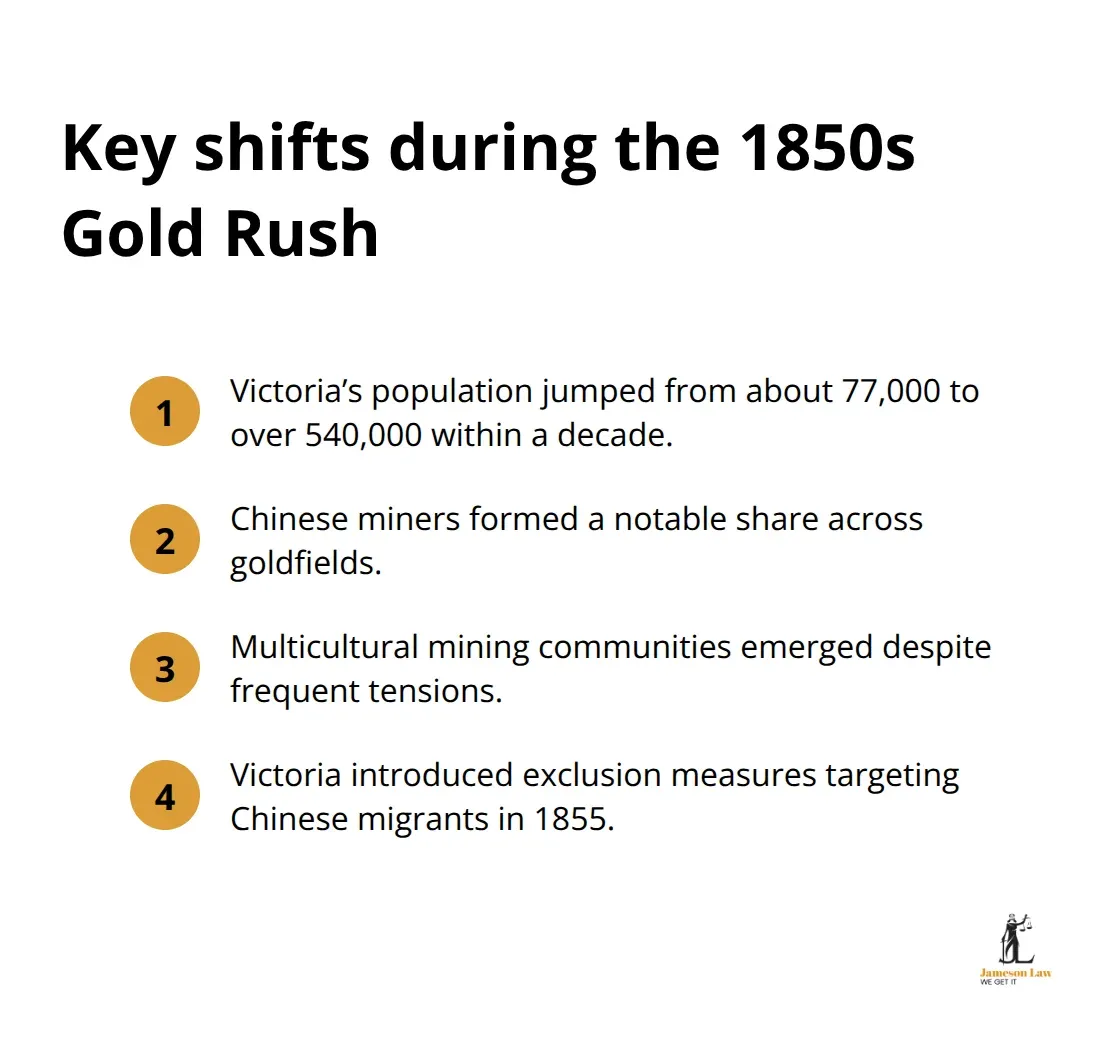
Concise list highlighting population surge, Chinese miners’ role, multicultural communities, and early exclusion policies during Australia’s 1850s gold rush

Post-War Migration and the Populate or Perish Campaign

Post-World War II migration was driven by the “Populate or Perish” campaign. Australia launched assisted passage schemes for British migrants (the “Ten Pound Poms”) and welcomed over 170,000 Displaced Persons from Europe. This shifted the nation’s demographic from exclusively British to broadly European.

Contemporary Migration and Demographic Shifts

Modern data from the Australian Bureau of Statistics (ABS) shows that as of 2024, approximately 31.5% of Australia’s population was born overseas. England remains the largest source country, followed closely by India and China.
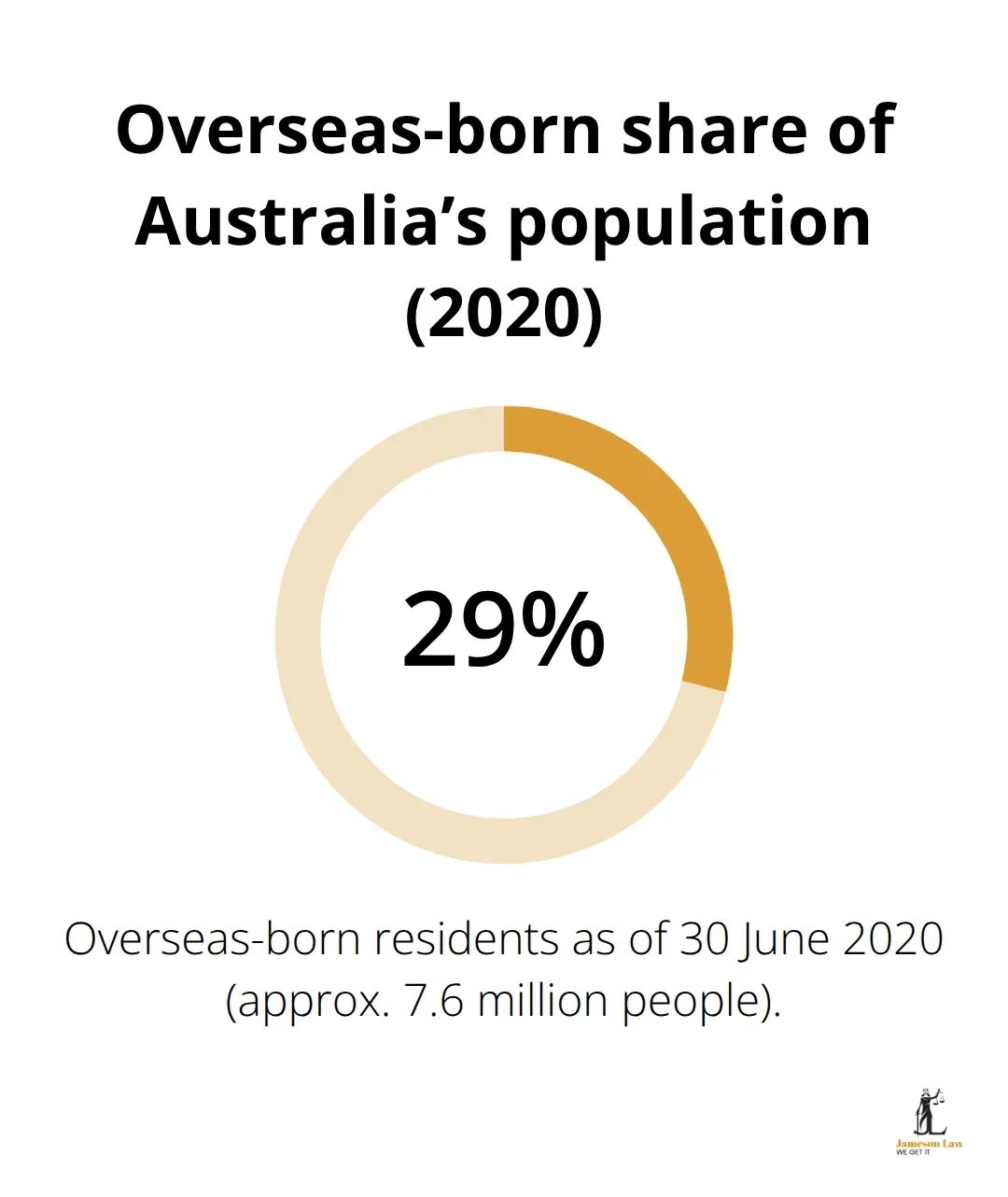
Percentage of Australia’s population that was overseas-born in 2020-2024 based on ABS data - waves of migration to australia

How Australia’s Migration System Works Today?

From Racial Exclusion to Skills-Based Selection

Australia’s migration system transformed with the end of the White Australia policy in 1973. Today, the system prioritises skills. The Skilled Migration Program targets workers in shortage occupations, driving economic growth.

Migration’s Impact on Employment and Innovation

OECD research demonstrates that a 1% increase in migrant inflow is associated with a 0.53% increase in Australian-born employment. Furthermore, higher-educated migrants boost regional innovation, with a 1% increase in their employment share leading to a 4.8% rise in patent applications.
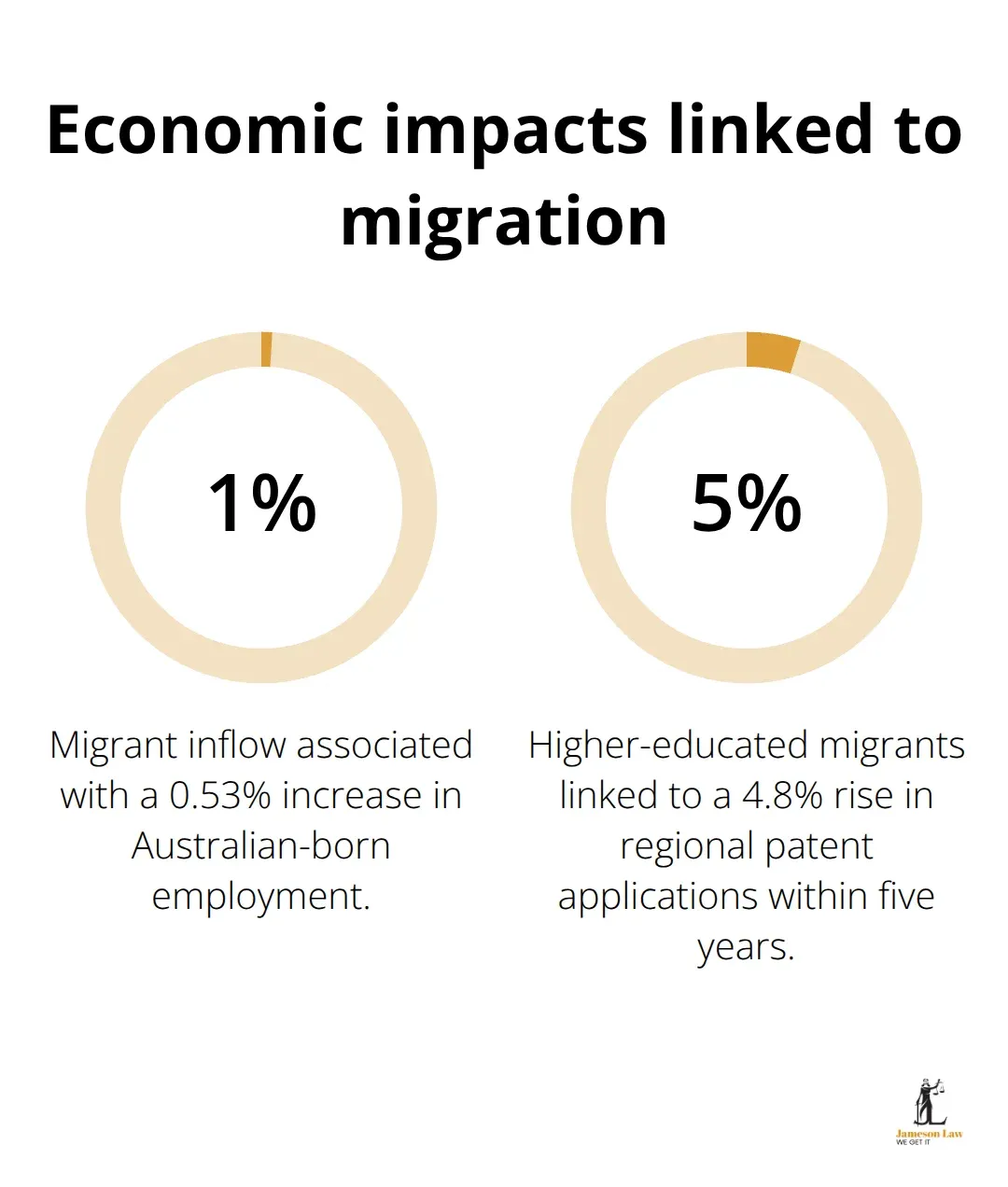
Percent changes associated with migration: employment gains and innovation outcomes in Australia - waves of migration to australia

Final Thoughts

Australia’s waves of migration transformed the nation from a penal colony into a multicultural powerhouse. From Indigenous heritage to post-war reconstruction, every wave has added a layer to our national identity.

The policy framework has evolved from exclusion to skills-based selection. If you are considering family sponsorship or skilled migration, contact Jameson Law. Our team provides tailored guidance grounded in Australia’s complex immigration history and current laws.


Speak to an Expert Lawyer today

Laywers-Jameson-Law-The-best-law-firm-in-Sydney- Sydney Lawyers - Sydney
BOOK NOW

WE'RE IN IT TO WIN IT

Book your consultation

Book Now
Book Now Mobile 06 02 2025

This form submission is encrypted and secured to ensure your information remains confidential.

What our Clients

Related Publications:

What our clients say

.

Jameson Law - Voted the Best Law firm in Sydney Award

Legal Answers ... In Short

We're here to help

Our mission is to ensure our client matters are resolved successfully every time. Success to us does not simply involve winning, but moreover ensuring we take the most feasible, economic and stress-free path to help our clients achieve their goals. We fight hard for our clients, and always go by the motto: we’re in it to win it.

Jameson Law - Best Law Firm in Sydney

WE'RE IN IT TO WIN IT

Book your consultation

Call us now on (02) 8806 0866 or fill out the form below

Book Now Mobile

This form submission is encrypted and secured to ensure your information remains confidential.

WE'RE IN IT TO WIN IT

Book your consultation

Book Now Mobile 06 02 2025
lock

This form submission is encrypted and secured to ensure your information remains confidential.

Our Sydney Offices

Offices Parramatta and Sydney Jameson Law
Parramatta CBD - Head Office
jameson Law - Blacktown
jameson Law - Liverpool Office
Jameson Law - Bankstown
Court Houses We Frequent Jameson Law

Court Houses We Frequent

Balmain Local Court

Registry: Monday to Friday, 9:00am to 4:30pm

Bankstown Local Court

Court Operating Hours: 9:30am-4:30pm

Blacktown Local Court

Registry Hours: 9:00 – 4:30
Telephone Hours: 8:30 -4:30
Days open: Mon-Fri

Burwood Local Court

Registry Hours: 9:00 – 4:30
Telephone Hours: 8:30 – 4:30
Days open: Mon – Fri

Campbell Local Court

Registry Hours: 9:00 – 4:30
Telephone Hours: 8:30 – 4:30
Days open: Mon – Fri

Central Local Court

Registry Hours: 9:00 – 1:00 and 2:00 – 4:30
Telephone Hours: 8:30 – 4:30

Downing Local Court

Registry Hours: 9:00 – 1:00 and 2:00 – 4:30
Telephone Hours: 8:30 – 4:30

Wollongong Local Court

Registry Hours: 9:00 – 1:00 and 2:00 – 4:30
Telephone Hours: 8:30 – 4:30

Fairfield Local Court

Registry Hours: 9:00 – 1:00 and 2:00 – 4:30
Telephone Hours: 8:30 – 4:30

Hornsby Local Court

Registry Hours: 9:00 – 1:00 and 2:00 – 4:30
Telephone Hours: 8:30 – 4:30

Liverpool Local Court

Registry Hours: 9:00 – 1:00 and 2:00 – 4:30
Telephone Hours: 8:30 – 4:30

Manly Local Court

Registry Hours: 9:00 – 1:00 and 2:00 – 4:30
Telephone Hours: 8:30 – 4:30

Newtown Local Court

Registry Hours: 9:00 – 1:00 and 2:00 – 4:30
Telephone Hours: 8:30 – 4:30

Parramatta Local Court

Registry Hours: 9:00 – 1:00 and 2:00 – 4:30
Telephone Hours: 8:30 – 4:30

Penrith Local Court

Registry Hours: 9:00 – 1:00 and 2:00 – 4:30
Telephone Hours: 8:30 – 4:30

Sutherland Local Court

Registry Hours: 9:00 – 1:00 and 2:00 – 4:30
Telephone Hours: 8:30 – 4:30

Waverley Local Court

Registry Hours: 9:00 – 1:00 and 2:00 – 4:30
Telephone Hours: 8:30 – 4:30

Windsor Local Court

Registry Hours: 9:00 – 1:00 and 2:00 – 4:30
Telephone Hours: 8:30 – 4:30

Wollongong Local Court

Registry Hours: 9:00 – 1:00 and 2:00 – 4:30
Telephone Hours: 8:30 – 4:30

Downing Centre District Court

Registry Hours: 9:00 – 4:30
Telephone Hours: 8:30 – 4:30
Days open: Mon – Fri

Parramatta District Court

Registry Hours: 9:00 – 4:30
Days open: Mon-Fri

Penrith District Court

Registry Hours: 9:00 – 4:30
Days open: Mon-Fri

Campbelltown District Court

Registry Hours: 9:00 – 4:30
Days open: Mon – Fri

Liverpool District Court

Registry Hours: 9:00 – 4:30
Days open: Mon – Fri

Wollongong District Court

Registry Hours: 9:00 – 1:00 and 2:00 – 4:30
Telephone Hours: 8:30 – 4:30

Supreme Court New South Wales

Registry Hours: 9:00 AM – 4:30 PM
Telephone Hours: 8:30 AM – 4:30 PM
Days Open: Monday to Friday

Federal Circuit and Family Court of Australia

Registry Hours: 9:00 AM – 4:30 PM
Telephone Hours: 8:30 AM – 5:00 PM
Days Open: Monday to Friday

Federal Court

Monday to Friday, 8:30 AM – 4:30 PM

High Court

Monday to Friday, 8:30 AM – 5:00 PM

Children’s Court of New South Wales

Registry Hours: 9:00 AM – 4:30 PM
Telephone Hours: 8:30 AM – 4:30 PM
Days Open: Monday to Friday

Coroner’s Court New South Wales

Registry Hours: 9:00 AM – 4:30 PM
Telephone Hours: 8:30 AM – 4:30 PM
Days Open: Monday to Friday

Industrial Relations Commission of New South Wales

Registry Hours: 9:00 AM – 4:30 PM
Telephone Hours: 8:30 AM – 4:30 PM
Days Open: Monday to Friday

Land and Environment Court of New South Wales

Registry Hours: 9:00 AM – 4:30 PM
Telephone Hours: 8:30 AM – 4:30 PM
Days Open: Monday to Friday

WE'RE IN IT TO WIN IT

Book your consultation

Book Now
Book Now Mobile 06 02 2025
lock

This form submission is encrypted and secured to ensure your information remains confidential.