Having an Australian parent or grandparent can open the door to citizenship by descent. It’s a pathway many people don’t realise they’re eligible for, yet it requires careful navigation of specific rules and documentation.
At Jameson Law, we’ve helped countless clients work through this process. We’ll walk you through the eligibility requirements, application steps, and common obstacles you might face.
Who Qualifies for Australian Citizenship by Descent
The pathway to Australian citizenship by descent hinges on one critical factor: whether your parent or grandparent held Australian citizenship at a specific moment in time. The Department of Home Affairs applies strict rules based on when you were born and where your ancestor’s citizenship status stood on that date. If your parent was an Australian citizen on the day you were born, you generally qualify. If your parent wasn’t a citizen but your grandparent was, the rules become more complex and depend heavily on whether your parent acquired citizenship before you were born.
How Legislation Changes Affect Your Eligibility
The legislation that governs citizenship has not remained static. Changes to citizenship law on 20 August 1986 mean that proof requirements and eligibility pathways differ significantly depending on whether you were born before or after that date. Anyone born before 1986 faces different documentation requirements than those born after. This is why you must check your specific eligibility against the exact legislation rather than relying on general assumptions.
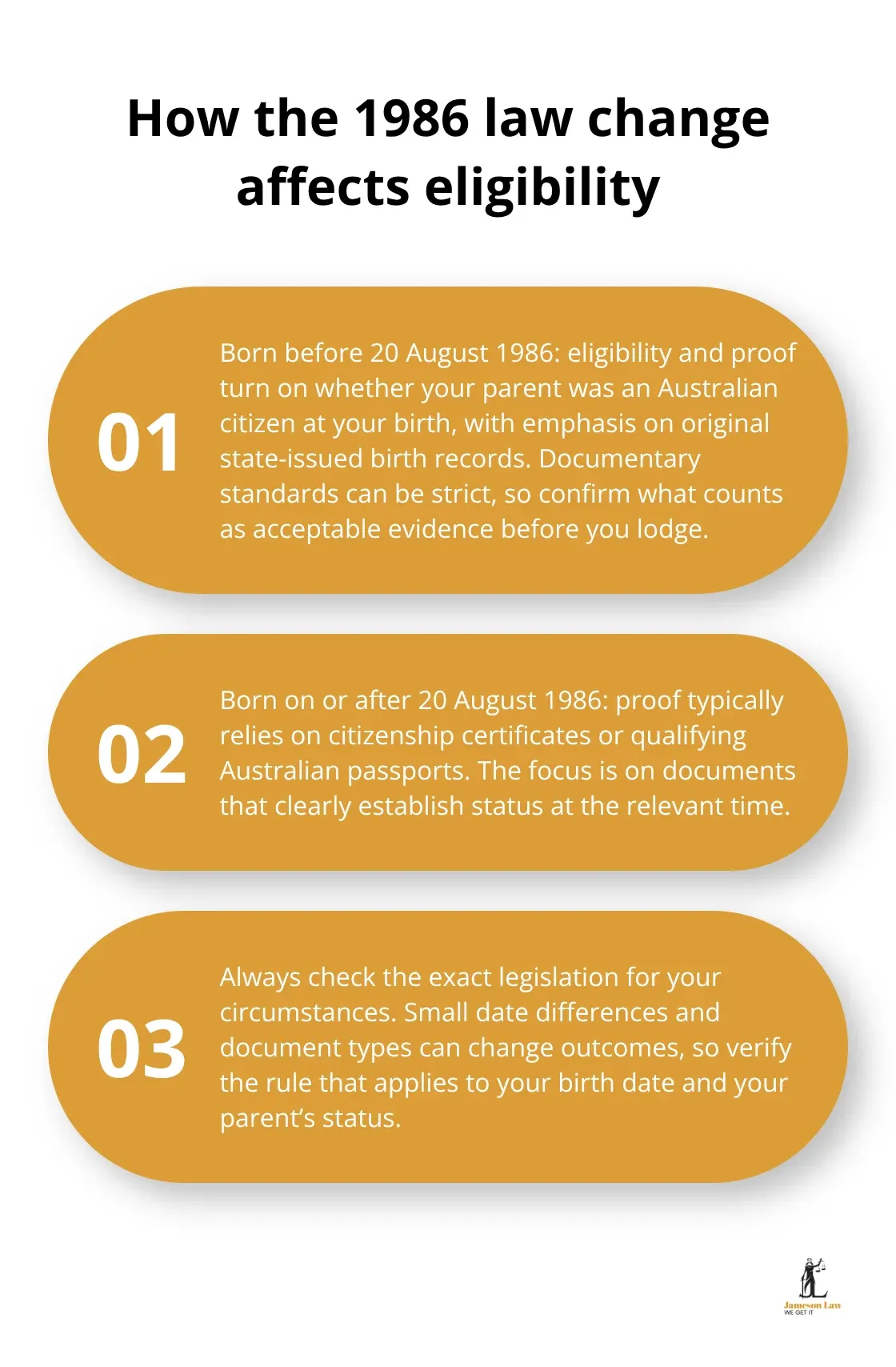
The distinctions are technical and easy to misinterpret without careful attention to dates and document types.
Birth Date Determines Your Proof Requirements
If you were born in Australia before 20 August 1986, you must provide your full original Australian birth certificate from your state’s Registry of Births, Deaths and Marriages, and it must show your parent or grandparent’s names. If you were born on or after 20 August 1986, you can prove citizenship through an Australian citizenship certificate issued in your name, an Australian passport issued after 1 January 2000 that remained valid for at least two years when issued, or documents proving citizenship by birth.
For citizenship by descent, if one parent was born in Australia before 20 August 1986 or was an Australian citizen when you were born, you must provide your birth certificate plus one of these: your parent’s full Australian birth certificate showing they were born in Australia before 1986, your parent’s Australian passport issued after 20 August 1986 and valid for at least two years, or your parent’s citizenship certificate showing citizenship acquired before you were born.
Name Changes Create Documentary Obstacles
Name changes complicate matters significantly. If your parent or grandparent changed their name, you must provide name-change documents to establish the link. This is where many applications stall. The Department of Home Affairs requires clear documentary evidence connecting your ancestor’s former and current names. Without it, the application cannot proceed.
Lodging Your Application Through the Official Portal
You must apply through ImmiAccount, the official government portal for citizenship services, and lodge all original documents or certified copies. Processing times vary, but the Department publishes current timeframes on its Citizenship Processing Times page, which you should check before you lodge to understand realistic wait periods. Understanding these timeframes helps you plan your next steps and prepare for what comes after your application reaches the Department.
Getting Your Application Right From the Start
Submitting a citizenship by descent application demands precision. The Department of Home Affairs receives thousands of applications annually, and incomplete or incorrectly prepared applications face immediate delays or rejection. You need original documents or certified copies, and the Department specifies exactly what constitutes acceptable evidence.
Proof of Your Own Citizenship
If you were born in Australia before 20 August 1986, you only need to provide your full birth certificate issued by an Australian RBDM. If you were born on or after that date, you can submit an Australian citizenship certificate in your name, an Australian passport issued after 1 January 2000 that remained valid for at least two years when issued, or documents proving citizenship by birth.
Evidence of Your Ancestor’s Citizenship
For citizenship by descent claims, the parent or grandparent documentation becomes your critical evidence. You must provide their full birth certificate showing Australian birth before 1986, their Australian passport if it was issued on or after 20 August 1986, issued before you were born and valid for at least 2 years when it was issued, or their citizenship certificate demonstrating citizenship acquisition before you were born. Name-change documents are non-negotiable if your ancestor changed their name at any point.
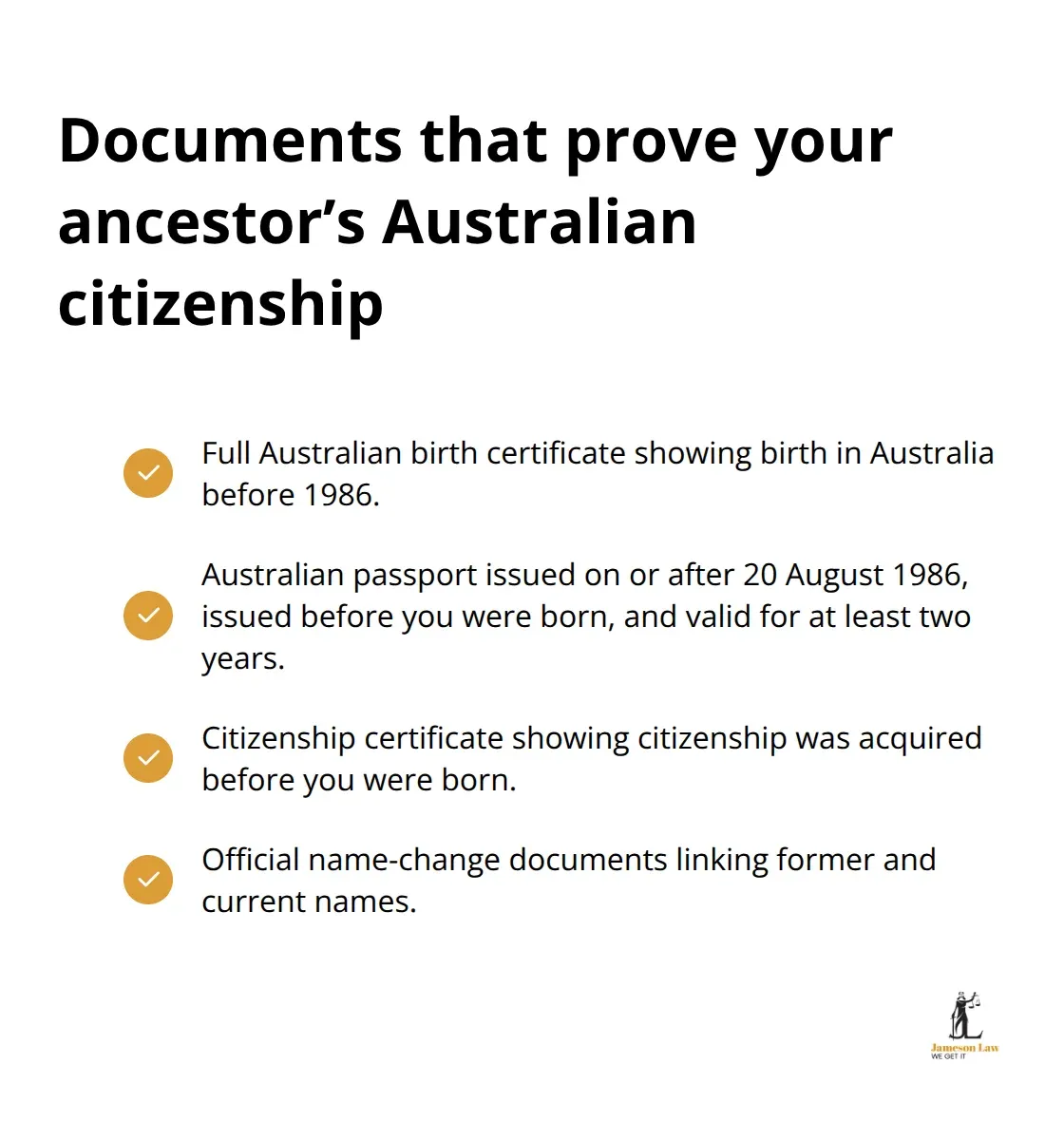
The Department will not progress your application without these connecting documents, and requesting them after lodgement creates significant delays.
Lodging Through ImmiAccount
You must submit everything through ImmiAccount, the official Department portal. Do not send documents by post or email to Home Affairs unless they specifically request it. ImmiAccount allows you to upload certified copies and track your application status in real time. Once lodged, your application enters a queue, and the Department contacts you only if they require additional documents or clarification. Silence from the Department does not mean approval-it typically means your application sits in the assessment queue.
Understanding Processing Timeframes
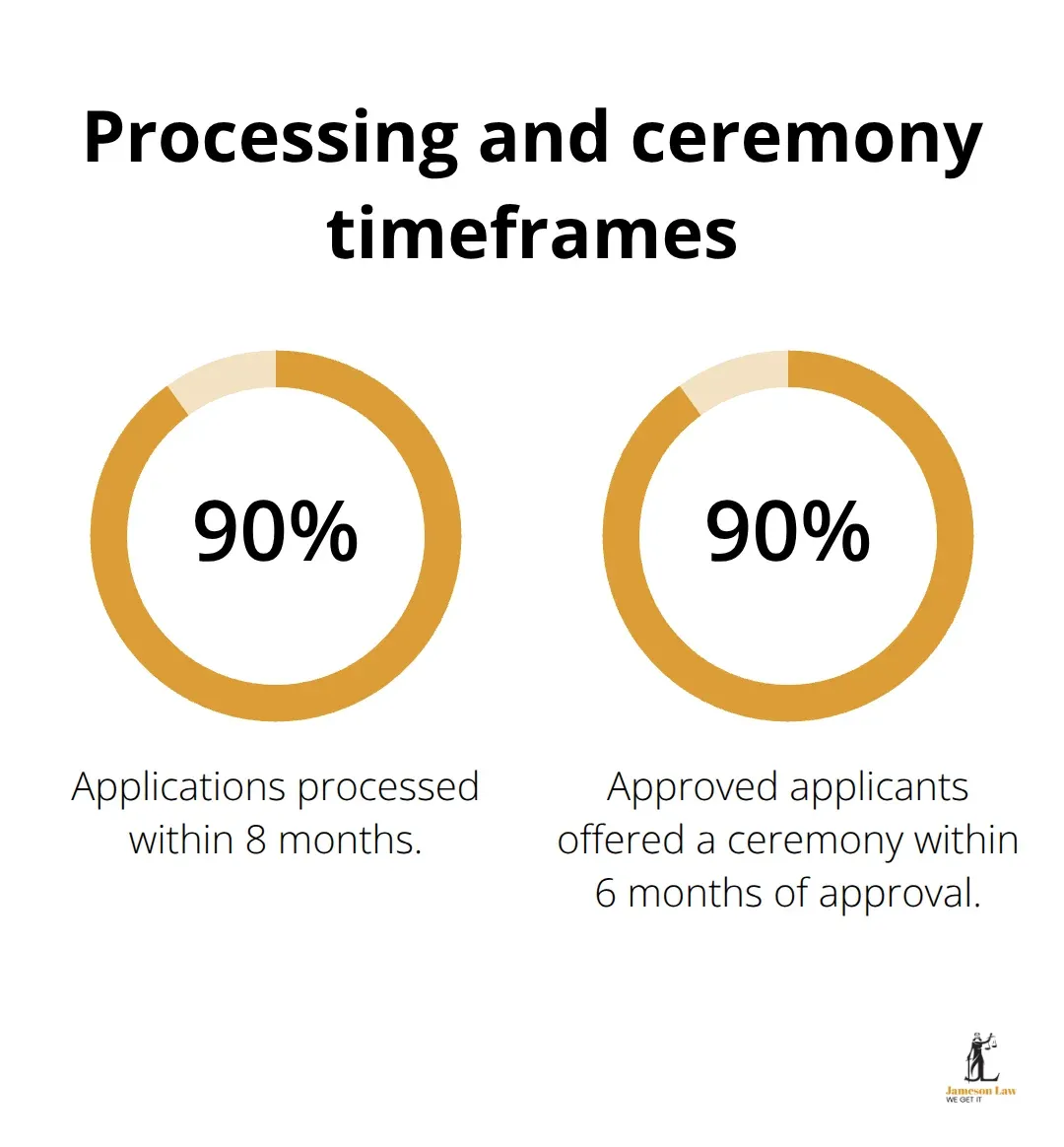
Processing times fluctuate considerably depending on application complexity and current Department workload. 90% of applications are processed within 8 months, and 90% of approved applicants will have the opportunity to attend a ceremony within 6 months of approval. The Department does not prioritise applications based on urgency or personal circumstances, so planning around realistic timeframes proves essential rather than hoping for faster processing.
Responding to Department Requests
Check ImmiAccount regularly for status updates and respond immediately to any Department requests, as failure to respond within the specified timeframe can result in application rejection. The Department may ask for clarification on documents, additional evidence of your ancestor’s citizenship, or proof of name changes (if applicable). Delays in responding compound processing times significantly. Some applications stall for months simply because applicants miss Department notifications or fail to provide requested information promptly. Your responsiveness directly affects how quickly the Department can assess your claim.
When the Department approves your application, you will receive notification through ImmiAccount, and the next phase involves understanding what happens after approval and how to obtain your citizenship certificate.
What Stops Citizenship by Descent Applications and How to Fix Them
Missing Documents Halt Most Applications
The gap between eligibility and approval is where applications fail. Most rejections stem from missing documents or incomplete evidence of your ancestor’s citizenship status rather than ineligibility itself. The Department of Home Affairs processes citizenship by descent applications with strict document requirements, and missing even one piece of evidence can halt your entire application.
Many applicants assume their parent’s or grandparent’s Australian residency proves citizenship, but residency and citizenship are fundamentally different. Your ancestor may have lived in Australia for decades without acquiring citizenship, which means their residency alone will not satisfy the Department. You must prove citizenship status through specific documents issued at specific times.
Original Australian birth certificates issued by state Registries of Births, Deaths and Marriages remain the strongest evidence, followed by passports issued after 1 January 2000 that remained valid for at least two years or citizenship certificates themselves. If your ancestor held none of these documents, your application faces significant difficulty. The Department will not accept statutory declarations alone or testimony from family members as proof of citizenship. Without documentary evidence, Home Affairs will request further information or reject your claim outright.
Historical Records Create Real Obstacles
Historical records present their own challenges. Birth certificates from the 1920s through 1960s are often damaged, poorly archived, or held by registries with limited digitisation. If your grandparent was born in a regional area or interstate, obtaining a certified copy can take three to four months through standard channels.
Some state registries charge significant fees for historical certificate searches, particularly when exact dates or names are unclear. Requesting expedited processing from registries rarely helps because they process applications in order regardless of urgency. This delay compounds when you lodge your application to the Department, as you cannot submit a complete file without these documents.
Name Changes Block Progress Without Proof
Name changes compound these delays substantially. If your parent or grandparent changed their name through marriage, deed poll, or other legal means, you must provide documents proving the connection between their former and current names. Marriage certificates are essential here, but obtaining historical marriage records from overseas or from decades ago presents real obstacles.
Some applicants discover their ancestor changed their name without formal documentation, which effectively blocks the application. The Department will not progress claims without clear documentary proof linking the former and current names. This is where the process becomes adversarial rather than administrative.
Department Assessments Require Prompt Responses
Home Affairs staff assess whether your documentation adequately proves the claimed connection, and their interpretation matters. If they believe the evidence is insufficient, they issue a request for further information. The Department sets specific deadlines, typically 28 days, and missing these deadlines results in application rejection.
Many applicants miss notifications because they fail to check ImmiAccount regularly or overlook emails from Home Affairs. Once rejected on this basis, you must lodge a new application and pay the application fee again. Your responsiveness directly affects how quickly the Department can assess your claim.
Seeking Legal Advice Before Lodgement
Applicants facing complex cases involving multiple name changes, overseas-born ancestors, or missing documents should seek legal advice early rather than attempting to navigate the process alone. A lawyer can review your specific circumstances and advise whether your documentation package is complete before you lodge, which prevents costly rejections and delays. The Department’s assessment process is not flexible, and incomplete applications waste months of your time.
Final Thoughts
Claiming Australian citizenship by descent requires methodical preparation and attention to detail. Your eligibility hinges on your parent or grandparent’s citizenship status at a specific moment in time, combined with your birth date and location. Verify your eligibility against the exact legislation and gather every document the Department of Home Affairs requires before you lodge anything, as missing even one piece of evidence delays your application significantly or results in rejection.
The application process itself moves forward once your documentation is complete. You lodge through ImmiAccount, track your progress online, and respond promptly to any Department requests. Most applications proceed within eight months, though complex cases involving name changes or overseas-born ancestors take longer. Original birth certificates, passports issued after 1 January 2000, and citizenship certificates provide your strongest evidence, while name-change documents prove essential if your ancestor changed their name at any point.
If your circumstances involve multiple name changes, overseas-born ancestors, or missing documents, seeking legal advice before you lodge prevents costly rejections and delays. Contact Jameson Law to discuss your citizenship by descent eligibility and next steps, and our team will review your specific situation and advise whether your documentation package is complete.