PUBLICATION

NSW Civil Litigation Basics: A Plain-Language Overview

"Understand NSW civil litigation basics with our plain-language guide to court processes, costs, and key steps involved in disputes."
NSW Civil Litigation Basics: A Plain-Language Overview

Civil disputes happen to businesses and individuals every day in NSW. Whether it’s a contract gone wrong, a property boundary issue, or unpaid debts, understanding NSW civil litigation basics helps you know what to expect.

We at Jameson Law have guided countless clients through the civil court system. This guide breaks down the process into plain language so you can make informed decisions about your situation.

What is Civil Litigation in NSW

Civil Litigation vs Criminal Law

Civil litigation handles disputes between people, businesses, and government organisations about rights and money, not criminal behaviour. Unlike criminal cases where the state prosecutes someone for breaking the law, civil disputes are typically started by private individuals or businesses seeking compensation or enforcing obligations. The standard of proof differs significantly: civil cases use the balance of probabilities (meaning the claim is more likely than not to be true), whereas criminal cases require proof beyond reasonable doubt. This lower threshold makes civil litigation more accessible for resolving everyday disputes.

Types of Civil Cases You Might Pursue

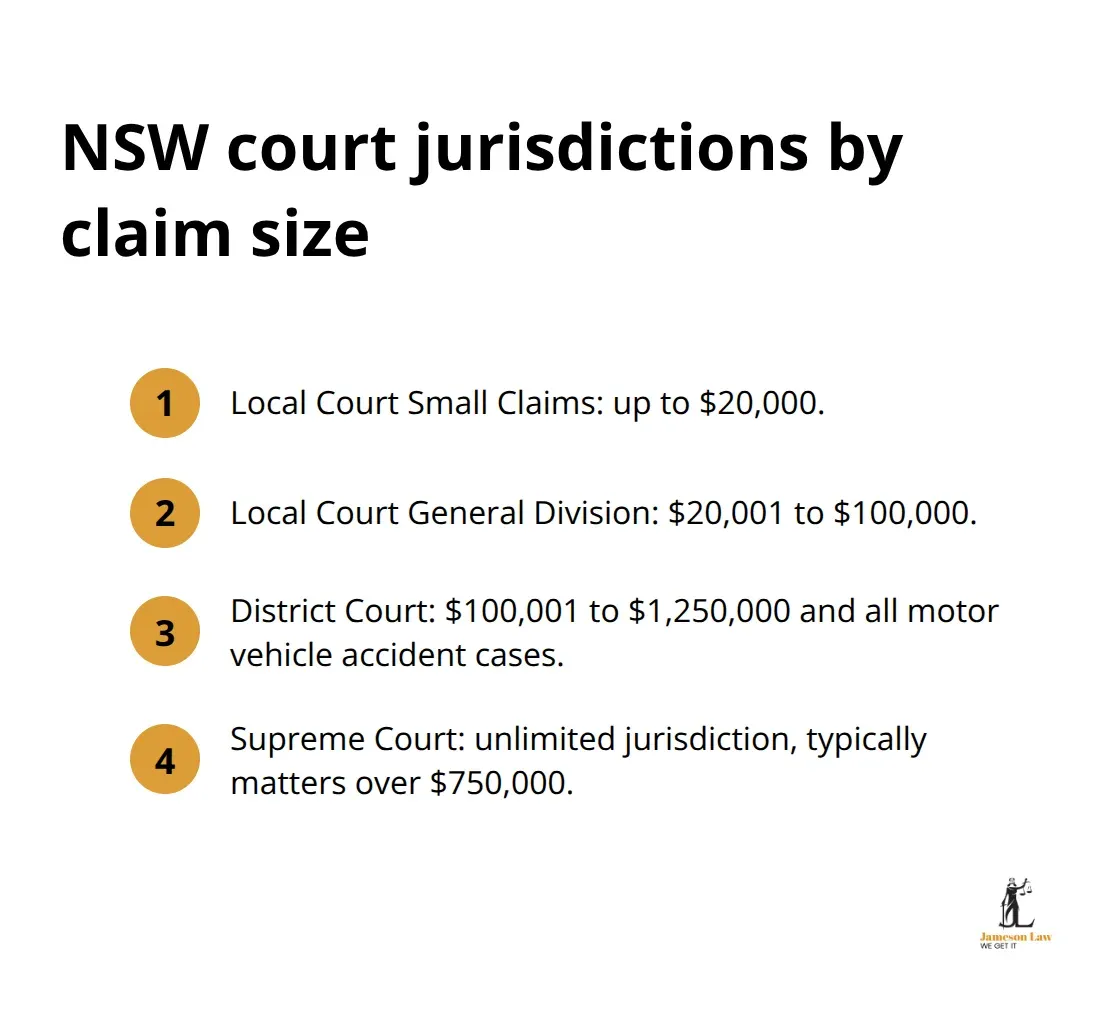
You might pursue civil action for contract breaches, unpaid debts, property disagreements, or personal injury claims due to negligence. NSW has structured its court system by claim value and subject matter to handle cases efficiently. The Local Court’s Small Claims Division handles claims up to $20,000, and the General Division handles claims over $20,000 up to $100,000. The District Court manages claims between $100,001 and $1,250,000 and handles all motor vehicle accident cases regardless of value. The Supreme Court has unlimited jurisdiction for claims exceeding $750,000.

Overview of NSW courts and the typical claim value ranges they handle

Specialist Courts and Tribunals

Specialist courts also exist for specific dispute types. The Land and Environment Court handles planning disputes and environmental breaches, while the NSW Civil and Administrative Tribunal covers tenancy, building works, and guardianship matters with faster timelines than traditional courts. Choosing the right forum matters because starting in the wrong court wastes time and money.

Matching Your Dispute to the Right Court

A contract dispute worth $50,000 belongs in the District Court, not the Local Court. Property boundary disputes typically go to the Land and Environment Court if government decisions are involved, otherwise to the appropriate general court. Debt recovery under $10,000 often resolves through demand letters before court action becomes necessary. Understanding which court handles your specific dispute type and value range sets you up for an efficient process. The next step involves exploring what happens before you actually file a claim in court.

How Civil Litigation Actually Unfolds in NSW

Resolving Disputes Before Court

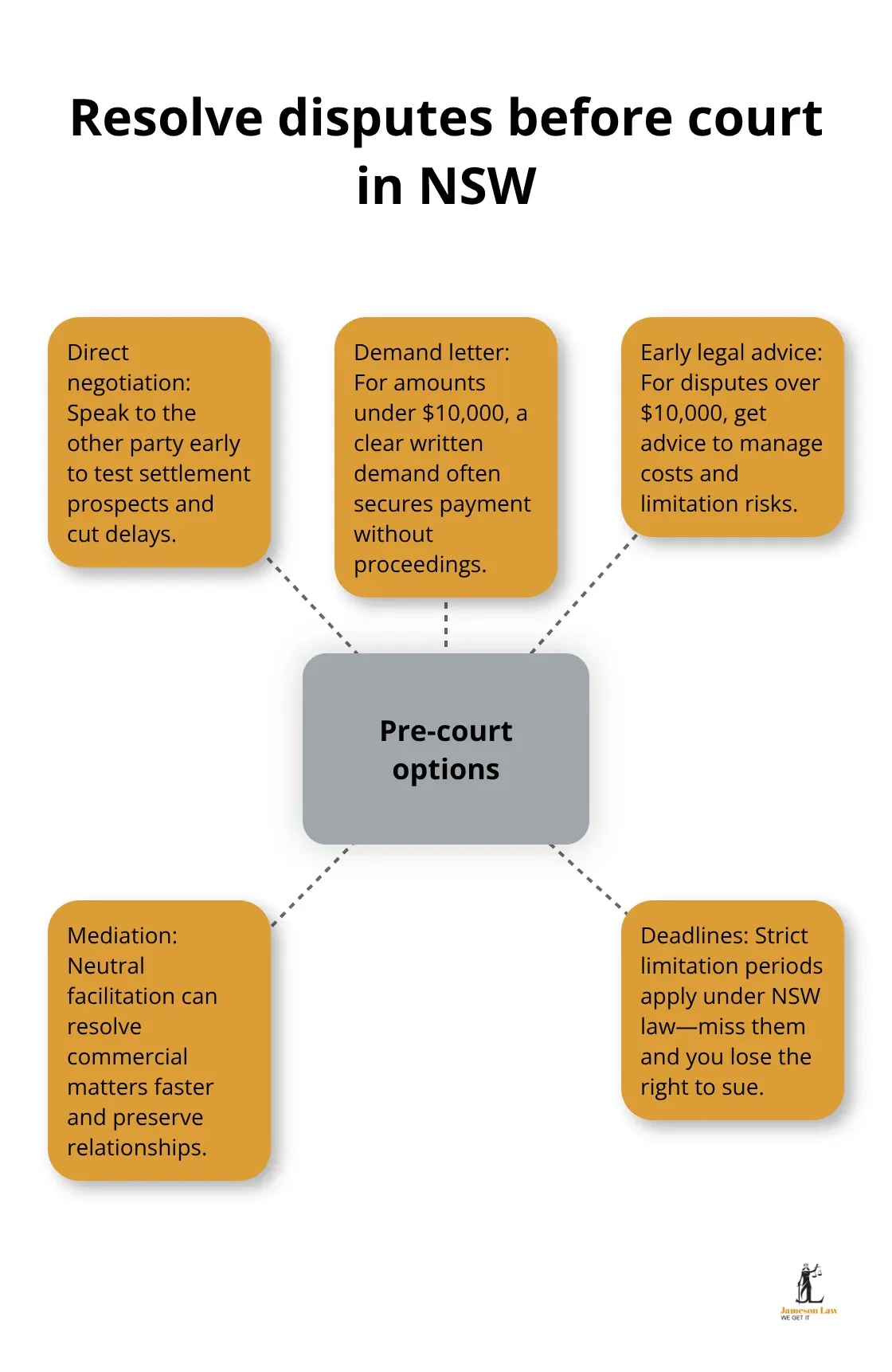
Before you file anything in court, you need to exhaust practical options that cost far less and move faster. Many clients could have resolved their disputes months earlier through direct negotiation or a formal demand letter. If you owe money under $10,000, a written demand letter often works without court involvement. For disputes over $10,000, seeking legal advice before starting proceedings is essential because court costs escalate quickly and time limits apply depending on your claim type. The Civil Procedure Act 2005 sets strict deadlines for different disputes, and missing them means you lose your right to sue entirely.

Pre-court pathways and why they matter in NSW civil disputes - NSW civil litigation basics

Talk directly to the other party first if possible, or send a professional demand letter outlining what you want and the timeframe for response. This conversation often reveals whether settlement is realistic before expensive litigation begins. If negotiation fails, mediation through alternative dispute resolution can resolve commercial disputes without a judge’s involvement. Many businesses find mediation saves thousands in legal fees and preserves working relationships, particularly when ongoing dealings matter.

Filing Your Claim in Court

Filing your claim requires precision because procedural mistakes cost time and money. In the District Court, you lodge a Statement of Claim or Summons identifying the court, the parties, and detailed claim information, along with filing fees set by the NSW District Court. The defendant then has 28 days to respond with a Defence; if they ignore this deadline, you can pursue a default judgment without a trial.

Once a defence is filed, the case enters case management with pre-trial conferences designed to encourage settlement before hearing dates arrive. The NSW District Court emphasises early settlement through this process because most civil cases never reach trial.

Evidence, Discovery, and Trial

Discovery follows, where both sides exchange documents and evidence. At trial, the judge hears the plaintiff’s case first, then witnesses give evidence or affidavits are filed, the defendant presents their defence, and final submissions happen before judgment. The balance of probabilities standard means you win if your claim is simply more likely true than false, not beyond reasonable doubt.

Enforcement and Settlement Options

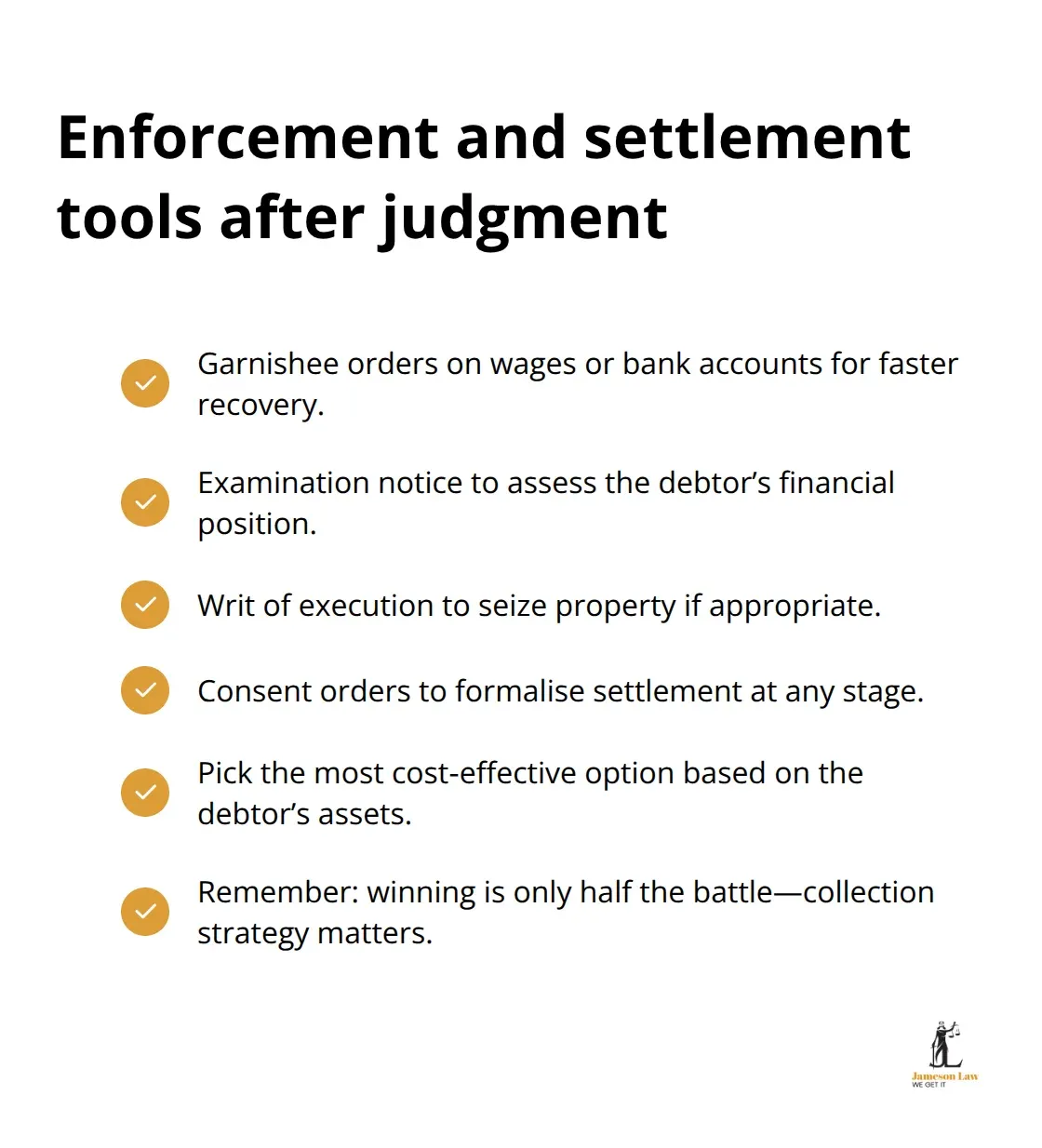
After judgment, if the other side loses and owes money, enforcement options include garnishee orders on wages or bank accounts, examination notices to establish their financial position, and writs of execution to seize property. Settlements can formalise as consent orders at any stage, which the court reviews before finalising, often saving both parties from proceeding further. Understanding these enforcement mechanisms matters because winning a judgment is only half the battle-collecting what you’re owed requires knowing your options. The specific type of dispute you face (whether contract, property, or debt-related) shapes which court handles your case and what evidence you’ll need to present.

Practical options to secure payment or conclude a matter after judgment in NSW - NSW civil litigation basics

Common Civil Disputes in NSW and How to Handle Them

Contract Breaches and Commercial Disagreements

Civil litigation is the legal process used to resolve disputes between individuals, businesses, or organisations through the court system. Contract disputes and commercial disagreements form the bulk of civil litigation in NSW, yet most businesses fail to document their agreements clearly enough to win in court. Vague terms about payment schedules or delivery dates create the real problem-not the breach itself. A contract worth $150,000 that lacks specifics about what each party owes will cost you $30,000 to $50,000 in legal fees to litigate, even if you win. The District Court handles these cases when they exceed $100,000, and judges apply the balance of probabilities test, meaning your evidence must simply be more convincing than the other side’s.

Written communications like emails, purchase orders, and invoices matter far more than verbal promises because courts need proof. If you’re owed money under a contract, collect every written exchange immediately-courts rarely accept someone’s word alone. Understanding commercial litigation strategies helps you navigate these disputes more effectively.

Property Disputes and Boundary Disagreements

Property disputes operate differently because they involve land, which courts treat with additional formality. Boundary disagreements often escalate unnecessarily when neighbours fail to obtain proper surveys before assuming they own additional land. The Land and Environment Court handles these cases when government decisions are involved, and the cost of litigation frequently exceeds the value of the disputed land. A $10,000 boundary dispute can cost $25,000 to resolve through court, making mediation far more sensible.

Debt Recovery and Time Limits

Debt recovery demands a different tactical approach because time limits apply strictly. The Uniform Civil Procedure Rules 2005 set different deadlines depending on your claim type-miss these and you lose the right to sue entirely. For debts under $10,000, send a formal demand letter first; most debtors pay when they realise you’re serious. For larger debts, act within the applicable limitation period or you forfeit your claim.

Enforcement Strategies After Judgment

Enforcement matters because winning a judgment doesn’t guarantee payment. Garnishee orders on bank accounts work better than writs of execution against property because they’re faster and cheaper. If the debtor has no assets, an examination notice reveals their financial position before you waste money on enforcement.

Why Strategy Matters From the Start

These three dispute types-contracts, property, and debt-require completely different evidence and strategies. Choosing the right approach from the start saves thousands in unnecessary legal costs.

Final Thoughts

Civil litigation in NSW doesn’t have to feel overwhelming once you understand the basic process. Most disputes resolve before trial through negotiation, mediation, or settlement discussions, which costs far less than court fees and legal expenses. Starting with a demand letter or direct conversation prevents costly procedural mistakes and helps you identify whether the other party will settle reasonably.

Timing matters enormously in civil litigation because missing limitation periods means you lose your right to sue entirely. The balance of probabilities standard means you simply need to prove your claim is more likely true than false, not beyond reasonable doubt, which makes civil litigation more accessible than criminal proceedings. Understanding NSW civil litigation basics helps you assess whether your claim has merit and which court handles your specific dispute.

When you face a civil dispute, getting legal advice early saves money and prevents mistakes. A lawyer can calculate realistic costs, identify the correct court, and advise whether settlement makes sense for your situation. We at Jameson Law provide practical, accessible advice tailored to your specific circumstances-contact us to discuss your options with someone who understands your dispute.

Speak to an Expert Lawyer today

Laywers-Jameson-Law-The-best-law-firm-in-Sydney- Sydney Lawyers - Sydney
BOOK NOW

WE'RE IN IT TO WIN IT

Book your consultation

Book Now
Book Now Mobile 06 02 2025

This form submission is encrypted and secured to ensure your information remains confidential.

What our Clients

Related Publications:

What our clients say

.

Jameson Law - Voted the Best Law firm in Sydney Award

Legal Answers ... In Short

We're here to help

Our mission is to ensure our client matters are resolved successfully every time. Success to us does not simply involve winning, but moreover ensuring we take the most feasible, economic and stress-free path to help our clients achieve their goals. We fight hard for our clients, and always go by the motto: we’re in it to win it.

Jameson Law - Best Law Firm in Sydney

WE'RE IN IT TO WIN IT

Book your consultation

Call us now on (02) 8806 0866 or fill out the form below

Book Now Mobile

This form submission is encrypted and secured to ensure your information remains confidential.

WE'RE IN IT TO WIN IT

Book your consultation

Book Now Mobile 06 02 2025
lock

This form submission is encrypted and secured to ensure your information remains confidential.

Our Sydney Offices

Offices Parramatta and Sydney Jameson Law
Parramatta CBD - Head Office
jameson Law - Blacktown
jameson Law - Liverpool Office
Jameson Law - Bankstown
Court Houses We Frequent Jameson Law

Court Houses We Frequent

Balmain Local Court

Registry: Monday to Friday, 9:00am to 4:30pm

Bankstown Local Court

Court Operating Hours: 9:30am-4:30pm

Blacktown Local Court

Registry Hours: 9:00 – 4:30
Telephone Hours: 8:30 -4:30
Days open: Mon-Fri

Burwood Local Court

Registry Hours: 9:00 – 4:30
Telephone Hours: 8:30 – 4:30
Days open: Mon – Fri

Campbell Local Court

Registry Hours: 9:00 – 4:30
Telephone Hours: 8:30 – 4:30
Days open: Mon – Fri

Central Local Court

Registry Hours: 9:00 – 1:00 and 2:00 – 4:30
Telephone Hours: 8:30 – 4:30

Downing Local Court

Registry Hours: 9:00 – 1:00 and 2:00 – 4:30
Telephone Hours: 8:30 – 4:30

Wollongong Local Court

Registry Hours: 9:00 – 1:00 and 2:00 – 4:30
Telephone Hours: 8:30 – 4:30

Fairfield Local Court

Registry Hours: 9:00 – 1:00 and 2:00 – 4:30
Telephone Hours: 8:30 – 4:30

Hornsby Local Court

Registry Hours: 9:00 – 1:00 and 2:00 – 4:30
Telephone Hours: 8:30 – 4:30

Liverpool Local Court

Registry Hours: 9:00 – 1:00 and 2:00 – 4:30
Telephone Hours: 8:30 – 4:30

Manly Local Court

Registry Hours: 9:00 – 1:00 and 2:00 – 4:30
Telephone Hours: 8:30 – 4:30

Newtown Local Court

Registry Hours: 9:00 – 1:00 and 2:00 – 4:30
Telephone Hours: 8:30 – 4:30

Parramatta Local Court

Registry Hours: 9:00 – 1:00 and 2:00 – 4:30
Telephone Hours: 8:30 – 4:30

Penrith Local Court

Registry Hours: 9:00 – 1:00 and 2:00 – 4:30
Telephone Hours: 8:30 – 4:30

Sutherland Local Court

Registry Hours: 9:00 – 1:00 and 2:00 – 4:30
Telephone Hours: 8:30 – 4:30

Waverley Local Court

Registry Hours: 9:00 – 1:00 and 2:00 – 4:30
Telephone Hours: 8:30 – 4:30

Windsor Local Court

Registry Hours: 9:00 – 1:00 and 2:00 – 4:30
Telephone Hours: 8:30 – 4:30

Wollongong Local Court

Registry Hours: 9:00 – 1:00 and 2:00 – 4:30
Telephone Hours: 8:30 – 4:30

Downing Centre District Court

Registry Hours: 9:00 – 4:30
Telephone Hours: 8:30 – 4:30
Days open: Mon – Fri

Parramatta District Court

Registry Hours: 9:00 – 4:30
Days open: Mon-Fri

Penrith District Court

Registry Hours: 9:00 – 4:30
Days open: Mon-Fri

Campbelltown District Court

Registry Hours: 9:00 – 4:30
Days open: Mon – Fri

Liverpool District Court

Registry Hours: 9:00 – 4:30
Days open: Mon – Fri

Wollongong District Court

Registry Hours: 9:00 – 1:00 and 2:00 – 4:30
Telephone Hours: 8:30 – 4:30

Supreme Court New South Wales

Registry Hours: 9:00 AM – 4:30 PM
Telephone Hours: 8:30 AM – 4:30 PM
Days Open: Monday to Friday

Federal Circuit and Family Court of Australia

Registry Hours: 9:00 AM – 4:30 PM
Telephone Hours: 8:30 AM – 5:00 PM
Days Open: Monday to Friday

Federal Court

Monday to Friday, 8:30 AM – 4:30 PM

High Court

Monday to Friday, 8:30 AM – 5:00 PM

Children’s Court of New South Wales

Registry Hours: 9:00 AM – 4:30 PM
Telephone Hours: 8:30 AM – 4:30 PM
Days Open: Monday to Friday

Coroner’s Court New South Wales

Registry Hours: 9:00 AM – 4:30 PM
Telephone Hours: 8:30 AM – 4:30 PM
Days Open: Monday to Friday

Industrial Relations Commission of New South Wales

Registry Hours: 9:00 AM – 4:30 PM
Telephone Hours: 8:30 AM – 4:30 PM
Days Open: Monday to Friday

Land and Environment Court of New South Wales

Registry Hours: 9:00 AM – 4:30 PM
Telephone Hours: 8:30 AM – 4:30 PM
Days Open: Monday to Friday

WE'RE IN IT TO WIN IT

Book your consultation

Book Now
Book Now Mobile 06 02 2025
lock

This form submission is encrypted and secured to ensure your information remains confidential.