Moving to Australia requires understanding your options. Whether you’re skilled, sponsored by family, or planning to invest, different pathways suit different circumstances.
At Jameson Law, we help people navigate these routes with clarity. This guide breaks down visa types, processing times, and how to choose what works for you.
Your Visa Options
Skilled Migration Pathways
Australia’s skilled migration programme targets workers who address labour shortages and contribute economically. According to the Department of Home Affairs, permanent skilled visas have a median processing time of 10 months as of April 2026. Temporary skilled visas move faster, with a median of 63 days, but this depends heavily on application completeness. You should lodge all required documentation upfront to avoid delays.
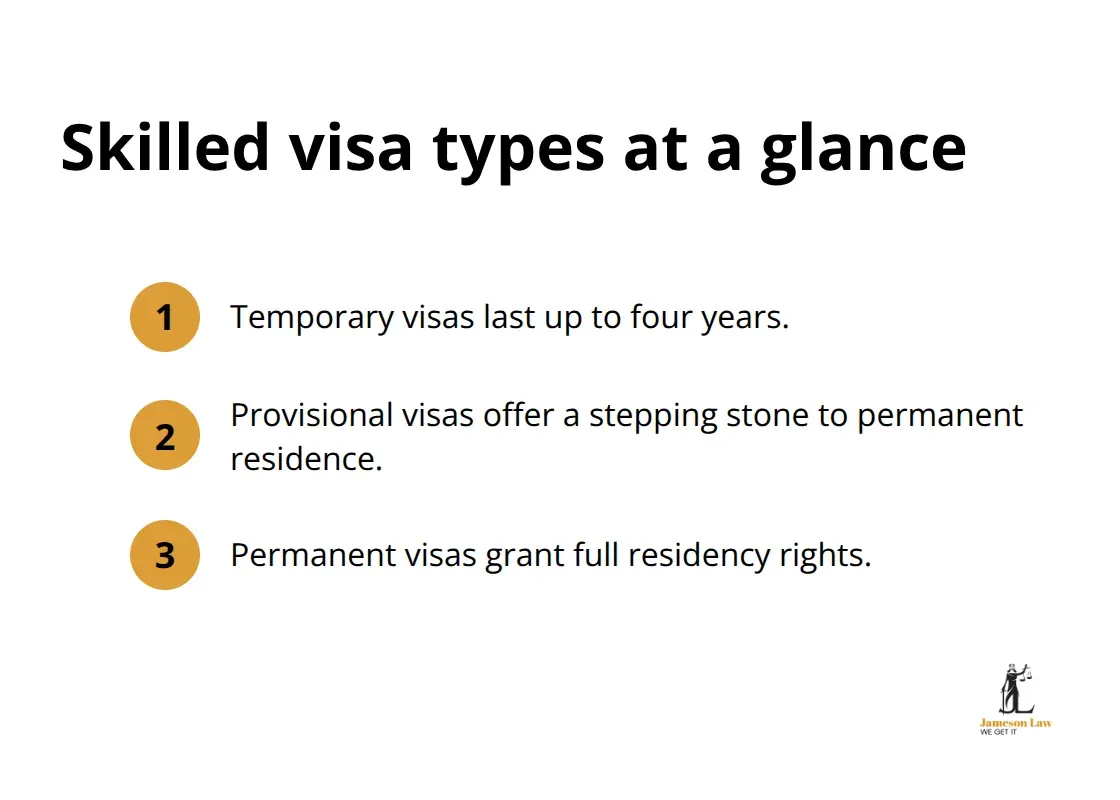
The Skilled Occupation List determines whether your role qualifies. Verify your occupation sits within eligible ANZSCO unit groups before investing time in an application. Skilled visas come in three main forms: temporary visas lasting up to four years, provisional visas offering a stepping stone to permanent residence, and permanent visas granting full residency rights.
Ministerial Direction No. 105 prioritises employer-sponsored visas in regional areas, healthcare and teaching occupations, and visas from accredited sponsors. Applications in these categories may process faster than others. If you hold employment or have a job offer, employer sponsorship often provides the most direct pathway.
Regional and Designated Area Options
Regional visas present another strong option, particularly if you are willing to work outside Sydney or Melbourne. Designated Area Migration Agreements expand occupation access in certain regions beyond standard skilled programme limits, sometimes offering faster settlement opportunities. These agreements help designated areas address labour shortages by broadening access to overseas workers.
Family Sponsorship Visas
Family sponsorship visas operate on different timelines and criteria. Partner visas, whether provisional or permanent, have a median processing time of 18 months according to Home Affairs. The Department prioritises older applications to manage complexity. If you have an Australian citizen or permanent resident partner, this route may suit you, but relationship evidence requirements are rigorous and documentation must be comprehensive.
Business and Investment Visas
Business and investment visas target entrepreneurs and investors who seek to establish Australian enterprises or contribute capital. These visas require substantial financial commitment and business planning, making them suitable only if you have genuine commercial intent and capital reserves. Unlike skilled migration, business visas do not rely on occupation lists but instead assess your business viability and investment capacity. Processing times vary significantly depending on application complexity and whether your business operates in a priority sector.
Selecting Your Pathway
All three pathways demand careful preparation and realistic assessment of your circumstances against eligibility criteria. Your choice depends on whether you have in-demand skills, family connections in Australia, or investment capital. The next section examines processing times and documentation requirements in detail, helping you understand what each pathway demands before you commit to an application.
How Long Will Your Visa Application Take
Processing times vary dramatically depending on which visa you pursue, and understanding these timelines helps you plan realistically. According to the Department of Home Affairs, permanent skilled visas take a median of 10 months as of March 2026, while temporary skilled visas process in around 63 days.
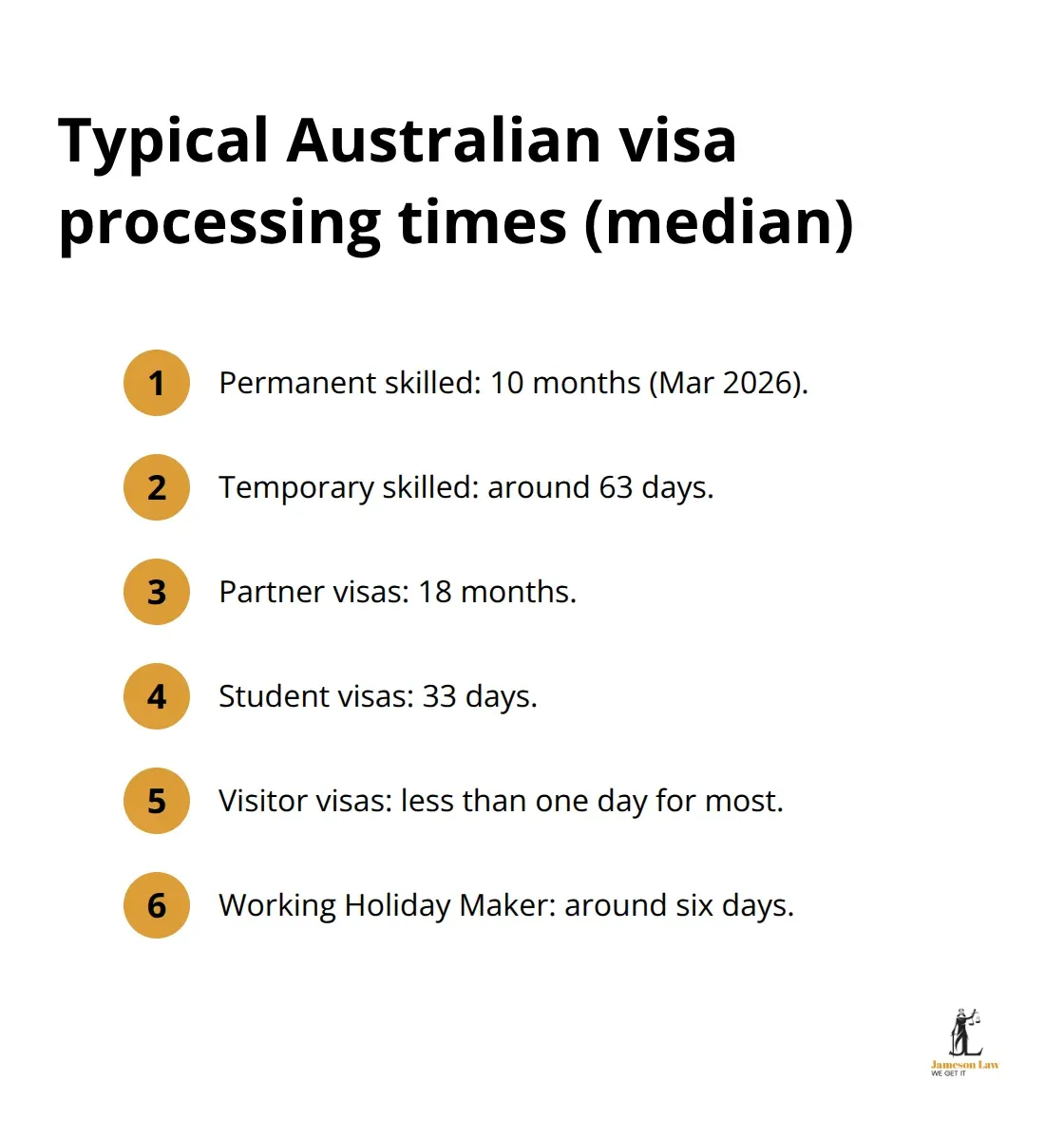
Partner visas stretch much longer at 18 months median processing time, reflecting the complexity of relationship assessments. Student visas move faster at 33 days median, and visitor visas are quickest at less than one day for most applications. Working Holiday Maker visas sit around six days. These figures matter because they shape your entire migration strategy. If you need to move within three months, a temporary skilled visa or student visa becomes realistic, but permanent skilled migration requires patience and advance planning.
Application Completeness Determines Your Timeline
Application completeness determines whether you hit these median timelines or exceed them significantly. The Department of Home Affairs emphasises that incomplete applications cause the most common delays for temporary skilled visas. You should submit every required document when you lodge your application, not after receiving requests. For temporary skilled visas specifically, you will accelerate processing substantially if you lodge your complete nomination and visa application together rather than separately. Health assessments and character checks happen in parallel with your application review, not sequentially, so these do not necessarily add months to your timeline.
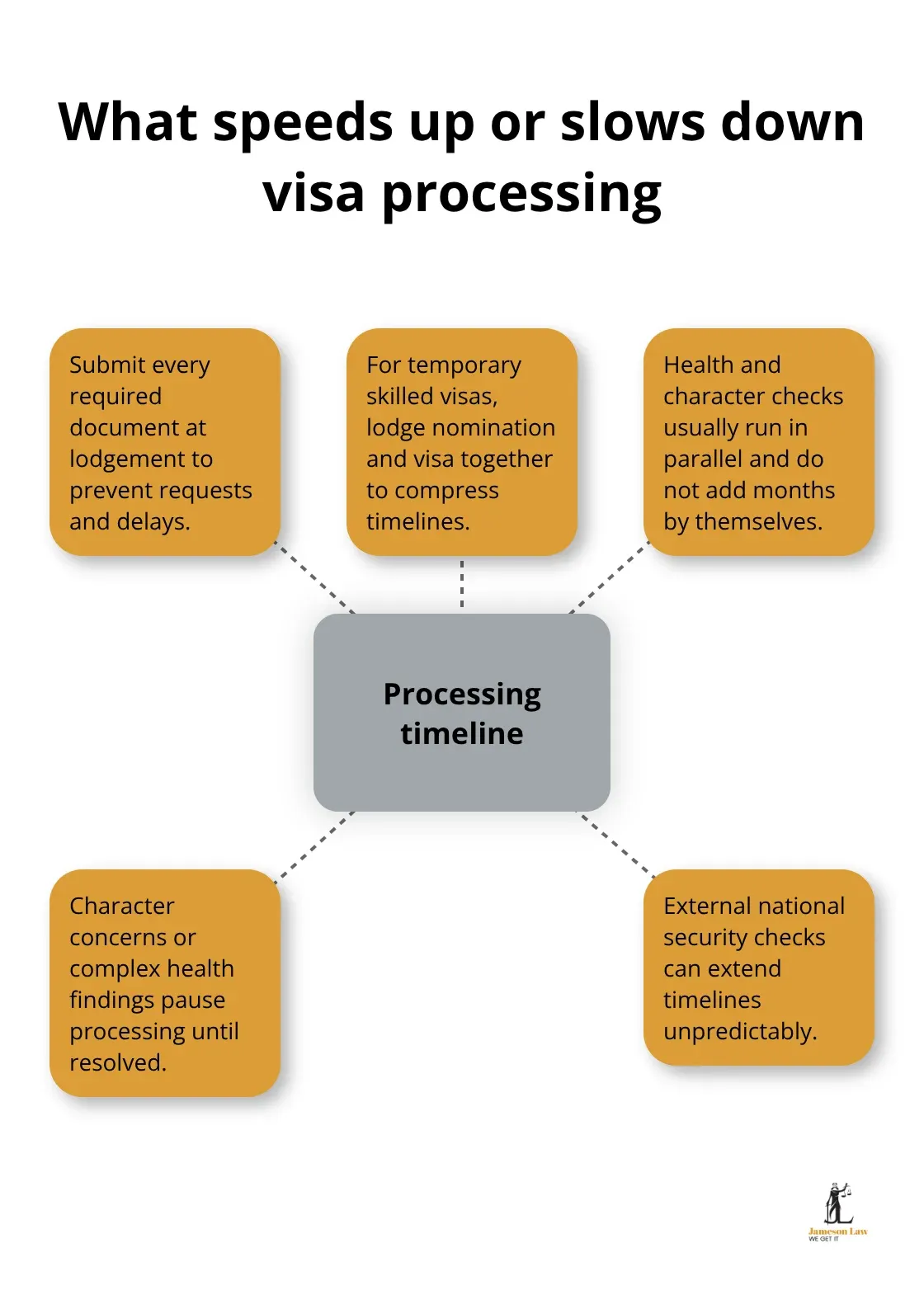
However, if the Department identifies issues during character checks or if your health assessment reveals conditions requiring further investigation, processing halts until matters resolve. External agency checks for national security purposes can also extend timelines unpredictably.
Priority Processing and Queue Position
Ministerial Direction No. 105 prioritises employer-sponsored visas in regional areas, healthcare occupations, and teaching roles, meaning these applications process ahead of general skilled migration applications regardless of lodgement date. Your application sits in a priority queue, not a first-come-first-served queue. If you fall outside these priority categories, your application waits longer even if submitted months earlier than a prioritised application. This system means your position in the queue depends on your visa type and occupation, not on when you applied.
Documentation Requirements Vary Significantly
Documentation requirements differ substantially between visa types, so you must gather the correct documents to avoid wasting weeks. Skilled visa applications demand skills assessments from recognised assessing authorities that verify your occupation matches the Skilled Occupation List. These assessments themselves take four to eight weeks to complete, so you should start this process before lodging your visa application. Employer-sponsored visas require detailed labour market testing evidence proving the employer advertised the position to Australian workers first. Family sponsorship visas demand extensive relationship evidence including joint financial documents, communication records, and statutory declarations from people who know the couple. Business visas require detailed financial statements, business plans, and evidence of capital. Character assessments require police certificates from every country where you have lived for more than three months, and these certificates take varying periods to obtain depending on the country. Health assessments require specific medical examinations at designated panel doctors, and these appointments often have waiting lists of several weeks in regional areas. You should gather documentation strategically before lodging your application to prevent the Department requesting missing items, which restarts processing timelines.
Planning Your Documentation Strategy
The complexity of documentation requirements means you must plan your application timeline backwards from your target move date. If you need a skills assessment (typically four to eight weeks), police certificates from multiple countries, and health examinations, your total preparation period extends well beyond the visa processing time itself. Starting documentation collection three to four months before you intend to lodge your visa application gives you realistic breathing room. This approach also reduces the risk of submitting incomplete applications that trigger additional requests and delays. Your choice of visa type directly affects how much documentation you must prepare, so understanding these requirements before you commit to a pathway helps you assess whether that option truly suits your circumstances and timeline.
Which Visa Pathway Suits Your Situation
Your choice between skilled migration, family sponsorship, and business visas depends entirely on your actual circumstances, not on which pathway sounds easiest. Most people pursuing Australian migration fall into one category clearly, and attempting to force yourself into a mismatched visa type wastes months and money. Start by honestly assessing where you stand across three dimensions: your occupational credentials, your family connections in Australia, and your financial capacity.
Skilled Migration: Qualifications and Work Experience
If you hold qualifications and work experience in an occupation listed on the Skilled Occupation List within an eligible ANZSCO unit group, skilled migration becomes your realistic option. This pathway requires you to obtain a formal skills assessment from a recognised assessing authority, which typically takes four to eight weeks and costs between 300 and 800 dollars depending on your occupation and the assessing body. The assessment confirms your qualifications and experience genuinely match the occupation standard.
Temporary skilled visas process in around 63 days according to the Department of Home Affairs, but only if you submit a complete application with all documentation from day one. Permanent skilled visas take a median of 10 months as of March 2026. If your occupation falls within healthcare or teaching, or if you secure employment in a regional area, Ministerial Direction No. 105 prioritises your application ahead of general skilled migration applications regardless of when you lodged it. This priority system means your occupation and employment location directly affect your processing timeline.
Employer Sponsorship and State Nomination Routes
Employer sponsorship typically offers the fastest skilled pathway because employers can lodge nomination and visa applications together, compressing your timeline significantly compared to state nomination or independent migration routes. However, employer sponsorship requires you to find an Australian employer willing to sponsor you, which itself takes time and persistence.
If you lack employment offers but have strong qualifications, state nomination through NSW provides another skilled route, though NSW nomination remains exceptionally competitive according to the Department of Home Affairs. NSW uses a selection-based invitation process where you submit an Expression of Interest and wait for invitation rounds that occur throughout the financial year with no publicly announced dates. Being invited does not guarantee nomination. The invitation remains valid for only 14 days, and after payment the nomination assessment typically takes about six weeks.
Family Sponsorship: Established Relationships
Family sponsorship becomes your pathway if you have an Australian citizen or permanent resident partner, parent, or sibling willing to sponsor you. Partner visas have a median processing time of 18 months, reflecting the extensive relationship evidence the Department requires. You must provide joint financial documents, communication records spanning your relationship, and statutory declarations from people who know you as a couple. The Department prioritises older applications to manage case complexity, so your position in the queue depends on application age, not occupation or priority category.
This visa type suits only those with genuine established relationships because the Department investigates relationship authenticity rigorously and fraudulent claims result in permanent visa refusal and potential criminal prosecution. Other family sponsorship visas for parents or siblings have even longer processing times and stricter financial requirements, so these options apply only to specific circumstances.
Business and Investment: Capital and Commercial Intent
Business and investment visas represent your third pathway, suitable only if you have genuine capital, a viable business plan, and honest commercial intent. These visas require substantial financial commitment typically ranging from 200,000 to 500,000 dollars depending on the specific visa subclass and your circumstances. Unlike skilled migration, business visas do not rely on occupation lists but instead assess your business viability, financial capacity, and whether your venture contributes economically to Australia. Processing times vary significantly based on application complexity and whether your business operates in a priority sector.
Your business plan must demonstrate genuine market research, realistic financial projections, and evidence you possess relevant business experience. The Department scrutinises business visas carefully because they attract applicants with limited genuine commercial intent, so superficial plans or unrealistic projections result in refusal. If you lack substantial capital or cannot articulate a genuine business opportunity, this pathway wastes your time and money.
Final Thoughts
Australia offers multiple pathways to migration, but no single route suits everyone. Your choice between skilled migration, family sponsorship, and business visas depends on your actual circumstances, not on which option appears simplest. Skilled migration works if you hold qualifications and experience in an occupation listed on the Skilled Occupation List and can obtain a skills assessment, while family sponsorship applies only if you have an established relationship with an Australian citizen or permanent resident willing to sponsor you. Business and investment visas require genuine capital and a viable commercial plan.
The key factors determining your success are honesty about where you stand and realistic planning around processing times. A temporary skilled visa processes in 63 days and requires complete documentation from day one, while permanent skilled migration at 10 months median demands advance preparation of skills assessments and police certificates. Partner visas stretch to 18 months and require extensive relationship evidence you must gather over months, so starting your documentation strategy three to four months before lodging your application prevents incomplete submissions that trigger delays and additional requests.
Your next step depends on which pathway matches your circumstances. If you hold relevant qualifications, verify your occupation sits within eligible ANZSCO unit groups on the Skilled Occupation List and contact a skills assessing authority to understand assessment costs and timelines. If you have family in Australia, confirm whether they can sponsor you and what relationship evidence you must gather, or if you plan to invest, develop a detailed business plan and confirm your capital position against visa requirements. Jameson Law helps people navigate immigration law with clarity and confidence, so contact our immigration law team if you need guidance understanding which pathway suits your circumstances or assistance preparing your application.