PUBLICATION

Waves of Migration to Australia: A Historical Overview

"Explore waves of migration to Australia from colonial times through modern diversity, immigration policy shifts, and cultural impact on the nation."
Waves of Migration to Australia: A Historical Overview

Australia’s migration story spans over 65,000 years, from Indigenous settlement through European colonisation to modern skilled migration programmes. The waves of migration to Australia have fundamentally shaped the nation’s economy, culture, and identity.

At Jameson Law, we recognise that understanding this history is essential for anyone navigating Australia’s current immigration landscape. This overview traces how successive migration movements have transformed Australia into one of the world’s most multicultural societies.

How Indigenous Australians and European Colonisers Shaped Australia’s First Migration Waves

Indigenous Settlement: 65,000 Years of Continuous Culture

Australia’s migration story did not begin with Europeans. Indigenous Australians arrived at least 65,000 years ago and established the world’s oldest continuous culture across the continent. Archaeological evidence reveals sophisticated settlement patterns, with Indigenous peoples developing intricate knowledge systems tied to land management, seasonal movement, and resource distribution. This was not random migration-it was purposeful settlement shaped by deep understanding of Australia’s diverse environments.

When European explorers arrived in the late 1700s, they encountered hundreds of distinct nations with their own languages, trade networks, and territorial boundaries. These societies had occupied Australia for 65 millennia, yet European maps and records largely ignored their existence.

Terra Nullius and the Misrepresentation of Indigenous Australia

Captain James Cook’s 1770 voyage mapped the eastern coastline and asserted terra nullius, claiming the land as empty and uninhabited. This assertion fundamentally misrepresented the reality of thriving Indigenous societies that had occupied Australia for thousands of generations. The legal fiction of terra nullius would shape colonial policy for nearly two centuries, providing the ideological foundation for dispossession and displacement.

Convict Transportation: Forced Migration and Colonial Settlement

The first European migration wave arrived as convicts and their guards starting in 1788. Britain and Ireland transported over 160,000 convicts to establish the penal colonies. This forced migration created Australia’s initial European population, fundamentally different from voluntary migration elsewhere. Convicts were not settlers seeking opportunity-they were coerced labourers sent to remote colonies as punishment.

Alongside convicts came free settlers, soldiers, and administrators who formed the colonial infrastructure. These early arrivals displaced Indigenous populations through frontier violence, disease, and systematic dispossession of land. The colonial period introduced European law, institutions, and agricultural practices that reshaped the continent’s landscape.

Colonial Foundations and Modern Immigration Law

The legal frameworks that govern modern immigration have roots in this colonial era. Colonial authorities established exclusionary policies and racial hierarchies that persisted well into the twentieth century. Understanding this period is essential for anyone engaging with Australia’s current immigration system, as contemporary migration law reflects decisions made during the colonial period.

The dispossession and racial exclusion that characterised early European settlement would shape Australia’s approach to immigration for generations. As Australia moved into the nineteenth century, these colonial foundations would influence which migrants could enter the country and how they were treated once they arrived.

Gold Rush and Industrial Transformation

The 1850s Gold Rush Reshapes Migration Patterns

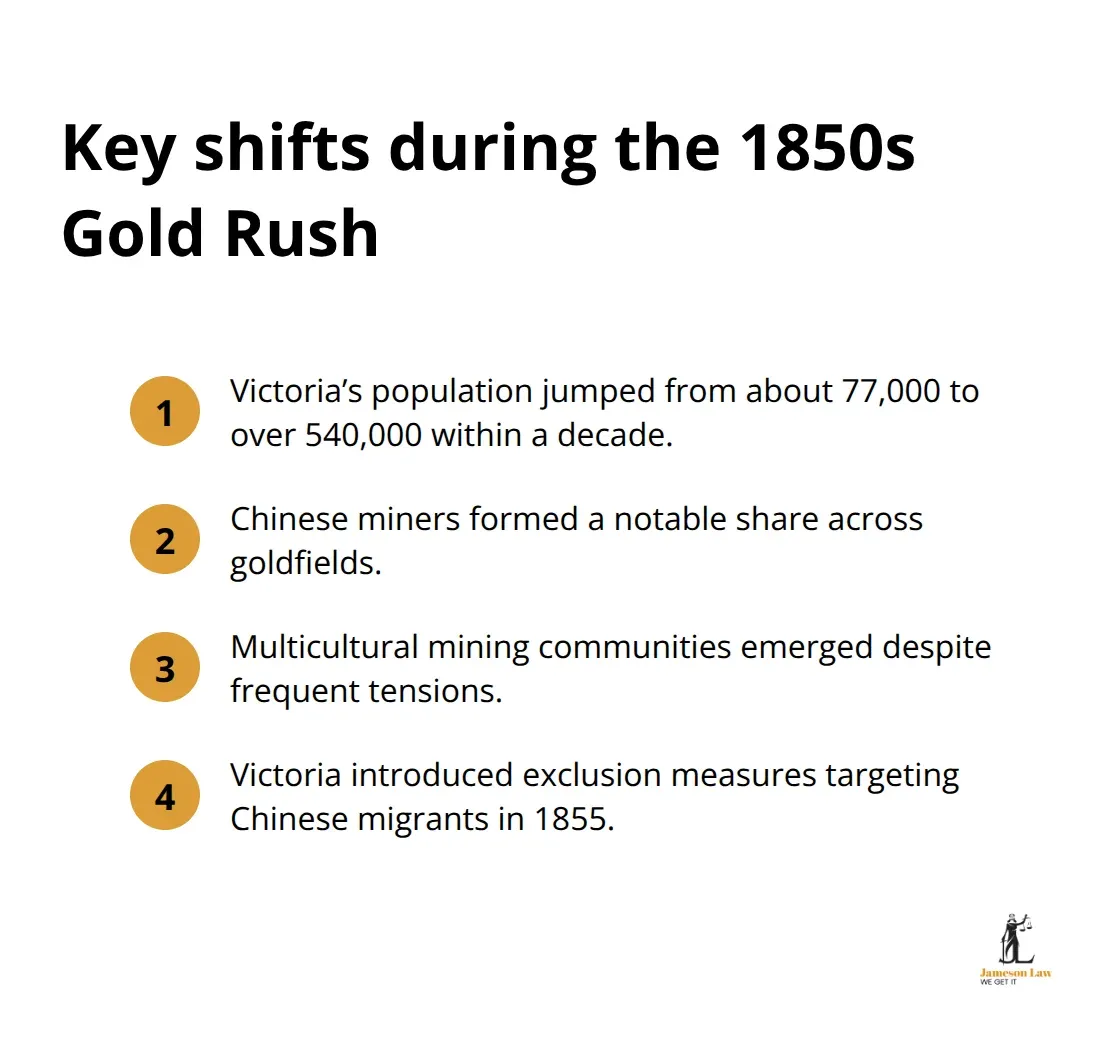
The 1850s gold rush fundamentally altered Australia’s migration patterns and shattered the colonial exclusivity that had defined the first sixty years of European settlement. When gold was discovered in Victoria in 1851, it triggered one of the largest voluntary migrations in Australian history. Within a decade, Victoria’s population exploded from around 77,000 to over 540,000 people.

Concise list highlighting population surge, Chinese miners’ role, multicultural communities, and early exclusion policies during Australia’s 1850s gold rush.

Chinese miners formed a substantial portion of this wave, though their numbers varied significantly across different goldfields.

Chinese communities established market gardens, restaurants, and laundries that became permanent fixtures in Australian towns. This economic contribution was met with racial hostility. Australia enacted early exclusion measures, including Victoria’s 1855 Immigration Restriction Act targeting Chinese migrants, establishing a pattern of discriminatory policy that would intensify over the next century. The gold rush also brought migrants from America, Germany, and other parts of Europe, creating genuinely multicultural mining communities despite the racial tensions that frequently erupted.

Post-War Migration and the Populate or Perish Campaign

Post-World War II migration represented a deliberate policy shift driven by the Populate or Perish campaign. Australia launched assisted passage schemes for British migrants, the famous Ten Pound Poms, but this programme was only the beginning. Between 1947 and 1953, Australia welcomed approximately 170,000 Displaced Persons from southern, eastern, and northern Europe, fundamentally changing the nation’s ethnic composition.

Large passenger liners like the Orcades, Fairsea, and Castel Felice transported tens of thousands of migrants across 35 to 40 days via the Suez route. The Empire Settlement Scheme brought over 200,000 British immigrants from 1922 onwards, while the Big Brother Movement transported approximately 12,264 young men. Migrants powered key sectors including mining, agriculture, sugar production, and services. The shift from exclusively British migration to European diversity laid groundwork for later multiculturalism, though official policy remained restrictive toward non-European migrants.

Refugee Waves and Seaborne Journeys

The 1960s and 1970s saw additional waves from Indochina, with East Timorese arrivals and larger numbers from Vietnam, Cambodia, and Laos arriving as refugees. These seaborne refugee journeys persisted into recent decades, often involving people-smuggling networks and generating political controversy that continues today.

Contemporary Migration and Demographic Shifts

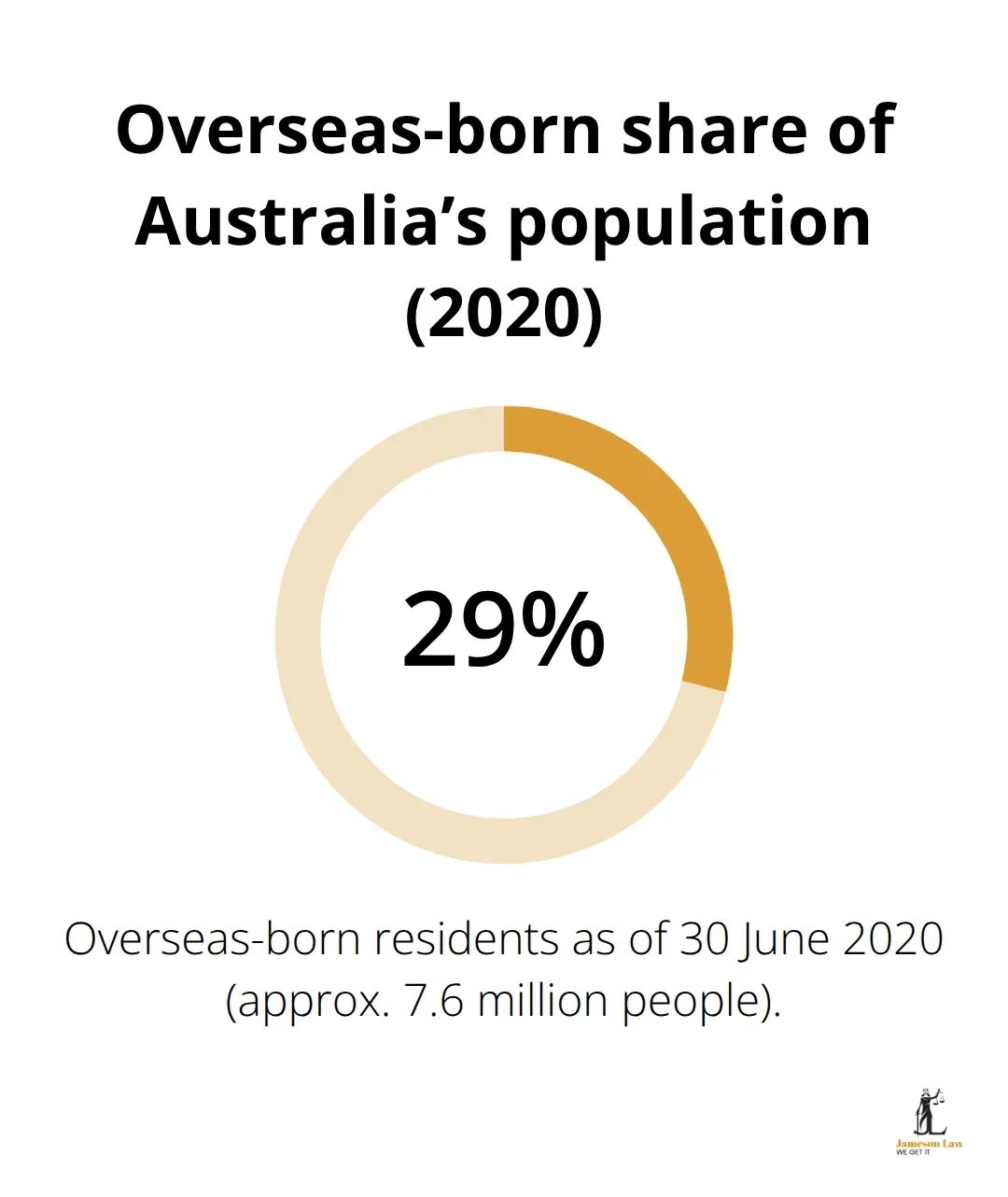
Modern data from the Australian Bureau of Statistics shows that overseas-born residents comprised 29.8% of Australia’s population as of 30 June 2020-approximately 7.6 million people. England remained the largest single overseas-born country with about 980,400 residents.

Percentage of Australia’s population that was overseas-born in 2020, based on ABS data. - waves of migration to australia

This reflects how post-war migration policy fundamentally repositioned Australia from a predominantly British nation toward genuine multicultural diversity, with contemporary arrivals dominated by skilled migrants from Asia rather than refugees or assisted British settlers.

These demographic transformations set the stage for Australia’s modern immigration framework, which now operates through multiple pathways designed to attract talent and skills from across the globe.

How Australia’s Migration System Works Today

From Racial Exclusion to Skills-Based Selection

Australia’s migration system has transformed dramatically from the racially restrictive policies of the early twentieth century into a framework that prioritises skills and labour market needs. The Migration Act amendments in 1973 formally ended the White Australia policy, and the 1975 Racial Discrimination Act cemented non-discriminatory immigration into law. Today, Australia operates through multiple migration pathways: skilled migration programmes that target workers in shortage occupations, family reunion schemes, humanitarian resettlement, and temporary visa categories including international students and working holiday makers. This shift reflects deliberate policy choices made over the past fifty years that have reshaped who can enter Australia and how they contribute to the nation.

The New Geography of Migration

As of 30 June 2024, the overseas-born residents comprised 8.6 million people in Australia’s population. India now ranks as the second-largest source country for overseas-born residents with approximately 721,000 people, followed closely by China with 651,000. These figures represent a fundamental shift from the post-war period when migration was dominated by British and European arrivals. The skilled migration stream has become the engine driving Australia’s current immigration intake, with employers and regional areas actively recruiting workers to fill labour gaps that Australian-born workers cannot satisfy.

Regional migration patterns reveal significant concentration in capital cities, particularly Melbourne and Sydney, though this is changing. Melbourne recorded the largest net overseas migration gain among capital cities in 2019-20 with approximately 56,100 arrivals, followed by Sydney with 50,100. However, internal migration patterns tell a different story: Sydney experienced a net loss of approximately 30,087 internal migrants while Brisbane gained roughly 13,779. This suggests that skilled migrants often arrive in major cities but Australian-born residents are increasingly relocating to regional centres, creating distinct demographic pressures in different areas.

Regional Competition and State-Level Strategies

State governments and regional development authorities now actively compete for migrants through targeted settlement programmes and employer sponsorship schemes. Western Australia had the highest overseas-born share by state at approximately 35% in 2016, reflecting its reliance on skilled workers in mining and resources sectors. This competition has intensified as regions recognise that attracting talent directly affects their economic prospects and population growth.

Migration’s Impact on Employment and Innovation

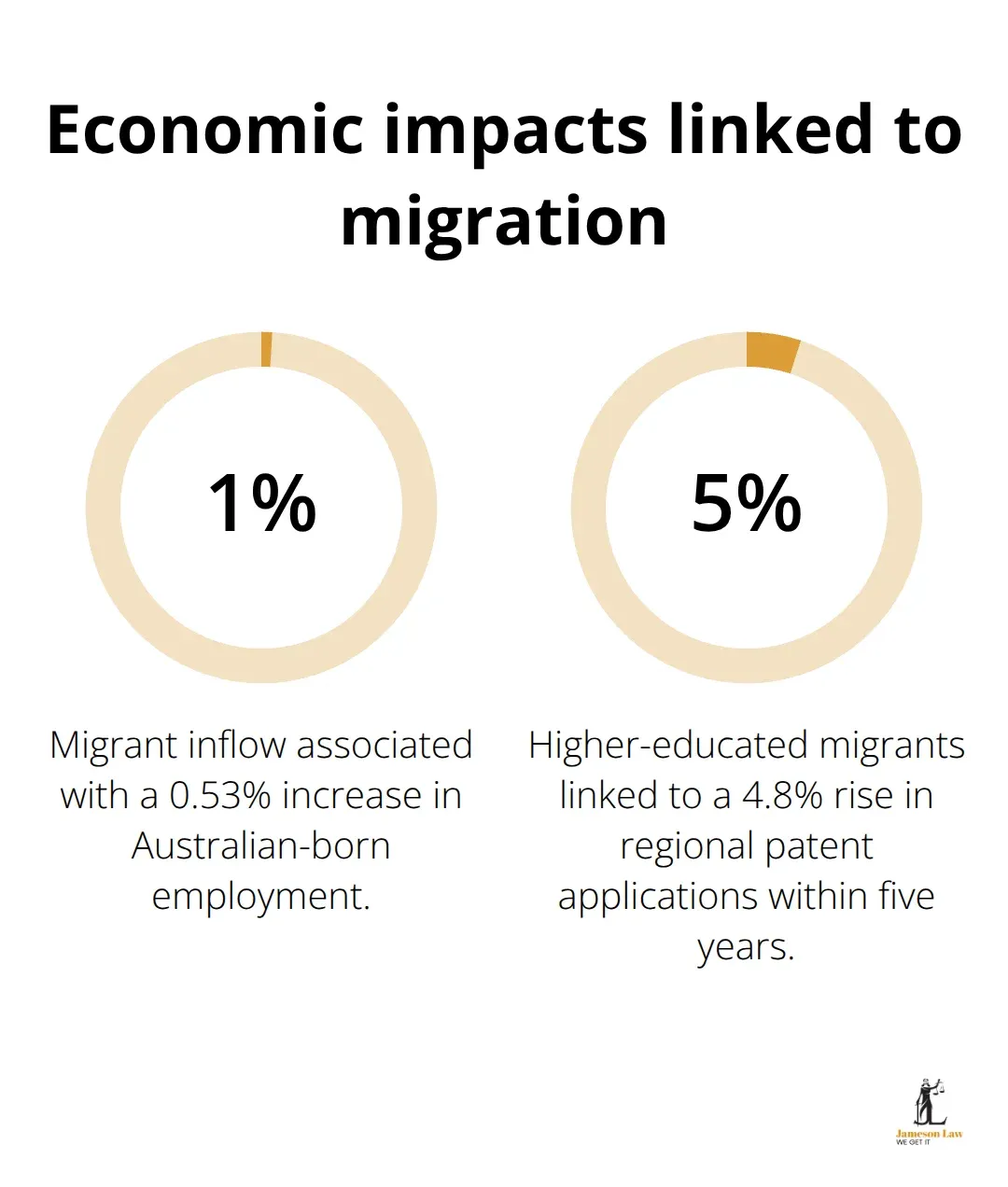
The OECD research released between 2023 and 2024 demonstrated that a migrant inflow associated with 0.53% increase in Australian-born employment, meaning migration creates jobs for existing residents rather than displacing them. Higher-educated migrants prove particularly valuable: a one percentage point increase in the regional employment share of higher-educated migrants leads to a 4.8% rise in regional patent applications within approximately five years, directly linking migration to regional innovation. These outcomes suggest that attracting skilled migrants generates measurable economic benefits that extend well beyond the migrants themselves, making migration policy a vital tool for regional economic development.

Percent changes associated with migration: employment gains and innovation outcomes in Australia. - waves of migration to australia

Final Thoughts

Australia’s waves of migration transformed the nation from a penal colony into one of the world’s most multicultural societies. Over 65,000 years of Indigenous settlement established the continent’s first cultures, yet European colonisation displaced these societies through terra nullius and frontier violence. The gold rush brought Chinese miners and European workers who faced racial exclusion policies, while post-war migration shifted Australia from British homogeneity toward genuine diversity with Displaced Persons from Europe arriving on assisted passage schemes.

Migration strengthens Australia’s economic performance in measurable ways. The OECD research demonstrates that a one percentage point increase in annual migrant inflow correlates with a 0.53% rise in Australian-born employment, proving migration creates jobs rather than displacing workers. Higher-educated migrants produce even stronger effects, with a one percentage point increase in regional employment share of college-educated migrants generating a 4.8% rise in patent applications within five years (directly linking migration to regional innovation and productivity).

The policy framework governing migration has evolved dramatically from the White Australia policy toward skills-based selection, and state governments now compete actively for migrants through targeted programmes. If you’re considering skilled migration, family sponsorship, or visa compliance, our team provides tailored guidance grounded in Australia’s complex immigration framework. We at Jameson Law help clients understand their migration options and obligations through expert immigration legal services.

Speak to an Expert Lawyer today

Laywers-Jameson-Law-The-best-law-firm-in-Sydney- Sydney Lawyers - Sydney
BOOK NOW

WE'RE IN IT TO WIN IT

Book your consultation

Book Now
Book Now Mobile 06 02 2025

This form submission is encrypted and secured to ensure your information remains confidential.

What our Clients

Related Publications:

What our clients say

.

Jameson Law - Voted the Best Law firm in Sydney Award

Legal Answers ... In Short

We're here to help

Our mission is to ensure our client matters are resolved successfully every time. Success to us does not simply involve winning, but moreover ensuring we take the most feasible, economic and stress-free path to help our clients achieve their goals. We fight hard for our clients, and always go by the motto: we’re in it to win it.

Jameson Law - Best Law Firm in Sydney

WE'RE IN IT TO WIN IT

Book your consultation

Call us now on (02) 8806 0866 or fill out the form below

Book Now Mobile

This form submission is encrypted and secured to ensure your information remains confidential.

WE'RE IN IT TO WIN IT

Book your consultation

Book Now Mobile 06 02 2025
lock

This form submission is encrypted and secured to ensure your information remains confidential.

Our Sydney Offices

Offices Parramatta and Sydney Jameson Law
Parramatta CBD - Head Office
jameson Law - Blacktown
jameson Law - Liverpool Office
Jameson Law - Bankstown
Court Houses We Frequent Jameson Law

Court Houses We Frequent

Balmain Local Court

Registry: Monday to Friday, 9:00am to 4:30pm

Bankstown Local Court

Court Operating Hours: 9:30am-4:30pm

Blacktown Local Court

Registry Hours: 9:00 – 4:30
Telephone Hours: 8:30 -4:30
Days open: Mon-Fri

Burwood Local Court

Registry Hours: 9:00 – 4:30
Telephone Hours: 8:30 – 4:30
Days open: Mon – Fri

Campbell Local Court

Registry Hours: 9:00 – 4:30
Telephone Hours: 8:30 – 4:30
Days open: Mon – Fri

Central Local Court

Registry Hours: 9:00 – 1:00 and 2:00 – 4:30
Telephone Hours: 8:30 – 4:30

Downing Local Court

Registry Hours: 9:00 – 1:00 and 2:00 – 4:30
Telephone Hours: 8:30 – 4:30

Wollongong Local Court

Registry Hours: 9:00 – 1:00 and 2:00 – 4:30
Telephone Hours: 8:30 – 4:30

Fairfield Local Court

Registry Hours: 9:00 – 1:00 and 2:00 – 4:30
Telephone Hours: 8:30 – 4:30

Hornsby Local Court

Registry Hours: 9:00 – 1:00 and 2:00 – 4:30
Telephone Hours: 8:30 – 4:30

Liverpool Local Court

Registry Hours: 9:00 – 1:00 and 2:00 – 4:30
Telephone Hours: 8:30 – 4:30

Manly Local Court

Registry Hours: 9:00 – 1:00 and 2:00 – 4:30
Telephone Hours: 8:30 – 4:30

Newtown Local Court

Registry Hours: 9:00 – 1:00 and 2:00 – 4:30
Telephone Hours: 8:30 – 4:30

Parramatta Local Court

Registry Hours: 9:00 – 1:00 and 2:00 – 4:30
Telephone Hours: 8:30 – 4:30

Penrith Local Court

Registry Hours: 9:00 – 1:00 and 2:00 – 4:30
Telephone Hours: 8:30 – 4:30

Sutherland Local Court

Registry Hours: 9:00 – 1:00 and 2:00 – 4:30
Telephone Hours: 8:30 – 4:30

Waverley Local Court

Registry Hours: 9:00 – 1:00 and 2:00 – 4:30
Telephone Hours: 8:30 – 4:30

Windsor Local Court

Registry Hours: 9:00 – 1:00 and 2:00 – 4:30
Telephone Hours: 8:30 – 4:30

Wollongong Local Court

Registry Hours: 9:00 – 1:00 and 2:00 – 4:30
Telephone Hours: 8:30 – 4:30

Downing Centre District Court

Registry Hours: 9:00 – 4:30
Telephone Hours: 8:30 – 4:30
Days open: Mon – Fri

Parramatta District Court

Registry Hours: 9:00 – 4:30
Days open: Mon-Fri

Penrith District Court

Registry Hours: 9:00 – 4:30
Days open: Mon-Fri

Campbelltown District Court

Registry Hours: 9:00 – 4:30
Days open: Mon – Fri

Liverpool District Court

Registry Hours: 9:00 – 4:30
Days open: Mon – Fri

Wollongong District Court

Registry Hours: 9:00 – 1:00 and 2:00 – 4:30
Telephone Hours: 8:30 – 4:30

Supreme Court New South Wales

Registry Hours: 9:00 AM – 4:30 PM
Telephone Hours: 8:30 AM – 4:30 PM
Days Open: Monday to Friday

Federal Circuit and Family Court of Australia

Registry Hours: 9:00 AM – 4:30 PM
Telephone Hours: 8:30 AM – 5:00 PM
Days Open: Monday to Friday

Federal Court

Monday to Friday, 8:30 AM – 4:30 PM

High Court

Monday to Friday, 8:30 AM – 5:00 PM

Children’s Court of New South Wales

Registry Hours: 9:00 AM – 4:30 PM
Telephone Hours: 8:30 AM – 4:30 PM
Days Open: Monday to Friday

Coroner’s Court New South Wales

Registry Hours: 9:00 AM – 4:30 PM
Telephone Hours: 8:30 AM – 4:30 PM
Days Open: Monday to Friday

Industrial Relations Commission of New South Wales

Registry Hours: 9:00 AM – 4:30 PM
Telephone Hours: 8:30 AM – 4:30 PM
Days Open: Monday to Friday

Land and Environment Court of New South Wales

Registry Hours: 9:00 AM – 4:30 PM
Telephone Hours: 8:30 AM – 4:30 PM
Days Open: Monday to Friday

WE'RE IN IT TO WIN IT

Book your consultation

Book Now
Book Now Mobile 06 02 2025
lock

This form submission is encrypted and secured to ensure your information remains confidential.