

Becoming an Australian citizen is a significant milestone, but the path to citizenship eligibility Australia isn’t always straightforward. Many applicants don’t realise they’re missing key requirements until their application is rejected.
At Jameson Law, our highly experienced team has helped countless people navigate this process successfully. This guide breaks down exactly what you need to qualify in 2026, what documents to prepare, and where most applications go wrong.
What Makes You Eligible for Australian Citizenship
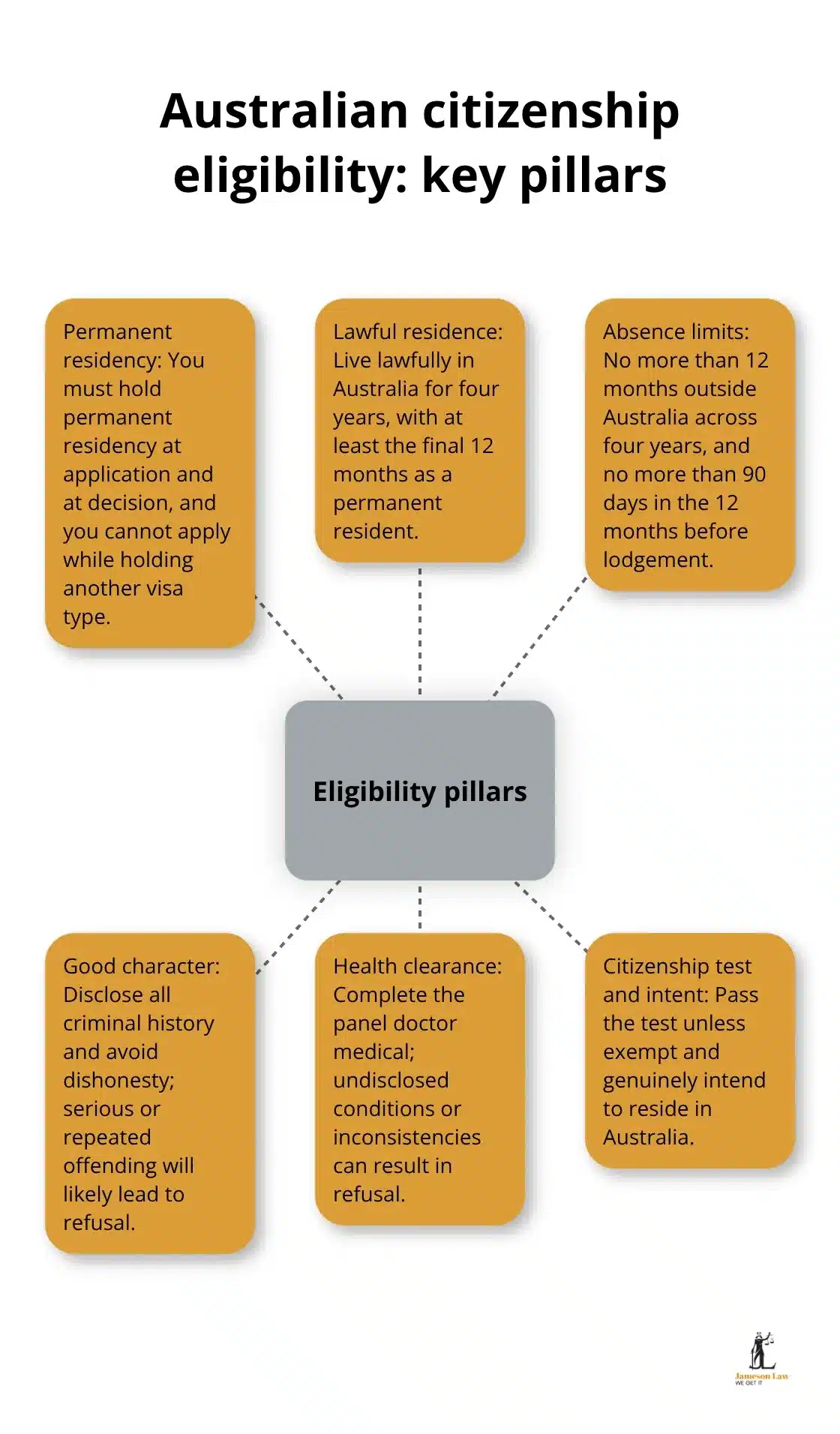
Permanent Residency Status
The path to citizenship starts with one non-negotiable requirement: you must hold permanent residency status at the time you apply and at the time the Department of Home Affairs makes its decision. This isn’t a technicality—it’s the foundation of the entire process. If your visa lapses between application and approval, your application faces refusal. Permanent residency allows you to remain in Australia indefinitely, but citizenship takes that further by granting voting rights, an Australian passport, and automatic entry to the country.
Residency Duration and Absence Limits
Once you have permanent residency locked in, the clock starts on the next critical requirement: your residency duration. Adults who became permanent residents on or after 1 July 2007 must have lived lawfully in Australia for four years immediately before applying. Within those four years, you must have held permanent residency for at least the final 12 months. The mathematics seems straightforward, but absences complicate everything. You cannot be absent from Australia for more than 12 months in total across the four-year period, and you cannot be absent for more than 90 days in the 12 months immediately before lodging your application.
Calculating Your Residence Eligibility
The Residence Calculator tool on the Department of Home Affairs website helps you estimate your eligibility, but understand that this tool provides guidance only. If you need precise travel records, you can request your international movement records free of charge from the department, which gives you documented proof of every entry and exit.
Character, Health, and the Citizenship Test
Beyond residency, character and health requirements filter out applicants who pose risks to the community. Good character assessment examines criminal history, fraud, and conduct that suggests you won’t respect Australian laws. The citizenship test requires you to demonstrate knowledge of Australia’s values, institutions, and history unless you’re under 18, over 60, or have a substantial impairment.
Getting Your Documentation Ready
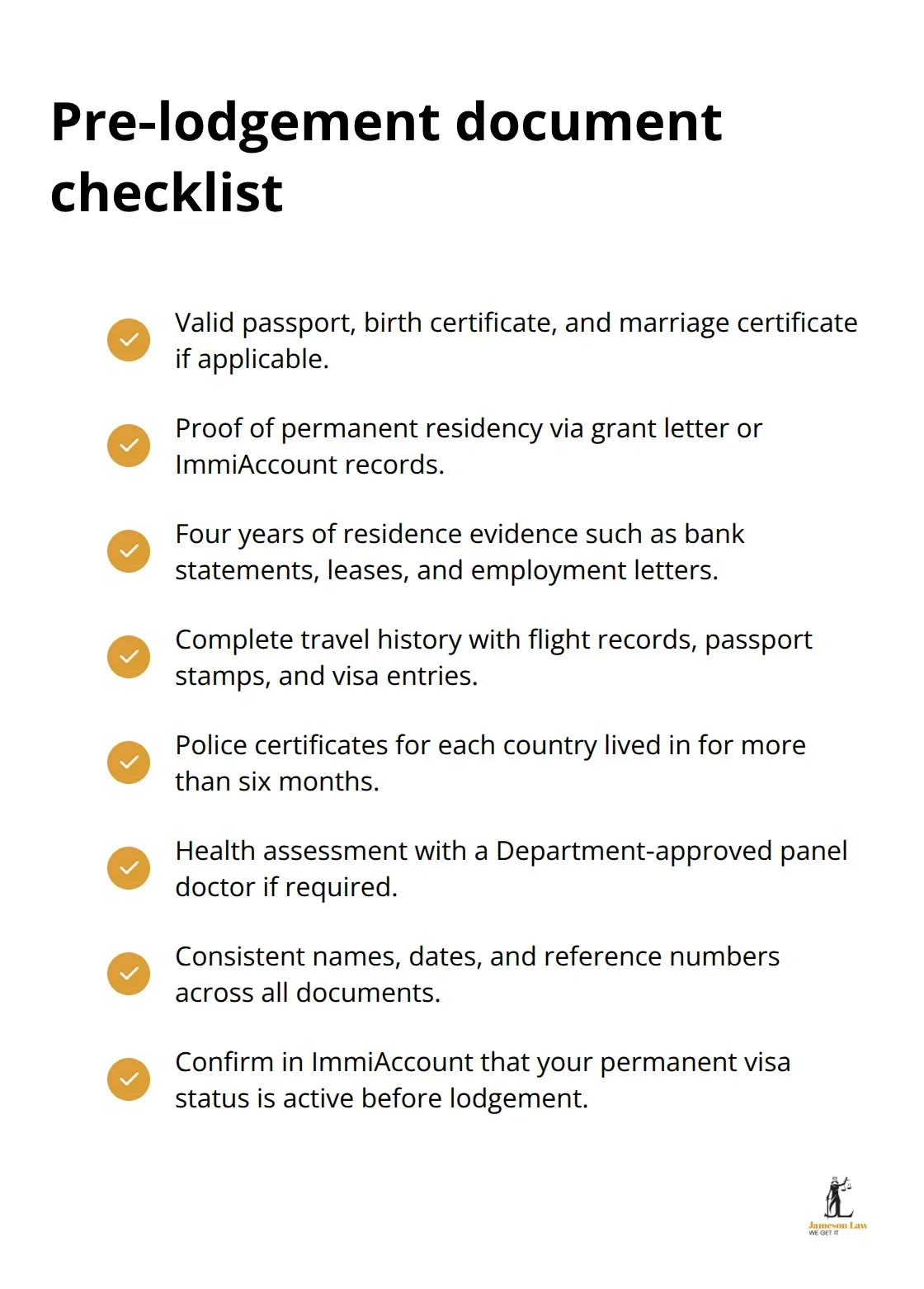
The Department of Home Affairs will not request documents piecemeal—they expect a complete file from the start. You must prove your identity, your permanent residency status, your residence history, your character, and your health clearance.
Identity and Permanent Residency Documents
Your passport, birth certificate, and marriage certificate (if your name has changed) form the foundation of your identity proof. Your permanent residency visa grant letter or ImmiAccount records showing your permanent visa details are non-negotiable.
Residence and Travel Documentation
Bank statements, rental agreements, utility bills, and employment letters spanning the four years you’ve lived in Australia establish your physical presence. Providing your own travel documentation—flight bookings, passport stamps, visa entry records—strengthens your application and prevents disputes about your absence calculations.
Character and Health Assessment Documents
Character assessment requires police certificates from every country where you lived for more than six months. Attempting to hide a conviction will guarantee refusal. Health assessments require a medical examination from a panel doctor approved by the Department.
Lodging Your Application and Tracking Progress
You lodge your application through ImmiAccount, and the Department processes new citizenship applications with a median timeframe of approximately four to six months. The application fee for general adult eligibility in 2026 is AUD $560. Check the current fee on the Department of Home Affairs website before lodging, as fees change periodically.
If your application receives approval, you will receive a citizenship certificate and an invitation to a citizenship ceremony. The Australian Electoral Commission then enrols you on the electoral register. If your application faces refusal, the Department provides reasons in writing, and you have the right to seek a review through the Administrative Review Tribunal (ART) if you believe the decision was wrong.
Why Citizenship Applications Get Refused
Residency Miscalculations and Absence Limits
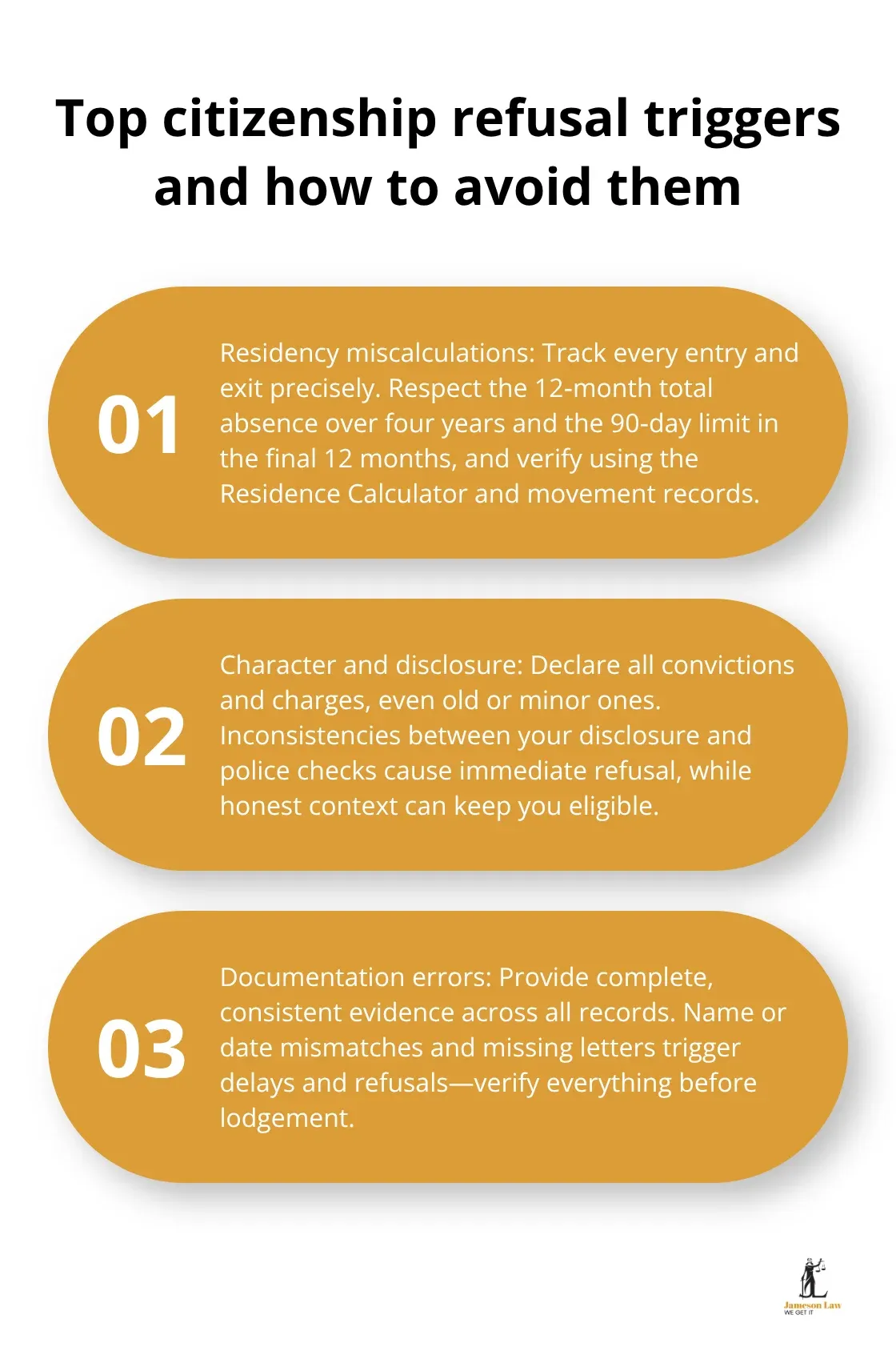
Residency miscalculations top the rejection list because applicants frequently underestimate their absences or miscount their permanent residency period. A four-week holiday, a two-week business trip, and a ten-day family visit totals 52 days, leaving you only 38 days of remaining absence allowance for that final year.
Character Assessment and Dishonesty
Character assessment rejections stem from undisclosed or inadequately explained criminal history. A single drink-driving conviction from ten years ago might be manageable with proper context, but attempting to hide it guarantees refusal.
Documentation Errors and Inconsistencies
Missing documents, inconsistent information across documents, and calculation errors trigger requests for further information that delay your application by weeks or months. Name spelling inconsistencies between your birth certificate, passport, and employment records create verification problems.
Critical Errors Before and After Lodgement
One critical error involves lodging applications without confirming your permanent visa status remains active at the time of lodgement. Another preventable error involves providing travel documentation that contradicts your residence claims.
Final Thoughts
You now understand the core requirements for citizenship eligibility Australia. Permanent residency status, four years of lawful residence with strict absence limits, good character, health clearance, and genuine commitment to residing in Australia form the foundation of your application.
If you’ve determined you meet the eligibility requirements, your next step involves lodging your application through ImmiAccount with complete documentation. If you’re uncertain about any requirement, have undisclosed criminal history, health concerns, or complex residence calculations, seeking professional legal advice before lodging protects you from preventable refusals.
We at Jameson Law provide expert immigration law assistance to help you navigate citizenship applications with confidence. The cost of professional guidance is minimal compared to the cost of a refused application and the time required to reapply through the Administrative Review Tribunal (ART).