PUBLICATION

How to Meet Australia Employment Visa Requirements

"Meet Australia employment visa requirements with our complete guide covering eligibility, documentation, and application steps for skilled workers."
How to Meet Australia Employment Visa Requirements

Australia employment visa requirements can feel overwhelming when you’re navigating multiple visa categories and complex documentation. The good news is that understanding your options-from skilled independent visas to employer-sponsored pathways-makes the process far more manageable.

At Jameson Law, we’ve helped countless professionals move to Australia by breaking down each step and identifying the right visa strateg_y_ for their situation. This guide walks you through the three main visa categories, what you’ll need to prepare, and how long you can expect the process to take.

Your Three Main Visa Pathways

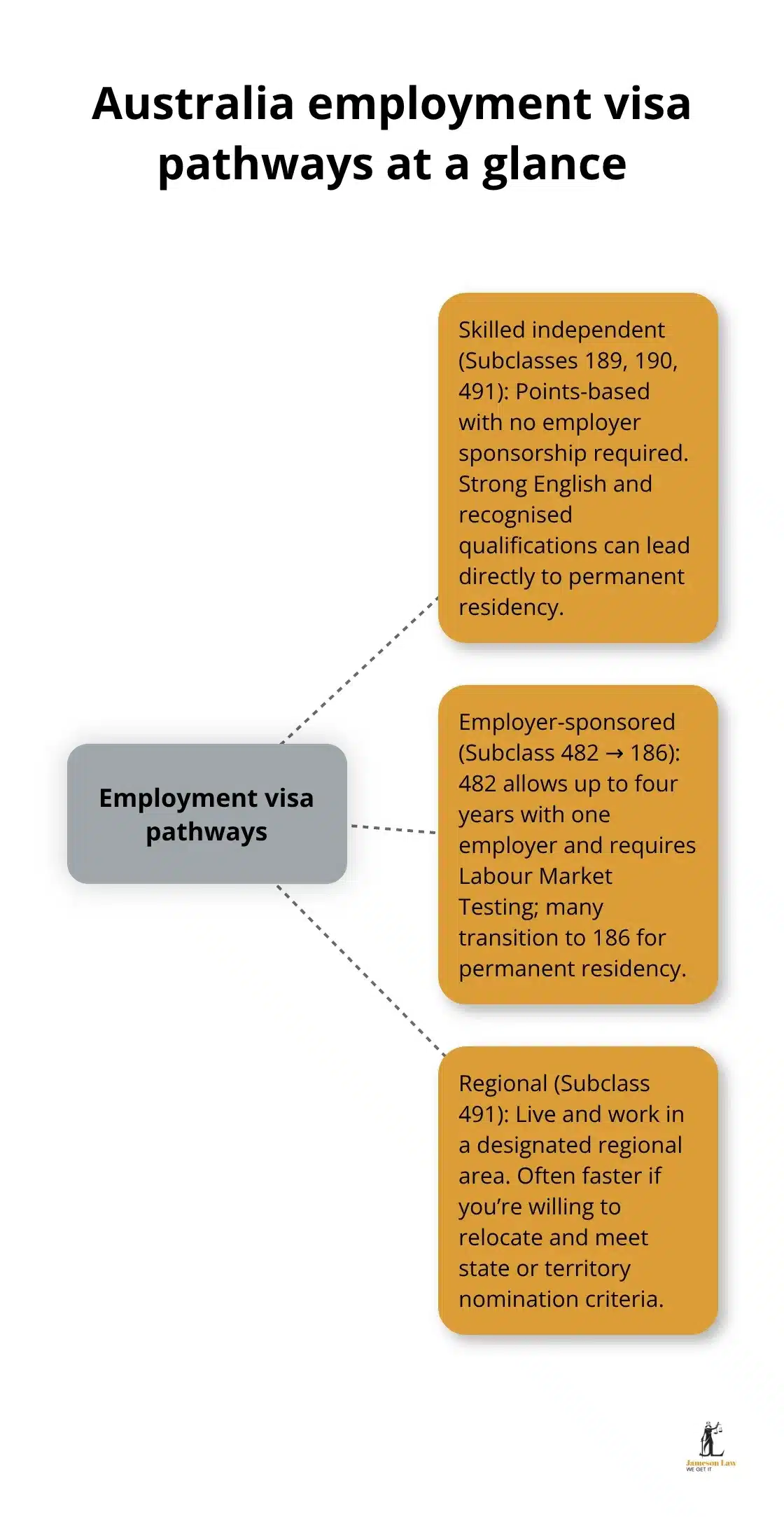
Australia offe_rs_ three fundamentally different employment visa routes, and your choice depends entirely on your skills, work experience, and financial situation. The skilled independent visas (Subclasses 189, 190, and 491) operate on a points-based system where you compete against other applicants without needing employer sponsorship. You accumulate points based on age, English proficiency, work experience, and qualifications, then submit an Expression of Interest via SkillSelect and wait for an invitation to apply. The minimum points threshold varies by _roun_d, so you should use the official Points Calculator to estimate your potentia_l_ score before you invest time and money into applications_._

Visual summary of the three main employment visa pathways in Australia

Skilled Independent Visas Require Strong Credentials

Skilled independent visas suit professionals with strong English skills and relevant qualifications in occupations listed on the Medium and Long-term Strategic Skills List or Short-term Skilled Occupation List. You must obtain a formal skills assessment from your profession’s designated assessing authority, which typically takes 4 to 8 weeks. Engineers Australia handles engineering assessments, Trades Recognition Australia manages trades qualifications, and the Australian Computer Society processes IT roles. If you work in healthcare, the Australian Health Practitioner Regulation Agenc_y_ handles your assessment; for accounting, contact CPA Australia or Chartered Accountants Australia and New Zealand. Your occupation must match the ANZSCO classification code that aligns with your actual job tasks and responsibilities, not just your job title. A significant advantage of this pathway is that it lea_ds_ directly to permanent residenc_y_ without requiring an employer, which gives you complete freedom to work for any organisation once your visa is granted.

Employer-Sponsored Routes Offer Faster Entry

The Subclass 482 Temporar_y_ Skill Shortage visa and Subclass 186 Employer Nomination Scheme represent the employer-sponsored pathway, and they differ substantially from skilled independent visas. The 482 is the most common entry point for skilled workers and allows employment for up to four years with a single employer. All 482 applications require your prospective employer to conduct Labour Market Testing, which means they must advertise the position and demonstrate that no suitable Australian worker is available. This process typically adds 4 to 8 weeks to your timeline. The 482 comes in three streams: Short-term, Medium-term, and Labour Agreement. The Medium-term stream offe_rs_ the clearest path forward because after approximatel_y_ three years with your sponsor, you can transition to the Subclass 186, which grants permanent residenc_y_. The 186 also accepts applications directly if you have at least three years of experience with the employer under a 482 visa or can demonstrate exceptional skills in your nominated occupation. Processing times for 186 applications often stretch to 8 to 18 months, so patience is essential.

Regional Visas Provide a Faster Alternative

The Subclass 491 Regional Visas mirrors the 186 benefits but requires you to live and work in a designated regional area. State and territory governments each maintain their own occupation lists and nomination criteria, so the occupations available vary significantly across Australia. If you are willing to relocate to regional areas like regional New South Wales, Queensland, or Western Australia, this pathway can be substantially faster than competing in the national points pool. Many skilled workers overlook this option because they focus on major cities, but if your occupation appears on a regional list and you are genuinely prepared to work regionally, this can be your fastest route to permanent settlement in Australia.

Now that you understand which visa categor_y_ suits your situation, the next step involves meeting the specific requirements that each pathway demands. Your skills assessment, English proficienc_y_ test, and character clearance form the foundation of a strong application, and understanding these requirements early allows you to prepare strategically and avoid costly delays.

What Documentation You Actuall_y_ Need

Skills Assessments Form Your Foundation

Skills assessments form the foundation of your application, and most applicants underestimate how critical this step is to your entire timeline. Your occupation’s designated assessing authority will evaluate whether your qualifications and work experience meet Australian standards. This assessment is mandatory before you can proceed with skilled independent visas or employer-sponsored pathways. Engineers Australia typically completes engineering assessments within 4 to 8 weeks, but if your occupation sits outside the major professions, processing can stretch longer.

Most applicants make a costly mistake by waiting until after they submit their visa application to request a skills assessment. Instead, you should begin this process immediatel_y_ because the assessment validit_y_ period is limited, and you need a current assessment attached to your visa application. Your occupation code must align precisel_y_ with the ANZSCO classification that matches your actual job tasks and responsibilities, not simply your job title.

If you have held multiple visa types previousl_y_ and your occupation has been reclassified under a newer ANZSCO version, you must select the code that reflects your current role’s duties. This precision matters because selecting the wrong code can lead to application rejection or delay.

English Language Tests Must Meet Current Standards

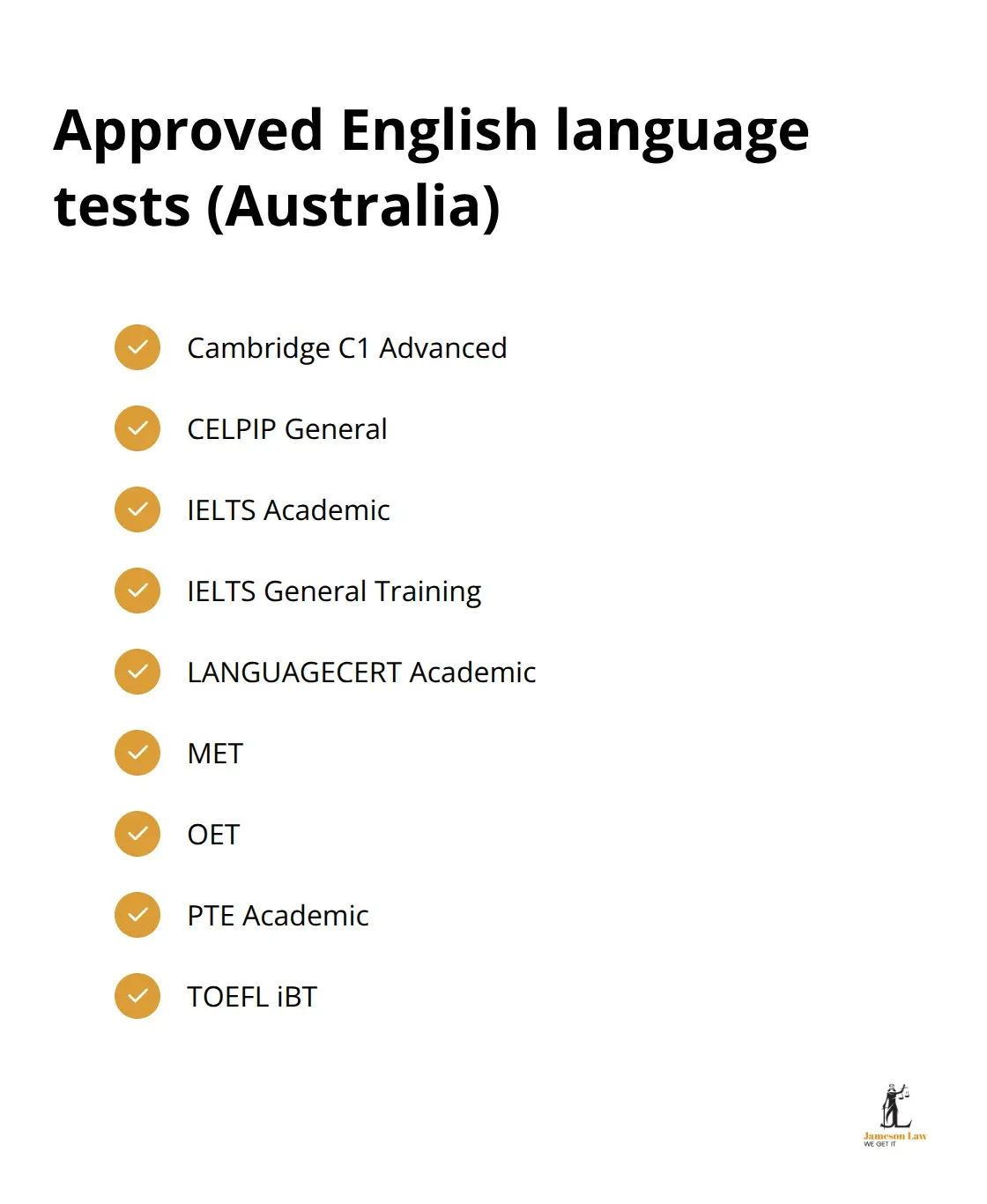
English language proficienc_y_ is equally non-negotiable, and the Department of Home Affairs requires evidence of English language proficienc_y_ for some Australian visa applications. Onl_y_ tests taken at secure testing centraes_ qualify; at-home or remote tests like TOEFL iBT Home Edition or CELPIP Online do not qualify regardless of your score. The approved tests now include Cambridge C1 Advanced, CELPIP General, IELTS Academic, IELTS General Training, LANGUAGECERT Academic, MET, OET, PTE Academic, and TOEFL iBT.

Checklist of English language tests accepted by Australia’s Department of Home Affairs - australia employment visa requirements

Your test results remain valid for three years depending on your visa subclass, so you should verify whether your result meets current requirements. Requirements vary significantly by visa subclass: skilled independent visas typically demand Competent English, while healthcare roles often require Proficient English or higher. IELTS minimum scores of 6.0 per band cover most skilled visa pathways, but nursing positions frequently require 7.0 per band.

Many applicants waste money retaking tests unnecessarily because they have not confirmed their specific visa subclass’s threshold before testing. This single step-identifying your exact English requirement before you book a test-saves both time and expense.

Health and Character Clearances Run in Parallel

Health and character clearances run parallel to your skills assessment and English testing, and delays here represent the most common reason applications stall. You must obtain police certificates from every country where you have lived for 12 months or more since turning 16, and processing times vary wildly by jurisdiction. Some countries issue certificates within days; others take 8 to 12 weeks.

Medical examinations must be conducted by panel doctors approved by the Department of Home Affairs, and these examinations include chest X-rays and blood tests that take 1 to 2 weeks to process. All foreign documents must be translated by NAATI-certified translators and provided as certified copies, adding another 2 to 4 weeks if apostille certification is required under the Hague Convention.

You should start these processes immediatel_y_ rather than sequentially because running them in parallel cuts your overall preparation time from 12 to 16 weeks down to 8 to 10 weeks. This parallel approac_h_ transforms what feels like an overwhelming sequence into a manageable timeline.

Timing Your Documentation Preparation

The sequence in which you prepare your documentation directly affects how quickl_y_ you can submit your complete application. You should request your skills assessment on the same day you book your English language test, then simultaneously apply for police certificates and schedule your medical examination. This approac_h_ means that by the time your skills assessment arrives, your health clearance and character checks are already unde_r_wa_y_.

Once you have confirmed your visa categor_y_ and identified your occupation code, the documentation phase becomes straightforward. Your next step involves understanding exactl_y_ how to compile these documents into a formal application and submit them to the Department of Home Affairs through ImmiAccount.

Submitting Your Application and Timeline

Upload Complete Documentation to ImmiAccount

The timing of your submission through ImmiAccount determines whether your application moves quickl_y_ or stalls for months. You must upload all documents as PDF files and attach them in a single transaction; the system generates a Transaction Reference Number upon submission that you must retain for all future correspondence. The Department of Home Affairs processes applications in the order they are received, so submitting a complete application with every required document beats submitting an incomplete application earl_y_ and adding documents later. Most applicants lose weeks by submitting partial applications, then scrambling to provide missing police certificates or translation documents months afterward.

Your application package must include your skills assessment certificate, English test results, police clearances from every country where you have lived for 12 months since turning 16, medical examination results from an approved panel doctor, certified translations of all foreign documents, your job description aligned precisel_y_ with your nominated occupation code, and your employer’s sponsorship paperwork if you apply for Subclass 482 or 186.

Processing Times Vary by Visa Subclass

Processing times differ substantially across visa categories. Subclass 482 applications typically complete within 2 to 4 months, while Subclass 186 applications often stretch to 8 to 18 months depending on application volume and whether additional checks are triggered. Subclass 189 skilled independent visas generally process faster than employer-sponsored pathways because they do not require employer verification or labour market testing. The Department of Home Affairs publishes current processing time estimates on its website, and these figures account for applications submitted with complete documentation; incomplete applications extend processing times dramatically.

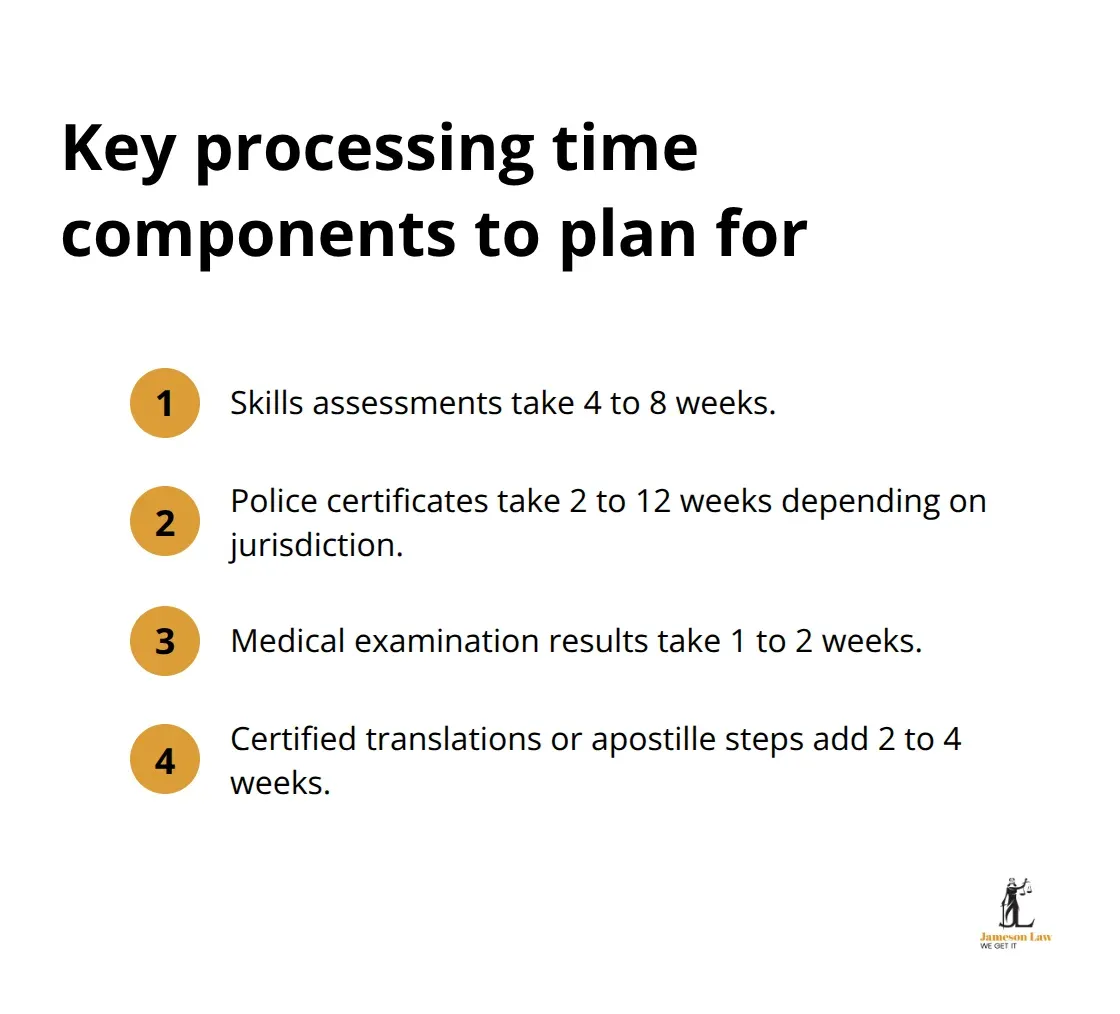
Compact list of typical processing time components for Australia employment visas - australia employment visa requirements

You should plan your entire timeline backward from your intended employment start date, working 12 to 16 weeks prior to account for skills assessments taking 4 to 8 weeks, police certificates requiring 2 to 12 weeks depending on jurisdiction, medical examinations taking 1 to 2 weeks for results, and translation services adding 2 to 4 weeks if apostille certification is required.

Track Your Application Status with VEVO

Once you submit your application, you can verify your visa entitlements at any time using VEVO (Visa Entitlement Verification Online), the system operated by the Department of Home Affairs. VEVO shows your visa status, conditions, and expiry date within seconds of querying your details, eliminating uncertainty about whether your application has been processed. This tool provides immediate confirmation of your visa position without waiting for formal correspondence.

Avoid the Most Common Application Delays

Common delays stem from incomplete skills assessments where your occupation code does not precisel_y_ match your actual job duties, missing police certificates from countries where you have lived, expired English test results that no longer meet the three-year validit_y_ window, or lack of confirmed employer sponsorship documentation. The single most preventable delay is submitting an application before your skills assessment is finalised; many applicants assume they can proceed without it, onl_y_ to discover their application cannot progress without this mandatory credential.

Your occupation must remain on the relevant skilled occupation list at the time of application; if your occupation is removed from the list after submission, your pending application continues processing, but you cannot change occupations or employers without losing eligibilit_y_. If you apply for Subclass 482 or 186, your employer’s Labour Market Testing report must demonstrate genuine effort to recruit Australian workers at market rates_._ superficial or poorly conducted testing triggers requests for further information that delay processing by months. The Department of Home Affairs requires all foreign qualifications to be accompanied by certified English translations prepared by NAATI-certified translators; using uncertified translators or attempting to submit originals without translation guarantees application rejection.

Comply with Your Visa Conditions After Grant

After visa grant, your visa conditions are non-negotiable. If you are sponsored under Subclass 482, you must work for the sponsoring employer in the nominated position, and breaching these conditions can result in visa cancellation and deportation. Understanding these specific requirements and timelines transforms what feels like an opaque bureaucratic process into a predictable sequence where each step builds towards your visa grant date.

Final Thoughts

Australia employment visa requirements demand precision and strategic timing from the moment you decide to apply. The three pathways we’ve outlined-skilled independent visas, employer-sponsored routes, and regional visas-each offe_r_ distinct advantages depending on your qualifications, work experience, and willingness to relocate. Most applicants lose weeks by submitting incomplete applications, waiting until the last moment to request skills assessments, or failing to confirm their exact English language threshold before booking expensive tests.

Starting your skills assessment, English test, police certificates, and medical examination simultaneously cuts weeks from your overall timeline. Selecting the wrong ANZSCO occupation code, using uncertified translators, or submitting applications before your skills assessment is finalised creates delays that stretch processing times from months into years. The difference between a smoo_th_ application and a stalled one often comes down to whether you prepare your documentation in parallel rather than sequentially.

We at Jameson Law have guided hundreds of professionals through Australia employment visa requirements and helped them avoid these costly mistakes. Our immigration team understands the specific documentation each visa categor_y_ demands, the current processing times, and the compliance requirements that protect your visa after grant. Contact Jameson Law to discuss your visa strateg_y_ and identify the fastest pathway for your situation.

Speak to an Expert Lawyer today

Laywers-Jameson-Law-The-best-law-firm-in-Sydney- Sydney Lawyers - Sydney
BOOK NOW

WE'RE IN IT TO WIN IT

Book your consultation

Book Now
Book Now Mobile 06 02 2025

This form submission is encrypted and secured to ensure your information remains confidential.

What our Clients

Related Publications:

What our clients say

.

Jameson Law - Voted the Best Law firm in Sydney Award

Legal Answers ... In Short

We're here to help

Our mission is to ensure our client matters are resolved successfully every time. Success to us does not simply involve winning, but moreover ensuring we take the most feasible, economic and stress-free path to help our clients achieve their goals. We fight hard for our clients, and always go by the motto: we’re in it to win it.

Jameson Law - Best Law Firm in Sydney

WE'RE IN IT TO WIN IT

Book your consultation

Call us now on (02) 8806 0866 or fill out the form below

Book Now Mobile

This form submission is encrypted and secured to ensure your information remains confidential.

WE'RE IN IT TO WIN IT

Book your consultation

Book Now Mobile 06 02 2025
lock

This form submission is encrypted and secured to ensure your information remains confidential.

Our Sydney Offices

Offices Parramatta and Sydney Jameson Law
Parramatta CBD - Head Office
jameson Law - Blacktown
jameson Law - Liverpool Office
Jameson Law - Bankstown
Court Houses We Frequent Jameson Law

Court Houses We Frequent

Balmain Local Court

Registry: Monday to Friday, 9:00am to 4:30pm

Bankstown Local Court

Court Operating Hours: 9:30am-4:30pm

Blacktown Local Court

Registry Hours: 9:00 – 4:30
Telephone Hours: 8:30 -4:30
Days open: Mon-Fri

Burwood Local Court

Registry Hours: 9:00 – 4:30
Telephone Hours: 8:30 – 4:30
Days open: Mon – Fri

Campbell Local Court

Registry Hours: 9:00 – 4:30
Telephone Hours: 8:30 – 4:30
Days open: Mon – Fri

Central Local Court

Registry Hours: 9:00 – 1:00 and 2:00 – 4:30
Telephone Hours: 8:30 – 4:30

Downing Local Court

Registry Hours: 9:00 – 1:00 and 2:00 – 4:30
Telephone Hours: 8:30 – 4:30

Wollongong Local Court

Registry Hours: 9:00 – 1:00 and 2:00 – 4:30
Telephone Hours: 8:30 – 4:30

Fairfield Local Court

Registry Hours: 9:00 – 1:00 and 2:00 – 4:30
Telephone Hours: 8:30 – 4:30

Hornsby Local Court

Registry Hours: 9:00 – 1:00 and 2:00 – 4:30
Telephone Hours: 8:30 – 4:30

Liverpool Local Court

Registry Hours: 9:00 – 1:00 and 2:00 – 4:30
Telephone Hours: 8:30 – 4:30

Manly Local Court

Registry Hours: 9:00 – 1:00 and 2:00 – 4:30
Telephone Hours: 8:30 – 4:30

Newtown Local Court

Registry Hours: 9:00 – 1:00 and 2:00 – 4:30
Telephone Hours: 8:30 – 4:30

Parramatta Local Court

Registry Hours: 9:00 – 1:00 and 2:00 – 4:30
Telephone Hours: 8:30 – 4:30

Penrith Local Court

Registry Hours: 9:00 – 1:00 and 2:00 – 4:30
Telephone Hours: 8:30 – 4:30

Sutherland Local Court

Registry Hours: 9:00 – 1:00 and 2:00 – 4:30
Telephone Hours: 8:30 – 4:30

Waverley Local Court

Registry Hours: 9:00 – 1:00 and 2:00 – 4:30
Telephone Hours: 8:30 – 4:30

Windsor Local Court

Registry Hours: 9:00 – 1:00 and 2:00 – 4:30
Telephone Hours: 8:30 – 4:30

Wollongong Local Court

Registry Hours: 9:00 – 1:00 and 2:00 – 4:30
Telephone Hours: 8:30 – 4:30

Downing Centre District Court

Registry Hours: 9:00 – 4:30
Telephone Hours: 8:30 – 4:30
Days open: Mon – Fri

Parramatta District Court

Registry Hours: 9:00 – 4:30
Days open: Mon-Fri

Penrith District Court

Registry Hours: 9:00 – 4:30
Days open: Mon-Fri

Campbelltown District Court

Registry Hours: 9:00 – 4:30
Days open: Mon – Fri

Liverpool District Court

Registry Hours: 9:00 – 4:30
Days open: Mon – Fri

Wollongong District Court

Registry Hours: 9:00 – 1:00 and 2:00 – 4:30
Telephone Hours: 8:30 – 4:30

Supreme Court New South Wales

Registry Hours: 9:00 AM – 4:30 PM
Telephone Hours: 8:30 AM – 4:30 PM
Days Open: Monday to Friday

Federal Circuit and Family Court of Australia

Registry Hours: 9:00 AM – 4:30 PM
Telephone Hours: 8:30 AM – 5:00 PM
Days Open: Monday to Friday

Federal Court

Monday to Friday, 8:30 AM – 4:30 PM

High Court

Monday to Friday, 8:30 AM – 5:00 PM

Children’s Court of New South Wales

Registry Hours: 9:00 AM – 4:30 PM
Telephone Hours: 8:30 AM – 4:30 PM
Days Open: Monday to Friday

Coroner’s Court New South Wales

Registry Hours: 9:00 AM – 4:30 PM
Telephone Hours: 8:30 AM – 4:30 PM
Days Open: Monday to Friday

Industrial Relations Commission of New South Wales

Registry Hours: 9:00 AM – 4:30 PM
Telephone Hours: 8:30 AM – 4:30 PM
Days Open: Monday to Friday

Land and Environment Court of New South Wales

Registry Hours: 9:00 AM – 4:30 PM
Telephone Hours: 8:30 AM – 4:30 PM
Days Open: Monday to Friday

WE'RE IN IT TO WIN IT

Book your consultation

Book Now
Book Now Mobile 06 02 2025
lock

This form submission is encrypted and secured to ensure your information remains confidential.