PUBLICATION

Skilled Visa Nomination NSW: Pathways to Australia’s Skilled Migration

"Explore skilled visa nomination pathways in NSW and discover your route to Australia's skilled migration program with expert guidance."
Skilled Visa Nomination NSW: Pathways to Australia’s Skilled Migration

NSW skilled visa nomination opens doors to permanent residency for qualified professionals. Australia’s skilled migration system prioritises occupations that fill genuine labour gaps, and NSW actively recruits workers across healthcare, engineering, IT, and trades.

At Jameson Law, we’ve guided hundreds of applicants through this process. This guide breaks down eligibility requirements, documentation needs, and realistic timelines so you understand exactly what to expect.

How NSW Skilled Visa Nomination Works

NSW skilled visa nomination operates differently from direct federal applications. When you apply for a skilled visa through NSW nomination, you ask the NSW Government to sponsor your occupation because they need workers in that field. This sponsorship does not guarantee permanent residency, but it significantly improves your chances by adding points to your application and signalling to the federal Department of Home Affairs that NSW has assessed your skills as genuinely needed. The NSW Government operates two main nomination pathways: the Skilled Nominated visa (subclass 190) for permanent residency, and the Skilled Work Regional visa (subclass 491) for provisional residency in regional NSW. Both are points-tested, meaning your age, English proficiency, work experience, and qualifications all contribute to a score that determines whether you receive an invitation to apply.

The Selection Process Is Competitive, Not First-Come-First-Served

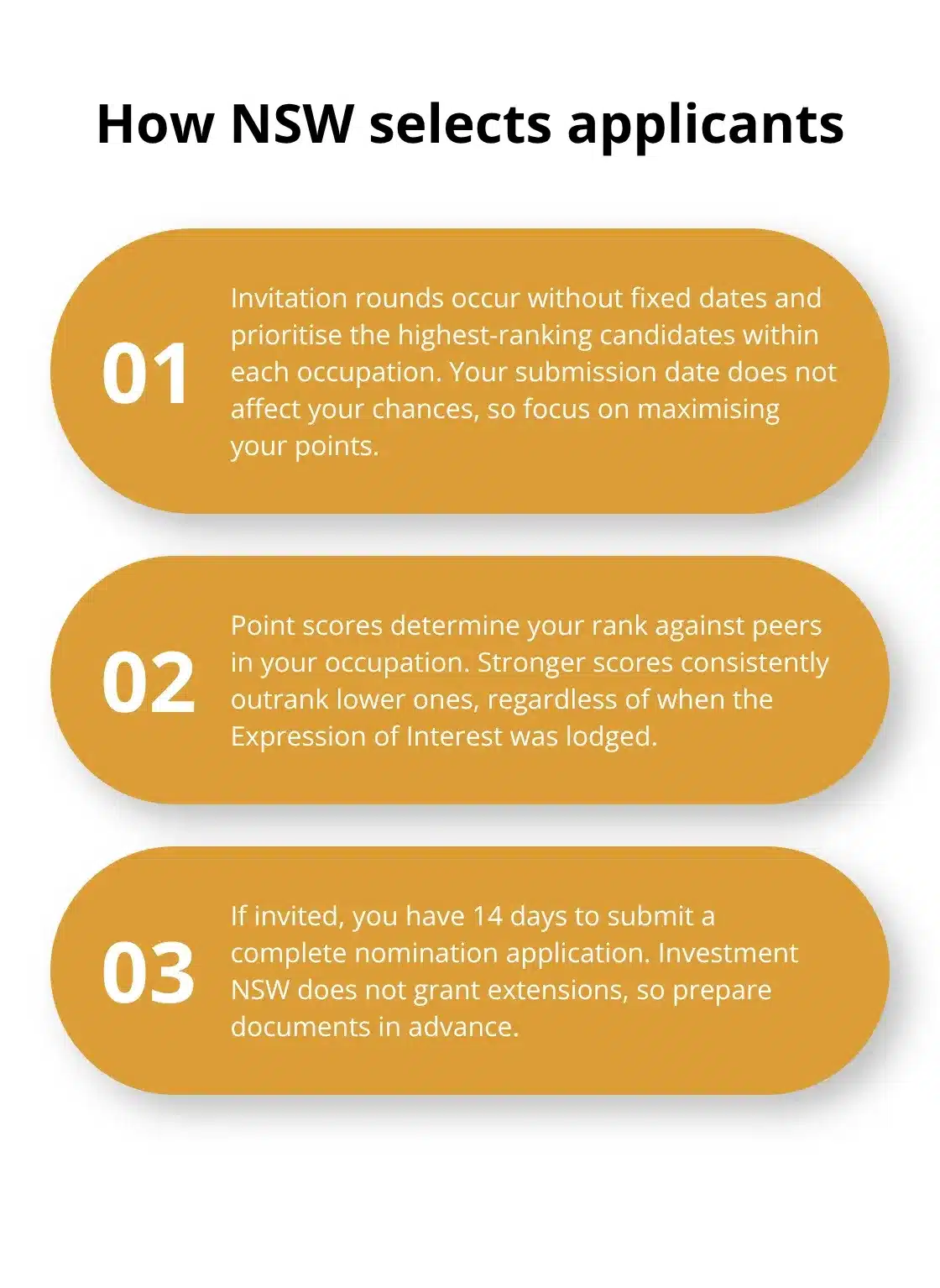
Investment NSW holds invitation rounds throughout the financial year with no fixed dates, and they invite only the highest-ranking applicants within each occupation group. Your submission date has no bearing on your chances. When you submit an Expression of Interest through SkillSelect, you compete against every other applicant in your occupation category, and only those with the strongest point scores receive invitations. A candidate with 85 points submitted yesterday will rank higher than one with 75 points submitted six months ago.

Overview of NSW	selection competitiveness and invitation window

Once invited, you face a strict 14-day deadline to submit your full nomination application with supporting documents. Investment NSW cannot extend this window, so applicants who miss the deadline lose their opportunity entirely.

What Happens After You Submit Your Nomination

The nomination assessment takes approximately six weeks after you submit your application. During this period, contacting NSW for updates simply delays processing rather than accelerates it. Investment NSW assesses whether you meet all criteria and whether nomination places remain available. The discretionary nature of nomination means Investment NSW reserves the right to refuse a nomination if criteria are not met or if the available allocation is fully committed. This is why preparing a complete, accurate application the first time matters significantly.

Eligibility Requirements You Must Meet

To qualify for NSW nomination, your occupation must appear on the NSW Skills List at the ANZSCO unit group level, and you must hold a valid skills assessment from the relevant assessing authority for that occupation. Your skills assessment is non-negotiable-without it, your application fails at the first gate. For the subclass 190 pathway, you must demonstrate eligibility through one of three residency options: working in NSW in your nominated occupation for at least 20 hours per week, residing in NSW continuously for six months, or residing offshore for six months. The 491 regional pathway has similar but slightly different residency requirements that prioritise regional employment and settlement.

How Points Accumulate in Your Application

Points accumulate from your age (younger applicants score higher), English language proficiency (fluent English adds 20 points), educational qualifications, and work experience. An applicant aged 45 with a bachelor’s degree, fluent English, and five years of skilled work experience in NSW will score significantly higher than a 50-year-old with the same qualifications but no local work history. This is why gaining Australian work experience before applying strengthens your application substantially. Your points determine your ranking against other applicants in your occupation group, and only the highest-ranked candidates receive invitations in each round.

Moving Forward With Your Application Strategy

Understanding these mechanics helps you assess your competitive position and identify where you can improve your points before submitting your Expression of Interest. The next section examines which occupations NSW actively nominates and how state sponsorship compares to federal migration pathways, so you can determine whether NSW nomination aligns with your professional background and career goals.

Key Occupations and Pathways for NSW Skilled Migration

NSW prioritises occupations that address genuine labour shortages across specific sectors. Healthcare, engineering, information technology, and skilled trades dominate the NSW Skills List because these fields experience persistent workforce gaps. Nurses, civil engineers, software developers, electricians, and plumbers appear consistently across nomination rounds, with healthcare professionals representing a significant proportion of successful nominations. The Australian Government Department of Home Affairs maintains the authoritative occupational lists, and NSW aligns its priorities with those lists at the ANZSCO unit group level. This means your occupation must appear on both the NSW Skills List and the federal skilled occupation lists to qualify. A registered nurse with strong points will face less competition than an accountant, simply because NSW nominates far fewer accountants relative to the number of applicants in that field.

Which Occupations NSW Actively Nominates

Your occupation choice determines your competitive position before you even submit your Expression of Interest. Occupations on the NSW Skills List reflect state economic priorities, particularly in growth sectors including engineering, science, architecture, planning, and trades. Examples of 190-eligible occupations include civil engineers, electrical engineers, mining engineers, ICT managers, general practitioners, and pharmacists. The 491 regional pathway extends eligibility to occupations like crop farmers, construction managers, agricultural technicians, and medical technicians, reflecting regional NSW’s economic needs.

However, appearing on the NSW Skills List does not guarantee nomination. Investment NSW assesses applications competitively within each occupation group, considering factors including age, English language proficiency, education, and points score. Your points score determines whether you rank high enough to be invited, and points accumulate from factors within your control-work experience, English proficiency, qualifications-and factors beyond your control, such as age. An applicant aged 35 with fluent English, a bachelor’s degree, and three years of Australian work experience in your nominated occupation will score substantially higher than a 55-year-old with identical qualifications but no Australian work history. This age penalty is significant and non-negotiable within the points system.

How State Sponsorship Changes Your Competitive Position

NSW nomination fundamentally alters your migration pathway compared to independent federal applications. A Skilled Independent visa (subclass 189) requires you to accumulate points and compete nationally without state sponsorship, whereas NSW nomination (subclass 190) adds the weight of state assessment and improves your overall points score. The Department of Home Affairs views NSW-nominated applicants differently because Investment NSW has already vetted your occupation as genuinely needed. This sponsorship does not guarantee approval, but it strengthens your application substantially.

You should view NSW nomination as your primary strategy if your occupation appears on the NSW Skills List and your points score is competitive. Pursuing both pathways simultaneously is possible through SkillSelect, but your resources are better spent maximising your NSW nomination application if that pathway is available to you. The 491 regional pathway operates similarly but targets regional NSW specifically, meaning your residency commitment differs and your occupation must align with regional economic needs rather than metropolitan priorities.

Processing Timelines and What to Expect

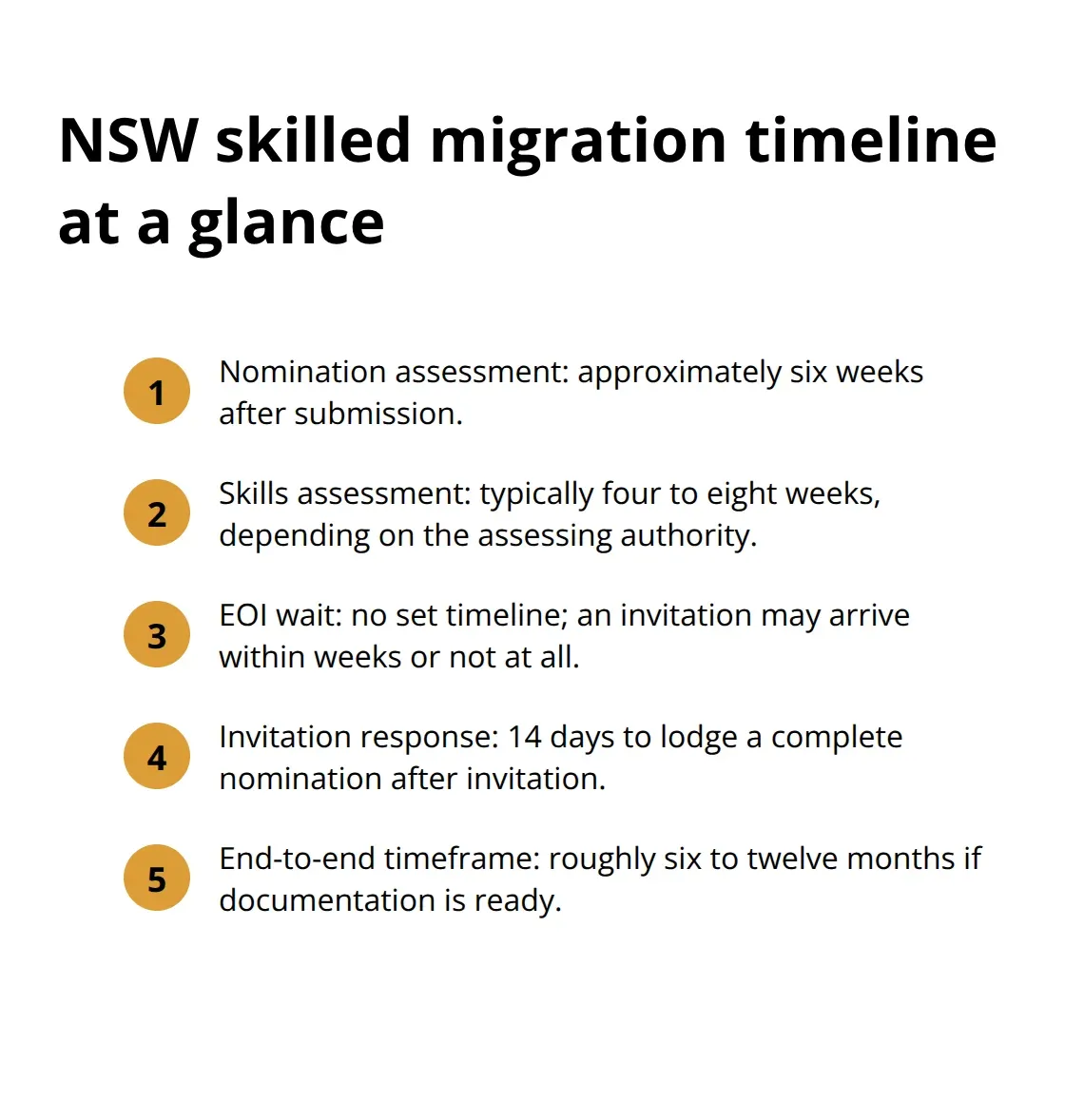
Nomination assessment takes approximately six weeks after you submit your complete application, provided Investment NSW does not request additional documents. This timeline is realistic based on current processing patterns, though periods of high application volume can extend assessment periods. The critical delay occurs before this stage: securing a skills assessment from your relevant assessing authority typically requires four to eight weeks, depending on the authority and whether your qualifications require verification from overseas institutions.

Your Expression of Interest phase has no set timeline-you submit your EOI and wait for an invitation, which may arrive within weeks or may not arrive at all if your points score falls below the invitation threshold in your occupation group. Many applicants underestimate this waiting period and submit incomplete applications when invited because they have not prepared documentation in advance. You should gather your skills assessment application documents, employment references, and qualification transcripts before submitting your Expression of Interest. This preparation ensures you can respond to an invitation within the strict 14-day window without scrambling for documents.

Key timeframes from EOI to visa grant for NSW nomination - Skilled visa nomination NSW

Once your nomination receives approval and you receive your visa grant, the total timeline from initial Expression of Interest to visa grant typically ranges from six to twelve months, depending on invitation timing and application completeness. Applicants who delay documentation preparation frequently experience timeline extensions, making advance preparation not optional but essential. The next section examines the specific documentation you must gather and how to strengthen your application through work experience and qualifications, so you can move forward with confidence in your migration strategy.

What Documents You Actually Need to Gather

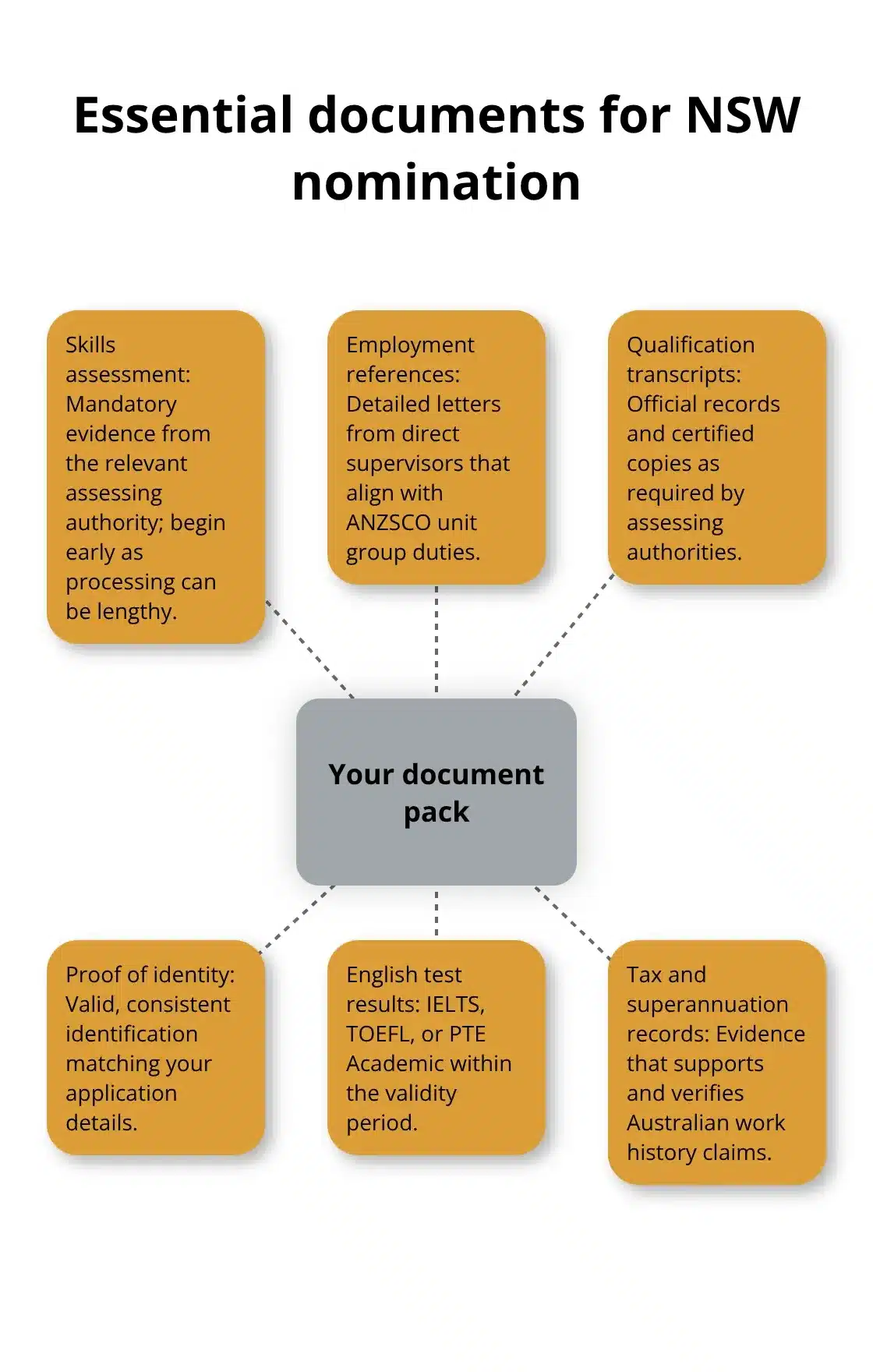
Investment NSW will not assess your application without complete documentation, and a missing document means a rejected application with no second chance. The 14-day window after invitation does not extend, so you must have everything prepared before you submit your Expression of Interest.

Core evidence to prepare before an invitation for NSW skilled visa nomination - Skilled visa nomination NSW

Your skills assessment takes six to 24 weeks from the relevant assessing authority, making this your first priority.

Start With Your Skills Assessment Application

For engineering occupations, Engineers Australia requires your qualification transcripts, employment references spanning your work history, and proof of identity. For nursing roles, the Nursing and Midwifery Board of Australia needs similar documentation plus evidence of registration. Contact your assessing authority now and obtain their checklist. Work backward from the submission deadline rather than waiting for an invitation to begin this process. Applicants who start collecting references and transcripts after receiving an invitation frequently miss the 14-day deadline because overseas institutions take weeks to respond to requests.

Your skills assessment application also requires evidence that your qualifications meet Australian standards. If you completed your degree overseas, you typically need official transcripts sent directly from your institution to the assessing authority, not photocopies you provide. This process alone takes three to six weeks depending on your institution’s processing speed and whether they need to verify qualifications with other bodies.

Secure Strong Employment References

Employment references must come from direct supervisors or managers who can speak to your actual duties and competency in your nominated occupation. A reference from your HR department stating your job title carries minimal weight compared to a detailed reference from someone who directly supervised your work. Request references that specifically address the ANZSCO unit group requirements for your occupation, not generic statements about your reliability or character.

Simultaneously, gather your employment history documentation including contracts, payslips, tax records, and superannuation statements that verify your work experience. Investment NSW cross-checks employment claims against Australian Tax Office records for applicants with Australian work history, so discrepancies between your claimed experience and tax records will trigger application rejection. If you worked in NSW for two years but your tax records show only 18 months in that role, your application fails immediately.

Document Your Overseas Work Experience

For overseas work experience, provide employment contracts, reference letters from employers, and evidence of salary payments. Australian authorities require substantial proof that you actually performed the role you claim because many applicants overstate their overseas experience. Your documentation must demonstrate the connection between your claimed duties and the ANZSCO unit group requirements for your nominated occupation.

Prove Your English Language Proficiency

Your English language proficiency must be evidenced through recognised tests including IELTS, TOEFL, or PTE Academic. Test results remain valid for three years, so check your test date before submitting your Expression of Interest. If your English proficiency falls below the required threshold, taking another test before submitting your EOI is more effective than hoping your existing score suffices.

Final Thoughts

Skilled visa nomination NSW represents a structured pathway to permanent or provisional residency, but success depends on understanding the process, meeting eligibility criteria, and preparing documentation thoroughly before you submit your Expression of Interest. The competitive nature of nomination rounds means your points score, occupation choice, and application completeness determine your outcome. Applicants who delay skills assessments, gather incomplete employment references, or submit applications without verified documentation face rejection with no opportunity to resubmit.

Verify your occupation appears on the NSW Skills List and contact your relevant assessing authority to start your skills assessment application immediately. This single step typically takes the longest and cannot be rushed. Simultaneously, request employment references from direct supervisors and compile your work history documentation, tax records, and qualification transcripts.

Once you have your skills assessment in hand and documentation prepared, submit your Expression of Interest through SkillSelect and wait for an invitation. When an invitation arrives, you have 14 days to submit your complete nomination application-this deadline cannot be extended. If your circumstances are complex, your work history spans multiple countries, or you are uncertain whether your occupation qualifies under the ANZSCO unit group requirements, Jameson Law can help you navigate skilled visa nomination and assess whether this pathway aligns with your situation.

Speak to an Expert Lawyer today

Laywers-Jameson-Law-The-best-law-firm-in-Sydney- Sydney Lawyers - Sydney
BOOK NOW

WE'RE IN IT TO WIN IT

Book your consultation

Book Now
Book Now Mobile 06 02 2025

This form submission is encrypted and secured to ensure your information remains confidential.

What our Clients

Related Publications:

What our clients say

.

Jameson Law - Voted the Best Law firm in Sydney Award

Legal Answers ... In Short

We're here to help

Our mission is to ensure our client matters are resolved successfully every time. Success to us does not simply involve winning, but moreover ensuring we take the most feasible, economic and stress-free path to help our clients achieve their goals. We fight hard for our clients, and always go by the motto: we’re in it to win it.

Jameson Law - Best Law Firm in Sydney

WE'RE IN IT TO WIN IT

Book your consultation

Call us now on (02) 8806 0866 or fill out the form below

Book Now Mobile

This form submission is encrypted and secured to ensure your information remains confidential.

WE'RE IN IT TO WIN IT

Book your consultation

Book Now Mobile 06 02 2025
lock

This form submission is encrypted and secured to ensure your information remains confidential.

Our Sydney Offices

Offices Parramatta and Sydney Jameson Law
Parramatta CBD - Head Office
jameson Law - Blacktown
jameson Law - Liverpool Office
Jameson Law - Bankstown
Court Houses We Frequent Jameson Law

Court Houses We Frequent

Balmain Local Court

Registry: Monday to Friday, 9:00am to 4:30pm

Bankstown Local Court

Court Operating Hours: 9:30am-4:30pm

Blacktown Local Court

Registry Hours: 9:00 – 4:30
Telephone Hours: 8:30 -4:30
Days open: Mon-Fri

Burwood Local Court

Registry Hours: 9:00 – 4:30
Telephone Hours: 8:30 – 4:30
Days open: Mon – Fri

Campbell Local Court

Registry Hours: 9:00 – 4:30
Telephone Hours: 8:30 – 4:30
Days open: Mon – Fri

Central Local Court

Registry Hours: 9:00 – 1:00 and 2:00 – 4:30
Telephone Hours: 8:30 – 4:30

Downing Local Court

Registry Hours: 9:00 – 1:00 and 2:00 – 4:30
Telephone Hours: 8:30 – 4:30

Wollongong Local Court

Registry Hours: 9:00 – 1:00 and 2:00 – 4:30
Telephone Hours: 8:30 – 4:30

Fairfield Local Court

Registry Hours: 9:00 – 1:00 and 2:00 – 4:30
Telephone Hours: 8:30 – 4:30

Hornsby Local Court

Registry Hours: 9:00 – 1:00 and 2:00 – 4:30
Telephone Hours: 8:30 – 4:30

Liverpool Local Court

Registry Hours: 9:00 – 1:00 and 2:00 – 4:30
Telephone Hours: 8:30 – 4:30

Manly Local Court

Registry Hours: 9:00 – 1:00 and 2:00 – 4:30
Telephone Hours: 8:30 – 4:30

Newtown Local Court

Registry Hours: 9:00 – 1:00 and 2:00 – 4:30
Telephone Hours: 8:30 – 4:30

Parramatta Local Court

Registry Hours: 9:00 – 1:00 and 2:00 – 4:30
Telephone Hours: 8:30 – 4:30

Penrith Local Court

Registry Hours: 9:00 – 1:00 and 2:00 – 4:30
Telephone Hours: 8:30 – 4:30

Sutherland Local Court

Registry Hours: 9:00 – 1:00 and 2:00 – 4:30
Telephone Hours: 8:30 – 4:30

Waverley Local Court

Registry Hours: 9:00 – 1:00 and 2:00 – 4:30
Telephone Hours: 8:30 – 4:30

Windsor Local Court

Registry Hours: 9:00 – 1:00 and 2:00 – 4:30
Telephone Hours: 8:30 – 4:30

Wollongong Local Court

Registry Hours: 9:00 – 1:00 and 2:00 – 4:30
Telephone Hours: 8:30 – 4:30

Downing Centre District Court

Registry Hours: 9:00 – 4:30
Telephone Hours: 8:30 – 4:30
Days open: Mon – Fri

Parramatta District Court

Registry Hours: 9:00 – 4:30
Days open: Mon-Fri

Penrith District Court

Registry Hours: 9:00 – 4:30
Days open: Mon-Fri

Campbelltown District Court

Registry Hours: 9:00 – 4:30
Days open: Mon – Fri

Liverpool District Court

Registry Hours: 9:00 – 4:30
Days open: Mon – Fri

Wollongong District Court

Registry Hours: 9:00 – 1:00 and 2:00 – 4:30
Telephone Hours: 8:30 – 4:30

Supreme Court New South Wales

Registry Hours: 9:00 AM – 4:30 PM
Telephone Hours: 8:30 AM – 4:30 PM
Days Open: Monday to Friday

Federal Circuit and Family Court of Australia

Registry Hours: 9:00 AM – 4:30 PM
Telephone Hours: 8:30 AM – 5:00 PM
Days Open: Monday to Friday

Federal Court

Monday to Friday, 8:30 AM – 4:30 PM

High Court

Monday to Friday, 8:30 AM – 5:00 PM

Children’s Court of New South Wales

Registry Hours: 9:00 AM – 4:30 PM
Telephone Hours: 8:30 AM – 4:30 PM
Days Open: Monday to Friday

Coroner’s Court New South Wales

Registry Hours: 9:00 AM – 4:30 PM
Telephone Hours: 8:30 AM – 4:30 PM
Days Open: Monday to Friday

Industrial Relations Commission of New South Wales

Registry Hours: 9:00 AM – 4:30 PM
Telephone Hours: 8:30 AM – 4:30 PM
Days Open: Monday to Friday

Land and Environment Court of New South Wales

Registry Hours: 9:00 AM – 4:30 PM
Telephone Hours: 8:30 AM – 4:30 PM
Days Open: Monday to Friday

WE'RE IN IT TO WIN IT

Book your consultation

Book Now
Book Now Mobile 06 02 2025
lock

This form submission is encrypted and secured to ensure your information remains confidential.