Moving to Australia and securing residency is a significant decision that requires understanding your options. We at Jameson Law know that Sydney residency pathways in NSW can feel overwhelming without clear guidance.
This guide walks you through the main visa routes available, what you’ll need to qualify, and how to navigate the application process from start to finish.
Your Residency Options in NSW
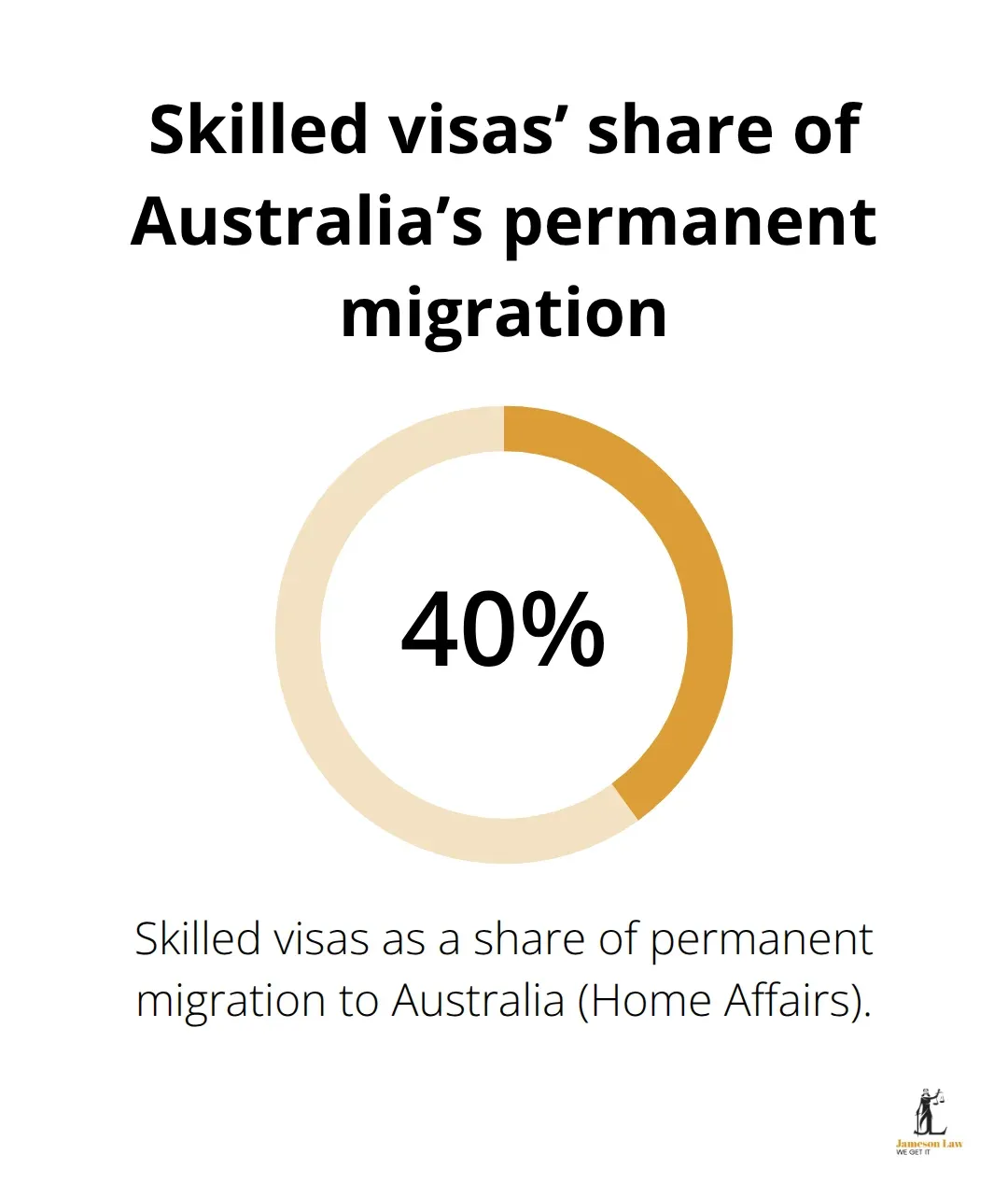
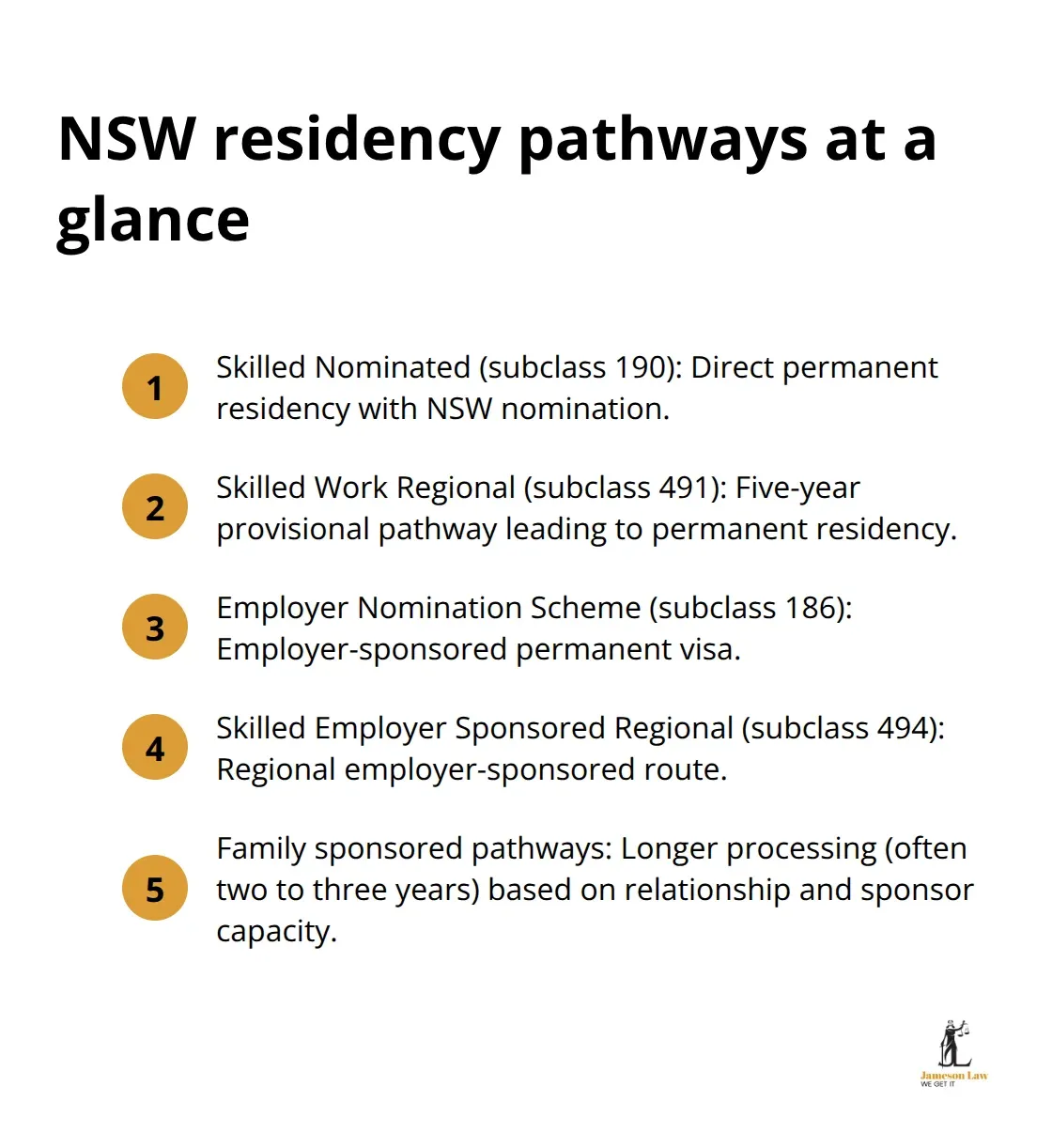
Australia offers three primary pathways to residency, each with distinct eligibility requirements and timelines. The skilled migration route remains the most competitive and fastest-growing option for NSW applicants. According to the Department of Home Affairs, skilled visas account for approximately 40 per cent of permanent migration to Australia, making points-based systems the dominant entry method for professionals. The Skilled Nominated visa subclass 190 provides permanent residency directly if you meet NSW nomination criteria, while the Skilled Work Regional visa (subclass 491) offers a five-year provisional pathway in designated regional NSW areas before you can apply for permanent residency. Both require a valid skills assessment, occupation on the NSW Skills List, and a points score that meets current thresholds.
NSW actively nominates professionals in health, education, ICT, infrastructure, and agriculture to address workforce shortages in these sectors. Employer sponsored visas operate differently-your employer must nominate you under schemes like the Employer Nomination Scheme (subclass 186) or the Skilled Employer Sponsored Regional visa (subclass 494). This approach bypasses the points competition entirely, but requires genuine employment in your nominated role at or above the TSMIT rate. Many applicants overlook this pathway because finding an employer willing to sponsor presents real challenges; however, if your occupation lacks competitiveness on the skills list, employer sponsorship may be your only viable route. Family sponsored pathways allow Australian citizens or permanent residents to sponsor relatives, though processing times stretch much longer-often two to three years-and eligibility depends on your relationship to the sponsor and their financial capacity to support you. This option suits those with close family ties in Australia but lacks the flexibility of skills-based routes.
Understanding the Points System
The points-based system rewards age, English proficiency, education, and skilled work experience. You typically need 65 points minimum to be considered, though competitive occupations regularly require 75 or higher. NSW publishes invitation rounds throughout the financial year without predetermined dates, and only Expression of Interest applications for occupations within identified ANZSCO unit groups receive assessment. Within each occupation group, the highest-ranked EOIs receive invitations-meaning your score relative to others in your field determines success, not an absolute threshold. If invited to apply, you have 14 days to respond with substantiating documents; this window cannot be extended. The nomination assessment typically takes six weeks after you pay the application fee, so avoid contacting NSW during this period. Calculate your points carefully using the Home Affairs points calculator before you lodge an EOI, and verify your occupation appears on the current NSW Skills List, as this list changes quarterly based on workforce demand.
Employer Sponsorship and Regional Pathways
Employer sponsored visas eliminate points competition but demand genuine employment. Under the subclass 491 regional pathway, your employer must demonstrate you have worked in a designated regional NSW area for at least six months in your nominated or closely related occupation, and you must earn at least the TSMIT rate. Some occupations qualify for TSMIT concessions if the employer meets specific criteria, though these concession applications are currently closed. The subclass 491 also offers alternative pathways: Investment NSW can invite you directly based on occupations on the NSW Regional Skills List, or you can apply after you graduate from a regional NSW institution within the past two years. Regional visas attract applicants because they lead to permanent residency after five years of residence, and NSW actively supports this progression. However, regional NSW applications for new entrants currently face closed allocations, meaning existing submissions are being finalised before new rounds open.
Understanding which pathway suits your circumstances-whether points-based competition, employer nomination, or regional opportunity-shapes your entire application strategy and timeline.
What You Must Satisfy to Qualify
Meeting the eligibility criteria for Sydney residency demands careful attention to multiple requirements that work together. Your skills assessment, points score, health status, and character all operate as interconnected filters that determine whether you progress toward permanent residency.
The Skills Assessment Foundation
You must obtain a formal skills assessment from an Australian authority recognised by the Department of Home Affairs that validates your occupation matches an eligible ANZSCO unit group. This assessment costs between AUD 300 and 1,000 depending on your profession and is non-refundable, so verify your occupation’s eligibility before you pay. The assessment body examines your qualifications, work experience, and professional credentials against Australian standards for your nominated role. Without this assessment, the Department of Home Affairs will not process your application, making it the essential first step in any residency pathway. You should obtain this assessment early, as processing times vary between assessment bodies and can extend to several months for some professions.
Points and Competitive Thresholds
Your points score determines competitiveness within the points-based system. The Department of Home Affairs allocates points across age (maximum 45 points if you’re between 25 and 32), English language ability (20 points for competent English), educational qualifications (15 points for a recognised bachelor degree), and skilled work experience (15 points maximum for ten years or more in your nominated occupation). Occupation demand shifts, meaning thresholds can change between application rounds as competition intensifies. You cannot control demand fluctuations, so calculate conservatively and assume higher thresholds than the published minimums.
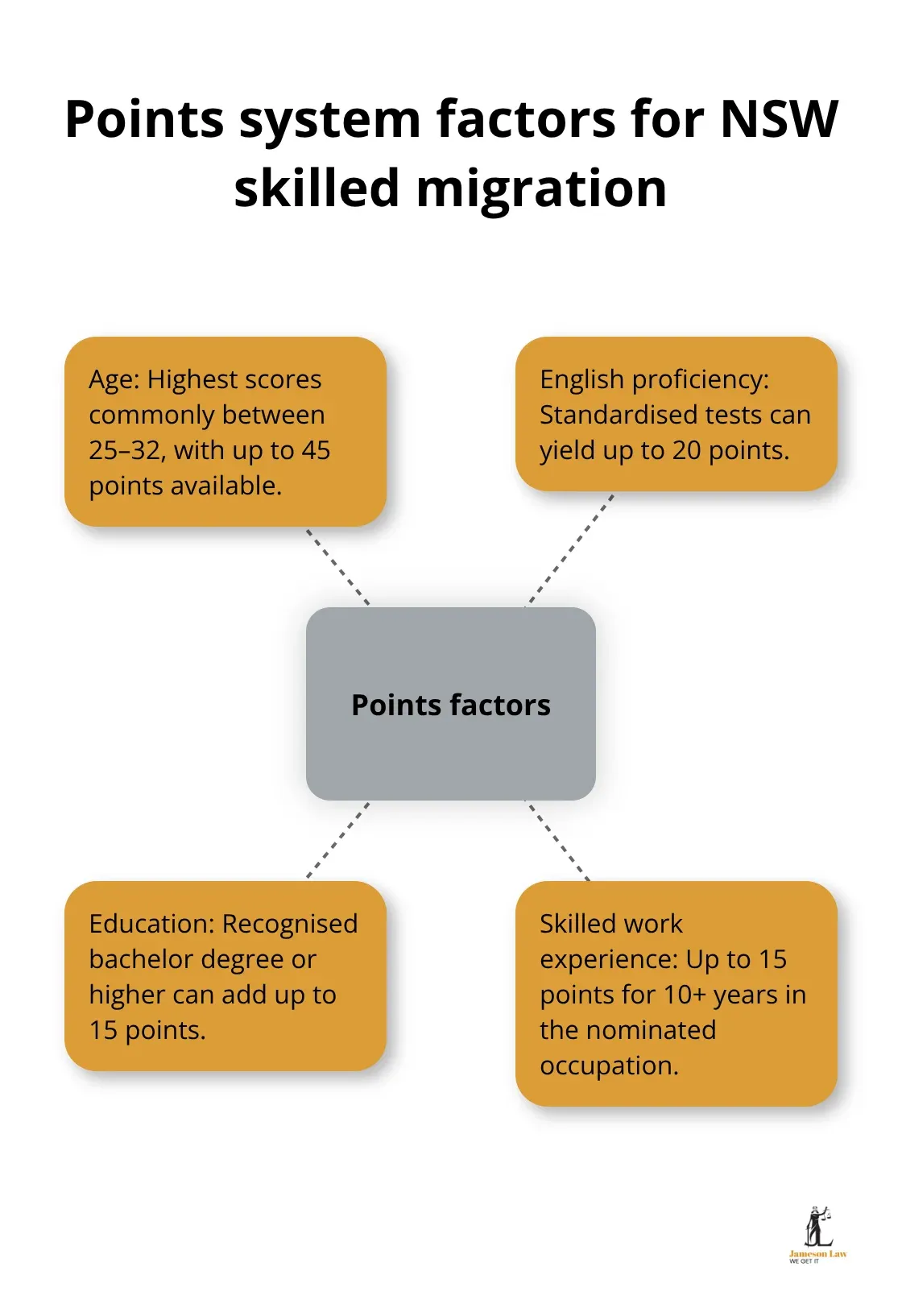
The Department of Home Affairs points calculator allows you to estimate your score before you lodge your Expression of Interest, and this step prevents wasted effort on applications that fall short of realistic thresholds.
Health and Character as Absolute Barriers
Health and character assessments operate as absolute barriers rather than scoring factors. The Department of Home Affairs conducts health assessments through panel doctors listed on the Home Affairs website, and you must declare all medical conditions honestly-deliberate omission leads to visa cancellation and potential bans from future applications. Character requirements examine your criminal history, financial conduct, and immigration compliance. The department obtains police certificates from every country where you lived for more than six months in the past ten years, and any conviction, regardless of sentence length, triggers detailed assessment. A single undisclosed conviction can result in visa refusal years after you lodge your application, so transparency protects your residency prospects.
English Language Standards and Exemptions
English language proficiency must meet minimum standards set by Home Affairs, typically IELTS 6.0 overall with no band below 5.0, or equivalent qualifications like TOEFL or Cambridge. If English is your first language and you hold tertiary qualifications from an English-speaking country, you may qualify for exemption. Submitting false documents or misrepresenting your English ability constitutes fraud and results in visa refusal and potential legal consequences. You should take the official test through an approved provider rather than relying on workplace English, as the Department of Home Affairs requires formal evidence of your proficiency level.
Gathering Evidence Before Your Invitation
You must collect all required evidence before you lodge your Expression of Interest-police certificates, skills assessment, English test results, and educational transcripts-because the 14-day response window after invitation leaves minimal time for document collection. The Department of Home Affairs will request that you substantiate every claim in your EOI with valid documentation, and incomplete submissions result in refusal. Once NSW invites you to apply, the clock starts immediately, and you cannot extend this deadline. Preparing your documentation package in advance means you respond quickly and demonstrate serious intent to the Department of Home Affairs. Your next step involves understanding how to navigate the formal application process and what the Department of Home Affairs expects from you once you receive an invitation to proceed.
Moving Your Application Forward
Once NSW invites you to apply, the Department of Home Affairs expects a swift and thorough response. You have exactly 14 days from the invitation date to submit your formal application with complete documentation-this deadline cannot be extended under any circumstances. Many applicants miss this window because they underestimate how quickly they must gather evidence, so the preparation you complete before receiving an invitation determines whether you actually proceed or lose your opportunity. The Department of Home Affairs will not accept late submissions, and a missed deadline means you must lodge a new Expression of Interest and wait for another invitation round, which could extend your timeline by months or even years depending on occupation demand.
Start collecting your police certificates, skills assessment results, English language test scores, and educational transcripts immediately after you submit your EOI, rather than waiting for an invitation. Police certificates take between four and twelve weeks to obtain from each country where you lived for more than six months in the past ten years, so request these early even though you may not need them immediately. The Department of Home Affairs verifies every claim in your application, and incomplete or inconsistent documentation results in refusal with minimal opportunity to resubmit. Gather certified copies of all documents-photocopies alone will not satisfy the department’s requirements.
Your skills assessment must come from an authority recognised by Home Affairs for your specific occupation, and the assessment body must issue a letter confirming your occupation matches an eligible ANZSCO unit group. English language test results must show you meet the required standard for NSW nomination, and the test must have been completed within three years of your application. Educational qualifications require certified English translations if the original documents are in another language, and you must provide official transcripts directly from your educational institution rather than personal copies.
Processing Timelines and Department Procedures
The Department of Home Affairs processes applications in order of receipt once you lodge them, and processing times vary significantly based on visa category and application complexity. For subclass 190 and 491 applications, the department typically finalises nominations within six weeks of you paying the application fee, though this timeline assumes complete and accurate documentation. If the department identifies missing information or inconsistencies, it issues a request for further evidence, and your processing time extends significantly while you respond. The department does not provide status updates during assessment, and contacting them before the six-week period expires only delays your application.
After NSW approves your nomination, the Department of Home Affairs conducts final visa processing, which involves health and character checks that can take an additional four to eight weeks depending on assessment complexity. Your health assessment occurs through panel doctors listed on the Home Affairs website, and you must declare all medical conditions honestly-deliberate omission or misrepresentation leads to visa cancellation and potential permanent bans from future Australian visas. The character assessment examines police records from every country where you lived, and even minor convictions trigger detailed assessment.
Visa Conditions and Compliance Requirements
Once the Department of Home Affairs grants your visa, you receive a letter outlining your visa conditions, which typically specify your nominated occupation, your employer if applicable, and any restrictions on work or study. Breaching visa conditions-such as working in an occupation outside your nomination or failing to notify the department of address changes within 14 days-results in visa cancellation and potential deportation. Understanding these consequences means you must comply strictly with every condition outlined in your grant letter.
Organising Your Evidence Package
Create a dedicated folder containing every document the Department of Home Affairs requires, organised by category and with a checklist to confirm nothing is missing before you submit. Your evidence package must include certified copies of your passport, birth certificate, marriage certificate if applicable, skills assessment letter, English language test results, police certificates from each relevant country, educational transcripts with certified English translations if necessary, employment references from your nominated occupation, and payslips or employment contracts demonstrating your work history. The Department of Home Affairs requires that documents be certified by a qualified person such as a lawyer, accountant, or notary public, not simply photocopied.
If you are applying under employer sponsorship, your employer must provide a statutory declaration confirming your employment, your role, your commencement date, and your salary or remuneration. Gaps in your employment history must be explained with supporting evidence-the department will assume unexplained gaps indicate you worked without a visa or failed to meet visa conditions. If you changed jobs during your visa period, you must demonstrate that your new employer was authorised to employ you in your nominated occupation or a closely related role. The department cross-references your employment claims against tax records and payroll audits, so any discrepancy between what you claim and what tax records show results in refusal. If you have been unemployed or working in a different occupation, be transparent about this in your application rather than attempting to conceal employment gaps, as concealment constitutes fraud and attracts serious consequences.
Final Thoughts
Sydney residency pathways NSW require you to verify your occupation appears on the current NSW Skills List, obtain a formal skills assessment from a Home Affairs recognised authority, and calculate your points score using the official Department of Home Affairs calculator. You must collect your police certificates, English language test results, and educational transcripts immediately after you submit your Expression of Interest rather than waiting for an invitation, since the 14-day response window after invitation leaves minimal time for document gathering. Prepare a complete evidence package organised by category with certified copies of every document the Department of Home Affairs requires, as incomplete submissions result in refusal with minimal opportunity to resubmit.
Professional legal advice becomes essential when your circumstances involve complexity such as criminal history, health conditions requiring assessment, employment gaps, or previous visa refusals. Your specific situation may benefit from early guidance before you lodge your Expression of Interest, as this approach prevents costly mistakes that delay your residency timeline or result in refusal. We at Jameson Law provide immigration law services to help you navigate these complexities and ensure your application meets all Department of Home Affairs requirements.