

Construction projects represent significant financial and emotional investments. When building disputes NSW arise—whether over defective workmanship, project delays, or payment disagreements—they can quickly escalate into complex legal battles.
At Jameson Law, our commercial and construction team guides homeowners, contractors, and developers through the strict statutory frameworks governing NSW building work. This guide delineates residential rights under the Home Building Act 1989 (NSW), the role of NCAT, and the specialised commercial Security of Payment regime.
Residential vs. Commercial Building Disputes in NSW
Before taking action, you must legally categorize your dispute. NSW law treats residential home building and commercial construction disputes entirely differently.
| Dispute Category | Governing Legislation | Primary Resolution Pathway |
|---|---|---|
| Residential Home Building (e.g., Homeowner vs. Builder for defects or incomplete work) |
Home Building Act 1989 (NSW) | NSW Fair Trading dispute resolution, followed by the NSW Civil and Administrative Tribunal (NCAT) or appropriate Court. |
| Commercial Progress Payments (e.g., Subcontractor vs. Head Contractor for unpaid invoices) |
Building and Construction Industry Security of Payment Act 1999 (NSW) (SOPA) | Statutory Adjudication process via an Authorized Nominating Authority, followed by Court enforcement. |
Residential Disputes: The Home Building Act 1989
For homeowners, the Home Building Act 1989 (NSW) provides critical consumer protections, most notably through implied statutory warranties.
Statutory Warranty Periods for Defective Work
Under Section 18B of the Act, every residential building contract implies warranties that the work will be performed with due care and skill, and in accordance with the law. The time limits for commencing legal proceedings for a breach of these warranties are strictly enforced:
- Major Defects: Proceedings must generally be commenced within 6 years from the completion of the work. A major defect is one in a major element (like load-bearing walls or waterproofing) that causes or is likely to cause the building to become uninhabitable, unsafe, or at risk of collapse.
- Other (Non-Major) Defects: Proceedings must generally be commenced within 2 years from completion.
Important Exception: If a defect becomes apparent within the final 6 months of the warranty period, the legislation may grant a limited extension of 6 months to enforce the claim. Homeowners must verify current law and act promptly to avoid having their claims permanently statute-barred.
The Dispute Resolution Process for Homeowners
1. Written Notice and Opportunity to Inspect
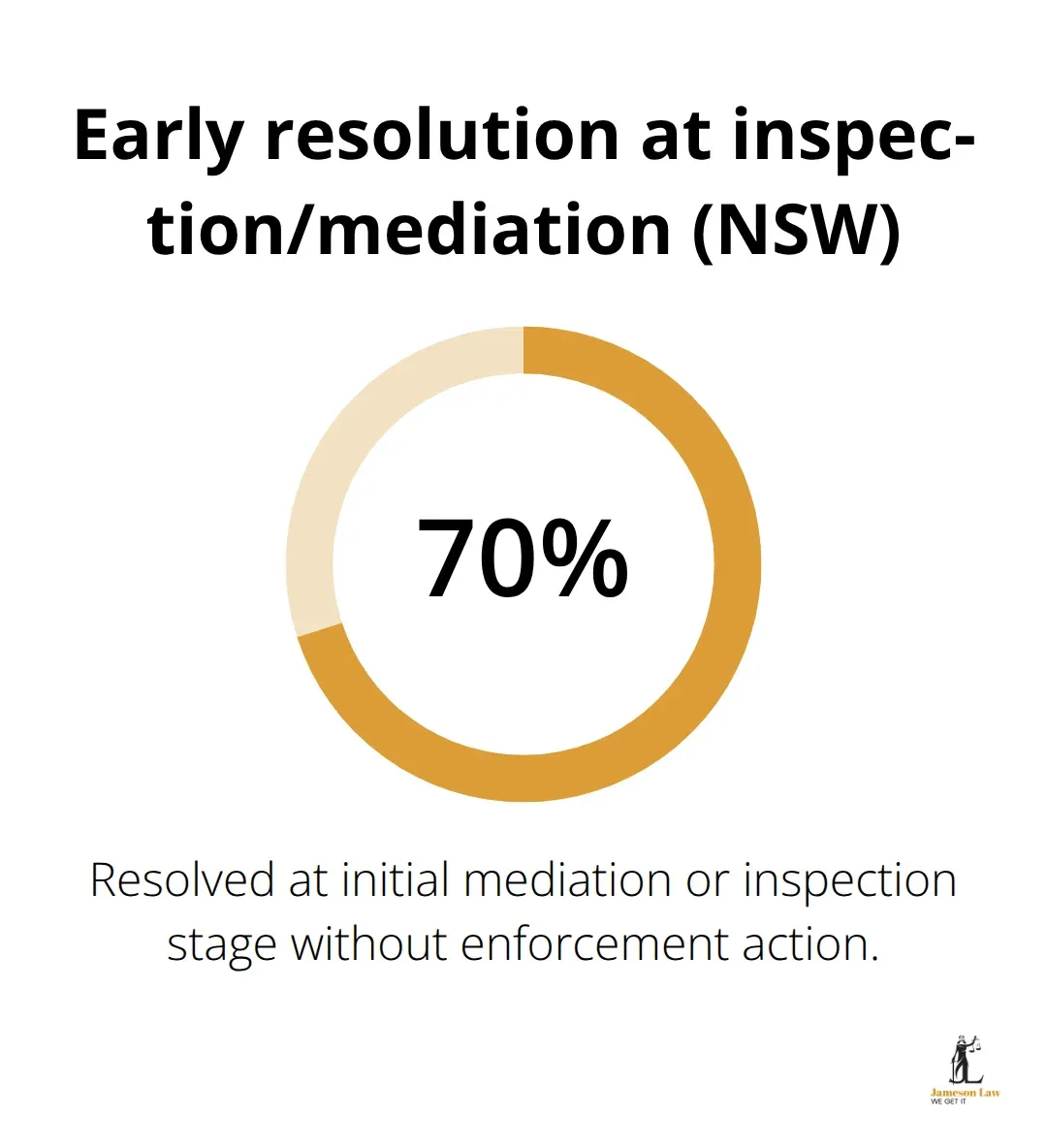
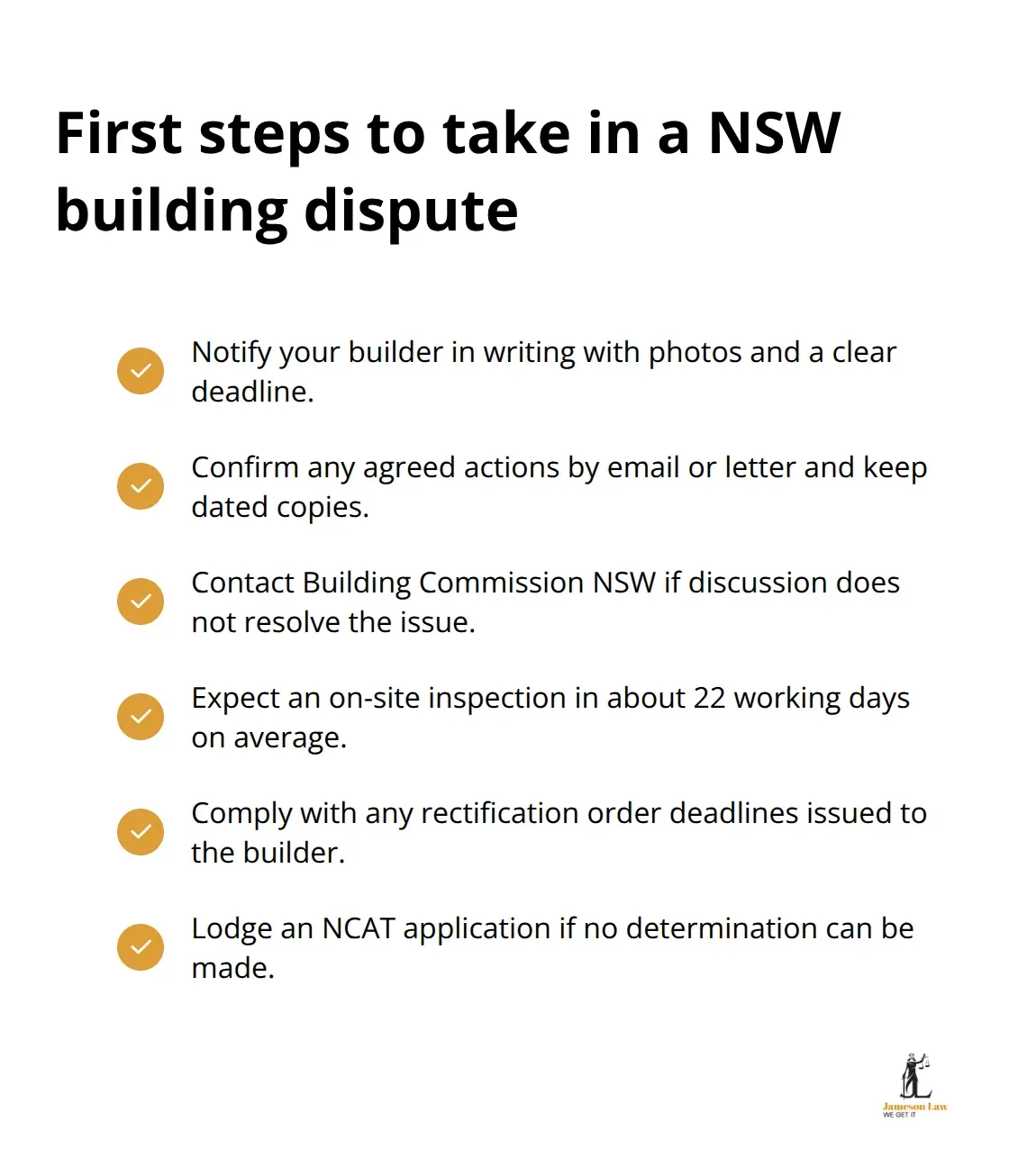
Before escalating a dispute, you should formally notify the builder of the defects in writing, accompanied by photographic evidence. Where appropriate and safe, the builder should be afforded a reasonable opportunity to inspect the issues and rectify them.
2. NSW Fair Trading Complaint
If direct negotiation fails, the Act generally requires homeowners to lodge a formal complaint with NSW Fair Trading before commencing legal proceedings. A Building Inspector may attempt to mediate the dispute and, if justified, can issue a Rectification Order compelling the builder to fix the work by a specified date.
3. The NSW Civil and Administrative Tribunal (NCAT)
If Fair Trading dispute resolution is unsuccessful, or if the builder ignores a Rectification Order, you may lodge an application with NCAT. NCAT can hear many residential building disputes in NSW and has power to order the payment of money, direct that rectification work be performed, or declare that a contract has been breached.
Commercial and Contracting Disputes: Security of Payment (SOPA)
For contractors, subcontractors, and suppliers facing unpaid invoices, the Building and Construction Industry Security of Payment Act 1999 (NSW) (SOPA) is a powerful tool designed to ensure cash flow (“pay now, argue later”).
Strict Statutory Deadlines
SOPA provides a rapid, specialised adjudication regime with strict statutory timeframes. A claimant must serve a valid payment claim. A respondent generally has 10 business days, or an earlier period specified by the construction contract, to provide a payment schedule; other deadlines also apply.
If a respondent fails to provide a Payment Schedule and fails to pay, the claimant may apply for statutory adjudication or seek summary judgment in court. Missing a SOPA deadline can remove a particular adjudication option or expose a respondent to recovery proceedings, so the current statutory timetable should be checked immediately.
Frequently Asked Questions
What are the statutory warranty periods for residential building work in NSW?
Under the Home Building Act 1989 (NSW), statutory warranties generally apply for 6 years for major defects (affecting structural elements or safety) and 2 years for all other defects, calculated from the date the work was completed. An additional 6 months may apply if the defect becomes apparent in the final 6 months of the warranty period.
Do I have to go to NSW Fair Trading before applying to NCAT?
Yes, in most residential building disputes. The Home Building Act generally requires you to notify NSW Fair Trading and attempt dispute resolution before you can lodge a formal application with the NSW Civil and Administrative Tribunal (NCAT), subject to certain exceptions.
What is the Building and Construction Industry Security of Payment Act (SOPA)?
SOPA is a specialised legislative regime designed to ensure cash flow in the construction industry. It provides a rapid statutory adjudication process for contractors, subcontractors, and suppliers to recover progress payments. It operates with extremely strict deadlines and is separate from the Home Building Act dispute process.
Final Thoughts
Navigating building disputes NSW requires precise identification of your legal standing. Whether you are a homeowner racing against a statutory warranty deadline to file a claim in NCAT, or a subcontractor needing to serve a valid Payment Claim under SOPA, timing and proper documentation are everything.
In both jurisdictions, waiting for the other party to “do the right thing” often results in lost rights. Compiling a coherent timeline, obtaining independent expert building reports, and securing formal legal guidance early are the most effective ways to protect your financial interests.
If you are involved in a residential defect dispute or require assistance recovering commercial construction payments, contact the commercial litigation team at Jameson Law to discuss your options.